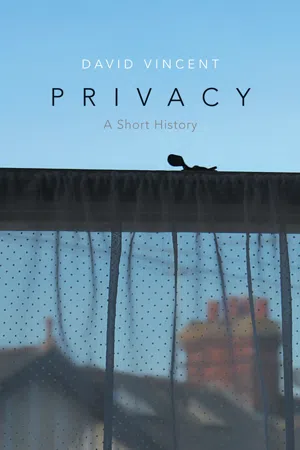
Privacy: A Short History provides a vital historical account of an increasingly stressed sphere of human interaction. At a time when the death of privacy is widely proclaimed, distinguished historian, David Vincent, describes the evolution of the concept and practice of privacy from the Middle Ages to the present controversy over digital communication and state surveillance provoked by the revelations of Edward Snowden.
Deploying a range of vivid primary material, he discusses the management of private information in the context of housing, outdoor spaces, religious observance, reading, diaries and autobiographies, correspondence, neighbours, gossip, surveillance, the public sphere and the state. Key developments, such as the nineteenth-century celebration of the enclosed and intimate middle-class household, are placed in the context of long-term development. The book surveys and challenges the main currents in the extensive secondary literature on the subject. It seeks to strike a new balance between the built environment and world beyond the threshold, between written and face-to-face communication, between anonymity and familiarity in towns and cities, between religion and secular meditation, between the state and the private sphere and, above all, between intimacy and individualism.
Ranging from the fourteenth century to the twenty-first, this book shows that the history of privacy has been an arena of contested choices, and not simply a progression towards a settled ideal. Privacy: A Short History will be of interest to students and scholars of history, and all those interested in this topical subject.
- English
- ePUB (mobile friendly)
- Available on iOS & Android
eBook - ePub
1
Privacy before Privacy 1300–1650

On Friday 13 July 1341, it was recorded at the London Assize of Nuisance that ‘Isabel relict of John Luter complains that John Trappe, “skynnere”, who has a tenement adjoining her garden in the par[ish] of St. John de Walbrok, has four windows of which the glass is broken, through which he and his servants can see into her garden.’ The site was visited, and judgment given that the defendant should repair his windows within 40 days. Isabel, however, was not finished. She next successfully complained that ‘John de Thorp, “skynnere”, has seven windows overlooking her adjoining tenement in the par[ish] of St. Stephen de Walbrok, less than 16ft. from the ground, through which he and his servants can see into the pl[aintiff]'s tenement.’ Then ‘John de Leche, fishmonger’ was summoned by the litigious widow. She charged that this neighbour ‘has a leaden watch-tower (garritam) upon the wall of his tenement adjoining hers in the same par[ish] upon which he and his household (familiares) stand daily, watching the private affairs of the pl[aintiff] and her servants.’ Finally she turned her attention to a fourth householder who overlooked her property: ‘The same Isabel complains that Joan relict of Simon Corp has twelve apertures (foramina) overlooking her adjoining tenement in the same par[ish] through which she and her servants can see the private business of the pl[aintiff] and her servants.’ Following visits, all the cases resulted in 40 days' notice to rectify the problems, ‘subject to the customary penalty’.1
These disputes in the crowded streets of late-medieval London challenge the frequent assumption that privacy did not emerge as an aspiration until the seventeenth century and was not a reality for the mass of the population for at least a further two centuries. At issue in the court hearings was the claim to protection from the surveillance of domestic life. There was a working distinction embedded in the Latin term privatus between matters which belonged to the collective arena and were subject to public authority, and those which pertained to an enclosed community governed by the head of the household.2 This boundary is invisible to some historians because they are looking for the wrong situation.3 During the modern era an individualistic conception of privacy has gained traction, given its most resonant definition as ‘the right to be let alone’ in the influential 1890 article of Warren and Brandeis.4 The emphasis is on the isolated, self-sufficient citizen, protecting their personal archive from invasion or theft by every kind of outside agency.5 Unsurprisingly this figure is hard to locate amid the crowded households and thin walls of urban or rural communities anywhere in fourteenth-century Europe. Except possibly in the specialized environment of the growing monastic orders, almost everyone shared their lives with others, whether spouses, children, servants, fellow workers or passing visitors. ‘The mistaken assertion that the notion of physical privacy was absent in medieval society’, writes Diane Shaw, ‘perhaps derives from the modern assumption that privacy is individual and absolute, rather than communal and relative.’6
The narrative of privacy is not a journey from absence to invention, from less to more, or even, as we will see in later chapters, from collective to personal. There are no beginnings in this history, only threatened endings. As William Reddy has argued, it is possible to locate values and behaviours that exist over long periods, interacting with but not fully conditional on changing physical and normative contexts.7 The task is to identify those features of privacy which are recognizable over the centuries and those which were specific to the aspirations and constraints of particular eras. Privacy was so deeply associated with the conduct of intimate social relations that its complete absence is difficult to imagine in any era of recorded history. In the words of Diana Webb's account of the medieval period, ‘there was surely never a time when individuals, families or groups did not sometimes claim the right to withdraw from public scrutiny into a space of their own.’8
There were three distinct motives for such a retreat that over time were consistent neither in themselves nor in relation to each other. There was the nurturing of intimate relations whose conduct required a realm of protected discourse. There was the search for an inner sanctum where individuals could manage their mental archive and conduct their bodily functions. And there was the defence of thought and behaviour from invasion by external structures of authority. Each of these was visible in the late-medieval period, but in forms that were to change radically over the succeeding centuries. What could be expected of intimacy in the multi-functional, shape-shifting households of fourteenth-century London had only a distant relation to the emotions invested in the tight domestic units of the late-modern era. Privacy as an arena of retreat and reflection had a long journey to make from the world of secret prayer that will be examined later in this chapter. And the private realm as opposed to the state which became a defining feature of liberal democracy can only distantly be glimpsed in the conflicts between households and authorities in this period. Over the years the terminology of privacy is inexact, and as the final chapter will argue it has become no less so in our own times, when the social and political functions have tended too easily to be subsumed into the right to control personal information.
Amidst the complex evolution of privacy there were several features of the cases at the London Assize of Nuisance that have remained constant throughout the period. The first was that in the definition and defence of privacy, there was a critical distinction between the inside and the outside of the dwelling place, however confined, insubstantial and overcrowded it might be. The expectation of what could be known of thoughts and behaviours changed radically once the threshold was crossed. The door might be flimsy, the fastening nominal, the party walls porous to sound, smell and damp, but the act of entering the domestic space from the street generated a specific set of requirements. For this reason, the nascent legal defence of privacy was bound up in a broader set of rights associated with the occupancy of property. The action of trespass began to take shape in the early-fourteenth-century courts, giving householders recourse against the physical invasion of their space. The concept of nuisance embraced every kind of behaviour by inhabitants of neighbouring buildings that diminished the value of the complainant's occupancy of his or her premises. An individual could not construct or occupy their property in a way that materially damaged the use of another.9 In the packed medieval urban communities this meant above all ensuring as far as possible that the materials out of which a house or tenement was constructed did not present a fire hazard to all those around it. It meant that rainwater should not leak into an adjoining building, nor sewage and its associated odours. And it also meant that the occupants' enjoyment of an enclosed universe of communication should not be compromised by sight or by sound. In terms of ...
Table of contents
- Cover
- Dedication
- Title page
- Copyright page
- Preface
- 1: Privacy before Privacy 1300–1650
- 2: Privacy and Communication 1650–1800
- 3: Privacy and Prosperity 1800–1900
- 4: Privacy and Modernity 1900–1970
- 5: Privacy and the Digital Age 1970–2015
- Further Reading
- Index
- End User License Agreement
Trusted by 375,005 students
Access to over 1.5 million titles for a fair monthly price.
Study more efficiently using our study tools.
Frequently asked questions
Yes, you can cancel anytime from the Subscription tab in your account settings on the Perlego website. Your subscription will stay active until the end of your current billing period. Learn how to cancel your subscription
No, books cannot be downloaded as external files, such as PDFs, for use outside of Perlego. However, you can download books within the Perlego app for offline reading on mobile or tablet. Learn how to download books offline
Perlego offers two plans: Essential and Complete
- Essential is ideal for learners and professionals who enjoy exploring a wide range of subjects. Access the Essential Library with 800,000+ trusted titles and best-sellers across business, personal growth, and the humanities. Includes unlimited reading time and Standard Read Aloud voice.
- Complete: Perfect for advanced learners and researchers needing full, unrestricted access. Unlock 1.5M+ books across hundreds of subjects, including academic and specialized titles. The Complete Plan also includes advanced features like Premium Read Aloud and Research Assistant.
We are an online textbook subscription service, where you can get access to an entire online library for less than the price of a single book per month. With over 1.5 million books across 990+ topics, we’ve got you covered! Learn about our mission
Look out for the read-aloud symbol on your next book to see if you can listen to it. The read-aloud tool reads text aloud for you, highlighting the text as it is being read. You can pause it, speed it up and slow it down. Learn more about Read Aloud
Yes! You can use the Perlego app on both iOS and Android devices to read anytime, anywhere — even offline. Perfect for commutes or when you’re on the go.
Please note we cannot support devices running on iOS 13 and Android 7 or earlier. Learn more about using the app
Please note we cannot support devices running on iOS 13 and Android 7 or earlier. Learn more about using the app
Yes, you can access Privacy by David Vincent in PDF and/or ePUB format, as well as other popular books in History & World History. We have over 1.5 million books available in our catalogue for you to explore.