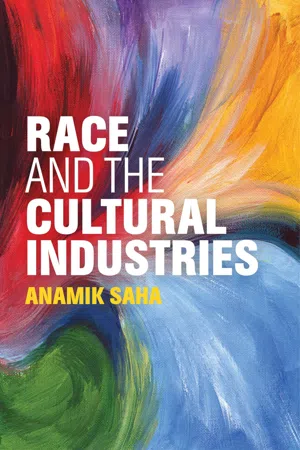
Studies of race and media are dominated by textual approaches that explore the politics of representation. But there is little understanding of how and why representations of race in the media take the shape that they do. How, one might ask, is race created by cultural industries?
In this important new book, Anamik Saha encourages readers to focus on the production of representations of racial and ethnic minorities in film, television, music and the arts. His interdisciplinary approach combines critical media studies and media industries research with postcolonial studies and critical race perspectives to reveal how political economic forces and legacies of empire shape industrial cultural production and, in turn, media discourses around race.
Race and the Cultural Industries is required reading for students and scholars of media and cultural studies, as well as anyone interested in why historical representations of 'the Other' persist in the media and how they are to be challenged.
- English
- ePUB (mobile friendly)
- Available on iOS & Android
eBook - ePub
Race and the Cultural Industries
About this book
Information
Part I
Framework
1
Race and the Cultural Industries
Introduction
Very few would argue with the notion that the cultural industries shape society’s ideas about race. Yet there remains relatively little sustained analysis of the production and circulation of racial discourses by the media. Why is the media considered a relatively trivial issue by scholars of race and racism? Similarly, why does the study of race take a marginal status in critical media studies? On the other hand, why in light of the very real material effects of racism – whether racial violence or forms of economic and social exclusion – should we even care about the media, especially in relation to popular culture? One way of opening up this discussion is by briefly uncovering a neglected aspect of the work of Frantz Fanon, the Caribbean psychiatrist, philosopher and revolutionary, who has become one of the key figures in postcolonial theory.
Fanon is eulogized for his writing on the psychosocial trauma of racism and anticolonial struggle, but he is less known for his interest in the media, popular culture and representation.1 Yet in Black Skin White Masks (1986[1952]), Fanon’s analysis of the psychological devastation caused by racism is littered with references from cinema and literature, and even supposedly benign forms of popular culture such as children’s songs and comics. For Fanon, the inherent Eurocentricity of the narratives contained within these cultural commodities contribute to the alienation experienced by the Negro subject. This is powerfully illustrated in the following quote, which describes his experience watching the Hollywood war film Home of the Brave in a French cinema hall among a white audience:
The Negro is a toy in the white man’s hands; so, in order to shatter the hellish cycle, he explodes. I cannot go to a film without seeing myself. I wait for me. In the interval, just before the film starts, I wait for me. The people in the theatre are watching me, examine me, waiting for me. A Negro groom is going to appear. My heart makes my head swim.The crippled veteran of the Pacific war says to my brother, ‘Resign yourself to your colour the way I got used to my stump; we’re both victims’. (Fanon, 1986: 140)
Fanon here describes the damaging effects of Western cultural goods upon the black psyche. For Fanon, texts such as popular literature, film or indeed Mickey Mouse comics perform the role of providing a ‘collective catharsis’ (Fanon, 1986: 145) for the population; a safety valve where the fears/desires/ aggression that accumulate in a society can be safely released. But in the West only the dominant white subject experiences catharsis, which plays on racial fears (and desires). Meanwhile, the products of Western culture industries flood into colonial societies where young black children learn invariably to identify with the white heroes who feature in the imported comics and storybooks. Growing up in this environment, Fanon, like his fellow colonial subjects from the Antilles and other Francophone nations, subconsciously identifies as white and French. But entering European society, and surrounded by the white people in the cinema hall, he suddenly feels the weight of his ascribed race, forced to identify with the ‘Negro’ protagonist who is about to come onscreen. As the quote vividly captures, this produces a disorienting and debilitating and, indeed, disassembling affect for Fanon, such that his heart makes his head ‘swim’ – and his body and mind eventually ‘explode’.
In the last part of the quote, Fanon refers to the final scene from the film Home of the Brave, released in 1949 (Robson, 1949). In it, an African American soldier called Mossy experiences a double trauma: of witnessing the death of his white best friend during a small US reconnaissance mission into a Japanese-held Pacific Island, and of experiencing racism, back home in America and within his company. Unable to deal with this dual burden, Mossy has a mental and physical breakdown, becoming paralysed from the waist down. A sympathetic psychiatrist eventually cures him by helping him face up to his victimhood. In this final scene, the white sergeant who has lost his arm on the same mission exhorts Mossy to treat his race like the sergeant treats his missing limb, an affliction that he will need to learn to deal with despite the disadvantages and prejudice he will face in the outside world. With its representation of psychiatry and black subjectivity, Home of the Brave uncannily encapsulates Fanon’s own concerns regarding the psychosocial effects of racism and also psychiatry as a means through which individuals of colour are suppressed/assimilated (see Bergner, 1999: 226). It provides a vivid scene for Fanon to explore the experience of being racialized in a white world.
There are two reasons for opening this book with this passage from Fanon. First, it evocatively illustrates the scarring and disfiguring impact of media on racialized minorities. Even the pleasures that black folk seem to experience in watching Hollywood films is regarded as a form of dissimulation for Fanon (1986: 152). Perhaps more than any other scholar, Fanon captures the sheer visceral brutality of racism in its physical and psychosocial manifestations, and, as suggested, an unrecognized element of his work is his attribution to the role of media texts in producing this affect. With particular pertinence for this book, in light of the psychological damage brought about by white cultural objects upon the Negro subject, Fanon considers the potential of black cultural production – using the examples of magazines and songs conceived specifically for black children – as constituting an integral part of a decolonizing project designed to counter the alienation of the Negro (1986: 146–148).
Second, underlining how Fanon’s emphasis on popular culture is a neglected aspect of his work allows me to open up to a broader point: that the study of the media and race as a whole is a relatively marginal area of research and scholarship. As I have suggested, in sociologies of race and racism the study of the media appears on the margins of the discipline. Inversely, in media and communications studies the study of race takes up a similar peripheral status. This is a point shared by Darnell Hunt (2005: 3–9), who describes the sociology of race and critical media studies as ‘two neighbours’ who rarely meet.
This was not always the case, however. The impact of cultural studies on both aforementioned disciplines, when inflected by postcolonial theory, for a moment turned our attention to the question of representation and the way in which ideologies of race take hold in society through the media. The idea that popular culture was something to be taken seriously, as well as news media, was a particularly important intervention. Yet this discussion has somewhat stalled in recent times – what Herman Gray (2013: 771) describes as a ‘“waning” in what a cultural politics of representation can yield’ – and has subsequently been dismissed as part of the culturalist turn in the social sciences, which, in the context of the sociology of race and racism, deflected attention from the very real experiences of racial violence, exclusion and marginalization. While the charge of cultural reductionism is unfair – the best media studies of race framed their approach explicitly in terms of structural racism and social injustice – this field ultimately was unable to translate its complex theoretical ruminations on the politics of representation into meaningful forms of social action.
Race and the Cultural Industries aims to reinvigorate research into race and the media. Studies of ‘race’ and ethnicity in the media are nearly always textual in focus. Such research exposes the ways that media representations shape our understandings of cultural difference, either reinforcing or challenging certain ideas around ethnicity and race at specific times and in specific contexts. Yet the tendency of these studies is to treat the text – whether a film, a book, a television programme or a piece of music – in isolation, as though it sprung directly out of the imagination of the author. That is, there is a lack of recognition of how such texts are a product of the cultural industries and also of rationalized and standardized industrial processes that determine the way that the text appears at the point of consumption. Put more simply, cultural industries shape the media products that we consume and, in turn, ideas about racial and ethnic difference as embodied in these texts. This point has immediate political ramifications. As critical political economist Nicholas Garnham (1990: 44) states, as long as we remain transfixed on just ‘the ideological content of the mass media it will be difficult to develop coherent political strategies for resisting the underlying dynamics of development in the cultural sphere in general which rest firmly and increasingly upon the logic of generalised commodity production’. While textual analyses can highlight the discourses and ideologies that underpin racialized representations of difference, they cannot tell us how and why these representations come to be made in the first place – and crucially, what strategies can be employed to disrupt their spread. In response, this book seeks to explore the complex ways in which race and ethnicity are experienced and operate in cultural production. It asks a very simple yet hitherto neglected question: how do cultural industries make race?2
The book’s central argument is that we need a new theory of race and ethnicity in cultural production, which foregrounds the cultural industries context in the making and circulation of symbolic goods. This entails an equal emphasis on macro questions that deal with power, history and structure, and micro issues dealing with labour, agency and texts in order to help understand why representations of race and ethnicity take the shape that they do. More specifically, it involves a deep engagement with cultural commodification and, again, its macro and micro dimensions, and how this process shapes racial discourse as embodied in cultural commodities. In other words, what I am proposing is a production analysis of race and the media.
The purpose of this opening chapter is to make the case for why we need to focus on production and, more precisely, frame the discussion on media representations of race within the cultural industries. To do so, it highlights the ways in which the study of the media and race have featured, and ultimately have become peripheral, in what I broadly describe as critical racial and ethnic studies, as well as media/cultural studies. As stated, after making an important intervention in drawing attention to the cultural forms of racism, media analyses of race and representation have been reduced to a marginal status and the purpose of this opening part of the chapter is to consider why that is the case. By highlighting the possibilities and limitations of textual approaches to race and the media, I then make the case for an interdisciplinary approach that situates the critical reading of media texts with an analysis of cultural production. Paying closer attention to the dynamic of cultural production, incorporating an analysis of changes and continuities in the political economy of the cultural industries, the cultures of production that emerge and the way that creative workers operate within, but in turn influence and shape the processes of production, deepens our understanding of how media discourses of race are physically made – or, indeed, how race itself is made. This subsequently reveals how the counter narratives of difference are governed within capitalism, and how racialized governmentalities, as I put it, can then be challenged and resisted. The paradox of living with racism in advanced capitalism is in how, on the one hand, racialized communities continue to be oppressed and their experiences and histories disavowed and, on the other, racial and ethnic differences become qualities used to distinguish products within a hypercompetitive market. The cultural industries provide the exemplary site in which to explore this contradiction of capital.
Race, racism and racialization in the twenty-first century
In the Forethought of The Souls of Black Folk, W.E.B. Du Bois (1994[1903]) declared that ‘the problem of the Twentieth Century is the problem of the colour line’. A hundred years later, Stuart Hall (1993: 361) echoes Du Bois in prognosticating that ‘the capacity to live with difference is, in my view, the coming question of the twenty-first century’. As the uneven flows of globalization intensify – not least the movement of people – demographics change, sometimes radically, producing anxiety, tension and fear in the national consciousness of Western states. (As global capitalism and free trade render national borders increasingly insignificant, one of the remaining places where borders still have very real, physical effects is in the regulation of the flow of people.) Hall highlights the slow, incremental and quiet, yet profoundly transformative, nature of the ‘multicultural drift’ that occurs in countries like the UK. But he also notes the ‘archaic forms of nationalism’ that are activated in reaction to the irreversible change that globalization brings.
Deep into the twenty-first century and we find racist histories repeating themselves in the West. Moral panics over ‘migrant crises’, ‘bogus asylum seekers’ or the clandestine entry of ‘swarms’ of ‘illegal immigrants’ still persist, with politicians from the left and the right of the political spectrum cynically unleashing anti-immigration rhetoric at moments of social unrest, while implementing policies designed to make countries a purposefully hostile place for migrants. Within the nation-state, urban governance produces formal and informal forms of segregation along the lines of class, race and ethnicity. The ghettoes that result are blighted by poor housing and schooling, a lack of healthcare provision, limited employment opportunities and significantly higher levels of incarceration that are the inevitable consequence of these forms of social deprivation. Moreover, these communities are physically brutalized, whether at the hands of the police or white vigilantes, such that racialized communities are still having to assert that black lives matter. Meanwhile, geopolitical developments and Western excursions into the Middle East have produced so-called home-grown terrorists, resulting in the use of biopolitical technologies and surveillance tools to monitor the nation’s Muslim, Arab and South Asian populations, both on and offline. Politicians shrug their shoulders and disingenuously lament a situation where they have no choice but to exercise undemocratic practices such as the indefinite detention of citizens suspected of terrorism and the enacting of rendition (coupled with illegal forms of torture) for the safety of the nation. Across Europe far right parties gain positions of power even in the social democratic Nordic nations, and deep-rooted antisemitism still finds expression, all playing out alongside ‘the routine acts of racist commentary and violence’ that constitute contemporary ‘digitalia’ (Gilroy, 2012: 381). David Theo Goldberg (n.d.) goes as far as suggesting that ‘public racist expression has generally grown more virulent and vicious than it has been since the 1960s’. Ash Amin (2010: 3) similarly comments how ‘the steady achievements of multiculturalism and the politics of diversity in general in the last decades of the 20th century have melted away’. The inauguration of the first black American president in 2009 supposedly ushered in a ‘post-race’ era, but his replacement, whose election campaign was avowedly racist, shows we are anywhere but.
Thus, how we live with difference remains the key issue of our time. Yet there is still a tendency, born of a lingering economic reductionism in the social sciences, to think of racism as an epiphenomenon of capitalism and modernity rather than as intrinsic to it. The discipline of sociology has traditionally been the most attuned to the dynamics of multiculture, yet it still appears reluctant to bring issues of race and racism into the centre of its research agenda. The fact is that the study of race and ethnicity remains of relative minor interest in a discipline that Gurminder Bhambra (2014) describes as hegemonically white, despite the critical contributions of collections such as The Empire Strikes Back and The Death of White Sociology (see Back and Tate, 2015). As part of her argument that American sociology still experiences a type of institutional and epistemological segregat...
Table of contents
- Cover
- Title Page
- Copyright
- Preface and Acknowledgements
- Part I: Framework
- Part II: Media, Race and Power
- Part III: The Cultural Politics of Cultural Production
- References
- Index
- End User License Agreement
Trusted by 375,005 students
Access to over 1.5 million titles for a fair monthly price.
Study more efficiently using our study tools.
Frequently asked questions
Yes, you can cancel anytime from the Subscription tab in your account settings on the Perlego website. Your subscription will stay active until the end of your current billing period. Learn how to cancel your subscription
No, books cannot be downloaded as external files, such as PDFs, for use outside of Perlego. However, you can download books within the Perlego app for offline reading on mobile or tablet. Learn how to download books offline
Perlego offers two plans: Essential and Complete
- Essential is ideal for learners and professionals who enjoy exploring a wide range of subjects. Access the Essential Library with 800,000+ trusted titles and best-sellers across business, personal growth, and the humanities. Includes unlimited reading time and Standard Read Aloud voice.
- Complete: Perfect for advanced learners and researchers needing full, unrestricted access. Unlock 1.5M+ books across hundreds of subjects, including academic and specialized titles. The Complete Plan also includes advanced features like Premium Read Aloud and Research Assistant.
We are an online textbook subscription service, where you can get access to an entire online library for less than the price of a single book per month. With over 1.5 million books across 990+ topics, we’ve got you covered! Learn about our mission
Look out for the read-aloud symbol on your next book to see if you can listen to it. The read-aloud tool reads text aloud for you, highlighting the text as it is being read. You can pause it, speed it up and slow it down. Learn more about Read Aloud
Yes! You can use the Perlego app on both iOS and Android devices to read anytime, anywhere — even offline. Perfect for commutes or when you’re on the go.
Please note we cannot support devices running on iOS 13 and Android 7 or earlier. Learn more about using the app
Please note we cannot support devices running on iOS 13 and Android 7 or earlier. Learn more about using the app
Yes, you can access Race and the Cultural Industries by Anamik Saha in PDF and/or ePUB format, as well as other popular books in Social Sciences & Media Studies. We have over 1.5 million books available in our catalogue for you to explore.