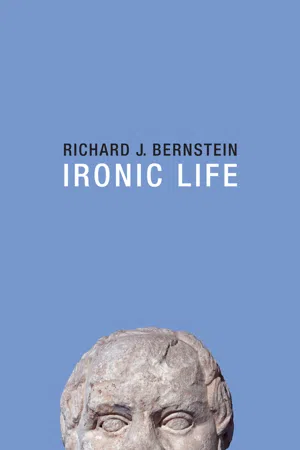
"Just as philosophy begins with doubt, so also a life that may be called human begins with irony" so wrote Kierkegaard. While we commonly think of irony as a figure of speech where someone says one thing and means the opposite, the concept of irony has long played a more fundamental role in the tradition of philosophy, a role that goes back to Socrates Ð the originator and exemplar of the urbane ironic life. But what precisely is Socratic irony and what relevance, if any, does it have for us today?
Bernstein begins his inquiry with a critical examination of the work of two contemporary philosophers for whom irony is vital: Jonathan Lear and Richard Rorty. Despite their sharp differences, Bernstein argues that they complement one other, each exploring different aspects of ironic life. In the background of Lear's and Rorty's accounts stand the two great ironists: Socrates and Kierkegaard. Focusing on the competing interpretations of Socratic irony by Gregory Vlastos and Alexander Nehamas, Bernstein shows how they further develop our understanding of irony as a form of life and as an art of living. Bernstein also develops a distinctive interpretation of Kierkegaard's famous claim that a life that may be called human begins with irony.
Bernstein weaves together the insights of these thinkers to show how each contributes to a richer understanding of ironic life. He also argues that the emphasis on irony helps to restore the balance between two different philosophical traditions philosophy as a theoretical discipline concerned with getting things right and philosophy as a practical discipline that shapes how we ought to live our lives.
eBook - ePub
Ironic Life
About this book
Information
Chapter 1
Jonathan Lear and Richard Rorty on Irony
In the opening chapter of The Compass of Irony, entitled “Ironology,” D. C. Muecke declares: “Getting to grips with irony seems to have something in common with gathering the mist; there is plenty to take hold of if only one could. To attempt a taxonomy of a phenomenon so nebulous that it disappears as one approaches is an even more desperate adventure” (Muecke 1969: 3). I am not sure that “nebulous mist” is the right metaphor, because even a superficial acquaintance with the history and the baffling (almost chaotic) variety of what has been described as irony might lead one to the despairing conclusion that almost anything can been labeled “irony.” The volumes and articles dealing with irony would fill several libraries. There doesn't even seem to be any consensus about classifying the varieties or types of irony. Nevertheless, there are identifiable strands that run through (some of the) discussions of irony. Perhaps the most common one is that irony is a rhetorical figure of speech. Gregory Vlastos succinctly describes this strand.
“Irony,” says Quintilian, is that figure of speech or trope “in which something contrary to what is said is to be understood” (contrarium ei quod dicitur intelligendum est). His formula has stood the test of time. It passes intact in Dr Johnson's dictionary (“mode of speech in which the meaning is contrary to the words” [1755]), and survives virtually intact in ours: “Irony is the use of words to express something other than, and especially the opposite of, [their] literal meaning” (Webster's). (Vlastos 1991: 21)
If we think of irony in this way, then it is a trope that anyone can – and frequently does – use. But there isn't anything intrinsically philosophical about this use. We find it in all sorts of oral and written discourse. So we might think that describing and analyzing the variety of types of irony is primarily a subject for rhetoricians, literary theorists, or lexicographers. Recently, several philosophers have sought to recover the concept of irony, because they think it tells us something philosophically important about what it means to live a human life. They do not think of irony exclusively as a figure of speech, but as something far weightier. Although their approaches are strikingly different and they sharply disagree with each other, a common thread runs through their analyses. Irony consists of “the art of living”; it is about how we might live worthy human lives. Jonathan Lear, Richard Rorty, Gregory Vlastos, and Alexander Nehamas think it is an important task for philosophy to explicate and illuminate the meaning of irony. When we do so, we learn something fundamental about living a human life and about philosophy itself. I want to explore what each of these thinkers is telling us about irony and what I take to be the strengths and weaknesses of their respective views. In the background of their thinking stand the two great ironists in the history of philosophy, Socrates and Søren Kierkegaard. I begin by discussing Lear's and Rorty's understandings of irony (Chapter 1). Then I consider the meaning of Socratic irony, focusing on two contemporary interpretations, by Gregory Vlastos and Alexander Nehamas (Chapter 2). I take up Kierkegaard's (and his pseudonymous authors') understanding of irony as well as Socratic irony (Chapter 3). Finally, I will explore what lessons we can draw from these varying philosophical understandings of irony as they pertain to the art of living (Chapter 4).
Lear's Case for Irony
Jonathan Lear lays out his views on irony in A Case for Irony, based on his Tanner Lectures.1 Lear seeks to break through “routine understandings of irony” and “routine understandings of ourselves” and “to make clear what irony is and why it matters” (Lear 2011: p. ix). From the outset he acknowledges that his sources of inspiration are Kierkegaard and Plato (more specifically, Plato's portrayal of Socrates). For these thinkers show us that irony is fundamental to understanding the human condition. Lear tells us that Kierkegaard “has everywhere been my teacher. Socrates was his teacher. But what Kierkegaard learned from Socrates is itself a source of confusion” (Lear 2011: p. x). Lear's distinctive approach to irony takes as a point of departure a single sentence from Kierkegaard's journal, written on December 3, 1854: “To become human…does not come that easily.”2 The full entry from which this sentence is quoted reads:
In what did Socrates' irony really lie? In expressions and turns of speech, etc.? No, such trivialities, even his virtuosity in talking ironically, such things do not make a Socrates. No, his whole existence is and was irony; whereas the entire contemporary population of farm hands and business men and so on, all those thousands, were perfectly sure of being human and knowing what it means to be a human being, Socrates was beneath them (ironically) and occupied himself with the problem – what does it mean to be a human being? He thereby expressed that actually the Trieben [drives] of those thousands was a hallucination, tomfoolery, a ruckus, a hubbub, busyness…Socrates doubted that one is a human being by birth; to become a human or learn what it means to be human does not come that easily.”
(Quoted by Lear 2011: 5)
Lear distinguishes “the experience of irony” from “the capacity for irony,” and he distinguishes both of these from what Kierkegaard calls “ironic existence” (Lear 2011: 9). Lear introduces several distinctions in order to explicate what he means by the experience of irony. Following Christine Korsgaard, he tells us that we constitute ourselves by our practical identities. A practical identity commits me “to norms that I must adhere to in the face of temptations and other incentives that might lead me astray” (Lear 2011: 4). Practical identities tend to be formulated as variations of social roles. Each of us has many practical identities. I am a father, a husband, a teacher, and a citizen. Normally, I acquire and occupy a practical identity unreflectively, but I may (for a variety of causes and/or reasons) reflect on what such a practical identity involves. What does a specific practical identity require me to do? What does it mean – or what ought it to mean – to be a Christian, a teacher, a citizen, or a businessman? Socrates, in Plato's Republic, asks Cephalus: “What is the greatest good you received by being wealthy”? Cephalus answers Socrates reflectively without any trace of irony. So being reflective or critical about one's practical identity does not necessarily involve irony. The reflective/nonreflective distinction does not capture the experience of irony. So what, precisely, is “the experience of irony,” and how is it related to practical identity? Here we need to introduce Kierkegaard's idea of pretense, but not as “make- believe.” He “is using ‘pretend’ in the older sense of put oneself forward or make a claim” (Lear 2011: 10). Pretense in this non-pejorative sense goes to the very heart of human agency. When I am asked – even in the simplest and most straightforward cases – what I am doing, I answer by making a claim. “Why are you bending down?” “I am tying my shoelaces.”3 But once we introduce this idea of pretense and distinguish it from the aspiration that is embedded in the pretense, then the gap opens for the possibility of irony.
The possibility of irony arises when a gap opens between pretense as it is made available in a social practice and an aspiration or ideal which, on the one hand, is embedded in the pretense – indeed, which expresses what the pretense is all about – but which, on the other hand, seems to transcend the life and the social practice in which that pretense is made. The pretense seems at once to capture and miss the aspiration.
(Lear 2011: 11)
The key phrase in the above passage is “the possibility of irony.” For even when there is a gap between pretense and the aspiration embedded in the pretense, there may not yet be the experience of irony. This gap may be the occasion for non-ironic reflection on the disparity between pretense and aspiration. If I claim to be a Christian, but don't think that I need to be concerned about the poor, someone may confront me and claim that I am not a Christian because I fail to take seriously the aspiration or ideal that is embedded in the claim to be a Christian. There is a gap or disparity between pretense and aspiration. If I am challenged, I may reflect on my practical identity as a Christian, and may even reform my conduct. So where does irony come in? Consider what Lear takes to be Kierkegaard's fundamental ironic question: “In all of Christendom, is there a Christian?” or, as Lear rephrases it more bluntly, “Among all Christians, is there a Christian?” (Lear 2011: 12). “Kierkegaard,” Lear tells us, “used ‘Christendom’ to refer to socially established institutions of Christianity, the ways in which understandings of Christianity are embedded in social rituals” (Lear 2011: 7).4 Although on the surface the above question is similar to a tautology, we don't hear it that way. We understand that “the question asks whether amongst all who understand themselves as Christian there is anyone who is living up to the requirements of Christian life” (Lear 2011: 12). Is there a “true,” “genuine,” “authentic” Christian? Using the language of pretense and aspiration, we are asking whether, among those who pretend or make a claim to be a Christian, there is anyone who is living up to the aspiration embedded in this pretense. But once again, even when we interpret Kierkegaard's question in this manner, it may not provoke the experience of irony. “The ironic question on its own is neither necessary nor sufficient to generate an experience of irony” (Lear 2011: 13). To grasp the “philosophically significant sense of irony” is to focus on precisely how one responds to the ironic question, how it grabs us. Lear admits that clarifying this way of being grabbed is tricky, yet crucial, for understanding the experience of irony.
Initially, Lear distinguishes two moments of this experience. “[F]irst, there is the bringing out of a gap between pretense and pretense-transcending aspiration” (Lear 2011: 16). We have already seen that awareness of this gap is not sufficient to induce the experience of irony. It may provoke only non-ironic reflection. “Second, there is the experience of ironic uptake that, I have suggested, is a peculiar species of uncanniness” (Lear 2011: 16). Here Lear is drawing upon Freud's famous essay “The Uncanny,” in which we learn that uncanniness is the experience “that something that has been familiar returns to me as strange and unfamiliar. And in its return it disrupts my world. For part of what it is to inhabit a world is to be able to locate familiar things in familiar places. Encountering strange things per se need not be world-disrupting, but coming to experience what has been familiar as utterly unfamiliar is a sign that one no longer knows one's way about” (Lear 2011: 15). This uncanniness is dramatically enhanced when what, until now, I have taken to be my practical identity strikes me as thoroughly unfamiliar. I no longer take it for granted. “Of course, the ironic question on its own does not guarantee ironic uptake – the experience of irony. But when the experience does occur, it has the structure of uncanniness” (Lear 2011: 16). The third moment that Lear specifies brings us closer to what he takes to be distinctive about the experience...
Table of contents
- Cover
- Title page
- Copyright page
- Acknowledgments
- Introduction
- Chapter 1: Jonathan Lear and Richard Rorty on Irony
- Chapter 2: What is Socratic Irony?
- Chapter 3: Søren Kierkegaard: Irony and Ethical Passion
- Chapter 4: Irony, Philosophy, and Living a Human Life
- References
- Name Index
- Subject Index
- End User License Agreement
Trusted by 375,005 students
Access to over 1.5 million titles for a fair monthly price.
Study more efficiently using our study tools.
Frequently asked questions
Yes, you can cancel anytime from the Subscription tab in your account settings on the Perlego website. Your subscription will stay active until the end of your current billing period. Learn how to cancel your subscription
No, books cannot be downloaded as external files, such as PDFs, for use outside of Perlego. However, you can download books within the Perlego app for offline reading on mobile or tablet. Learn how to download books offline
Perlego offers two plans: Essential and Complete
- Essential is ideal for learners and professionals who enjoy exploring a wide range of subjects. Access the Essential Library with 800,000+ trusted titles and best-sellers across business, personal growth, and the humanities. Includes unlimited reading time and Standard Read Aloud voice.
- Complete: Perfect for advanced learners and researchers needing full, unrestricted access. Unlock 1.5M+ books across hundreds of subjects, including academic and specialized titles. The Complete Plan also includes advanced features like Premium Read Aloud and Research Assistant.
We are an online textbook subscription service, where you can get access to an entire online library for less than the price of a single book per month. With over 1.5 million books across 990+ topics, we’ve got you covered! Learn about our mission
Look out for the read-aloud symbol on your next book to see if you can listen to it. The read-aloud tool reads text aloud for you, highlighting the text as it is being read. You can pause it, speed it up and slow it down. Learn more about Read Aloud
Yes! You can use the Perlego app on both iOS and Android devices to read anytime, anywhere — even offline. Perfect for commutes or when you’re on the go.
Please note we cannot support devices running on iOS 13 and Android 7 or earlier. Learn more about using the app
Please note we cannot support devices running on iOS 13 and Android 7 or earlier. Learn more about using the app
Yes, you can access Ironic Life by Richard J. Bernstein in PDF and/or ePUB format, as well as other popular books in Philosophy & Philosophy History & Theory. We have over 1.5 million books available in our catalogue for you to explore.