The connections between race and sexuality are constant in our lives, yet they are not often linked together in productive, analytical ways.
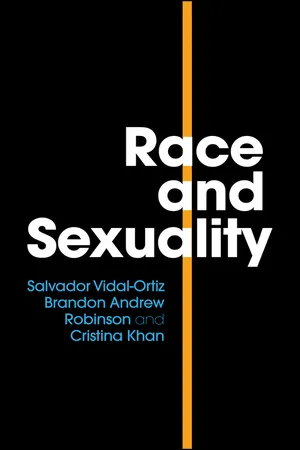
This illuminating book delves into the interrelation of race and sexuality as inseparable elements of our identities and social lives. The authors approach the topic through an interdisciplinary lens, focusing on power, social arrangements and hierarchies, and the production of social difference. Their analysis maps the historical, discursive, and structural manifestations of race and sexuality, noting the everyday effects that the intersections of these categories have on people's lived experiences. Considering both US-based and transnational cases, this book presents an empirical grounding for understanding how race and sexuality are mutually constitutive categories.
Providing a comprehensive overview of racialized sexualities, this book is an essential text for any advanced course on race, sexuality, and intersectionality.
- English
- ePUB (mobile friendly)
- Available on iOS & Android
eBook - ePub
Race and Sexuality
About this book
Information
Part I
Discourses of Race/Sexuality
1
Two Systems Operating Synchronously
In August of 2016, Kimberlé William Crenshaw offered a presentation at the American Sociological Association's annual meeting, entitled “Rethinking Social Movements: Can Changing the Conversation Change the World?”. Crenshaw's intervention aligned with her decades-old work on critical race theory. Charlene Carruthers and Mariame Kaba, feminist and queer activists involved in Black Youth Project 100 and movement-building work against police brutality across the country, accompanied Crenshaw during this presentation. Alongside these activists, Crenshaw's focus was on her most recent project that makes visible the often hidden violence faced by black women and her campaign entitled #SayHerName. Crenshaw notes in this and other presentations how the Black Lives Matter visibility in the media tends to foreground the lives of (cisgender) black men, to the detriment of as many (if not more) women of color facing violence and death at the hands of police. The invisibility of gender violence (faced, every day, by cisgender and transgender women of color) in the women's interactions with police − as an extension of the gendered raced state violence faced by all women of color − provoked Crenshaw's focus on #SayHerName as an extension of her intersectionality work from the late 1980s and early 1990s. However, sexuality is often left without articulation in this work on gendered and racialized violence. More precisely, the inherently gendered and sexualized violence faced by transgender women − for breaking gendered and sex expectations, for embodying what is stereotyped as hypersexualized bodies that are also commodified and placed on a sexualized gendered market − merits as much attention as the ability to connect #SayHerName to queer and sexuality-specific racialized work (which the other activists-scholars more clearly did).1
As noted in the introduction, racialized sexualities is a new area of study that is influenced by sociology, anthropology, history, American Studies, queer studies, feminist and gender studies, critical race theory, literary studies, English, rhetoric, political science, and geography. Our purpose in this book is to advance a more focused understanding of the notion that racialization is always already sexual, and sexualization is always already raced. How these categories are mutually co-constituted is in many ways the purpose of this chapter. We delve into the various theoretical approaches and conceptual discussions on the topic, as well as interrogate the tenets of some of their propositions. Race and sexuality as mutually constituted is something that scholars in the field of the queer-of-color critique (Cohen 1997; Reddy 1998; Muñoz 1999; Ferguson 2004) have already argued. Some of these arguments are based upon women-of-color feminism − mainly lesbians of color − who articulated how gender, sexuality, race, and class are interconnected (Moraga and Anzaldúa 1981; Lorde 1984; Barbara Smith, Demita Frazier, and all of the other authors of the Combahee River Collective Statement 1977).2 More recently, queer theoretical formulations of race and sexuality, with the work of scholars such as Manalansan IV (2003), Guzmán (2006), Decena (2011), and Pérez (2015), emerged as both support for, as well as a challenge to, some feminist and gender studies scholarship. In this and other chapters we approach this theoretical and conceptual discussion as a scaffolding of layers that will, eventually, illustrate the connections between these fields of study, as well as how the notion of racialized sexualities differs from these other scholarly arenas. Whereas the introduction portrayed works at the disciplinary level, in this chapter, we embrace critiques, conceptual approaches, and contributions to knowledge production from smaller (non-disciplinary) projects, as well as interdisciplinarily.
Notice that, in our opening vignette, Crenshaw, a lawyer, is speaking at a sociology conference and is returning to intersectionality − a term she coined − and to the conceptual paradigm of exploring the place of women of color in feminist and race studies. We also frame the chapter with Crenshaw's intervention as it serves a dual purpose: it allows for the introduction of one of the topics we discuss in this chapter − intersectionality − while also breaking away from disciplinary structures (sociology, anthropology) and into a field of study with more specificity. But Crenshaw's appearance among a panel of activist women of color also introduces a break with the typical academic/activist binary so many of us operate in. Crenshaw and her fellow panelists draw attention to the lack of state intervention in the violence experienced by women of color. Crenshaw weaves together this structural phenomenon with the interpersonal by insisting on naming the axes of power that contribute to the lack of attention such events receive. By deliberately naming the perpetuation of structural violence (and subsequent invisibility) experienced by women of color, Crenshaw lays bare how the politics of invisibility are embedded in racialized and gendered discourses.
Thus we begin chapter 1 by discussing the different conceptualizations of race and how historical moments, structures, and processes impact racial formations. We focus in on main contributors to critical race theory, as well as the criticisms of some omissions from these theories. We also think through some potential (and current) expansions of such work. We then move to scholarship on sexuality using the very same structure, and addressing the connection between feminist and gender studies and queer theoretical formulations. In these two sections, we reveal how sexuality is often erased or invisible in how most people conceptualize racial formations, and we think through the implications of previous theorizing of race without thinking about sexuality. We then move to think about how sexuality and sexualization are conceptualized, and also interrogate the absence of race in these conceptualizations. We discuss the implications around the invisibility of race in discussions of sexual formations and also the tension created by including sexuality within an intersectional analysis − an important focus in the latter part of this chapter. We conclude chapter 1 by thinking through the academic, social, political, and cultural stakes of imagining sexuality and race as mutually exclusive analytical concepts versus co-constitutive social formations.
In the end, this chapter illuminates the conceptualization and utility of discursive practices in order to rethink the relationship of race and sexuality, in ways that will inform the next chapter, which focuses on lived experiences. Because we treat racialization and sexualization as discursive practices that have to be continually untangled and produced as distinctive, on and off the same grid, this conceptual chapter oscillates between earlier discussions by feminist and gender studies and racial formation theory, then delves into sexuality and queer theory in order to discuss intersectionality. Indeed, as we will show, we see both race and sexuality operating in and through each other all the time, so that racialization is not just about race and sexualization is not just about sexualities, although they are often continuously produced as supposedly being distinctive.
Race systems: the deployment of an ideology of raced beings
Conceptually, and building off the definitions and historical context provided in the introduction, this section expands on our understandings of race, racial formations, and racialization. To begin, the history of the United States is rooted in genocide, slavery, and the imperial foundation of the thirteen colonies' project of “manifest destiny” (a doctrine that alluded to the inherent and unstoppable urge to conquer all land west and south of the colonies). Colonial encounters acted as the foundation of the distribution of wealth; colonizers marginalized and dehumanized Native Americans and enslaved African peoples, and established the inherited systemic disadvantages − measured by resources such as land and freedom − that benefited white people over the rest. These historical processes of racial formation are an important historical point of departure. These power encounters that enforced labor and control, along with subhuman treatment, became part of the early racializing practices of domination that marked certain groups of people as inferior. (In Marxist language, the owners of the means of production controlled the free movement of, and threatened to assault and kill, those who became the enslaved workers producing the goods.) Those processes of demarcating all African enslaved peoples as black and forcing Native Americans off the radar and into imagined “nations within the nation” took decades to solidify. These same processes also signified white people as those who had access to and controlled the resources. Under the continuous expansion of the land by the United States, exploitation became the form of sustaining large quantities of production of buildings, of processing food and raw material, and the overall advancement of resource accumulation for those who became understood as white. The American Civil War began to map out a series of historical interventions to change the treatment of African Americans, but it would take another century for the actual implementation of civil rights (see Kibria, Bowman, and O'Leary 2014).
In the project of “manifest destiny,” and the expansion of the wealth and power of the United States, the solidification of whiteness, as one extreme, and its counterpart, blackness, became the solid stones on which the country was built. This history haunts white people in the United States today, even when there are dismissive strategies and forms of rewriting history (people in the United States may recall the 2015 discussion about a high-school textbook produced by the publisher McGraw-Hill Education − one of the biggest textbook suppliers to the country − that discussed African enslaved people as “workers”)3 or other strategies of deflection that take place in order to avoid the historical structural violence and internal genocide of African enslaved peoples and Native Americans.
Omi and Winant's Racial Formation in the United States (1986, 1994, 2015) is squarely located at the center of this chapter in terms of thinking about the history of the United States, the forcefulness of the racial system, racial categories, and processes of racialization and nation-building. In particular, their conceptualization of racial formation theory as the mechanism through which racial categories were and are “created, inhabited, transformed and destroyed” (1994: 55) serves our framing of this chapter. Racial formation theory ties together the historical processes of racialization with the understandings of race. Racial Formation continues to influence these discussions, especially as we think about a notion of a “post-racial” society − a myth that continues to be enacted by multiple streams of conservatism and some forms of liberalism to dismantle denunciations of racism and discrimination. In this post-racial society, a social justice project gets rebranded as a “diversity” framework based on “inclusion” and “difference” – without bringing power into these discussions.
The twenty-first century brought a set of challenges to this black/white binary that had been so ingrained in the USAmerican imaginary of race. This obstinate binary could also be seen in the so-called “race relations” (Steinberg 2007) that arrived with multiculturalism, which accompanied us until the end of the twentieth century. Indeed, until the Twin Towers attack on September 11, 2001, the black/white binary still ruled the racial landscape in the USAmerican imaginary. This black/white binary was intact in spite of the 1965 immigration law changes that opened the doors to millions of immigrants who, according to Steinberg, were seen as the “new ethnics.” However, when we insert 9/11 into conversations about racialization of Arabs/South Asians/Middle Easterners, and those (of any ethno-racial background) who are Muslim, we are not talking about immigration − and culture − but of groups associated with immigrant communities that have been racialized in powerful enough ways so as to authorize black and Latina/o people to endorse the surveil and register practices of those most targeted (Ahmad 2002). Historical discussions of racial classifications and the subjective meaning of race (for instance, the use of the documentary Race: The Power of an Illusion, The House We Live In) are important, but changes in the structural view of who becomes part of the groups at the “bottom” of the social-racial ladder (such as how 9/11 altered racial formations and meanings) are necessary.
Scholars have advanced the initial theoretical mapping and development of central concepts (such as racial formation and racialization) by pointing to the blind spots in Omi and Winant's theoretical contributions in terms of gender and sexuality (just as earlier scholars debated the saliency and centrality of class versus race − in particular, liberal thinking that it is not about race, but class), and what ultimately is foregrounded. For instance, the polarizing way in which the two (whiteness and blackness) were never to meet (literally, as in public space, and figuratively, as in interracial eroticism) was structured around ideas of access through gender and sexuality (e.g., anti-miscegenation laws). Likewise, African enslaved peoples were unable to sustain hegemonic ideas of familial structures, furthering experiences of domination and o...
Table of contents
- Cover
- Table of Contents
- Title page
- Copyright page
- Acknowledgments
- Introduction
- Part I: Discourses of Race/Sexuality
- Part II: Transnational, Local, and Global Sexual/Raced Messages
- Conclusion: Racialized Sexualities – On Experience, Policy, and Scholarship
- References
- Index
- End User License Agreement
Trusted by 375,005 students
Access to over 1.5 million titles for a fair monthly price.
Study more efficiently using our study tools.
Frequently asked questions
Yes, you can cancel anytime from the Subscription tab in your account settings on the Perlego website. Your subscription will stay active until the end of your current billing period. Learn how to cancel your subscription
No, books cannot be downloaded as external files, such as PDFs, for use outside of Perlego. However, you can download books within the Perlego app for offline reading on mobile or tablet. Learn how to download books offline
Perlego offers two plans: Essential and Complete
- Essential is ideal for learners and professionals who enjoy exploring a wide range of subjects. Access the Essential Library with 800,000+ trusted titles and best-sellers across business, personal growth, and the humanities. Includes unlimited reading time and Standard Read Aloud voice.
- Complete: Perfect for advanced learners and researchers needing full, unrestricted access. Unlock 1.5M+ books across hundreds of subjects, including academic and specialized titles. The Complete Plan also includes advanced features like Premium Read Aloud and Research Assistant.
We are an online textbook subscription service, where you can get access to an entire online library for less than the price of a single book per month. With over 1.5 million books across 990+ topics, we’ve got you covered! Learn about our mission
Look out for the read-aloud symbol on your next book to see if you can listen to it. The read-aloud tool reads text aloud for you, highlighting the text as it is being read. You can pause it, speed it up and slow it down. Learn more about Read Aloud
Yes! You can use the Perlego app on both iOS and Android devices to read anytime, anywhere — even offline. Perfect for commutes or when you’re on the go.
Please note we cannot support devices running on iOS 13 and Android 7 or earlier. Learn more about using the app
Please note we cannot support devices running on iOS 13 and Android 7 or earlier. Learn more about using the app
Yes, you can access Race and Sexuality by Salvador Vidal-Ortiz,Brandon Andrew Robinson,Cristina Khan in PDF and/or ePUB format, as well as other popular books in Social Sciences & Gender Studies. We have over 1.5 million books available in our catalogue for you to explore.