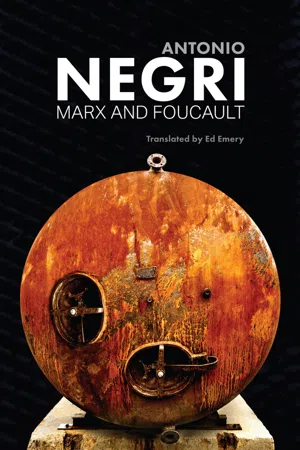
This the first of a new three-part series in which Antonio Negri, a leading political thinker of our time, explores key ideas that have animated radical thought and examines some of the social and economic forces that are shaping our world today.
In this first volume Negri shows how the thinking of Marx and Foucault were brought together to create an original theoretical synthesis - particularly in the context of Italy from May '68 onwards. At around that time, the structures of industry and production began to change radically, with the emergence of new producer-subjects and new fields of capitalist value creation. New concepts and theories were developed by Foucault, Deleuze and Guattari and others to help make sense of these and related developments - concepts such as biopower and biopolitics, subjectivation and subsumption, public and common, power and potentiality. These concepts and theories are examined by Negri within the broader context of the development of European philosophical discourse in the twentieth century.
Marx and Foucault provides a unique account of the development of radical thought in the late 20th and early 21st centuries and will be a key text for anyone interested in radical politics today.
- English
- ePUB (mobile friendly)
- Available on iOS & Android
eBook - ePub
About this book
Trusted by 375,005 students
Access to over 1.5 million titles for a fair monthly price.
Study more efficiently using our study tools.
Information
Part I
1
Why Marx?
Why Marx? Because a dialogue with Marx is essential for anyone developing the concept of class struggle at the centre and/or in the subaltern conditions of the capitalist empire and proposing a communist perspective today. The lessons from, and the discussion with, Marx are decisive for three reasons.
The first is political. Marxist materialism makes it possible to demystify all progressivist and consensual notions of capitalist development and to affirm, on the contrary, its antagonistic character. Capital is an antagonist social relationship; subversive politics locates itself ‘within’ this relationship, and immerses into it in equal measure the proletarian, the militant and the philosopher. The Kampfplatz [place of struggle] is ‘within and against’ capital.
The second reason why we cannot abandon Marx has to do with critique. Marx locates critique within historical ontology, which is constructed by, and always traversed by, the class struggle. Critique is thus the ‘viewpoint’ of the oppressed class in movement and enables you to follow the logic of the capitalist cycle, to understand its crisis, and by the same token to describe the ‘technical composition’ of the oppressed class and, eventually, to organise its ‘political composition’ in a perspective of revolution. The autonomy of the ‘class point of view’ is central to the critique.
The third reason for staying with Marx is that his theoretical elaboration made it possible, in the course of the twentieth century, to follow the deepening of the crisis of mature capitalism in its dual form (liberal and socialist), and at the same time to organise the liberation movements against colonial power and imperialism.
Today Marx’s theory has to come to terms with a radically different world of work and markets, of division of labour and geography of power – in short, with a new configuration of the classes in struggle. We need to establish whether, in addressing the new figures of exploitation, Marx’s theory can help with grasping their points of crisis, and then with liberating an appropriate imagination of the ‘common’. After the defeat of Soviet socialism we need a new theory of ‘common value’.
Within the limits of this chapter it is not possible to develop a comprehensive discussion on each of these points. Rather I shall limit myself to providing – on each point – an example drawn from Marx’s Capital.
1
By examining Sections IV, V and VI of Book 1 of Capital (chs 10–20), where Marx defines relative surplus value and analyses the process of formation of the system of the ‘large-scale factory’, we can arrive at an understanding of the constitution of a political point of view in Marx, and at the same time at his definition of a class politics.
Now, since the transition from the extraction of absolute surplus value to that of relative surplus value radically changes the relations of magnitude between the two parts of the working day (necessary labour time and surplus labour time), this transition has to be followed by a revolutionising of the conditions of production, both in the forms of value creation and in the forms of the labour process. There is a shortening of the labour time socially necessary for the production of a commodity, so that a smaller amount of work has the potential to produce a greater quantity of use value. At this point we have a radical modification of capitalism: the assumption of a machinic aspect that, as relative surplus value develops, comes to invest and transform the whole of society. These are the terms in which Marx studies the transition from manufacturing to the large-scale factory and the ensuing subsumption of labour cooperation to the exclusive command of capital. This transition creates the conditions for a huge increase in surplus value and for the subjection of a multitude of workers to the discipline of capital, as well as a progressive extension of the employers’ despotism from the factory to the whole of society. Thus the implementation of the processes of extraction of relative surplus value is not just about the division of the worker’s working day between the necessary labour part and the surplus labour part: it also revolutionises from top to bottom both the technical processes of labour and the social groupings. While on the one hand the body of workers active in the factory becomes a form of existence of capital itself, on the other hand the division of labour in the factory has to be reflected in a matching social division of labour – which means that, also outside the factory, social life is gradually subsumed to capital, first in a ‘formal’ manner, and then in ‘real’ terms. Nature itself is completely subjugated to the capitalist mode of production, agriculture to large-scale industry, and so forth.
But this genealogy of relative surplus value and this expansion of big industry, both of which appear invincible, actually have a very bizarre historical origin. The fact is that capital, in order to produce, has to incorporate human material and it has attempted to do this in history (which always repeats itself) since its origins, enormously expanding labour time and extending the appropriation of additional labour power – the labour of women and children, for example, in the first phase of industrial accumulation in Europe. In such circumstances the very survival of the working class as a ‘breed’ was put at risk, so ferocious was the degree of exploitation. Marx speaks of a holocaust of the proletariat. Resistance is born. The very transition from manufacturing to large-scale industry – as Marx explains – is brought about by working-class rebellion. This is in fact what happened. At that point the state had to intervene, using the force of law, to oblige the capitalists to shorten the length of the working day. We might also add: to force them to understand that the life of workers is not just brute raw material but is vital activity, historically consolidated and qualified – and, on this basis, resistant.
When the resistance of labour power appears, the whole picture (as described thus far in these sections of Capital) changes. We have not only the historical event of the passage from the extraction of absolute surplus value to relative surplus value, there is not only the birth of the big factory, of the factory system, and of the mode of production of large-scale industry; what also becomes apparent, with the spread of this new figure of capital, is its internal structure as an antagonistic social relationship. Once one looks at it not solely from the viewpoint of the power of the capitalist but also from the point of view of the workers, of their resistance, of their potentiality [potenza], it becomes apparent that the categories that define capital are twofold. We can put this more succinctly: rather than as an ‘objective organism’ or as an irresistible despot, capital here shows itself as one partner in a game that has two players – and because, as Marx tells us, what the workers partially lose is concentrated in capital, and against them, it is as an enemy of the workers. On the one side is the exploiter, on the other the exploited.
Let us return to the ‘dual nature’ of the categories, not presuming to offer a complete picture but giving a few basic examples. We have seen from the definition of surplus value that surplus labour exists in opposition to necessary labour. But these definitions, these abstractions need to be related back to the materiality of the capital relation in order to be able immediately to measure its antagonism: when labour power reaches that point of the working day where it considers that it has worked enough to get the wages necessary for its own reproduction, it refuses to work further and has to be forced to do so. If this is the case, it follows that in the process of production the relationship between the labour process and the process of value creation, between the organisation of work and the organisation of exploitation, is always conflictual. Consequently, simultaneously with becoming more productive, labour power also has to be socially weakened, exposed to the overabundance and competition of other labour power, and, through this, subjected to a greater oppression. However, at this point labour power has reached higher forms of consciousness in the face of capitalist repression and, through its higher levels of productivity, has brought about a greater capacity for resistance. So – in Marx’s narrative – labour is now in a position to impose reductions in the duration of the working day and increases in the overall wage bill. Relative surplus value is an outcome of the struggles.
Furthermore, the advent of a production based on the extraction of relative surplus value requires an intensification of cooperation by workers, since it is through the cooperation of labour power that labour productivity is increased. And if this cooperation always goes hand in hand with the capitalist division of labour, by virtue of this fact it poses itself as an element of contradiction in relation to capital. The antagonistic relationship that constitutes capital is, in this case, deepened in social terms. The capital relation, which always requires a combination of cooperation and subordination, is able neither to conceal the opposition nor to block its expression – so that the resistance to value creation in the labour process is further accentuated by the political consciousness that cooperation produces.
Furthermore, it is especially in the relationship with machines that labour power shows its potential power [potenza], because when the machine, in its relative independence, transmits value to the product, what it transmits still remains dead labour, while only the activity of the workers, of living labour, enables machines to be productive.
In short, capitalist despotism, both in the factory and in society, cannot rid itself of the use value of working-class labour, of labour power, and all the more so as the social productive power of labour progresses. The capitalist relation is therefore always subject to this contradiction, which can explode at any moment and which, on an everyday basis, banally but efficaciously, presents itself as the problem of wages. When the process of purchasing labour power on the capitalist market is enacted, it immediately becomes apparent that what happens there is an exchange of unequal magnitudes, an exchange that is conflictual. And whereas thus far we have stayed with a reading of chapters 10–20 of Book 1 of Capital, permit me now to recall how, in chapter 8 of Section III of the same book, Marx, by bringing the Factory Act into his theoretical analysis, makes it clear that, as regards the dimensions of the working day, in the factory there is always an antinomy, that of right set against right. He concludes: between equal rights, force decides. Put more strongly, in the precise terms of the critique of political economy, the situation is as follows:
in the division between surplus-value and wages, which division essentially determines the rate of profit […] there are functions of two independent variables, which limit one another, and it is their qualitative difference that is the source of the quantitative division of the produced value. (Marx, 1972, p. 364 = Capital, Book 3, Section V, ch. 22)
It was by viewing the wage as an ‘independent variable’ in the capitalist relation that I learned to do politics. And many others with me. This discovery of the antagonism, in other words of a contradiction that is not resolvable but could be acted on from the point of view of global labour power, and by the working class – this represented the essential dispositif from which political research, or rather ‘co-research’ [con-ricerca] together with the exploited, could develop; it could also extend in various ways – moving outwards from the organisation of the struggles in the factory to social struggles, from wage objectives to struggles over welfare, from the contestation of the restrictions of freedom imposed on the working-class struggles to revolution in the conditions of freedom of life… There were no objective laws to be met – rather it was a matter of developing that (material and political) independent variable that the production of the revolutionary struggle determined: constituent projects to be actualised, always within that liberation of and from work that, alone, constitutes society and history.
2
The quotation from Book 3 given above brings us to a discussion of the critical function that Marx’s teaching produces: there we found a clear statement of the antagonism between capital and labour power as ‘independent variables’ that limit each other on the basis of their ‘qualitative differences’. At this point we have a striking Marxian statement that is worth quoting: ‘the real barrier of capitalist production is capital itself’ (Marx, 1972, p. 250 = Capital, Book 3, Section III, ch. 15). If this statement is true, the entire critical dispositif of Marxism has to be read in its light.
By way of example we could look at the whole of S...
Table of contents
- Cover
- Title Page
- Copyright
- Introduction
- Part I
- Part II
- Part III
- References
- Origin of the Texts
- End User License Agreement
Frequently asked questions
Yes, you can cancel anytime from the Subscription tab in your account settings on the Perlego website. Your subscription will stay active until the end of your current billing period. Learn how to cancel your subscription
No, books cannot be downloaded as external files, such as PDFs, for use outside of Perlego. However, you can download books within the Perlego app for offline reading on mobile or tablet. Learn how to download books offline
We are an online textbook subscription service, where you can get access to an entire online library for less than the price of a single book per month. With over 1.5 million books across 990+ topics, we’ve got you covered! Learn about our mission
Look out for the read-aloud symbol on your next book to see if you can listen to it. The read-aloud tool reads text aloud for you, highlighting the text as it is being read. You can pause it, speed it up and slow it down. Learn more about Read Aloud
Yes! You can use the Perlego app on both iOS and Android devices to read anytime, anywhere — even offline. Perfect for commutes or when you’re on the go.
Please note we cannot support devices running on iOS 13 and Android 7 or earlier. Learn more about using the app
Please note we cannot support devices running on iOS 13 and Android 7 or earlier. Learn more about using the app
Yes, you can access Marx and Foucault by Antonio Negri, Ed Emery in PDF and/or ePUB format, as well as other popular books in Philosophy & Political Philosophy. We have over 1.5 million books available in our catalogue for you to explore.