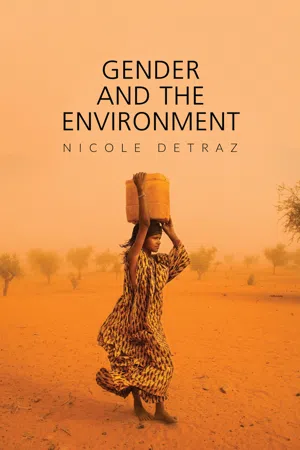
Climate change, natural disasters, and loss of biodiversity are all considered major environmental concerns for the international community both now and into the future. Each are damaging to the earth, but they also negatively impact human lives, especially those of women. Despite these important links, to date very little consideration has been given to the role of gender in global environmental politics and policy-making.
This timely and insightful book explains why gender matters to the environment. In it, Nicole Detraz examines contemporary debates around population, consumption, and security to show how gender can help us to better understand environmental issues and to develop policies to tackle them effectively and justly. Our society often has different expectations of men and women, and these expectations influence the realm of environmental politics. Drawing on examples of various environmental concerns from countries around the world, Gender and the Environment makes the case that it is only by adopting a more inclusive focus that embraces the complex ways men and women interact with ecosystems that we can move towards enhanced sustainability and greater environmental justice on a global scale.
This much-needed book is an invaluable guide for those interested in environmental politics and gender studies, and sets the agenda for future scholarship and advocacy.
- English
- ePUB (mobile friendly)
- Available on iOS & Android
eBook - ePub
Gender and the Environment
About this book
Information
1
Introduction: How Are Gender and the Environment Connected?
Environmental challenges are widely recognized as important issues for the international community to address. Climate change, loss of biodiversity in forests and oceans, natural disasters, dependence on polluting energy sources: all of these are environmental issues that have captured the attention of people and policymakers around the world. Environmental issues are typically understood to be complex and transboundary, but they are not always recognized as being gendered. This book provides an introduction to the links between gender and the environment by analyzing some of the key issues and topics within global environmental politics (GEP) through gender lenses. In particular, it identifies sustainability and justice as two central goals within GEP in general. Actors seek sustainable solutions to environmental challenges, and many also strive to ensure that these solutions are fair and just. Including gender in discussions and evaluations of these aims is both necessary and helpful.
There are both instrumental and ethical reasons for reflecting on the connections between gender and environmental politics. The instrumental reason relates to the overall goal of sustainability: halting environmental change requires consulting multiple perspectives and understanding a diverse range of experiences. Humans have a strong incentive to identify and pursue effective paths toward sustainability. The chapters of this book make the case that we are unlikely to get there unless we incorporate gender into our understanding of sustainability. The ethical reason for including gender is that current distributions of environmental ills and environmental benefits are uneven across the international system. People who are most likely to suffer from environmental change are also those who experience discrimination and marginalization at multiple levels and based on multiple categories (gender, race, class, ethnicity, etc.). Gender lenses allow us to examine specific gendered manifestations of injustice that have been underexplored in GEP.
By examining debates about population, consumption, security, and governance, the book considers how looking at the environment through gender lenses pushes us to ask different questions and broaden our sphere of analysis. It specifically claims that the concepts of sustainability and justice can shape how we see gender in these debates. These topics are appropriate to include because of the fact that they (1) are central concepts within GEP debates, and (2) have important gender components that are often ignored in both scholarship and policymaking. The central argument running through the text is that considering the environment through gender lenses challenges the primacy of some traditional environmental concepts and shifts the focus of sustainability and justice goals to be more inclusive.
Exploring the objectives of sustainability and justice through gender lenses is particularly important because society's understanding and enforcement of gender norms influence how we interact with the environment in numerous ways. Men and women are typically differently placed in terms of both their vulnerabilities to environmental change and their agency in addressing environmental issues. Without exposing the relevance and presence of gender in these kinds of discussions, important debates may continue without the inclusion of a key element. This book highlights gendered understandings of key environmental issues and topics and reveals the complexities of these discussions. It argues that a feminist perspective will help advance the GEP field by highlighting the gendered assumptions that go into scholarship and policymaking, and thus should help us come to a more complete understanding of and response to global environmental problems. These contributions directly relate to goals of sustainability and justice. Environmental processes and experiences are gendered – meaning that gender currently (and historically) intersects with power relations, which influence, among others, political processes of environmental decision-making; economic processes, which can help or hinder environmental sustainability; and social processes, which determine which tasks members of society will be expected to perform. The objective of the current volume is to reveal this gendering in order to facilitate dialogue across academic disciplines but also to better inform policymaking.
This undertaking is particularly important now because environmental issues are the subject of high-stakes policymaking in states across the globe. Issues like climate change, energy independence, green jobs, etc. have had a central place on the agenda of policymakers in recent years. These environmental debates have included several of the topics that are explored in the chapters of this book, including population, consumption, and environmental security. It is essential that students and the general public understand the role of gender in these topics so that they can better comprehend the ongoing discussions about environmental change and environmental policymaking.
Also, this undertaking is important because environmental issues have profound implications for human well-being. Rather than the repercussions of environmental change simply being a theoretical issue, these concerns are also often survival issues for those living in many parts of the world. Much feminist work has focused on the particular gendered implications of environmental change for marginalized populations in society, focusing especially on the unique hardships that women face because of environmental degradation. This includes women having to travel farther from home to collect water or fuelwood, women's unique experiences as environmental refugees, or women suffering food insecurity in greater numbers than men. These examples are important to understand because they offer insight into the gendered complexities of environmental issues.
This book is situated in the field of GEP. As an intellectual tradition with many connections to international relations (IR), GEP assess the politics of identifying, coping with, and addressing environmental protection and change. For many years, feminist scholars have claimed that IR has been slow to incorporate gender into its analysis (Tickner 2001). Since many GEP scholars have been trained within IR, it is not very surprising that gender does not factor into the work of most GEP scholars in a consistent and sustained fashion. This is not to say that there is necessarily a hostility to looking at environmental issues through gender lenses, but rather that there is a silence about gender. For example, most foundational texts within GEP contain very little attention to gender. Again, this is not to suggest that the authors and editors of these texts have specifically excluded gender on purpose. Rather, it is indicative of larger silences about gender within the field as a whole.
Understanding environmental politics
What is the environment? This is a question that I pose to my students, and which receives a wide array of responses. Many claim that “the environment” encompasses humans and the places and spaces in which they live. Others argue that the environment is a forest or field that is largely untouched by human hands. Since the Enlightenment in particular, there has been a tendency in many societies to think of nature as an entity that is external to humanity, and in many cases, something for humans to dominate (Hartmann et al. 2005; Plumwood 2002). Those who are critical of this tendency claim that terms like “nature,” “environment,” and “wilderness” must be understood as being historically contingent. The chapters of this book adopt a wide perspective on what “counts” as the environment. They draw on critical scholarship that sees discourses used in environmental debates as fluid entities that shape our understandings of global environmental political issues and the solutions we propose to address them.
Discourses are powerful forces within both academic and policy debates. The use of one discourse over another has very real implications for how we understand and seek to address international concerns (Ackerly and True 2010).1 For example, there are multiple discourses around the concept of “genetically modified food.” One discourse may include narratives of genetic modification as a solution to food shortages, while a second discourse may include narratives of genetic modification as a dangerous source of food insecurity. Policies made about the genetic modification of food will be supportive of the practice if the first discourse is used, and are likely to prohibit the practice if the second is used. Discourses shape our understanding of the terms of a debate, and are therefore important to how policies about environmental issues will be made (Detraz 2014).
There is a very long history of humans being concerned about perceived negative changes in their “environment.” The late 1800s and early 1900s saw individuals and groups call attention to the radical changes that accompanied processes of industrialization. During this timeframe, well-known authors in the global North2 like Henry David Thoreau, Ralph Waldo Emerson, and others reflected on the impacts of industrialization on pastoral landscapes, wilderness, and simple ways of life. John Muir challenged the society of the time to consider the meaning and necessity of preservation of wild spaces. Gifford Pinchot raised questions of conservation in the face of industrialization's hasty use of resources (Wapner 2012). In fact, the timeframe associated with the rapid spread of industrialization is frequently cited as a turning point in humanity's relationship with “nature,” as well as our understanding of that relationship. In the face of these debates, some governments began to manage natural resources “scientifically” through policies such as sustained yield management for timber and other resources.
Despite the attention of some, the environment was not considered a central political issue for much of the history of the modern state system.3 It was not until the 1960s and 1970s that public demand for safer and cleaner spaces, coupled with the rise of environmentally focused nongovernmental organizations (NGOs), resulted in states paying increased attention to the environment as a political issue. Environmental NGOs have had a strong presence in the environmental issue area. The first environmental NGOs emerged in the late nineteenth century, including the International Union of Forestry Research Organizations in 1891 and the International Friends of Nature in 1895 (Betsill 2014). In later years, Greenpeace, Earth Island Institute, Rainforest Action Network, World Wildlife Fund and Conservation International, along with others, emerged as examples of transnational environmental activist groups working to protect environmental quality across the globe (Wapner 2012).
By the late 1970s and 1980s many governments had created environmental departments or ministries to specifically tackle environmental policymaking (Chasek et al. 2006). Early examples include the US Environmental Protection Agency (EPA), which was created in 1970, and the Canadian Department of the Environment and the French Environment Ministry, both established the following year. Singapore's Ministry of the Environment followed in 1972. The 1970s also saw the United Nations (UN) Conference on the Human Environment held in June 1972 in Stockholm, Sweden. This conference was heralded as reflecting a growing recognition of the seriousness of environmental issues, as well as their transboundary nature. One important outcome of the conference was the establishment of the United Nations Environment Programme (UNEP), located in Nairobi, which adopted a mission to “provide leadership and encourage partnership in caring for the environment by inspiring, informing, and enabling nations and peoples to improve their quality of life without compromising that of future generations” (UNEP 2015).
Two additional global environmental conferences are regarded as significantly shaping the trajectory of environmental politics: the 1992 United Nations Conference on Environment and Development held in Rio de Janeiro, Brazil (popularly known as the Earth Summit), and the 2002 World Summit on Sustainable Development in Johannesburg, South Africa. These global conferences witnessed heated debates about which environmental issues should be on the global agenda, who is responsible for protecting the environment, and how best to halt or reverse environmental change. In the years from 1972 to the present, the governance of global environmental issues has involved both state and non-state actors working on a diverse range of problems related to environmental processes (Betsill 2014; Stevis 2014).
GEP scholarship
The environment came to be recognized as a central topic of scholarship within political science during a similar timeframe. Scholars of the late 1960s and early 1970s began to reflect on issues like the role of states and global institutions as well as the global economy with regard to the environment. GEP emerged as a specific topic of study under the umbrella of IR. As a subfield of political science, IR focuses on political relations that reach across political boundaries. GEP scholars within IR examine the nature of these associations as they relate to the global environment. The focus of GEP scholarship has included work on environmental actors and regimes, studies of the ecological impact of the global political economy, and work on the ethics of environmental politics, among many other topics (Dauvergne and Clapp 2016). Many GEP scholars are political scientists who draw from existing work in their field, as well as reach across disciplinary boundaries in order to build theories about why environmental change occurs and how best to approach it. While not all GEP scholars are explicitly associated with political science, this book largely focuses its attention on debates within this particular academic community.
Over the years, the types of issues on the radar of scholars and policymakers have changed. Early concerns included the extraction and use of resources and species and the implications of population growth for them (Stevis 2014). “Worries about energy supply, animal rights, species extinction, global climate change, depletion of the ozone layer in the upper atmosphere, toxic wastes, the protection of whole ecosystems, envi...
Table of contents
- Cover
- Table of Contents
- Dedication
- Title page
- Copyright page
- Acknowledgments
- Abbreviations
- 1: Introduction: How Are Gender and the Environment Connected?
- 2: Sustainability and Sustainable Development as Gendered Concepts
- 3: Revealing Gender in Environmental Justice
- 4: Too Many People? Gender and Population Debates
- 5: Too Much Stuff? Gender and Debates about Consumption
- 6: Too Little Security? Gender and the Securitization of the Environment
- 7: Conclusion: Gendered Sustainability and Justice in Climate Change Debates
- References
- Index
- End User License Agreement
Trusted by 375,005 students
Access to over 1.5 million titles for a fair monthly price.
Study more efficiently using our study tools.
Frequently asked questions
Yes, you can cancel anytime from the Subscription tab in your account settings on the Perlego website. Your subscription will stay active until the end of your current billing period. Learn how to cancel your subscription
No, books cannot be downloaded as external files, such as PDFs, for use outside of Perlego. However, you can download books within the Perlego app for offline reading on mobile or tablet. Learn how to download books offline
Perlego offers two plans: Essential and Complete
- Essential is ideal for learners and professionals who enjoy exploring a wide range of subjects. Access the Essential Library with 800,000+ trusted titles and best-sellers across business, personal growth, and the humanities. Includes unlimited reading time and Standard Read Aloud voice.
- Complete: Perfect for advanced learners and researchers needing full, unrestricted access. Unlock 1.5M+ books across hundreds of subjects, including academic and specialized titles. The Complete Plan also includes advanced features like Premium Read Aloud and Research Assistant.
We are an online textbook subscription service, where you can get access to an entire online library for less than the price of a single book per month. With over 1.5 million books across 990+ topics, we’ve got you covered! Learn about our mission
Look out for the read-aloud symbol on your next book to see if you can listen to it. The read-aloud tool reads text aloud for you, highlighting the text as it is being read. You can pause it, speed it up and slow it down. Learn more about Read Aloud
Yes! You can use the Perlego app on both iOS and Android devices to read anytime, anywhere — even offline. Perfect for commutes or when you’re on the go.
Please note we cannot support devices running on iOS 13 and Android 7 or earlier. Learn more about using the app
Please note we cannot support devices running on iOS 13 and Android 7 or earlier. Learn more about using the app
Yes, you can access Gender and the Environment by Nicole Detraz in PDF and/or ePUB format, as well as other popular books in Social Sciences & Gender Studies. We have over 1.5 million books available in our catalogue for you to explore.