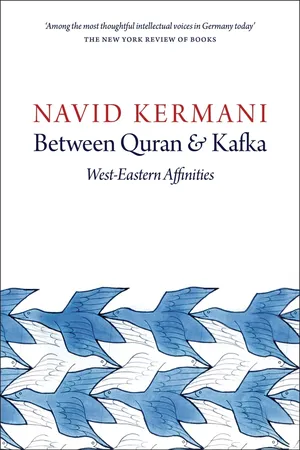
What connects Shiite passion plays with Brecht?s drama? Which of Goethe?s poems were inspired by the Quran? How can Ibn Arabi?s theology of sighs explain the plays of Heinrich von Kleist? And why did the Persian author Sadeq Hedayat identify with the Prague Jew Franz Kafka?
?One who knows himself and others will here too understand: Orient and Occident are no longer separable?: in this new book, the critically acclaimed author and scholar Navid Kermani takes Goethe at his word. He reads the Quran as a poetic text, opens Eastern literature to Western readers, unveils the mystical dimension in the works of Goethe and Kleist, and deciphers the political implications of theatre, from Shakespeare to Lessing to Brecht. Drawing striking comparisons between diverse literary traditions and cultures, Kermani argues for a literary cosmopolitanism that is opposed to all those who would play religions and cultures against one another, isolating them from one another by force. Between Quran and Kafka concludes with Kermani?s speech on receiving Germany?s highest literary prize, an impassioned plea for greater fraternity in the face of the tyranny and terrorism of Islamic State.
Kermani?s personal assimilation of the classics gives his work that topical urgency that distinguishes universal literature when it speaks to our most intimate feelings. For, of course, love too lies ?between Quran and Kafka?.
- English
- ePUB (mobile friendly)
- Available on iOS & Android
eBook - ePub
About this book
Information
1
DON’T FOLLOW THE POETS!
The Quran and Poetry
Muhammad lived from 570 to 632. When he was about forty, his visions and, more importantly, his auditory revelations began, and they would continue until his death, a period of some twenty-two years. He recited the revelations to his compatriots, addressing his neighbours in Mecca directly, but at the same time speaking to all Arabs. He delivered to them ‘an Arabic recitation’, qurʾānan ʿarabīyan; the word ‘quran’ means nothing other than ‘recitation’ or ‘that which is to be recited’, and in the early surahs it is often used without the definite article – it had not yet become a proper noun. Over and over again, the Quran distinguishes between an ‘Arabic’ and a possible ‘foreign-langugage’ (aʿjami) revelation, one not addressed to the Arabs in particular; indeed, in the history of religion there is no other text that so often and so emphatically points out and reflects on the obvious fact that it is composed in a particular language. Thus in surah 41, verse 44:
And if we had made it
a non-Arabic qurʾān (qurʾānan aʿjamīyan),
They would have said,
‘Why are its verses not clear?
What does it mean: a
Non-Arabic qurʾān
And an Arab speaker!’
Thus Muhammad appeared as the ‘Arab’ speaker of a message that God sent to all peoples.
We have sent no Messenger
Save with the tongue of his people, that he might make all clear to them.1
To hold such a concept of revelation, the Arabs must have felt themselves to be a community, in contrast to other communities and peoples, the non-Arabs. Although today that may go without saying, it was by no means self-evident in the seventh century in view of the political situation, the geographical conditions, and the tribal structure of society on the Arabian peninsula. The Arabs of the Jahiliyyah, the pre-Islamic period, were not united by any alliance or common political platform. On the contrary: clans raided one another; blood feuds tore the country apart. The most important form of organization by far, dominating the individual’s world view and personal attachments, was the tribe. Yet the countless clans, socially and culturally highly diverse, regularly at war with one another, considered themselves a single people: the Arabic language was, in spite of all conflicts, the unifying element on the Arabian peninsula in the early seventh century. Although each tribe spoke its own dialect, which was difficult for members of other tribes to understand, the formal language of Arabic poetry, the ʿarabīya, reigned over all the tribal dialects. Poetry was the foundation of a shared identity; it bore the roots of a unified memory that defied disintegration.
The situation might be compared with that of Germany in the late eighteenth century, when literature helped the small and tiny states to develop a common, specifically ‘German’ identity. And yet the Arabs’ situation was different. In the early seventh century they were desert dwellers, living at oases, interconnected only by the merchants’ caravans and the regular wars between the tribes, which were an economic activity in their own right (the word ‘razzia’, descended from Arabic and still current in German, recalls those plundering raids). There were few other contacts between the individual tribes and practically no means of communication. Only the rudiments of writing were generally known; almost everyone was illiterate; and the various dialects were so different at that time that communication between one native tongue and another was difficult at best. And yet, in a territory as big as a third of all Europe, from Yemen in the south to Syria in the north, from the fringes of modern-day Iraq to the borders of Egypt, ancient Arabic poetry, with its ceremonial language, its sophisticated techniques and its very strict norms and standards, was a constant. ‘How this was achieved we do not know and most probably shall never learn’, the Israeli Orientalist Shlomo D. Goitein wrote of this astounding circumstance.2
Ancient Arabic poetry is a highly complex edifice. Its vocabulary, its grammatical peculiarities and its detailed norms were passed down from generation to generation, and only the greatest of the time mastered all its subtleties. No one dared call himself a poet until he had studied under one for years or decades. Muhammad grew up in a world in which the poetic word was revered almost religiously, and he had not learned the difficult craft of poetry before he began reciting verses to his contemporaries. Initially, the Quran was not a text written down from beginning to end but consisted of separate recitable units, which only later coalesced into a whole text. The earliest surahs were dominated by dramatic scenarios of disaster and damnation, calls for spiritual and ethical repentance, and appeals for equality and responsibility among people. Their wording was insistent and forceful, and they fascinated the listeners of the time by their pulsating rhythms, their poignant onomatopoeia, their fantastic array of images. And yet Muhammad’s preaching was different from poetry, and also from the rhymed prose of the soothsayers, the second form of inspired, structured oratory at that time. It strangely violated the norms of ancient Arabic poetry: its narratives went a different way; it suspended metre; the themes, the metaphors, the whole ideological thrust of the early Quran, unlike the conservative, affirmative poetry of that time – all of it was new to Muhammad’s contemporaries and amounted to a revolutionary change in the world they lived in. At the same time, the application of the verses almost always conformed to the rules of ancient Arabic poetry. What was still more important, however, was that the Quran was composed in ʿarabīya, the code of poetry at that time. That was the reason why, in spite of the differences in form and content between his recitation and poetry, many Meccans initially took Muhammad for a poet.
No other revealed text documents its own reception as the Quran does: it records the reactions of the faithful and the unbelievers, quoting them and commenting on them. We learn from the Quran itself that no other reproach troubled the Prophet as much as the assertion that he was ‘just’ a poet. In the later surahs, the rebuttal to that accusation becomes formulaic, but the thoroughness of the early instances is evidence that the danger was genuine. We must conclude that Muhammad found himself compelled, especially in the initial phase of his prophecy, to struggle against being mistaken for a poet because of certain of his acts, behaviours or speeches. If there had been nothing in his ministry to suggest that identification, his opponents would never have thought of calling him one in the first place. They would have found other arguments to challenge his claim to divine revelation. They could have said, for example, that he was a liar, a thief or a charlatan. ‘But they said: He is just making up verse; he is a poet’ (21:5).
Muhammad’s opponents’ assertion that the Quran was poetry cannot have been merely polemical: it must have reflected many people’s actual impressions – not because the Quran was identical with poetry in the minds of the community that received it, but because poetry (and the other genres of inspired oratory) was the only point of reference they could compare it with; it was the thing that was least different from the Quran. The Muslim tradition documents this, reporting again and again that the Meccans went to poets and other masters of the literary language and asked them what to call Muhammad’s recitations. In answering – with fascination and amazement – that the Quran was neither poetry nor rhymed prose, they outlined the horizon of their expectations. ‘I know all kinds of qasidas and the rajaz; I am familiar even with the poems of the jinn. But, by God, his recitation is like none of them’, Muhammad’s famous contemporary Walid ibn al-Mughira confessed – to quote just one of many similar opinions.3 And in its consistent reports that the poets and rhetoricians were aware of the Quran’s stylistic uniqueness, the tradition mentions conversely that it was not easy for simple people to distinguish clearly between poetry and the revelation. The story is told, for example, of one of the Prophet’s followers, the poet Abdullah ibn Rawaha, that his wife surprised him leaving a concubine’s chamber and demanded an explanation. She had long suspected him of having secret affairs. Knowing that Abdullah had once sworn an oath never to recite the Quran except in a state of ritual purity – and, if he had lain with the concubine, he would have been unclean – she challenged him to recite something from the Quran as a way of exposing him. The poet immediately recited three lines of a poem that sounded so similar to the Quran that his wife was persuaded of his innocence: she ‘thought it was a qurʾān’.4
Since it was in danger of being confused with poetry, the Quran was compelled to repudiate poetry: ‘And the poets – the perverse follow them.’5 Only the awareness of these circumstances allows us to understand the polemics against poets contained in the Quran, especially in the 26th surah. The Quran was not taking part in a literary competition. Poets might vie for the leadership of a single tribe, but the Quran radically challenged the whole tribal structure of Arab society and its polytheism by proclaiming the principle of unity – both the unity of God and that of the community. The poets meanwhile, more than any other group in that society, were protagonists of the tribal order of the Jahiliyyah. To read into the Quran a blanket condemnation of poetry, as people often do, is not defensible. The Quran criticizes the poets only where they cling to their leadership role and take inspiration from devils, and it makes an explicit exception for those poets ‘who believe, do good, and are mindful of God’ (26:227).
Evidently the Prophet was victorious in his conflict with the poets, otherwise Islam would not have spread so rapidly. The Quran itself only hints at the reasons for that success. Although it reflects the situation at the time of the revelation, referring to specific events and developments, it does so for an audience that is already familiar with those events. It does not recount, as a history book would, what happened on this or that specific day, but instead alludes to the events by isolated cues that stimulated the memories of its immediate audience. To understand the historical context, later readers often have to rely on secondary sources such as the biographies, the history books and the traditional texts on the ‘occasions of the revelations’ (asbāb an-nuzūl).
In the European view of Islam’s early history, Muhammad’s success is attributed to social, ideological, propagandistic or military factors; writers emphasize the Prophet’s charisma or his egalitarian message. Muslim sources draw a different picture. According to them, Islam triumphed primarily by the verbal force of the Quran, by the sheer aesthetic power of its melodic recitation. Only here, in the history books, biographies and theological compendia, in the Muslim community’s retrospection on its salvation history, Muhammad’s conflict with the poets coalesces into a struggle with a literary aspect, fought, to a certain extent, after the model of the ancient poets’ duels, as in the anecdote about the greatest of Arabia’s poets, Labid ibn Rabia. The pages of his poems were hung on the doors of the Kaaba as a symbol of his supremacy. None of his fellow poets dared accept the challenge by hanging his own verses beside Labid’s. One day, however, there came some followers of Muhammad, who at that time was reviled by the heathen Arabs as an obscure sorcerer and a mad poet. They hung an excerpt from the second surah of the Quran on the door and challenged Labid to read it aloud. The prince of poets laughed at their presumption. To pass the time, or perhaps in derision, he acquiesced and began to declaim the verses. He was overpowered by their beauty and professed Islam on the spot.
Conversions of this kind are one of the most frequent topoi in Islamic salvation history. The tale is also told, for example, of a scout who came to Mecca from Yathrib, the future Medina, to investigate the mysterious rumours about the appearance of a new prophet. Sternly warned against the prophet’s magic tricks, the man had been urged to plug his ears before encountering people who recited his prophecy. So the investigator walked along the streets of Mecca and encountered a group of the faithful listening to a Quran recitation. He thought to himself, ‘I am a man of reason and experience. Why make a fool of myself by plugging my ears just because someone is reciting something?’ He took the wadding out of his ears, heard the sound of the Quran, and professed Islam then and there. The famous sirens in book twelve of Homer’s Odyssey cannot have been more enticing.
These conversion stories, which always have the same structure, reveal their unique character when we look for an analogous theme in other religions. The phenomenon of a conversion effected by an aesthetic cause, which is frequently claimed in Islam even in later centuries, is scarcely attested in Christianity, for example. Neither in the Gospels nor anywhere else are there corresponding accounts in any comparable density. The great conversions and initiation experiences in Christian history – those of St Paul, St Augustine, Pascal and Martin Luther, to name just a few – were triggered, as far as we know from the autobiographical testimony, by experiences which, while no less remarkable to the onlooker or the reader, are not primarily aesthetic: it is not the beauty of the divine revelation that stands out in the subject’s consciousness but its moral and ethical message to the individual. That does not mean that the development and the religious practice of Christianity, or any other religion, would be conceivable without the aesthetic fascination of certain spaces, texts, chants, shapes, smells, acts, gestures,...
Table of contents
- Cover
- Title Page
- Copyright
- Preface: A Personal Note
- 1 Don’t Follow the Poets!: The Quran and Poetry
- 2 Revolt against God: Attar and Suffering
- 3 World without God: Shakespeare and Man
- 4 Heroic Weakness: Lessing and Terror
- 5 God Breathing: Goethe and Religion
- 6 Filth of My Soul: Kleist and Love
- 7 The Truth of Theatre: The Shiite Passion Play and Alienation
- 8 Liberate Bayreuth!: Wagner and Empathy
- 9 Swimming in the Afternoon: Kafka and Germany
- 10 The Duty of Literature: Hedayat and Kafka
- 11 Towards Europe: Zweig and the Borders
- 12 In Defence of the Glass Bead Game: Hesse and Decadence
- 13 The Violence of Compassion: Arendt and Revolution
- 14 Tilting at Windmills: Mosebach and the Novel
- 15 One God, One Wife, One Cheese: Golshiri and Friendship
- 16 Sing the Quran Singingly: Neuwirth and Literalist Piety
- Appendix
- On the Sixty-Fifth Anniversary of the Promulgation of the German Constitution: Speech to the Bundestag, Berlin, 23 May 2014
- On Receiving the Peace Prize of the German Publishers’ Association: Speech in St Paul’s Church, Frankfurt am Main, 18 October 2015
- About the Text
- Index
- End User License Agreement
Trusted by 375,005 students
Access to over 1.5 million titles for a fair monthly price.
Study more efficiently using our study tools.
Frequently asked questions
Yes, you can cancel anytime from the Subscription tab in your account settings on the Perlego website. Your subscription will stay active until the end of your current billing period. Learn how to cancel your subscription
No, books cannot be downloaded as external files, such as PDFs, for use outside of Perlego. However, you can download books within the Perlego app for offline reading on mobile or tablet. Learn how to download books offline
Perlego offers two plans: Essential and Complete
- Essential is ideal for learners and professionals who enjoy exploring a wide range of subjects. Access the Essential Library with 800,000+ trusted titles and best-sellers across business, personal growth, and the humanities. Includes unlimited reading time and Standard Read Aloud voice.
- Complete: Perfect for advanced learners and researchers needing full, unrestricted access. Unlock 1.5M+ books across hundreds of subjects, including academic and specialized titles. The Complete Plan also includes advanced features like Premium Read Aloud and Research Assistant.
We are an online textbook subscription service, where you can get access to an entire online library for less than the price of a single book per month. With over 1.5 million books across 990+ topics, we’ve got you covered! Learn about our mission
Look out for the read-aloud symbol on your next book to see if you can listen to it. The read-aloud tool reads text aloud for you, highlighting the text as it is being read. You can pause it, speed it up and slow it down. Learn more about Read Aloud
Yes! You can use the Perlego app on both iOS and Android devices to read anytime, anywhere — even offline. Perfect for commutes or when you’re on the go.
Please note we cannot support devices running on iOS 13 and Android 7 or earlier. Learn more about using the app
Please note we cannot support devices running on iOS 13 and Android 7 or earlier. Learn more about using the app
Yes, you can access Between Quran and Kafka by Navid Kermani,Navid Kermani in PDF and/or ePUB format, as well as other popular books in Literature & Literary Criticism Theory. We have over 1.5 million books available in our catalogue for you to explore.