Academic, writer, figure of melancholy, aesthete – Claude Lévi-Strauss (1908–2009) not only transformed his academic discipline, he also profoundly changed the way that we view ourselves and the world around us.
In this award-winning biography, historian Emmanuelle Loyer recounts Lévi-Strauss's childhood in an assimilated Jewish household, his promising student years as well as his first forays into political and intellectual movements. As a young professor, Lévi-Strauss left Paris in 1935 for São Paulo to teach sociology. His rugged expeditions into the Brazilian hinterland, where he discovered the Amerindian Other, made him into an anthropologist. The racial laws of the Vichy regime would force him to leave France yet again, this time for the USA in 1941, where he became Professor Claude L. Strauss – to avoid confusion with the jeans manufacturer.
Lévi-Strauss's return to France, after the war, ushered in the period during which he produced his greatest works: several decades of intense labour in which he reinvented anthropology, establishing it as a discipline that offered a new view on the world. In 1955, Tristes Tropiques offered indisputable proof of this the world over. During those years, Lévi-Strauss became something of a French national monument, as well as a celebrity intellectual of global renown. But he always claimed his perspective was a 'view from afar', enabling him to deliver incisive and subversive diagnoses of our waning modernity.
Loyer's outstanding biography tells the story of a true intellectual adventurer whose unforgettable voice invites us to rethink questions of the human and the meaning of progress. She portrays Lévi-Strauss less as a modern than as our own great and disquieted contemporary.
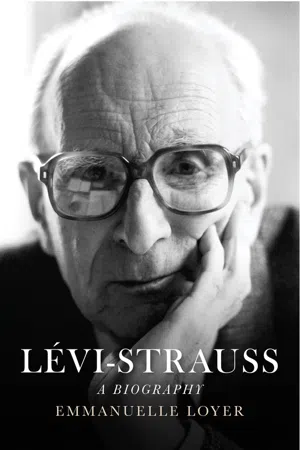
eBook - ePub
Lévi-Strauss
A Biography
- English
- ePUB (mobile friendly)
- Available on iOS & Android
eBook - ePub
Lévi-Strauss
A Biography
About this book
Information
Part I
Yesterday’s Worlds (…–1935)
1
The Name of the Father
But so long as a great name is not extinct it keeps in the full light of day those men and women who bear it; and there can be no doubt that, to a certain extent, the interest which the illustriousness of these families gave them in my eyes lay in the fact that one can, starting from to-day, follow their ascending course, step by step, to a point far beyond the fourteenth century, recover the diaries and correspondence of all the forebears of M. de Charlus, of the Prince d’Agrigente, of the Princesse de Parme, in a past in which an impenetrable night would cloak the origins of a middle-class family, and in which we make out, in the luminous backward projection of a name, the origin and persistence of certain nervous characteristics, certain vices, the disorders of one or another Guermantes.Marcel Proust1
Yesterday’s world: that combination of narratives, memories, images, smells, dreams, aversions, fears, postures of body and mind, and ways of being and thinking that are inherited, along with our name, on the day of our birth. A kind of backcountry, whether luminous or obscure, a ground that might be nurturing or barren, made of family legends sifted through social memory and national history, from which we may later feel the urge to extricate ourselves, but which, in the meantime, makes up the stuff of intimacy itself.
Indeed, the story of Claude Lévi-Strauss, born in Brussels on 28 November 1908, does not begin there. Just as he expressed feelings of nostalgia for times he had not known, he was, like all of us, replete with a history that he had not himself lived, but that he nonetheless incorporated. A history that was passed on to him in the form of a compound name, designed to articulate a social and individual destiny – a yesterday’s world of Alsatian Jewish inflection, illuminated by the success of one family member in particular: Isaac Strauss, Claude’s great-grandfather, whose name Claude’s father appropriated, adding it to his own, Lévi, to produce this cypher of a name. A Jewish name, an old-line French Jewish name to be precise, which carried within it a strong sense of the lineage’s artistic calling. An unstable name as well, recently compounded, whose patronymic fragility maps the vicissitudes of modern French Jewry. A name that had to be claimed, both literally and figuratively. Tracing a few of its historical twists will serve to delineate the powerful logic of this name, through the ups and downs of life, its legends and its silences.
A halo around the name
‘With a name like yours!’
It was September 1940, following the French defeat and military demobilization at Montpellier. Claude Lévi-Strauss, then a teacher of philosophy, had been appointed to the prestigious Lycée Henri IV in Paris to begin teaching in the autumn of that year. Confined to the Free Zone in southern France, he went to Vichy to request authorization to return to the capital to take up his post: ‘The Ministry’s headquarters had been established in a municipal school, and the office in charge of secondary education was being housed in a classroom. The official in charge looked at me, dumbfounded: “With a name like yours”, he said to me, “you want to go to Paris? You’re not serious, are you?” It was only at that moment that I began to understand.’2 The moment of realization, as was often the case with Lévi-Strauss, was simultaneously a moment of indecision and a decisive turning point – a biographical turning point (as for thousands of French Jews), but also an intellectual turning point, one that shook him out of a kind of historical naivety and into an awareness of the stigma that his name now bore. A dangerous name under the new conditions of occupied France. A name that, like all names, was classified and indexed, but that also, in a context of police identification, betrayed its bearer. There is a historical irony in the fact that his new perception of his name, revealed to him by the civil servant’s astonishment, occurred in Vichy – the town of former family glory, where in 1861, his great-grandfather, Isaac Strauss, had hosted Emperor Napoleon III himself in the Strauss family villa, but now also the town that served as the administrative capital of the Vichy government.
Less than a year later, Claude Lévi-Strauss left France to go into exile in the United States. In New York, he was welcomed by the new institution where he was to teach for the next few years, but which nonetheless strongly encouraged him to change his name to ‘Claude L. Strauss’. Why? ‘The students would find it funny’,3 was the answer he was given, because of the brand of jeans! Such were the misfortunes of the name, the fragile traces of historical and biographical adventures, sometimes tragic, sometimes ridiculous, but never without significance. The name – its connotations, its homonymic potential – could lead one to the concentration camps of a Europe at war or, less tragically, to misunderstandings that strained the self-esteem of a budding young intellectual. ‘Lévi-Strauss, the pants or the books?’ became a recurring refrain during his time in postwar America.4
It seems plausible to imagine that this experience of onomastic stigmatization and mutilation was what made Claude Lévi-Strauss particularly sensitive to the issue, or rather to the problem, of names. In chapter 6 of The Savage Mind, he explores the attribution of proper names as the highest level of individuation. Contrary to certain anthropologists who considered them to be insignificant, a mere residue of intelligibility, the Lévi-Strauss theory posited that proper names were meaningful. Whether intended as a clear mark of identification – confirming an individual’s belonging to such and such a social group, clan or caste – or freely created by the one who names, in both cases to name is always to classify (either others or oneself) and is thus always meaningful.5 Consider the name one chooses for one’s dog, for example: ‘I may regard myself as free to name my dog according to my tastes. But if I select “Médor” I shall be classed as commonplace; if I select “Monsieur” or “Lucien”, as eccentric or provocative; and if I select “Pelléas”, as an aesthete.’6 Thus, in the contemporary field of anthropology, Lévi-Strauss built a theory in which the dynamic of classification is operative down to the most elementary level, that of the individual who bears a name that is his own.
‘Claude Lévi, aka Lévi-Strauss’
The anthropological stakes of a name thus always involve the assignation of a place in the world’s taxonomic structure. The logic of naming may also give rise to affirmative reappropriations, for instance through name changes, which the civil register in post-revolutionary France made possible, if always with extremely tight constraints. In France, ‘to officially change names is no easy task’.7 It requires patience and strong motivation. The law of Germinal 11, year XI (1803) created the possibility for a special dispensation from the principle of the immutable character of names, but the final decision was up to an ‘administrative court and constitutes a pure privilege that the court is always at liberty to refuse at its discretion’.8 Furthermore, the procedure was a protracted one: adult individuals applying for a name change must first publish (at their own expense) a notice in the Journal officiel summarizing their application, then file a request with the ministry of justice detailing their motives for giving up their original name and adopting a new one, submitting a sworn affidavit, the birth certificates of their ancestors, and proof of their own identity and nationality. It was this lengthy process that Claude Lévi-Strauss chose to undertake, as attested by his personal archives.
The whole affair is rather intriguing and little known.9 In the 1950s, the French administration refused to officially recognize the name ‘Claude Lévi-Strauss’, as the anthropologist was already commonly known, but which had in fact never been made official, with the addition of the name ‘Strauss’ to that of ‘Lévi’, his father’s official name. The permissiveness of earlier years regarding surnames was no longer the case, and the compound name, which was considered a pseudonym in the eyes of officialdom, was no longer accepted. Many administrative headaches ensued, exacerbated by the birth of a second son, Matthieu, in 1957. Thus, on 24 October 1960, at the behest of his wife Monique, and with the help of a lawyer, Suzanne Blum, ‘Gustave Claude Lévi, aka Lévi-Strauss, professor at the Collège de France’ officially deposited his request with the Keeper of the Seals – in his own name and in that of his children, Laurent Jacquemin, born in New York on 16 March 1947 (and registered at the French consulate under the name of Lévi-Strauss), and Matthieu Raymond, born in Paris on 25 August 1957 (and registered under the name of Lévi) – to add to his given surname that of ‘Strauss’.
Three arguments were put forward: first of all, his father, born in Paris in 1881, had consistently gone by the name of Lévi-Strauss, as shown in the many portraits signed in his own hand, which had become the property of Tristan Bernard, Victor Marguerite and Louis Jouvet, among others, as well as official papers attesting to his membership in professional organ...
Table of contents
- Cover
- Copyright
- Dedication
- Acknowledgements
- Introduction: The Worlds of Claude Lévi-Strauss
- Part I: Yesterday’s Worlds ( –1935)
- Part II: New Worlds (1935–1947)
- Part III: The Old World (1947–1971)
- Part IV: The World (1971–2009)
- Works by Lévi-Strauss
- Archives Consulted
- Abbreviations of Works by Lévi-Strauss
- Index
- End User License Agreement
Trusted by 375,005 students
Access to over 1.5 million titles for a fair monthly price.
Study more efficiently using our study tools.
Frequently asked questions
Yes, you can cancel anytime from the Subscription tab in your account settings on the Perlego website. Your subscription will stay active until the end of your current billing period. Learn how to cancel your subscription
No, books cannot be downloaded as external files, such as PDFs, for use outside of Perlego. However, you can download books within the Perlego app for offline reading on mobile or tablet. Learn how to download books offline
Perlego offers two plans: Essential and Complete
- Essential is ideal for learners and professionals who enjoy exploring a wide range of subjects. Access the Essential Library with 800,000+ trusted titles and best-sellers across business, personal growth, and the humanities. Includes unlimited reading time and Standard Read Aloud voice.
- Complete: Perfect for advanced learners and researchers needing full, unrestricted access. Unlock 1.5M+ books across hundreds of subjects, including academic and specialized titles. The Complete Plan also includes advanced features like Premium Read Aloud and Research Assistant.
We are an online textbook subscription service, where you can get access to an entire online library for less than the price of a single book per month. With over 1.5 million books across 990+ topics, we’ve got you covered! Learn about our mission
Look out for the read-aloud symbol on your next book to see if you can listen to it. The read-aloud tool reads text aloud for you, highlighting the text as it is being read. You can pause it, speed it up and slow it down. Learn more about Read Aloud
Yes! You can use the Perlego app on both iOS and Android devices to read anytime, anywhere — even offline. Perfect for commutes or when you’re on the go.
Please note we cannot support devices running on iOS 13 and Android 7 or earlier. Learn more about using the app
Please note we cannot support devices running on iOS 13 and Android 7 or earlier. Learn more about using the app
Yes, you can access Lévi-Strauss by Emmanuelle Loyer, Ninon Vinsonneau, Jonathan Magidoff, Ninon Vinsonneau,Jonathan Magidoff in PDF and/or ePUB format, as well as other popular books in Social Sciences & Cultural & Social Anthropology. We have over 1.5 million books available in our catalogue for you to explore.