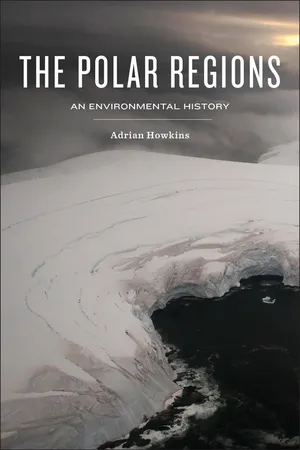
The environmental histories of the Arctic and Antarctica are characterised by contrast and contradiction. These are places that have witnessed some of the worst environmental degradation in recent history. But they are also the locations of some of the most farsighted measures of environmental protection. They are places where people have sought to conquer nature through exploration and economic development, but in many ways they remain wild and untamed. They are the coldest places on Earth, yet have come to occupy an important role in the science and politics of global warming.
Despite being located at opposite ends of the planet and being significantly different in many ways, Adrian Howkins argues that the environmental histories of the Arctic and Antarctica share much in common and have often been closely connected. This book also argues that the Polar Regions are strongly linked to the rest of the world, both through physical processes and through intellectual and political themes. As places of inherent contradiction, the Polar Regions have much to contribute to the way we think about environmental history and the environment more generally.
Few things differentiate the Arctic from Antarctica more than the scale and chronological scope of their early human histories. By the year 1800, people had been living, traveling, and hunting north of the Arctic Circle for thousands of years. Only some islands, inland regions, and the extreme far north had no human populations. In contrast, the first recorded sightings of Antarctica did not take place until 1820; the size and hostility of the Southern Ocean barred the presence of people. It would not be until the middle of the twentieth century that the first permanently occupied settlements would be built on the Antarctic continent. While large parts of the Arctic therefore have a history of human occupation stretching into the deep past, at the turn of the nineteenth century the Antarctic continent remained completely unseen and unknown. A case could be made that prior to 1800, everything in Antarctica was myth while the Arctic already had a long human history.
In contemporary western culture, the word “myth” is often used to imply something that is not true while the word “history” is usually assumed to have some relationship to what actually happened. While such a distinction has been widely challenged and would not be recognized by many cultures around the world, it is a dichotomy that retains much of its power, at least in the west. Rather than suggesting a stark distinction between Arctic history and Antarctic myth, a study of the two Polar Regions up to 1800 reveals myth and history to be much more fluid than is often believed. In many parts of the Arctic, the elaborate myths that are told about a place are fundamental to the way people make sense of their environment. It makes little sense in this context to ask what is true and what is not, since myths are a fundamental part of the history. In Antarctica speculation about the existence of a southern continent existed long before the first recorded sighting, and this speculation has become part of the history. In particular, very few books on the history of Antarctica begin without some reference to the classical geographies of Aristotle and Ptolemy that hypothesized the existence of a southern continent.1
Myths and histories are seldom politically neutral, and the way we perceive the distant past shapes the recent past and the present. By telling stories about Greek and Roman speculation, for example, Europeans have created for themselves a longstanding connection with Antarctica that goes back more than ten times further than the continent’s known existence. In the twentieth century, such a historical connection proved politically useful for the European countries that sought to assert their ownership of the southern continent. In both north and south, in the triumphalist stories of Enlightenment explorers such as Captain Cook, the act of exploration is presented as the replacing of the unknown with the known, myth with history. Over time, however, the historical deeds of these explorers often become myths in their own right through frequent retelling and embellishment.2 In the Arctic, European colonialism often began with the appropriation of indigenous myths. Colonial anthropologists such as Knud Rasmussen sought to rationalize and make sense of Arctic belief systems, rather than taking them purely on their own terms. Colonial powers sought to replace indigenous myths with supposed Christian and scientific truths, thereby creating disconnects with place and the environment and facilitating land removal and political control. Historical resistance to such a process has often focused not on direct competition, but on the perpetuation and valorization of the myths that connect people to the land.
The blurring of myth and history has important implications for the field of environmental history. It highlights the importance of perception in human interaction with the natural world. In seeking to understand the role of the environment in human history, environmental historians have tended to privilege the place of scientific understanding over other ways of making sense of the natural world. Modern scientific understanding of climate change and ice ages, for example, are used to explain how people first arrived in Arctic North America. While there is certainly nothing wrong with this approach, it is important to acknowledge that it is neither fully objective, nor politically neutral. Although tremendously powerful, science offers just one way among many of making sense of the natural world. The early human history of the Polar Regions offers a useful reminder that history—including the history of science—can become myth as easily as myth can become history. This in turn calls for a degree of humility in the way we go about seeking to understand the past.
One of the recurring themes associated with attempts to integrate human history with an understanding of the natural world is the idea of environmental determinism.3 In this reading, the environment becomes the all-powerful determinant of what happens in human history. The history of Norse settlers in Greenland offers one of the most debated case studies of environmentally induced “collapse.”4 On the one hand, there is much that is compelling in placing such a heavy emphasis on the role of the environment: it would seem to make sense, for example, that as the climate cooled in the fourteenth century life got a lot harder for the communities living in southern Greenland. On the other hand, an overemphasis on the causal power of the environment can obscure the complex interplay among environmental perceptions, human actions, and the material environment. In the case of Greenland, a careful examination suggests that multiple factors played into the abandonment of the settlement. Environmental determinism can remove human agency from history, often with racial and colonial undertones. Emphasizing the role played by human perceptions through myths and histories sets up a more dynamic, and arguably much more interesting, approach to the environmental histories of the Arctic and Antarctica.
Inuit Creation Myths
Early in the twentieth century an Iglulik Inuit named Ivaluardjuk living in the far north of Canada told a story about the creation of the world:
During the first period after the creation of the earth, all was darkness. Among the earliest living beings were the raven and the fox. One day they met, and fell into talk, as follows: “Let us keep the dark and be without daylight,” said the fox. But the raven answered: “May the light come and daylight alternate with the dark of night.” The raven kept on shrieking:
… And at the raven’s cry light came, and day began to alternate with light.5
In this particular story, light came from darkness, not as the result of some elemental struggle between good and evil, or at the will of some omnipotent god, but as a consequence of an altercation between a fox and a raven. Besides its obvious anthropomorphism, the story is perhaps most notable for its somewhat mundane quality: in Ivaluardjuk’s telling, there is nothing particularly spectacular about the creation of the world and the origins of darkness and light.6
The Arctic environment had a bearing on how stories such as Ivaluardjuk’s were told. During the active months of summer there were fewer opportunities for community storytelling with people scattered in different directions.7 But during the darkness of the polar night there was plenty of time for such entertainment. Many of the elaborate oral cultures of the Inuit developed sitting around blubber lanterns in iglu, typically built of rocks, earth, and driftwood. Despite people’s intimate familiarity with winter darkness and the several attractions of this time of year, the polar night could be a deeply depressing time.8 People were cut off from the vitamin-enhancing rays of the sun and deprived of many of the activities of summer. In these conditions, the telling of stories was crucial to people’s ability to get through the winter. They also created community through the sharing of common values. As a consequence of the important role played by oral culture, storytellers occupied an important place in the community, and were often associated with shamanism.
At the same time as the Arctic environment shaped the way stories were told, the stories themselves were filled with descriptions of the natural environment and explanations for how it came to be. Cold, snow, and ice fill the stories, and Arctic animals populate the landscape. In th...
6. Exploitation and Preservation: Environmental Conflict
Conclusion: Geographies of Despair and Hope
Bibliography
Index
End User License Agreement
Trusted by 375,005 students
Access to over 1.5 million titles for a fair monthly price.
Study more efficiently using our study tools.
Frequently asked questions
Yes, you can cancel anytime from the Subscription tab in your account settings on the Perlego website. Your subscription will stay active until the end of your current billing period. Learn how to cancel your subscription
No, books cannot be downloaded as external files, such as PDFs, for use outside of Perlego. However, you can download books within the Perlego app for offline reading on mobile or tablet. Learn how to download books offline
We are an online textbook subscription service, where you can get access to an entire online library for less than the price of a single book per month. With over 1.5 million books across 990+ topics, we’ve got you covered! Learn about our mission
Look out for the read-aloud symbol on your next book to see if you can listen to it. The read-aloud tool reads text aloud for you, highlighting the text as it is being read. You can pause it, speed it up and slow it down. Learn more about Read Aloud
Yes! You can use the Perlego app on both iOS and Android devices to read anytime, anywhere — even offline. Perfect for commutes or when you’re on the go. Please note we cannot support devices running on iOS 13 and Android 7 or earlier. Learn more about using the app
Yes, you can access The Polar Regions by Adrian Howkins in PDF and/or ePUB format, as well as other popular books in History & World History. We have over 1.5 million books available in our catalogue for you to explore.