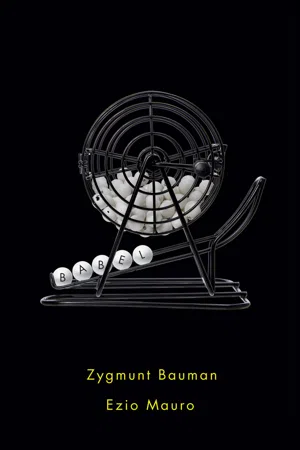
We are living in an open sea, caught up in a continuous wave, with no fixed point and no instrument to measure distance and the direction of travel. Nothing appears to be in its place any more, and a great deal appears to have no place at all. The principles that have given substance to the democratic ethos, the system of rules that has guided the relationships of authority and the ways in which they are legitimized, the shared values and their hierarchy, our behaviour and our life styles, must be radically revised because they no longer seem suited to our experience and understanding of a world in flux, a world that has become both increasingly interconnected and prone to severe and persistent crises.
We are living in the interregnum between what is no longer and what is not yet. None of the political movements that helped undermine the old world are ready to inherit it, and there is no new ideology, no consistent vision, promising to give shape to new institutions for the new world. It is like the Babylon referred to by Borges, the country of randomness and uncertainty in which 'no decision is final; all branch into others'. Out of the world that had promised us modernity, what Jean Paul Sartre had summarized with sublime formula 'le choix que je suis' ('the choice that I am'), we inhabit that flattened, mobile and dematerialized space, where as never before the principle of the heterogenesis of purposes is sovereign.
This is Babel.
eBook - ePub
Babel
About this book
Information
1
Inside a dematerialized space
Ezio Mauro Like an invading army in a sleeping kingdom, the crisis, with astonishing ease, marches over the entire material, institutional and intellectual system of democratic structures that the West has raised in the wake of the war: governments, parliaments, intermediary bodies, social subjects, antagonisms, the welfare state, parties, and national, international and continental movements – that is to say, everything that we set up to develop and perfect the machinery of democracy in order to protect ourselves in our life together.
We now know that such machinery cannot protect us on its own, that the crisis penetrates and deforms it as it marches on, emptying it out. In fact, we are discovering that swearing by the forms and institutions of democracy does not protect us: it is not enough. Democracy is not self-sufficient.
We cannot help but wonder, then, to what point the current crisis will take the changes that it has brought about. This crisis is economic and financial, if we look at what triggered it. But it is also political, institutional and, therefore, cultural, if we assess its everyday impact, which can be summed up as follows: democratic government is unstable because everything is out of control.
We all knew right from the start that this would not be a mere blip but a deep transformation, and that the changes that originated in the sphere of financial economy first, then of industry and employment, would soon turn into social and political dynamics whose consequences would affect capitalism and systemic governance as we know them, society’s forms of spontaneous organization – in other words, democracy itself.
But what strikes me today is something else, something to which I would like to draw your attention. I shall call it the autonomy of the crisis. Let us take a look at it. The crisis is indifferent to the democratic process, it moves under its shadow-line, so to speak, taking advantage of its weaknesses and exaggerating them.
We must therefore acknowledge the fact that the crisis is a force, but one lacking any thinking. This does not mean, of course, that there are no causes, interests, blames and responsibilities in its origin and development, and that there are not those who still reap its benefits to this day. But, as with the wrecking ball that destroys everything at the end of Fellini’s Orchestra Rehearsal, so it is with the crisis: it is a force that asserts its autonomy without any perceivable theory of itself and its action, without a project, but with a force of action whose consequences are painfully visible.
For this reason, I keep wondering whether my country – and in all likelihood yours too – whether this great Country that is Europe, is able, today, to think itself (if, by ‘thinking itself’, we mean here reflecting together upon its future, mindful of the past and scanning the horizons in search of some prospect, now that every great Hope has set). As if now, without the ideologies that we have luckily buried behind us, we were no longer able to look together into our hearts and out to what lies ahead. As soon as everything that helped us create this ‘together’ collapsed – the parties, the great political culture, the modes of expression – the room for thought and discussion suddenly shrank and the current public discourse atrophied. Perhaps we are no longer capable of forming a public opinion, even though we peddle freely in private opinions reduced to pills and pelted around the globe with thousands of daily tweets, and even though we are deep in a sea of comments and shards of judgement spun into jokes, puns, invectives, aphorisms.
You have witnessed the meltdown of everything that was meant to give shape and substance to a solid, wellorganized thought that builds up and develops through debate. You gave a name to this phenomenon. Now we have to ask the ultimate, radical question: we must ask whether even the very thought that thinks the liquid world will end up melting. And then we will have to wonder how we will be able to live under the threat of unremitting waves, with no fixed points or instruments to gauge the weight and distance of things, completely alone on the open sea. Because if democracy is under attack – since this is the issue at stake today – we must wonder whether it is still capable of thinking itself, whether it is still capable of re-thinking itself, so as to re-imagine and recover the power to actually govern.
Zygmunt Bauman You hit the bull’s-eye when pointing out that the present crisis, affecting all aspects of our condition, cuts deep into ‘everything that we set up to develop and perfect the machinery of democracy in order to protect ourselves in our life together’. Indeed, it does. Suddenly, we all feel vulnerable – singly, severally and all together: as a nation, or indeed as the human species. But, as Thomas Paine warned our ancestors in Common Sense (1776), one of the most seminal documents of the modern era:
when we suffer, or are exposed to the same miseries by a government, which we might expect in a country without government, our calamity is heightened by reflecting that we furnish the means by which we suffer. Government, like dress, is the badge of lost innocence; the palaces of kings are built on the ruins of the bowers of paradise. For were the impulses of conscience clear, uniform, and irresistibly obeyed, man would need no other lawgiver; but that not being the case, he finds it necessary to surrender up a part of his property to furnish means for the protection of the rest; and this he is induced to do by the same prudence which in every other case advises him out of two evils to choose the least. Wherefore, security being the true design and end of government, it unanswerably follows that whatever form thereof appears most likely to ensure it to us, with the least experience and greatest benefit, is preferable to all others.1
The words above were scribbled down by Paine more than a century after Thomas Hobbes – in his Leviathan, another founding document of modernity – proclaimed the assurance and provision of security to be the prime reason, paramount task and inalienable obligation of the state – and hence its raison d’être. We can’t live without governments properly armed with the means of coercion, Hobbes suggested, because in the absence of such governments people would be afflicted with ‘continual fear’; the life of man would then be ‘solitary, poor, nasty, brutish, and short’.2 The purpose of having a government is to be safe. As Sigmund Freud observed, for the sake of greater security we tend to be willing to sacrifice and forfeit a good deal of another value we cherish – that of freedom. Though, as these two values are in practice not fully reconcilable (for every addition to security one must pay with a part of freedom – and vice versa!), human life is doomed to remain a resented but unavoidable compromise between forever incomplete security and forever incomplete freedom. It lies therefore in the nature of that compromise that it can’t be fully satisfactory; any specific settlement tempts both sides to try to negotiate or impose a different balance of gains and losses. We move, pendulum-style, from yearning for more freedom to yearning for more security. But we cannot get both of them in sufficient quantity. As English folk wisdom sadly concludes, ‘you can’t have your cake and eat it too’. As Paine warned us, we are now ‘exposed to the same miseries by a government, which we might expect in a country without government’. That harrowing misery from which we trusted governments to relieve us but that haunts us nowadays on governments’ initiative, with governments’ active assistance or resigned indifference, is in the nutshell the sense of existential insecurity. As you rightly emphasize, it is by the democratic system as such, that dense network of institutions which our fathers ingeniously designed and laboriously had woven, that a growing number of their successors and our contemporaries feel betrayed and disappointed.
The most gruesome manifestation of that frustration is the distance growing between those who vote and those who are put in power through their vote. Less and less do voters trust the promises made by the people whom they are electing to govern; bitterly disavowed by the broken promises of old, voters hardly expect that this time the promises are likely to be fulfilled. More and more often, voters just go through the motions – guided more by their learned habits than by hopes of a change for the better that their voting will bring. At best, they go to the ballot boxes to choose the lesser between evils. For a large majority of citizens, a prospect of turning the course of events in the right direction – a possibility that used, in the past, to make democracy so attractive and active participation in democratic procedures so desirable – is now seldom, if ever, believed to be on the cards and within reach. As J. M. Coetzee noted in his Diary of a Bad Year:
Faced with a choice between A and B, given the kind of A and the kind of B who usually make it onto the ballot paper, most people, ordinary people, are in their hearts inclined to choose neither. But that is only an inclination, and the state does not deal in inclinations. [. . .] The state shakes its head. You have to choose, says the state: A or B.3
We witness these days that traditional choice between ‘placid servitude on the one hand and revolt against servitude on the other’ falling into disuse, and failing to grasp the present-day attitude taken by most of the electorate towards those whom they elect to govern: a third attitude is fast growing in popularity and is by now ‘chosen by thousands of millions of people every day’ – a stance described by Coetzee as marked by ‘quietism, willed obscurity, or inner emigration’. A breakdown of communication between the political elite and the rest?
Let us bear in mind José Saramago’s Seeing,4 that brilliantly insightful 2004 allegory, or rather premonitory intimation – written ten years ago – of where the present gradual though persistent falling of democracy’s integrative powers may eventually lead us.
EM You use a word that may well define the whole phase we are living in currently, which will last who knows how long. ‘Vulnerable’: we the lost individuals are indeed vulnerable, and so is the weakened social structure, and ultimately democracy itself, which is exhausted. This is not merely a political concept but one that is material, physical and psychological at the same time. It shows us how deeply the crisis delves, touching us in the flesh and in the spirit, which our societies have rendered so fragile. And you are right to extend the notion of the crisis, because the economic–financial disorder has been able to spread out of all proportion only insofar as it has found the gates of our democracy already flung wide open and off their hinges, and it was thus able to infiltrate easily the weak spots in the democratic machinery, like rust. The short circuit is clear: perceiving one’s vulnerability triggers fear, but if the duty of governments is first and foremost to guarantee security, then the governments become the main suspects in the face of this new, spreading insecurity. In fact, politics ends up being the champion of a world that does not work – its overturned totem.
There is even method in it. The exchange you refer to, which has characterized modernity (I, the citizen, sacrifice quotas of my freedom; you, the state, give me increasing quotas of security, which to me are more valuable) – well, that exchange has stopped. The state has no interest in my quotas because the Stock Market of power does its fixing elsewhere, in the impersonal spaces of financial flows. Most importantly, public power has no certainties and safeguards to offer or trade in, and at any rate it can hardly guarantee what it sells, because government is deteriorating and everything is now out of control.
Originally, however, we had handed over the monopoly of force to the state precisely so that it might defend us as individuals and as a group; we had built, through the free play of politics, a common way to legitimize the political–juridical power and the roles that derive from it. But if that mechanism stops, then the state gives in to the crisis, finance turns out to be an independent variable, labour becomes unstable goods and not a means of setting oneself in relation to others, globalization blows the arena of the crisis out of all proportion, and eventually the role of the citizen and the bonds of mutual dependence that link individuals to public power end up collapsing too.
You identify the breaking point with the widening gap between electors and elected – that is to say, with the evident crisis of representation. People do not vote any more, or they do it with indifference, without passion or at least without much conviction; they do not believe in the right to vote as the most effective way to reward and punish, and to choose. It is true that the problems of representation are ancient and cyclical. Walter Lippmann wrote as early as 1925 that ‘the private citizen today has come to feel rather like a deaf spectator in the back row, who ought to keep his mind on the mystery off there, but cannot quite manage to keep awake’.5 But it is all the more true that this weary, drowsy and puzzled deafness has now paradoxically become a form of reversed politics, as if the disillusion came full circle and the rejection of politics gave shape to ‘real anti-politics’, just as there once was ‘real socialism’. Jacques Julliard phrases it thus: when the system of representation becomes a ‘bad conductor of the general will’, at a deeper level the ‘rejection of politics reveals the individual’s blind aspiration to autonomy, a sort of allergy to the notion of government itself’.6
But now, right now, we are one step beyond: the disappointed citizen’s allergy to government confu...
Table of contents
- Cover
- Title Page
- Copyright
- Prologue
- 1 Inside a dematerialized space
- 2 Inside a changing social space
- 3 Interconnected loners
- Epilogue
- End User License Agreement
Trusted by 375,005 students
Access to over 1.5 million titles for a fair monthly price.
Study more efficiently using our study tools.
Frequently asked questions
Yes, you can cancel anytime from the Subscription tab in your account settings on the Perlego website. Your subscription will stay active until the end of your current billing period. Learn how to cancel your subscription
No, books cannot be downloaded as external files, such as PDFs, for use outside of Perlego. However, you can download books within the Perlego app for offline reading on mobile or tablet. Learn how to download books offline
Perlego offers two plans: Essential and Complete
- Essential is ideal for learners and professionals who enjoy exploring a wide range of subjects. Access the Essential Library with 800,000+ trusted titles and best-sellers across business, personal growth, and the humanities. Includes unlimited reading time and Standard Read Aloud voice.
- Complete: Perfect for advanced learners and researchers needing full, unrestricted access. Unlock 1.5M+ books across hundreds of subjects, including academic and specialized titles. The Complete Plan also includes advanced features like Premium Read Aloud and Research Assistant.
We are an online textbook subscription service, where you can get access to an entire online library for less than the price of a single book per month. With over 1.5 million books across 990+ topics, we’ve got you covered! Learn about our mission
Look out for the read-aloud symbol on your next book to see if you can listen to it. The read-aloud tool reads text aloud for you, highlighting the text as it is being read. You can pause it, speed it up and slow it down. Learn more about Read Aloud
Yes! You can use the Perlego app on both iOS and Android devices to read anytime, anywhere — even offline. Perfect for commutes or when you’re on the go.
Please note we cannot support devices running on iOS 13 and Android 7 or earlier. Learn more about using the app
Please note we cannot support devices running on iOS 13 and Android 7 or earlier. Learn more about using the app
Yes, you can access Babel by Zygmunt Bauman,Ezio Mauro in PDF and/or ePUB format, as well as other popular books in Social Sciences & Sociology. We have over 1.5 million books available in our catalogue for you to explore.