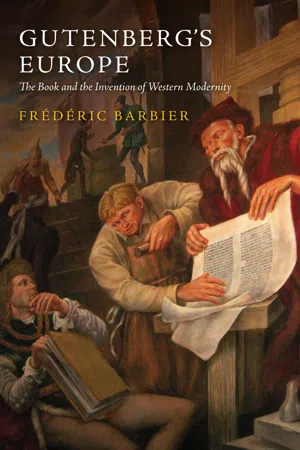
Major transformations in society are always accompanied by parallel transformations in systems of social communication – what we call the media. In this book, historian Frédéric Barbier provides an important new economic, political and social analysis of the first great 'media revolution' in the West: Gutenberg?s invention of the printing press in the mid fifteenth century. In great detail and with a wealth of historical evidence, Barbier charts the developments in manuscript culture in the twelfth and thirteenth centuries, and shows how the steadily increasing need for written documents initiated the processes of change which culminated with Gutenberg. The fifteenth century is presented as the 'age of start-ups' when investment and research into technologies that were new at the time, including the printing press, flourished.
Tracing the developments through the sixteenth century, Barbier analyses the principal features of this first media revolution: the growth of technology, the organization of the modern literary sector, the development of surveillance and censorship and the invention of the process of 'mediatization'. He offers a rich variety of examples from cities all over Europe, as well as looking at the evolution of print media in China and Korea.
This insightful re-interpretation of the Gutenberg revolution also looks beyond the specific historical context to draw connections between the advent of print in the Rhine Valley (?paper valley?) and our own modern digital revolution. It will be of great interest to students and scholars of early modern history, of literature and the media, and will appeal to anyone interested in what remains one of the greatest cultural revolutions of all time.
- English
- ePUB (mobile friendly)
- Available on iOS & Android
eBook - ePub
About this book
Part I
Gutenberg before Gutenberg

1
The Preconditions for a New Economy of the Media

Though [King Charles V] understood Latin well and there was never any need for it to be expounded to him, he was so farseeing, out of love for his successors, that he wanted to provide for them in times to come instruction and knowledge leading to all the virtues. For this purpose he had all the most notable books translated from Latin into French by the accepted masters and experts in all the sciences and arts…
Christine de Pisan
The Key Space of Modernity: The Town
Growth and tipping point
The modernity of the Middle Ages was based on the town. Though the growth of urbanization and of the innovation it encouraged assumed a major transformation in the countryside, it was also the main factor for change in the sphere of writing. The change was first socio-political: in the town, social structures, occupations and modes of representation were all renewed. The society of the early Middle Ages and the Carolingian period had been a rural society, but, beginning in the eleventh century, there was a step change; urban centres developed, which in their turn promoted innovation in every sphere, including that of the symbolic systems – and of writing. In the words of Fernand Braudel:
prompted by demographic expansion – never before had towns sprung up so thickly within such easy reach of one another. A clear distinction of functions, a ‘division of labour’ between town and countryside, sometimes brutally felt, became the norm. The towns took over industrial activity, became the motors of accumulation and growth, and re-invented money.1
Table 1.1 Large towns in the Middle Ages

The geographical distribution of towns shifted westwards, whereas only the great Mediterranean civilizations, Byzantium and the Arabo-Muslim world, had previously been represented. Of the earliest European metropolises (more than 50,000 inhabitants), all, at the beginning of the thirteenth century, had still belonged to the Byzantine or Islamic worlds (Baghdad, Cairo, Constantinople), but the balance gradually shifted, first in favour of the Italian peninsula, then of other regions. By the middle of the fourteenth century, the list includes four Italian towns (Venice, Genoa, Milan and Florence), later to be joined by Naples. Around 1350, and in spite of the Black Death, it was the turn of North-western Europe, with Paris (80,000 inhabitants) and Ghent (60,000 inhabitants). The end of the fifteenth century was marked by the disappearance of independent Burgundy (and the decline of Ghent), but also by the increasing importance of the Iberian Peninsula: Valencia and Lisbon joined the list.
Table 1.2 Urban population and rate of urbanization in Europe, 1300–1500
| Dates | Urban population | Rate of urbanization (%) |
|---|---|---|
| 1300 | 7750 million | 10.3 |
| 1400 | 7560 million | 13.6 |
| 1500 | 8390 million | 11.2 |
Source: Paul Bairoch, Jean Batou and Pierre Chèvre, La Population des villes européennes, 800–1850: banque des données et analyse sommaire des résultats 800–1850: The Population of European Cities: Data Bank and Short Summary of Results 800–1850 (Geneva, 1988, p. 225).
The shift was even more marked at the level of large towns (between 20,000 and 50,000 inhabitants). The pre-eminence of Italy, though still real, was lessened to the benefit of other areas, in particular, around 1500, the Iberian Peninsula – with Granada (the last Muslim capital in Europe, which passed into Christian hands in 1492), Seville, Toledo and Barcelona – and the Low Countries and North-western Europe (with Antwerp, Bruges, Brussels, Ghent, Lille, Cologne and London). Other towns had already almost reached this size, including Medina Del Campo, Valladolid and Zaragoza. In short, between the end of the twelfth century and the end of the fifteenth, the dynamic of urbanization shifted, initially to the advantage of Italy alone, then of Western Europe, by contrast with Byzantium and Islam.2 For innovation, this was a decisive factor.
Models of urban success
Let us set aside the political dimension, and the distinction between communes, bonnes villes, ‘residence towns’ (Residenzstadt), etc. The distinguishing feature of urban society was the specialization of the crafts, by contrast with a rural economy characterized by the self-sufficiency of the community. The town, an agglomeration of persons dependent on external sources for their food supply (Werner Sombart), was the natural site for the invention of other models of consumption, hence of life.
Max Weber proposed, speaking very generally, three successful urban models, often found in combination. The first was the town of crafts, for example Chartres, economic capital of Beauce and town of markets. Large numbers of artisans congregated in the suburbs which grew up outside its walls in the eleventh century. Innovation was concentrated on the watercourses, where leather and wool were processed, before activities later diversified. The wealth of the town was given spectacular expression in the construction of the cathedral of Notre Dame, as also in the size of its chapter (seventy-two members!), whose prebends were among the richest in France. As might be expected, these very favourable conditions had consequences for the sphere of writing, whether in the case of the bishop, the chapter or the many religious houses or of the small schools and the prestigious cathedral school itself.3
The second model, which accounted for the most spectacular success stories, was that of the trading town, in particular the town of long-distance trade. This was the case in Italy, at a time when Westerners, Italians in the vanguard, established permanent settlements in Byzantium and the great centres of the eastern Mediterranean, whose trade they dominated. In the north, the Hanseatic networks were controlled by Bruges and Lübeck, though London should not be forgotten. In the fourteenth century, Bruges was the transit centre for wool and the entrepôt for the Hanseatic towns. This period of prosperity continued under the dukes of Burgundy (from 1384), when the presence or proximity of the court encouraged the growth of intellectual and artistic activities. As well as the men of the book (copyists and calligraphers, miniaturists, booksellers and then printers), there were artists, in particular painters, most notably Van Eyck (died 1441) and Memling (died 1494).4 In the interior, it was the fair towns which were the chief hubs for the exchange, regulation and redistribution of merchandise and values, from the fairs of Champagne to the great Italian, French (Lyon), Spanish (Medina Del Campo) and German (Frankfurt on main) fairs. The lift-off of towns such as Leipzig in the fifteenth century was similarly related to their role as trading hubs, in this case connecting the Germanic and Slav worlds.
The third model was that of the princely town, home both to a more or less rich and spectacular court and to administrative services controlling a territory. In central France, in and around the Loire Valley, towns such as Nantes, Angers and even Bourges fall into this category. Let us look more carefully at this model: for the historian, understanding comes from the dialectic between different levels of analysis, from large units to the local level, the latter serving both as illustration and as opportunity for detailed scrutiny. The history of Bourges confirms the general trend, while also illustrating the transition from one model of success to another. In the Roman period, the powerful Gaulish city became capital of the province of Aquitania prima. As the Roman Empire disintegrated, a wall protected it from external attacks. Many buildings testify to the role of Bourges as a religious capital, assisted by the residence of the primate of Aquitaine. The urban renaissance of the tenth century saw the creation of parishes (St Bonnet) and ‘bourgs’ along the roads leading to the gates, which were home to a growing population which practised new crafts. The Benedictine abbey of Chezal-Benoît, founded in 1093, was a cultural centre and its rich library was completely reorganized in 1488 by Abbot Peter du Mas; it later passed in part to the Maurists.5
From the crafts to trade: a bourgeoisie of business and commerce gradually developed in Bourges, active first in wool (sheep farming in the Champagne berrichone), weaving, dyeing and trade (at the fairs). The supremacy of the town was based on its dominance over the surrounding countrys...
Table of contents
- Cover
- Table of Contents
- Dedication
- Title page
- Copyright page
- Foreword
- Abbreviations
- The Media and Change
- Part I: Gutenberg before Gutenberg
- Part II: The Age of Start-ups
- Part III: The First Media Revolution
- Conclusion
- Index
- End User License Agreement
Trusted by 375,005 students
Access to over 1.5 million titles for a fair monthly price.
Study more efficiently using our study tools.
Frequently asked questions
Yes, you can cancel anytime from the Subscription tab in your account settings on the Perlego website. Your subscription will stay active until the end of your current billing period. Learn how to cancel your subscription
No, books cannot be downloaded as external files, such as PDFs, for use outside of Perlego. However, you can download books within the Perlego app for offline reading on mobile or tablet. Learn how to download books offline
Perlego offers two plans: Essential and Complete
- Essential is ideal for learners and professionals who enjoy exploring a wide range of subjects. Access the Essential Library with 800,000+ trusted titles and best-sellers across business, personal growth, and the humanities. Includes unlimited reading time and Standard Read Aloud voice.
- Complete: Perfect for advanced learners and researchers needing full, unrestricted access. Unlock 1.5M+ books across hundreds of subjects, including academic and specialized titles. The Complete Plan also includes advanced features like Premium Read Aloud and Research Assistant.
We are an online textbook subscription service, where you can get access to an entire online library for less than the price of a single book per month. With over 1.5 million books across 990+ topics, we’ve got you covered! Learn about our mission
Look out for the read-aloud symbol on your next book to see if you can listen to it. The read-aloud tool reads text aloud for you, highlighting the text as it is being read. You can pause it, speed it up and slow it down. Learn more about Read Aloud
Yes! You can use the Perlego app on both iOS and Android devices to read anytime, anywhere — even offline. Perfect for commutes or when you’re on the go.
Please note we cannot support devices running on iOS 13 and Android 7 or earlier. Learn more about using the app
Please note we cannot support devices running on iOS 13 and Android 7 or earlier. Learn more about using the app
Yes, you can access Gutenberg's Europe by Frédéric Barbier in PDF and/or ePUB format, as well as other popular books in History & Social History. We have over 1.5 million books available in our catalogue for you to explore.