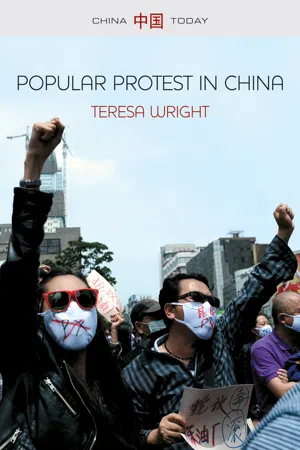
Popular protest in China has been widespread and prevalent. Why do people protest and how are such demonstrations handled by the authorities? Could they ultimately imperil China's political system?
In this book, Teresa Wright analyzes the array of protests that have swept China in the post-Mao period. Exploring popular contention through a range of different groups – from farmers to factory workers, urban homeowners to environmentalists, nationalists to dissidents, ethnic minorities to Hong Kong residents, Wright shows that – with the exception of the latter – popular protest has achieved adequate government responses to the public's most serious grievances.
Yet Wright cautions that this may not last forever. For Chinese citizens that engage in protest often suffer serious emotional and physical costs. As a result, they have developed an unhealthy relationship with the regime. In this context, Xi Jinping's recent efforts to restrict public expression may backfire – leading to an explosive dynamic that may threaten the political stability that China's ruling elites so desire.
- English
- ePUB (mobile friendly)
- Available on iOS & Android
eBook - ePub
Popular Protest in China
About this book
Information
1
Popular Protest in the Post-Mao Era
Popular protest in China has changed over the course of the post-Mao period. From the late 1970s through the late 1980s, a small number of major urban protests arose, focusing mainly on national-level political reform. As noted in the Introduction, these protests climaxed in the massive student-led demonstrations of the spring of 1989. Since 1989, mass street protests aimed at systemic political reform have been non-existent. But, popular protests have been much more frequent, and have encompassed a far wider range of citizens and geographical locations. Indeed, protest has become so common that China has been recognized as a “contentious authoritarian” state.1 Instead of viewing these protests as a threat, central political leaders seem to have accepted them as a mechanism of ensuring that popular discontent does not become focused on national-level political change.
This chapter examines how protest has changed during China's post-Mao period, particularly in terms of protest quantity, actions, and demands, and their geographic and demographic distribution. The first part of the chapter examines the early post-Mao era, which encompasses roughly 1978–89. The second part discusses how protest in China has changed since 1989. Although the number and frequency of protests have risen dramatically in comparison to the early post-Mao period, the character of protest has been far less threatening to national authorities.
Indeed, inasmuch as China's central political leaders have acted to ameliorate public grievances articulated in mass protests, popular trust in top CCP leaders has been bolstered, and the likelihood of popular support for political protest against the central government has diminished. However, as noted in the Introduction and more fully explored in the Conclusion, if current central leaders make it more difficult for Chinese citizens to effectively express their grievances, the regime may lose its ability to satisfactorily respond to those grievances, and may come to face more serious and widespread public calls for national-level political reform – particularly because sizeable swaths of the Chinese public are now accustomed to participating in collective contentious action.
Popular Protest in the Early Post-Mao Era (1976–89)
In the early post-Mao era, only a few major popular protests occurred. They arose in urban areas, and focused on national-level leaders and policies. To a large degree, they reflected the changing focus of the CCP during this time, as well as factional struggles within the highest ranks of the Party that were related to this change. Each of the major protests during this period emerged when members of the public perceived support for greater reform on the part of some top CCP leaders, and felt that there was an opening to safely prod the Party in this direction. But in each instance, after varying lengths of time, key political elites turned against the protestors, and their actions were suppressed.
The death of Mao Zedong in 1976 ushered in a new era in China. When Mao died, China was in the tenth year of the “Great Proletarian Cultural Revolution.” Though Mao ostensibly launched the Cultural Revolution to remove all vestiges of “feudalism” and “capitalism” in China and instill a pure communist culture, the campaign also punished and removed from power all CCP leaders that Mao viewed as a threat. One of them was Deng Xiaoping, who was labeled a “capitalist roader,” removed from all of his posts, and forced to do manual labor to “reform” his thoughts. The Cultural Revolution also created chaos within Chinese society, as bands of young “Red Guards” roamed freely, punishing anyone they deemed to be “revisionist” in thought or action. Universities were shut down – targeted as bastions of such activity – and city folk were “sent down” to the countryside to become imbued with communist beliefs through manual labor.
The “April 5th Incident” of 1976
The year of Mao's death was tumultuous. The Party leader that most urban residents expected and hoped would succeed Mao, the administrative and diplomatic genius Zhou Enlai, died in January 1976 – nine months prior to Mao's death in September. In 1974, Zhou had convinced Mao to bring Deng back into the Party leadership, and Deng became the Party-state's Vice-Premier. Meanwhile, Mao's wife, Jiang Qing (and her comrades-in-arms, known collectively as the “Gang of Four”) vied to take control of the Party. Evidencing public support for Zhou during the spring 1976 annual commemoration of deceased ancestors, wreaths honoring Zhou appeared in many Chinese cities, including a stack nearly forty feet high at Beijing's central Tiananmen Square. When Deng voiced his support for these actions, little lights and bottles – plays on Deng's name – appeared at the Square. Over the next five days, crowds gathered at the Square, bringing wreaths, singing songs, reciting poetry, and making speeches expressing their weariness and bitterness from their suffering during the Cultural Revolution, and welcoming a new day of stability. But, that day had not yet come. On April 4, police arrived at the Square, clearing away the protestors. The next day, angry crowds returned. They were met by thousands of police and other armed forces. Up to one hundred were killed, and up to several thousand were arrested. On April 7, Deng was stripped of all official posts and branded an “unrepentant capitalist roader.” On April 17, the official newspaper of the CCP, the People's Daily, issued a verdict on the “April 5 incident,” calling it a “counter-revolutionary” rebellion. In the following months, many thousands reportedly were arrested.2
Thus, when Mao died in September, the Party's future direction was uncertain. Temporarily, a relatively unknown and inexperienced Party cadre – Hua Guofeng – assumed the helm. Less than a month after Mao's death, Hua was able to orchestrate the arrest of his main competitors for power, the Gang of Four. In July 1977, Deng was restored to a number of high-level Party-state positions. Deng criticized the Cultural Revolution and called for a “Beijing Spring” wherein citizens could express their grievances. By late 1978, Deng had out-maneuvered Hua, and was recognized as the top leader of the Party.
With this, China's “Reform Era” was ushered in. In December 1978, the CCP's Central Committee laid out a new reform program that emphasized economic modernization, acknowledged the importance of free enterprise, and promised to strengthen democracy and law. The general theme was pragmatism over ideological correctness. Former Party leaders that had been purged during the Cultural Revolution were brought back into positions of power, and an estimated 10,000 political prisoners were freed and cleared of any wrongdoing.3 The official verdict on the “April 5 incident” was reversed, labeling those who had been jailed as heroes. China's universities were re-opened and tasked with training young people to spur China's economic and technological modernization.4
The Democracy Wall Movement (1978–80)
Shortly after Mao's death, and increasingly through 1977 and 1978, people began to publicly post personal appeals related to wrongs they suffered during the Cultural Revolution. In addition to gathering at Tiananmen Square, they affixed “big character” posters on a wall near the Square that became known as “Democracy Wall.” When the official verdict on the “April 5” incident was reversed, hundreds of citizens gathered at the wall. In the days that followed, the crowds grew, both there and at Tiananmen Square. People from out of town flowed to Beijing and other major cities to express their grievances.
Most of the participants were relatively young. They included factory workers, students, and junior political officials that had suffered during the Cultural Revolution. Most sought various forms of redress for the many hardships that they had endured. But others moved beyond individual grievances, voicing broader political concerns. These individuals tended to be more educated, and seemed to have connections within the now-pragmatically-focused CCP leadership. Along with putting up “big character” posters promoting ideals such as democracy, science, political reform, and economic modernization, they produced mimeographed “people's periodicals” that they posted on Democracy Wall and even sold. At their peak, there were 55 such periodicals in Beijing, and at least 127 in nearly 30 other cities. Most of the periodicals’ editors saw themselves as reformers rather than rebels, voicing support for the pragmatic reforms promoted by Deng. However, a small number took their political criticisms a step further. Most prominently, in late 1978 Wei Jingsheng's periodical, Explorations, called for democracy, and criticized Deng by name.
Initially, central authorities – including Deng – responded favorably to these activities. But official reactions changed as the number of petitioners and cities involved grew; the demands of the periodicals became more critical of the Party; and Deng became more firmly entrenched as the Party's top leader. Most importantly, Deng – the most powerful leader in the Party – turned against the movement. In late January 1979, a leader of the petitioners’ movement in Beijing was arrested. In February, petitioners and protestors in Shanghai staged a 12-hour sit-in on the tracks of the Shanghai train station, disrupting long distance travel for many days. In March, Deng publicly criticized those calling for “democracy” and announced that all speech, pictures, posters, and publications must abide by the “Four Cardinal Principles” of CCP leadership, proletarian dictatorship, Marxism, and socialism. Shortly thereafter, Explorations came out with a special edition entitled, “Do We Want Democracy or a New Dictatorship?,” attacking Deng's speech. Three days later, Wei and his staff were arrested. On April 5, 1979, the People's Daily asserted that the purposes of the movement of April 1976 had been achieved, and criticized “ultra-democratization.” In October 1979, Wei was put on trial and sentenced to 15 years. In December, central authorities announced that Democracy Wall had been closed, and in January 1980, Deng struck from the state constitution the rights to the “four big freedoms” (to speak out freely, air views fully, hold great debates, and write big-character posters). This marked the end of the second major popular protest since 1976.
The Student-Led Protests of 1986–7
For five years, there were no further significant instances of popular protest. During this period, the “ideologues” of the Mao-era CCP's top leadership were no longer in power; all were now pragmatists. At the apex of Party power was Deng Xiaoping and seven other CCP elders. Among them, Deng was the most committed to expanding China's economy through marketization and opening to the global capitalist economy. Yet Deng exhibited only tenuous support for political liberalization. Within the second and third tiers of the CCP, leaders jockeyed for power and disagreed over policy. For most of the 1980s, the more pro-reform faction was led by CCP General Secretary Hu Yaobang and state Premier Zhao Ziyang, both of whom had been placed in their positions by Deng. The other major faction was led by Li Peng, who had been eschewed by Deng as the successor to Party leadership, and who believed that reform must occur slowly.
Throughout the 1980s, conflict between these two groups caused CCP policy to move fitfully and uncertainly between reform and retrenchment in the economic sphere, and opening and constriction in the political sphere. Meanwhile, the suffering and tumult of the Mao years fueled skepticism among university students regarding China's political, economic, and social status quo, and stimulated their admiration of alternative systems – particularly those found in the West.5 In the latter half of the 1980s, these factors contributed to the emergence of two more major collective contentious actions focused on national-level political reform, led by university students.
The first occurred in the winter of 1986–7. In the first half of 1986, General Secretary Hu Yaobang and other pro-reform CCP elites publicly argued that in order to proceed with China's economic modernization, further educational, political, and administrative reform was needed. Seeing this as an opportunity, students began to collectively voice their support. At the same time, they expressed a number of economic and political grievances. The protests began at the University of Science and Technology (UST) in the city of Hefei in Anhui province. The first public gatherings occurred on December 5, 1986, when UST students met to protest their inability to nominate candidates for the local People's Congress.6 Four days later, students demonstrated for three hours, and local officials agreed to postpone the election. When the election was held, UST vice-president Fang Lizhi and two students collectively garnered 50 percent of the vote. Students across the country expressed their support – demonstrating, putting up “big character” posters, and boycotting classes. Along with demanding greater participation in local political institutions, they railed against Party cadre corruption – expressing particular indignation at the gap be...
Table of contents
- Cover
- Table of Contents
- Series page
- Title page
- Copyright page
- Map
- Chronology
- Acknowledgments
- Introduction
- 1: Popular Protest in the Post-Mao Era
- 2: Rural Protest
- 3: Labor Protest
- 4: Homeowner Protest
- 5: Environmental Protest
- 6: Nationalist Protest
- 7: Political Protest
- 8: Ethnic Minority Protest
- 9: Protest in Hong Kong
- Conclusion
- Index
- End User License Agreement
Trusted by 375,005 students
Access to over 1.5 million titles for a fair monthly price.
Study more efficiently using our study tools.
Frequently asked questions
Yes, you can cancel anytime from the Subscription tab in your account settings on the Perlego website. Your subscription will stay active until the end of your current billing period. Learn how to cancel your subscription
No, books cannot be downloaded as external files, such as PDFs, for use outside of Perlego. However, you can download books within the Perlego app for offline reading on mobile or tablet. Learn how to download books offline
We are an online textbook subscription service, where you can get access to an entire online library for less than the price of a single book per month. With over 1.5 million books across 990+ topics, we’ve got you covered! Learn about our mission
Look out for the read-aloud symbol on your next book to see if you can listen to it. The read-aloud tool reads text aloud for you, highlighting the text as it is being read. You can pause it, speed it up and slow it down. Learn more about Read Aloud
Yes! You can use the Perlego app on both iOS and Android devices to read anytime, anywhere — even offline. Perfect for commutes or when you’re on the go.
Please note we cannot support devices running on iOS 13 and Android 7 or earlier. Learn more about using the app
Please note we cannot support devices running on iOS 13 and Android 7 or earlier. Learn more about using the app
Yes, you can access Popular Protest in China by Teresa Wright in PDF and/or ePUB format, as well as other popular books in Politics & International Relations & Terrorism. We have over 1.5 million books available in our catalogue for you to explore.