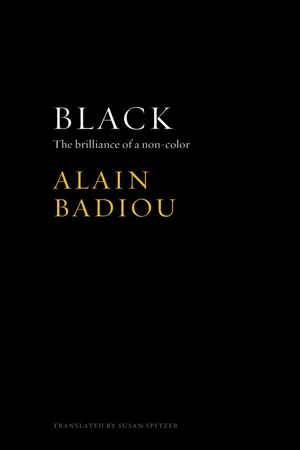
Who hasn't had the frightening experience of stumbling around in the pitch dark? Alain Badiou experienced that primitive terror when he, with his young friends, made up a game called "The Stroke of Midnight." The furtive discovery of the dark continent of sex in banned magazines, the beauty of black ink on paper, but also the mysteries of space and the grief of mourning: these are some of the things we encounter as the philosopher takes us on a trip through the private theater of his mind, at the whim of his memories. Music, painting, politics, sex, and metaphysics: all contribute to making black more luminous than it has ever been.
- English
- ePUB (mobile friendly)
- Available on iOS & Android
eBook - ePub
About this book
Information
Physics, biology, and anthropology
The metaphorical black of the Cosmos
When you exclaim “I’m lost in the dark!” it no doubt has a first meaning: there’s no light, you can’t see a thing. But just as the word “light,” and especially its plural, “lights” [i.e., the Enlightenment], came to mean, from the eighteenth century on, the triumph of science and rationalism, including revolutionary rationalism, so, too, “dark” has slipped from a purely visual connotation to a derived meaning, whose context is mental. The expression “I’m really in the dark” could then mean, for example, that you can’t see how to continue the proof of a mathematical proposition you’ve been working on for days and nights on end.
Two essential metaphors of contemporary cosmology must be attributed to a combination of the original and the derived meanings of the adjective noir: “dark matter” [matière noire] and “black hole” [trou noir].
The matter and the hole aren’t “dark” or “black” in the exact same way.
It’s the hole, for once, that possesses the fullness of meaning here. And it’s even the hole, inasmuch as it is black, that denotes the most compact fullness! Let’s take the easier case to describe: a star located near the center of the galaxy, having reached a certain stage of its evolution, implodes under the enormous attractive force of its predominantly iron core. Its outer layers disintegrate, generating a massive abyss of light, which is mistakenly called a “supernova”: it was previously believed that a new star (“nova”) was being created, but it was actually the death of the star. And its dark death, moreover, since, after a few spectacular weeks – its light can be equal to that of an entire galaxy – the star is reduced, as a result of this gravitational catastrophe, to its core alone. Inside the core, which from a cosmological perspective is minuscule, the particles are stuck to each other with no empty space at all between them. As a result, given its inconceivable density, it exerts such a tremendous attraction on everything that nothing – neither matter nor light – can escape from it. The star, in this at once shrunken and immensely powerful form, is therefore totally invisible. Even though existing, since no sign of this existence can be deduced from “what” exists, it makes a hole in all possible perception; it is a black hole in it.
But we should note: even though it’s a hole in perception, and hence in relation to the presumed activity of a star detector in a galaxy, it is in no way a hole in the real. It is instead a kind of a magic sphere or ball: everything that comes near it immediately becomes part of it. As a negligible but mercilessly agglutinate mass, the dead star lies at the border between nothingness (the hole) and super-reality (a dense, self-contained mass that treats everything passing by it as indistinguishable from itself). As usual, black – very apt here for its misnomer “hole” – symbolizes, without distinction, both lack and excess.
Dark matter, unlike the misnomer “hole,” is not the dark result of excessive light. It is certainly not the dark remnant of the implosion of a massive star, which might have lit up the immensity of the sky for a while, sometimes even in broad daylight. Instead, out of sight, it strives to fill a gap in thought. In a nutshell, if the matter of the universe were the matter that our scientific calculations measure of the “real” (everything observable or rationally deducible from observation), then galaxies, and to an even greater extent clusters of galaxies, wouldn’t rotate the way we can see that they do. For these gigantic spirals of stars and their haphazard connections to rotate the way they do, there would have to be mass. A lot of mass, enormously more of it than we are able to “see”. There would have to be at least six or seven times more!
As usual, we black out whatever we don’t know. We hypothesize that an astronomical (so to speak) quantity of “dark matter” exists. The details are far from being finalized, and theories as complex as they are contradictory compete with one another . . . But the fact remains that “dark” in this way designates what is lacking in perception so that nothing should be lacking in thought.
Thus is confirmed that the black of the Cosmosis not so much the black of night, that poetic opposite of the blue of the sky, as it is the name for what has disappeared (the black hole), the name for any possible perception as well as for everything that ought to exist (dark matter) so that there should be nothing lacking in the concept. In the end, what the black of the Cosmos connotes is less absence or death than what thought opposes to them.
One additional note: in that universal glue of empiricism, the English language, this dialectic of black is accepted only grudgingly. Lack and excess? Perception versus concept? “Shocking Platonism!”17 So English-speaking empiricists don’t say “black matter,” they say “dark matter,” hence matière sombre. “Come on,” they say, “it’s not nothingness, it’s not pure concept! It’s just matter that’s still too dimly illuminated. Someday, it will be light. And we will see.”
The secret blackness of plants
From what we can see of it, the plant world has hardly any black in it. Rather, on a stunning background where every shade of green is explored, the plant world is, for our dazzled eyes, the apotheosis of colors. All over the world, flowers are the beautiful symbol of true color, whose different shades we artfully cultivate, while we explore roses’ infinite gamut of fragrances, tulips’ erectness, cattleya orchids’ refined rarity, and chrysanthemums’18 gift to the poor dead who, “hidden in earth where they / Are warmed and have their mysteries burnt away,”19 suddenly feel much better, almost alive.
The plant world rises as, apart from it, only deserts and high mountains do, to the spatial challenge of the oceans, their measurelessness. It has become – it deserved better, perhaps, than this ambiguous pedigree – the banner of contemporary political environmentalism. In democratic assemblies everywhere now, seats are proudly held by Green Party members, who no doubt think, because of this, that they’re on intimate terms with nature’s abundance. In any case, there is no worse insult for a Green than to be called black – naturally not in the sense of Africans but in that of Mussolini’s followers’ shirts.
Should we conclude that plants are the symbol of nonblack, of the dethroning of black by the brilliance of the colors on the green felt of theworld’s gaming table? This would seem to be implied by Alexandre Dumas’ having made the “black tulip,” in a famous novel of his, into the symbol of the impossible, the ultimate flower, the paradoxical Idea of the flower, the Platonic Flower, in short, which all the main characters, in a historically complicated Holland, compete to develop.
And yet, and yet . . . The black radish alone should make us suspicious!
For it may well be – as the radish attests – that the true essence of flowers, and stems, and branches, and leaves, is what tethers them to Mother Earth, that immense system for capturing water, sap, beneficial bacteria, and mushrooms maintained in a productive parasitic alliance – in a nutshell, the subterranean blackness of roots.
What would that enormous tree, that hive of bee-leaves, that solar buzzing high above our heads, be if it hadn’t grown one day from a rotten fruit fallen on the ground, and if, at every stage of its growth, it hadn’t secured its foundation through a tangled underground web as big as itself, and far stronger, gnarly, and riddled with rootlets? On the invisible underside of the green ground and its panoply of colors lies the black network of roots, of which the black radish is just one tiny witness.
This is what Hugo understood, guided as he was by the sure instinct that made him see everywhere the hidden blackness all life requires and produces, just as he recreated the slimy depths of the sewers underneath Paris-the-City-of-Lights. In the poem “The Satyr” he showed this symbol of natural life, this secret enemy of the light of the gods, in its deep, so to speak, relationship with the plant world. He probed its subterranean reality. Unlike superficial painters, who are endlessly inspired by bouquets and bushes, and unlike elegiac poems, which are nothing but glosses on roses, the satyr goes straight to the heart of things:
The satyr seemed lost in the vast abyss;
He gave a root’s-eye view of trees; depicted
Murderous plants in subterranean combat –
Caverns unknown to light, but known to fire –
The shadowy underside of the creation.20
Here we go! The essential, secret blackness of plants only reveals itself to those who, far from the Greens’ fantasies, understand the subterranean vegetal frenzy, the murder below ground, the vegetal black hole into which no light can enter. And to do so you have to be able to depict “the root’s-eye view of trees,” which, rather than to some childish idolizing of Mother Nature, of the goddess Gaia, leads you straight to “the shadowy underside of the creation,” to the blackness of which nature’s greenery is both the product and the mask.
And so Hugo was able...
Table of contents
- Cover
- Title Page
- Copyright
- Translator’s note
- Childhood and youth
- The dialectics of black
- Clothing
- Physics, biology, and anthropology
- End User License Agreement
Trusted by 375,005 students
Access to over 1.5 million titles for a fair monthly price.
Study more efficiently using our study tools.
Frequently asked questions
Yes, you can cancel anytime from the Subscription tab in your account settings on the Perlego website. Your subscription will stay active until the end of your current billing period. Learn how to cancel your subscription
No, books cannot be downloaded as external files, such as PDFs, for use outside of Perlego. However, you can download books within the Perlego app for offline reading on mobile or tablet. Learn how to download books offline
Perlego offers two plans: Essential and Complete
- Essential is ideal for learners and professionals who enjoy exploring a wide range of subjects. Access the Essential Library with 800,000+ trusted titles and best-sellers across business, personal growth, and the humanities. Includes unlimited reading time and Standard Read Aloud voice.
- Complete: Perfect for advanced learners and researchers needing full, unrestricted access. Unlock 1.5M+ books across hundreds of subjects, including academic and specialized titles. The Complete Plan also includes advanced features like Premium Read Aloud and Research Assistant.
We are an online textbook subscription service, where you can get access to an entire online library for less than the price of a single book per month. With over 1.5 million books across 990+ topics, we’ve got you covered! Learn about our mission
Look out for the read-aloud symbol on your next book to see if you can listen to it. The read-aloud tool reads text aloud for you, highlighting the text as it is being read. You can pause it, speed it up and slow it down. Learn more about Read Aloud
Yes! You can use the Perlego app on both iOS and Android devices to read anytime, anywhere — even offline. Perfect for commutes or when you’re on the go.
Please note we cannot support devices running on iOS 13 and Android 7 or earlier. Learn more about using the app
Please note we cannot support devices running on iOS 13 and Android 7 or earlier. Learn more about using the app
Yes, you can access Black by Alain Badiou in PDF and/or ePUB format, as well as other popular books in Philosophy & Philosophy History & Theory. We have over 1.5 million books available in our catalogue for you to explore.