Information overload, the shallows, weapons of mass distraction, the googlization of minds: countless commentators condemn the flood of images and information that dooms us to a pathological attention deficit.
In this new book, cultural theorist Yves Citton goes against the tide of these standard laments to offer a new perspective on the problem of attention in the digital age. Phrases like ?paying attention? and ?investing one?s attention? attest to our mistaken belief that attention can be conceptualized in narrow economic terms. We are constantly drawn towards attempts to quantify and commodify attention, even down to counting the number of 'likes' a picture receives on Facebook or a video on YouTube. By contrast, Citton argues that we should conceptualize attention as a kind of ecology and examine how the many different environments to which we are exposed – from advertising to literature, search engines to performance art – condition our attention in different ways.
In a world where the demands on our attention are ever-increasing, this timely and original book will be of great interest to students and scholars in media and communications and in literary and cultural studies, and to anyone concerned about the long-term consequences of the profusion of images as well as digital content in the age of the internet.
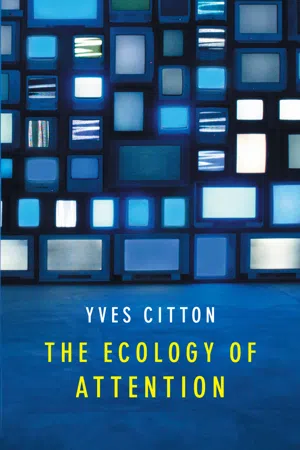
- English
- ePUB (mobile friendly)
- Available on iOS & Android
eBook - ePub
The Ecology of Attention
About this book
Information
Part I
Collective Attention
1
MEDIA ENTHRALMENTS AND ATTENTION REGIMES
Let us imagine the surface of the Earth seen from Saturn through a high-powered telescope that would not only allow us to observe the movements of human bodies, even inside their houses, but also to record and speed up their developments over the centuries. We see them every day, going in their masses to the fields, factories or offices, taking public transport and getting into cars that coagulate in traffic jams. We think we understand that they move in this way because of functional necessity: producing food, clothing, tools, and the skills necessary for their continued existence.
From the eighteenth century, we notice that a certain proportion, negligible to start with but soon growing to a majority, remains almost motionless, their eyes fixed on sheets of paper or glowing screens. Some only give themselves over to this immobility in the evenings or at the weekend, when their productive movements have come to an end, but an increasing number give themselves over to it almost all the time, to the point that it becomes hard to tell when their immobility has a productive function and when it is relaxation unrelated to work. We see them make micro-movements which very subtly affect the sheets of paper or the screens they look at, and which suggest they are contributing to productive collaborations. But, starting in the twentieth century, we also see the proliferation of a variety of devices into which they seem to speak, and more recently make hand gestures, and which seem to allow them to communicate with each other with increasing speed and over ever greater distances.
Indeed, adjusting the telescope we see multiple networks, in the form of periodicals, telegraphic lines, radio waves or fibre-optic cables, being established between them with increasing density. For a few decades, this communication seemed to be organized from a few central points, which sent out the same messages to all the surrounding places of reception; but, starting in the 1990s, highly interactive networks developed at a remarkable pace. At the beginning of the third millennium, the surface of the inhabited regions of the Earth seems to be completely covered by a thick, dense cloud of messages, sounds and images circulating in a great many directions – let’s call this the ‘mediasphere’ – to the extent that, in the middle of this entanglement, it becomes very difficult to distinguish who is speaking and who is listening, who is producing and who is receiving, who is carefully working and who is having fun.
The Mediasphere Seen from Above
Despite their apparent physical immobility, all the Earthlings seem acutely mobilized by what circulates in this mediasphere. It is hard to fathom why, from the middle of the twentieth century, they are sometimes glued in their millions to little screens in order to watch trim young people push a leather ball around, climb mountain passes on bikes, or hit the top half of each other’s body with large coloured gloves. During other less physical and essentially verbal contests, held every three or four years between people generally wearing ties, they seem to decide, through the insertion of paper into ballot boxes, who among them will take charge of the administration of their future interactions within vast associations called ‘nations’.
However complex the effects produced by the entanglement of multidimensional communications mixing with each other in this mediasphere, we can clearly see from Saturn, if the unfolding of the decades is sped up, entire generations start to grow their hair, wear only black clothes, be outraged by the sexual escapades of a politician, cry over the death of a princess, buy up addictive gadgets or criminalize the wearing of certain clothes – all with striking synchrony. And so the general function of this entire mediasphere, of which we had difficulty deciding whether it related to the necessities of production or to the puzzling pleasures of entertainment, comes into view. The very fact of watching the same things together at the same time, even if in apparent isolation from each other, produces effects of communal valorization which are indispensable to the constant renewal of the system of production. As a local informant lucidly suggests,
mass media, taken as a whole, is the deterritorialized factory, in which spectators do the work of making themselves over in order to meet the libidinal, political, temporal, corporeal, and, of course, ideological protocols of an ever intensifying capitalism. [. . .] [T]he media, as a deterritorialized factory, has become a worksite for global production. The value of our look also accrues to the image; it sustains the fetish.1
Seen from Saturn, the mediasphere forms, therefore, the necessary counterpart to the industrial production line: in order for factories to offload the material goods that they produce on a mass scale, the media must produce subjects wanting to buy them. In other words: seen from above, human attention seems to be massively channelled by an entanglement of media apparatuses which enthral us [nous ‘envoûtent’].2 The media should be conceived more in terms of ecosystems (of diffusion) than as ‘channels’ (of transmission). As was so well analysed by Niklas Luhmann, they form a system that actively reconditions the reality that it is supposed faithfully to represent.3 This ecosystem functions as an echo chamber, whose reverberations ‘occupy’ our minds (in the military sense of the term): most of the time, we think (in our ‘heart of hearts’) only what is made to resonate in us in the media vault by the echoes with which it surrounds us. In other words, media enthralments create an ECHOSYSTEM, understood as an infrastructure of resonances conditioning our attention to what circulates around, through and within us.
It would be terribly reductive – even if partially true – to characterize such enthralments in terms of an opposition between ‘them’ (the media, journalists, the powerful, rulers, elites, the establishment) and ‘us’ (the poor little ignorant people, shamefully manipulated by Machiavellian politicians, big bosses of multinational firms, spin doctors and storytellers). Media enthralments result from an echosystem in which we are all implicated (literally: ‘folded’) – with very different and harshly unequal (but nonetheless interconnected) levels of participation, responsibility, activity, exploitation and profit. Even if we are led to find its deplorable and degrading effects deeply repulsive, this echosystem can only be conjugated in the first-person plural: whether we like it or not it constitutes ‘our’ environment, ‘our milieu’ (another word etymologically related to the word ‘medium’) – we are what and who we are because we live in the ‘middle’ of it. We don’t merely live in it: to a large extent, ‘we’ are it. And just like our atmosphere or climate, however unbreathable or overheated they may be, our media echosystem – with all its nuances, standardized sectors and no-go zones – is necessarily communal. Here as well, there is no plan(et) B.
Every time that – spontaneously or with reflection – ‘I’ give my attention to this rather than that, it is under the influence of a media enthralment to whose resonance, around (and inside) each of us, we all contribute. The morning radio, the evening TV news, the afternoon newspaper, Facebook pages, telephone conversations, constant texts and tweets – all of this continually in-forms the contents of ‘our’ (necessarily communal) thoughts.
The particular effect of media enthralments has less to do with efficient causation than it has with formal causation. Among the four causes distinguished by Aristotle,4 besides the ‘material’ cause (the marble the statue is made of), the ‘final’ cause (the payment or glory the sculptor hopes to obtain through his work) and the ‘efficient’ cause (the gestures he makes with his hammer and chisel), the ‘formal’ cause designates the import of a pre-existing form on the development of a procedure. But, as Thierry Bardini, following Marshall McLuhan and Lance Strate,5 rightly highlights, the formal cause relates to environmental permeability and recursive circularity: it is difficult to prove (and to admit) that I bought a Nespresso coffee machine because I fell into the crude trap of identifying myself with George Clooney, who does their commercials; on the other hand, it is reasonable enough to think that it is because we are all submerged in Nestlé’s huge marketing campaign that my friends learned of the existence of such a machine, tried a sample, were seduced by its taste or design, spoke to me about it, etc.
Even if the efficient cause remains elusive – since it is generally the case that a combined bundle of impulses compels me to adopt a given behaviour – the introduction of a form, designed to circulate among us with the highest possible frequency, helps to explain how it is that our tastes and habits so often intersect with choices that are simultaneously free (since the action is not immediately forced upon them by an efficient cause) but nevertheless strongly conditioned (since they tend to be moulded spontaneously to the formal causes available in our environment). The formal causation lurking in every corner of our media echosystem incessantly feeds our ability to think – and it is quite suggestive to see this faculty which the Greeks referred to by the term nous (νους) resonate with the very pronoun used in French for the first-person plural (nous). To say the same thing differently again: the media echosystem is structured by a FORMAL CAUSALITY based on the power the forms circulating among us have to in-form our most intimate and spontaneous thoughts.
We must set out from here if we are to challenge the individualist presuppositions that lead most discourses on the attention economy astray: before being a matter of individualized choices, attention is first of all structured (and spellbound) by collective enthralments, which are inextricably architectural and magnetic, and which are induced by media apparatuses circulating certain forms (rather than others) among and within us. It is based on this capacity to thi...
Table of contents
- Cover
- Title Page
- Copyright
- Acknowledgements
- Foreword
- Introduction: From Attention Economy to Attention Ecology
- Part I Collective Attention
- Part II Joint Attention
- Part III Individuating Attention
- Conclusion: Towards an Attention Echology
- Name Index
- Subject Index
- End User License Agreement
Trusted by 375,005 students
Access to over 1.5 million titles for a fair monthly price.
Study more efficiently using our study tools.
Frequently asked questions
Yes, you can cancel anytime from the Subscription tab in your account settings on the Perlego website. Your subscription will stay active until the end of your current billing period. Learn how to cancel your subscription
No, books cannot be downloaded as external files, such as PDFs, for use outside of Perlego. However, you can download books within the Perlego app for offline reading on mobile or tablet. Learn how to download books offline
Perlego offers two plans: Essential and Complete
- Essential is ideal for learners and professionals who enjoy exploring a wide range of subjects. Access the Essential Library with 800,000+ trusted titles and best-sellers across business, personal growth, and the humanities. Includes unlimited reading time and Standard Read Aloud voice.
- Complete: Perfect for advanced learners and researchers needing full, unrestricted access. Unlock 1.5M+ books across hundreds of subjects, including academic and specialized titles. The Complete Plan also includes advanced features like Premium Read Aloud and Research Assistant.
We are an online textbook subscription service, where you can get access to an entire online library for less than the price of a single book per month. With over 1.5 million books across 990+ topics, we’ve got you covered! Learn about our mission
Look out for the read-aloud symbol on your next book to see if you can listen to it. The read-aloud tool reads text aloud for you, highlighting the text as it is being read. You can pause it, speed it up and slow it down. Learn more about Read Aloud
Yes! You can use the Perlego app on both iOS and Android devices to read anytime, anywhere — even offline. Perfect for commutes or when you’re on the go.
Please note we cannot support devices running on iOS 13 and Android 7 or earlier. Learn more about using the app
Please note we cannot support devices running on iOS 13 and Android 7 or earlier. Learn more about using the app
Yes, you can access The Ecology of Attention by Yves Citton in PDF and/or ePUB format, as well as other popular books in Social Sciences & Popular Culture. We have over 1.5 million books available in our catalogue for you to explore.