What do we know of the emotional life of the Middle Ages? Though a long-neglected subject, a multitude of sources – spiritual and secular literature, iconography, chronicles, as well as theological and medical works – provide clues to the central role emotions played in medieval society.
In this work, historians Damien Boquet and Piroska Nagy delve into a rich variety of texts and images to reveal the many and nuanced experiences of emotion during the Middle Ages – from the demonstrative shame of a saint to a nobleman's fear of embarrassment, from the enthusiasm of a crusading band to the fear of a town threatened by the approach of war or plague. Boquet and Nagy show how these outbursts of joy and pain, while universal expressions, must be understood within the specific context of medieval society. During the Middle Ages, a Christian model of affectivity was formed in the 'laboratory' of the monasteries, one which gradually seeped into wider society, interacting with the sensibilities of courtly culture and other forms of expression.
Bouqet and Nagy bring a thousand years of history to life, demonstrating how the study of emotions in medieval society can also allow us to understand better our own social outlooks and customs.
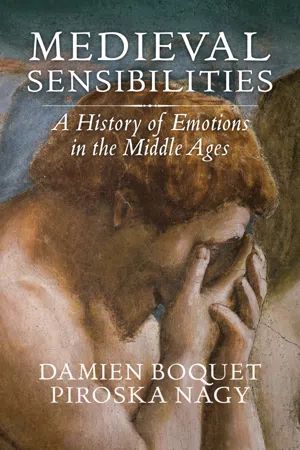
eBook - ePub
Medieval Sensibilities
A History of Emotions in the Middle Ages
- English
- ePUB (mobile friendly)
- Available on iOS & Android
eBook - ePub
Medieval Sensibilities
A History of Emotions in the Middle Ages
1
The Christianization of Emotion (Third to Fifth Centuries)
A large part of the Western medieval conception of emotions and of the affective life was established between the third and fifth centuries. This period in the development of Christian thought exerted a considerable influence on culture – and learned culture most of all – throughout the remaining centuries of the Middle Ages. This was in part because this period witnessed the general adoption of the Vulgate, the Latin version of the Bible translated by St Jerome (d. 420), which was read and ruminated on for the next thousand years, but it was also a result of the position of authority enjoyed by the earliest generations of Christian theologians and philosophers. Yet the authors to be discussed here were not understood or read by medieval people as they are understood and read today. Notably, their works were transmitted by multiple paths, both direct and indirect, at times encumbered by erroneous attributions or in incomplete or corrupted states. Over the course of the Western Middle Ages, the thought of the Church Fathers, always invoked as an inviolable authority, was constantly reinterpreted, adapted, even distorted by the contemporary inspirations of the authors who claimed to represent them. This book will follow the evolution of Christian thought on the emotions, which innovated only while hiding behind the prestige of the past. Here it will be shown how the Latin masters who espoused the Christian faith in this formative period developed, both from the Bible and their inherited philosophical culture, a conception of humanity, and especially of the emotions, that was profoundly new.
The theology of emotion
An emotional God
The Bible is rich in emotions of every sort and every intensity.1 From the most violent to the most subtle, from the most noble to the most vile, they abound in its historical and prophetic books and saturate those of poetry and wisdom (the Psalms, the Song of Songs, the Wisdom of Sirach). These latter texts were given pride of place in the meditations of medieval intellectuals, especially those in religious orders. The emotions described in the Scriptures are not solely those of humans, but also those of God. The God of the Bible was neither unemotional nor impassive – especially in his often tumultuous relations with his people. The Old Testament overflows with situations where the wrath of God is palpable: ‘Therefore the Lord heard, and was angry; a fire was kindled against Jacob, and wrath came up against Israel’ (Ps 77: 21).2 In return, this irascible God could also show mercy and let himself be moved: ‘But he is merciful, and will forgive their sins: and will not destroy them. And many a time did he turn away his anger: and did not kindle all his wrath. And he remembered that they are flesh: a wind that goeth and returneth not’ (Ps 77: 38–9). The image here is of a wrathful God rendered suddenly tender, almost hesitant, by the fragility of his creation.
In the New Testament, divine wrath is likewise present. The advent of God made man in the person of Jesus changed everything, however.3 More than his Father, Jesus overflowed with emotions that he sought neither to hide nor to neutralize, since they were signs of his own humanity. Christ, God made flesh, thus experienced compassion, fear, love, and pity. He felt no jealousy, envy, or hate. Rather his emotions were virtuous, contributing to salvation but also to just wrath. On the Mount of Olives on the eve of his death, Jesus’ anguish and pain were so intense that an angel came to comfort him (Luke 22: 42–3). He wept for the fate of Jerusalem before bringing his full wrath to bear against the merchants of the Temple, whom he ruthlessly expelled (Luke 19: 41). By contrast, the canonical Gospels are less inclined to evoke Christ's emotions during the Passion, beyond his famous cry of anguish: ‘My God, my God, why have you forsaken me?’ (Mark 15: 34; Matt. 27: 46). How did Jesus experience the outrages and humiliations he suffered? Did he feel shame or indignation when faced with the jibes and spitting of the crowd? Did he suffer in spirit over and above the physical pain that he had to endure during his ordeal? In paradise, did he continue to suffer as a man for the sins of humanity? The authors of the Middle Ages posed all of these questions. They were especially crucial in so far as they determined the very nature of God, and the writers developed specific responses to them. During his corporeal life, Jesus was able to feel all of the virtuous emotions as a man, from the sweetest to the most painful. On the other hand, if the resurrected Jesus continued to feel emotions, these were experienced in a non-carnal – and thus non-human – manner. He could thus no longer shed tears, however great his pain.4
The first and foremost commandment of the Gospels is the commandment of love: ‘Thou shalt love the Lord thy God with thy whole heart, and with thy whole soul, and with thy whole mind’ (Matt. 22: 37); ‘This is my commandment, that you love one another, as I have loved you’ (John 15: 12); ‘Love your enemies: do good to them that hate you: and pray for them that persecute and calumniate you’ (Matt. 5: 44). To love God, to love oneself, to love one's neighbour, to love one's enemies: such is the order of love – both in the sense of injunction and of hierarchy – which ought to preside over the social life of man and his ties to God. When Western Christians received the message of the Gospel, they identified this commandment with a specific form of love: ‘charity’. Jerome used caritas to translate the Greek agapè, a term which described a measured and impartial attachment that engaged every aspect of one's being, including both reason and the will. This love could be distinguished from amor – erôs in Greek – without necessarily being opposed to it. The latter term implied longing, a drive to possess something, whether spiritual or material, that was often irrepressible.5 Described as an encompassing and inclusive embrace, the love found in charity was meant to expand outwards, without excess or passion: it called for the care of one's neighbour as well as oneself. The love described by amor, however, was an intense state of feeling which picked its target and plunged towards it, like a hunter's spear towards its prey. It was a hazardous, exclusive, and violent experience. As such, it galvanized mystics, pulling them wholly towards God and creating an inseparable bond, while blinding the greedy, who remained ensnared in worldly desires.
The theologians of these first Christian centuries also used the word dilectio to describe the love that emanated from the spirit and the soul. Its meaning was very close to caritas, but more personal: the term was related to electio, choice.6 If the term caritas was not unheard of in pagan Latin – Cicero includes it within the family of virtues upon which social life was founded – this dilectio was absent. The duty of Christian love proved a fitting substitute for the Roman ethical value of fides, i.e. trust in one's word and in the law. ‘Trust’ configured as ‘faith’ developed into ‘love’. For Paul, this ‘commandment of love’ – a neat expression of this new alliance – subsumed the Mosaic Law: ‘Love [dilectio] is the fulfilment of the Law’ (Rom. 13: 10). St John completed this emotional revolution. He bound the Law and God himself together to form a conclusion that contained the quintessence of Christianity in the medieval West: ‘God is charity: and he that abideth in charity, abideth in God, and God in him.’ God was not only endowed with emotions: he was himself the emotional force of love.
God's wrath: a proof of his existence
For the most part, the Latin theologians of these first Christian centuries were educated in the schools of the Empire. From Tertullian (d. c. 220) through to Augustine, all the Latin Fathers – a list that includes Lactantius (d. c. 320), Ambrose of Milan (d. 397), Arnobius (d. early fourth century), and Jerome – had a solid formation in classical culture.7 Some, like Lactantius and Augustine, had even been masters of rhetoric and philosophy before devoting their life and their quills to their new faith. Christian theology did not emerge by spontaneous generation: it was deeply anchored in the Scriptures but also nourished by pagan culture, especially the immense Greco-Roman philosophical heritage. This was a great accumulation of thought, beginning with Socratic philosophy and continuing through to the Neo-Platonic thought of Plotinus, the Peripatetic school, and the Stoicism of the late Empire.8 For these philosophical schools, however, the mere mention of a God capable of wrath was nonsensical. Wrath was a passion, and as such, a deviation from reason. God, the prime mover, was by nature apathès, and thus devoid of all passion. This doctrine of divine apatheia, an impassivity which the Latins sometimes called tranquilitas, the tranquillity of the soul, was essential. Nevertheless, impassivity, the absence of passions, did not necessarily mean insensibility, the incapacity to feel emotions or an indifference towards them. How rigid these philosophical conceptions were depended on the school. The disciples of Aristotle were less dismissive of such possibilities than the Stoics, for whom God was a being of pure reason: for them, certain palpable emotions, such as measured joy, could be considered compatible with apatheia.
Greek theologians, greatly influenced by Stoicism, did not seek to break from philosophical tradition on this point. They...
Table of contents
- Cover
- Table of Contents
- Dedication
- Title page
- Copyright page
- Foreword
- Acknowledgements
- Introduction
- 1: The Christianization of Emotion (Third to Fifth Centuries)
- 2: The City of Desire: The Monastic Laboratory
- 3: Emotions for a Christian Society: The Frankish World (Fifth to Tenth Centuries)
- 4: The Zenith of Monastic Affection
- 5: The Ethics and Aesthetics of Aristocratic Emotions in Feudal Society (Eleventh to Thirteenth Centuries)
- 6: The Emotive Nature of Man (Eleventh to Thirteenth Centuries)
- 7: The Politics of Princely Emotion (Twelfth to Fifteenth Centuries)
- 8: The Mystical Conquest of Emotion (Thirteenth to Fifteenth Centuries)
- 9: Common Emotion (Thirteenth to Fifteenth Centuries)
- Conclusion
- Abbreviations
- Bibliography
- Figure Sources and Credits
- Index
- Supplemental Images
- End User License Agreement
Trusted by 375,005 students
Access to over 1.5 million titles for a fair monthly price.
Study more efficiently using our study tools.
Frequently asked questions
Yes, you can cancel anytime from the Subscription tab in your account settings on the Perlego website. Your subscription will stay active until the end of your current billing period. Learn how to cancel your subscription
No, books cannot be downloaded as external files, such as PDFs, for use outside of Perlego. However, you can download books within the Perlego app for offline reading on mobile or tablet. Learn how to download books offline
Perlego offers two plans: Essential and Complete
- Essential is ideal for learners and professionals who enjoy exploring a wide range of subjects. Access the Essential Library with 800,000+ trusted titles and best-sellers across business, personal growth, and the humanities. Includes unlimited reading time and Standard Read Aloud voice.
- Complete: Perfect for advanced learners and researchers needing full, unrestricted access. Unlock 1.5M+ books across hundreds of subjects, including academic and specialized titles. The Complete Plan also includes advanced features like Premium Read Aloud and Research Assistant.
We are an online textbook subscription service, where you can get access to an entire online library for less than the price of a single book per month. With over 1.5 million books across 990+ topics, we’ve got you covered! Learn about our mission
Look out for the read-aloud symbol on your next book to see if you can listen to it. The read-aloud tool reads text aloud for you, highlighting the text as it is being read. You can pause it, speed it up and slow it down. Learn more about Read Aloud
Yes! You can use the Perlego app on both iOS and Android devices to read anytime, anywhere — even offline. Perfect for commutes or when you’re on the go.
Please note we cannot support devices running on iOS 13 and Android 7 or earlier. Learn more about using the app
Please note we cannot support devices running on iOS 13 and Android 7 or earlier. Learn more about using the app
Yes, you can access Medieval Sensibilities by Damien Boquet,Piroska Nagy, Robert Shaw in PDF and/or ePUB format, as well as other popular books in History & European Medieval History. We have over 1.5 million books available in our catalogue for you to explore.