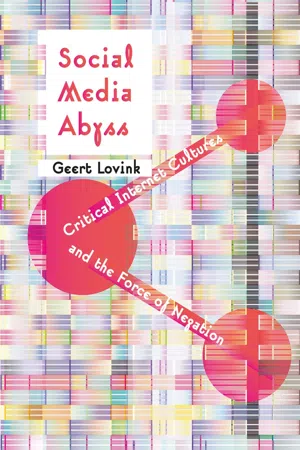
Social Media Abyss plunges into the paradoxical condition of the new digital normal versus a lived state of emergency. There is a heightened, post-Snowden awareness; we know we are under surveillance but we click, share, rank and remix with a perverse indifference to technologies of capture and cultures of fear. Despite the incursion into privacy by companies like Facebook, Google and Amazon, social media use continues to be a daily habit with shrinking gadgets now an integral part of our busy lives. We are thrown between addiction anxiety and subliminal, obsessive use. Where does art, culture and criticism venture when the digital vanishes into the background?
Geert Lovink strides into the frenzied social media debate with Social Media Abyss - the fifth volume of his ongoing investigation into critical internet culture. He examines the symbiotic yet problematic relation between networks and social movements, and further develops the notion of organized networks. Lovink doesn't just submit to the empty soul of 24/7 communication but rather provides the reader with radical alternatives.
Selfie culture is one of many Lovink's topics, along with the internet obsession of American writer Jonathan Franzen, the internet in Uganda, the aesthetics of Anonymous and an anatomy of the Bitcoin religion. Will monetization through cybercurrencies and crowdfunding contribute to a redistribution of wealth or further widen the gap between rich and poor? In this age of the free, how a revenue model of the 99% be collectively designed? Welcome back to the Social Question.
- English
- ePUB (mobile friendly)
- Available on iOS & Android
eBook - ePub
About this book
Information
1
What is the Social in Social Media?
Headlines for the Few: ‘Next time you're hiring, forget personality tests, just check out the applicant's Facebook profile instead.’ – ‘Stephanie Watanabe spent nearly four hours Thursday night unfriending about 700 of her Facebook friends – and she isn't done yet.’ – ‘Facebook apology or jail time: Ohio man gets to choose.’ – ‘Study: Facebook users getting less friendly’ – ‘Women tend to have stronger feelings regarding who has access to their personal information. (Mary Madden) – ‘All dressed up and no place to go.’ (Wall Street Journal) – ‘I'm making more of an effort to be social these days, because I don't want to be alone, and I want to meet people.’ (Cindy Sherman) – ‘30 per cent posted updates that met the American Psychiatric Association's criteria for a symptom of depression, reporting feelings of worthlessness or hopelessness, insomnia or sleeping too much, and difficulty concentrating.’ – ‘Hunt for Berlin police officer pictured giving Nazi salute on Facebook’ – ‘15-year-old takes to Facebook to curse and complain about her parents. The disgusted father later blasts her laptop with a gun.’
The use of the word ‘social’ in the context of information technology dates back to the very beginnings of cybernetics. A sub-field called socio-cybernetics was created inside of sociology to study the ‘network of social forces that influence human behaviour’, able to optimize or modify information systems.1 With the production of software well underway, the social pops up in the 1980s emergence of ‘groupware’. In the same period, Friedrich Kittler from the materialist school of German media theory dismissed the use of the word ‘social’ as irrelevant fluff (computers calculate, they do not interfere in human relations, so we should stop projecting our mundane all-too-human desires onto electronic circuits, etc).2 Meanwhile, holistic hippies of the Wired school ignored such cynical machine knowledge from Old Europe, celebrating instead a positive, humanistic approach that worshipped computers as tools for personal liberation, a mentality later turned by Steve Jobs into a design principle and marketing machine. Before the dotcom venture capital takeover of IT in the second half of the 1990s, progressive computing was primarily occupied with making tools, and focused on collaborations between two or more people; not for ‘sharing’, but for getting work done. The social, in this context, meant exchanges between isolated nodes. Owing partly to its ‘alternative’ beginnings, the Californian individualistic emphasis on cool interface design and usability was always supplemented with ‘community’ investments in networks. But this Californian ‘social’ just means sharing amongst users. It doesn't get close to anything like collective ownership or public utility.
Computers have, in fact, always been hybrids of the social and the post-human. From the beginning of their industrial life as giant calculators, the linking up of different units was seen as both a possibility and necessity.3 In his never-published essay, ‘How Computer Networks Became Social’, Sydney-based media theorist Chris Chesher maps out the historical and interdisciplinary development – from sociometry and social network analysis (with roots going back to the 1930s) through Granovetter's work on ‘weak links’ in 1973, to Castells’ Network Society (1996) and the current mapping efforts of the techno-scientists who gather under the Actor Network Theory umbrella – of an ‘offline’ science that studies the dynamics of human networks. The conceptual leap that is most relevant to grasp is the move from groups, lists, forums and communities to the empowerment of loosely connected individuals in networks. This shift had already begun in the neoliberal 1990s, facilitated by growing computing power, storage capacity and internet bandwidth, alongside simplifying interfaces on smaller and smaller (mobile) devices. This is where we enter the Empire of the Social.
If we want to pose the question of what this ‘social’ in today's social media really means, a possible starting point could be its disappearance, as described by Jean Baudrillard, the French sociologist who theorized the transition of the subject into a consumer. According to Baudrillard, at some point the social lost its historical role and imploded into media. If the social is no longer the once dangerous mix of politicized proletarians, frustrated unemployed and dirty clochards that hang out on the streets, waiting for the next opportunity to revolt under whatever banner, then how do social elements manifest themselves in the digital networked age?
The ‘social question’ may not have been resolved, but for decades in the West it has felt as if it was neutralized. In the post-World War II period, instrumental knowledge of how to manage the social was seen as necessary, to the extent that thinking about ‘the social’ in an intellectual and technical sense was delegated to a somewhat closed circle of professional experts. Now, in the midst of a global economic downturn, can we see a return or even renaissance of the social? Or is all this talk about the rise of ‘social media’ just a linguistic coincidence? Can we speak, in the never-ending aftermath of the 2008 financial crisis, of a growing social and class awareness, and, if so, can this spread into the electronic realm? Despite the hardships of unemployment, increasing income disparities and the achievements of the Occupy protests, a globally networked uprising that scales up quickly seems unlikely. Protests are successful precisely because they are local, despite their networked presence. ‘Memes’ are travelling at the speed of light, spreading basic concepts. But how can the separate entities of work, culture, politics and networked communication in a global context be connected in such a way that information (for instance, via Twitter) and interpersonal communication (email, Facebook) can have an effect on the actual organization of world events?
Here we must reframe considerations of the social into a larger, strategic context than the typical ‘social media question’ poses. Maybe all these neatly administrated contacts and address books at some point spill over and leave the virtual realm, as the popularity of dating sites seems to suggest. Do we only share information, experiences and emotions for the mirroring sake of it, or do we also conspire, as ‘social swarms’, to raid reality in order to create so-called ‘real world’ events? Will contacts mutate into comrades? It is clear that social media solved some of the organizational problems of the social that the baby boom / suburb generation faced fifty years ago: boredom, isolation, depression and desire. How do we come together, differently, right now? Do we unconsciously fear (or long for) the day when our vital infrastructure breaks down, and we really need each other? Or should we read the Simulacrum of the Social as more like organized agony – confronting the loss of community after the fragmentation of family, marriage, friendship and so on? With what rationale do we assemble these ever-growing collections of contacts otherwise? Is the Other, relabelled as ‘friend’, going to be more than a future customer, or ‘lifesaver’ only of our business dealings in precarity? What new forms of social imaginary already exist? And on the other side of these questions, should solitude as a response to the daily pressures of the ‘social’ be promoted as Kulturideal, as the likes of Nietzsche and Ayn Rand also proposed?4 At what point does our administration of others mutate into something different altogether? Will befriending disappear overnight, like so many other new media-related practices that vanished into the digital nirvana, such as Usenet forums, telnet log-ins to servers, or our once wide-spread HTML coding of our own websites?
The container concept ‘social Web’ once described a fuzzy collection of websites from MySpace, Digg, YouTube, Flickr to Wikipedia. Five years later, the term was broadened to include a wider range of soft and hard devices (including not only PCs and laptops) and rebranded into ‘social media’. There was very little that was nostalgic about this project, no revival of the once dangerous potential of ‘the social’ along the lines of the angry mob that once demanded the end of economic inequality. Instead, to remain inside Baudrillard's vocabulary, the social was reanimated as a mere simulacrum of its own capacity to create meaningful and lasting social relations. Roaming around in virtual global networks, we believe that we are less and less committed to our roles within traditional communities such as the family, church, political party, trade union and neighbourhood. Historical subjects, once defined in terms like ‘citizens’ or ‘members of a class’, carrying certain rights, have been transformed into subjects with agency: dynamic actors called users, customers who complain, and prosumers. The social is no longer a reference to society even – an insight that troubles us theorists and critics whose empirical research still proves that people, despite all their outward behaviour, remain quite firmly embedded in certain cultural, local and especially hierarchical structures. Stripped of all metaphysical values, the social is becoming a placeholder for something resembling inter-personal rubble, the leftovers after the neoliberal destruction of ‘society’, a loose collection of ‘weak ties’. As a concept, it lacks both the religious undertone of terms such as ‘community’ and the retroactive anthropological connotation of the ‘tribe’. To put this in marketing terms, the current ‘social’ is just that which is technical and vaguely ‘open’ – the space between you and me and our friends.
Accordingly, the social no longer manifests itself primarily as a class, movement or mob, nor does it institutionalize itself anymore, as happened during the post-war decades of the welfare state. Even the postmodern phase of disintegration and decay seems over. Nowadays, the social manifests itself in a network form. Its practices emerge outside of the walls of the twentieth-century institutions, leading to a corrosion of conformity. The network then becomes the actual shape of the social. What counts, for instance in politics and business, are the ‘social facts’ as they present themselves through network analysis and its corresponding data visualizations. The institutional part of life takes shape as another matter altogether, the banal disappearing base of social data that quickly falls into the background of discussion, into some distant universe of concern. It is tempting here to remain positive and insist on the portrayal of a synthesis, farther down the road, between the formalized power structures inside institutions and the growing influence of the informal networks. But there is little evidence for this pleasant Third Way approach being either useful or realistic. The PR-driven belief system that social media will, one day, be integrated into functional institutions and infrastructures may be nothing more than New Age optimism in an age of growing tensions over scarce resources. Within this tension, the social can appear like a wonder glue, used to either repair or gloss over historical damages, or it can quickly turn into explosive material. A total ban on this explosiveness is nearly impossible, not even in authoritarian countries. Ignoring social media as background noise also backfires. This is why institutions, from hospitals to universities, hire swarms of temporary consultants to manage social media for them.
Social media fulfil the promise of communication as exchange: instead of forbidding responses, they demand replies or at least a technical notion of reciprocity. Similar to how Baudrillard outlined earlier media forms, today's networks are ‘reciprocal spaces of speech and response’5 that lure users into saying something, anything … Later on, Baudrillard changed his position and no longer believed in the emancipatory aspect of talking back to the media. Restoring the symbolic exchange wasn't helpful – meanwhile this feature is precisely what social media offer their users as a gesture of liberation. For the late Baudrillard, what counted was the superior position of the silent majority.
In their 2012 pamphlet, Declaration, Michael Hardt and Antonio Negri avoid discussing the larger social dimensions of community, cohesion and society. What they witness is unconscious slavery: ‘People sometimes strive for their servitude as if it were their salvation.’6 It is primarily individual entitlement that interests these theorists in social media, not the social at large: ‘Is it possible that in their voluntary communication and expression, in their blogging and social media practices, people are contributing to instead of contesting repressive forces?’ For us, the mediatized ones, work and leisure can no longer be separated. But why didn't Hardt and Negri express interest also in the equally obvious fact of a productive side in being connected to others?
Hardt and Negri make the...
Table of contents
- Cover
- Title page
- Copyright page
- Acknowledgements
- Introduction: Preparing for Uncommon Departures
- 1: What is the Social in Social Media?
- 2: After the Social Media Hype: Dealing with Information Overload
- 3: A World Beyond Facebook: The Alternative of Unlike Us
- 4: Hermes on the Hudson: Media Theory after Snowden
- 5: Internet Revenue Models – A Personal Account
- 6: The MoneyLab Agenda: After Free Culture
- 7: For Bitcoin to Live, Bitcoin Must Die
- 8: Netcore in Uganda: the i-network Community
- 9: Jonathan Franzen as Symptom: Internet Resentment
- 10: Urbanizing as a Verb: The Map is not the Tech
- 11: Expanded Updates: Fragments of Net Criticism
- 12: Occupy and the Politics of Organized Networks
- Select Bibliography
- End User License Agreement
Trusted by 375,005 students
Access to over 1.5 million titles for a fair monthly price.
Study more efficiently using our study tools.
Frequently asked questions
Yes, you can cancel anytime from the Subscription tab in your account settings on the Perlego website. Your subscription will stay active until the end of your current billing period. Learn how to cancel your subscription
No, books cannot be downloaded as external files, such as PDFs, for use outside of Perlego. However, you can download books within the Perlego app for offline reading on mobile or tablet. Learn how to download books offline
Perlego offers two plans: Essential and Complete
- Essential is ideal for learners and professionals who enjoy exploring a wide range of subjects. Access the Essential Library with 800,000+ trusted titles and best-sellers across business, personal growth, and the humanities. Includes unlimited reading time and Standard Read Aloud voice.
- Complete: Perfect for advanced learners and researchers needing full, unrestricted access. Unlock 1.5M+ books across hundreds of subjects, including academic and specialized titles. The Complete Plan also includes advanced features like Premium Read Aloud and Research Assistant.
We are an online textbook subscription service, where you can get access to an entire online library for less than the price of a single book per month. With over 1.5 million books across 990+ topics, we’ve got you covered! Learn about our mission
Look out for the read-aloud symbol on your next book to see if you can listen to it. The read-aloud tool reads text aloud for you, highlighting the text as it is being read. You can pause it, speed it up and slow it down. Learn more about Read Aloud
Yes! You can use the Perlego app on both iOS and Android devices to read anytime, anywhere — even offline. Perfect for commutes or when you’re on the go.
Please note we cannot support devices running on iOS 13 and Android 7 or earlier. Learn more about using the app
Please note we cannot support devices running on iOS 13 and Android 7 or earlier. Learn more about using the app
Yes, you can access Social Media Abyss by Geert Lovink in PDF and/or ePUB format, as well as other popular books in Social Sciences & Popular Culture. We have over 1.5 million books available in our catalogue for you to explore.