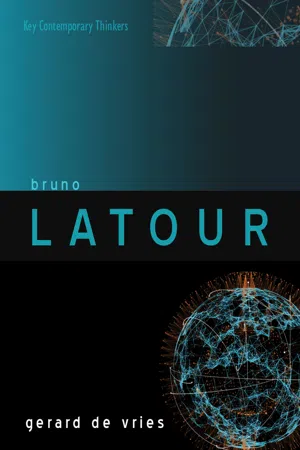
Bruno Latour is among the most important figures in contemporary philosophy and social science. His ethnographic studies have revolutionized our understanding of areas as diverse as science, law, politics and religion. To facilitate a more realistic understanding of the world, Latour has introduced a radically fresh philosophical terminology and a new approach to social science, 'Actor-Network Theory'.
In seminal works such as Laboratory Life, We Have Never Been Modern and An Inquiry into Modes of Existence, Latour has outlined an alternative to the foundational categories of 'modern' western thought Ð particularly its distinction between society and nature Ð that has major consequences for our understanding of the ecological crisis and of the role of science in democratic societies.
Latour's 'empirical philosophy' has evolved considerably over the past four decades. In this lucid and compelling book, Gerard de Vries provides one of the first overviews of Latour's work. He guides readers through Latour's main publications, from his early ethnographies to his more recent philosophical works, showing with considerable skill how Latour's ideas have developed.
This book will be of great value to students and scholars attempting to come to terms with the immense challenge posed by Latour's thought. It will be of interest to those studying philosophy, anthropology, sociology, science and technology studies, and almost all other branches of the social sciences and humanities.
eBook - ePub
Bruno Latour
About this book
Information
1
Empirical Philosophy
A truly bewildering Wunderkammer. The collection of Bruno Latour's publications brings an early-modern cabinet of curiosities to mind. Their subject matters range from laboratory life in Nobel Prize winner Roger Guillemin's Salk Institute (LL); the shared history of microbes, microbiologists and society (PF); the tragic fate of an innovative public transport system (AR); file handling and the passage of law at the French supreme court for administrative law, the Conseil d’État (ML); geopolitics in the epoch of the Anthropocene (FG); religion (REJ); economics (SPI); ethnopsychiatry (CM); modernity (NBM, AIME); to Paris (PVI), politics (PN, MTP) and philosophy of science (SA, PH). Pick up any of Latour's books and you will be guided again through a maze of surprising connections – from the technical details of a rotary motor to meetings at the Transportation Ministry and a photo-op with French Prime Minister Jacques Chirac; from Pasteur's laboratory in Paris to a farm in Pouilly-le-Fort; from the Conseil d’État in session to its mail room and to the file folders, stamps and paperclips in a secretary's cubicle; from a dialogue between lovers to Fra Angelico's fresco of the empty tomb in Florence; or from the Salk Institute's lab benches to the hectic travel schedule of its boss on his way to meet an endless array of colleagues, firms and high-level civil servants.
What's the point? Is there any order in this confusing, rambling, seemingly boundless list of subjects, actors, institutions and places? Who's interested in a High Court secretary's office paraphernalia or in the smile on the face of a politician sitting in a prototype of a public transport system? Why doesn't Latour stick to science and technology, the study of which brought him international fame; why did he fan out to other topics? And why doesn't he take the trouble to sort the various aspects of what he's talking about into neat categories, to leave technical details to scientists and engineers, legal matters to jurists, so that social scientists can focus on organizational matters, institutional relations and politics, after which philosophers can sit down to discuss foundational and methodological issues, the crumbs that fall from the other disciplines’ dinner tables?
To find our way in the world, to understand the modern world we live in, Latour claims we have to abandon the intuitions and explanatory ideals we have been trained to hold dear. The world does not present itself in pre-packed items that nicely fit into the pigeonholes of the established scientific disciplines. An education in law may have prepared lawyers for carefully reading texts and discussing legal subtleties, but if secretaries and court-clerks run out of file folders and paperclips, court documents will get messed up, chaos will emerge and before long the process of administering justice will have come to a full stop. So if we are interested in what lawyers are doing and how justice is administered, we better start taking an interest also in such seemingly trivial material aspects of legal practice as file folders and other office paraphernalia. Is it really possible to understand anything about societies without taking technology into account? Amazingly, the topic is not covered by sociology. Pick up any sociology textbook and you will see that sociologists are trained to study human groups, institutions, cultures and maybe the impact of technology on society, but not how technology makes up a substantial part of the fabric of society. So, Latour boldly claims, to become realistic about society, sociology has to be reformed. Can one truly understand modern science if one neglects the fact that a winner of the Nobel Prize in Physiology or Medicine will have spent long days not only at his lab, in hospitals and on academic conferences, but also in meeting rooms to discuss his work with patent lawyers, representatives of pharmaceutical firms and government officials? No. So we better start rewriting the usual stories about science. Why should one respect the established boundaries of scientific disciplines if scientists themselves keep trespassing them time and again? Engineers mix with politicians for work, not for pleasure; chemists, biologists and climate scientists discuss ecological problems with government representatives who probably have been educated as economists, lawyers, or as policy analysts. Only social theorists and philosophers tend to rigidly guard the borders of their fields.
As a consequence of his lack of respect for disciplinary boundaries, Latour's work is difficult to label. No wonder bookshops find it difficult to decide where to place his books on their shelves. In Paris, you will find most of them in the Social Sciences section; in Oxford and Cambridge they are stored under History and Philosophy of Science; in Amsterdam in the Philosophy corner. His papers are published in a wide variety of journals. To locate some of his other work, you may even have to travel to a museum – to the Karlsruhe Zentrum für Kunst und Medientechnologie (ZKM) where Latour has curated exhibitions, or to the Centre Pompidou in Paris where he organized a series of conferences – or to visit his website www.bruno-latour.fr to find a ‘sociological web opera’ posted next to a video of a re-staged debate between Durkheim and Tarde, with Latour impersonating the latter. The fruits of Latour's labours are not easy to categorize.
But first impressions are deceptive. What may appear as a hotchpotch of projects that lacks disciplinary rigour is driven by a clear intent, namely to describe science, law, politics, religion and other key institutions of the modern world in a new way. Latour claims that several of the established conceptual distinctions used to demarcate modern institutions – e.g. nature versus society, and facts versus values – provide at best little guidance to understanding what goes on in science, law, politics and religion and more likely will lead us astray. To articulate the nature of the world we live in, to get a more realistic view, we need to redescribe these institutions, their values and the ways in which they differ from one another. In spite of the fact that most of Latour's academic papers have been published in social science journals, this intent is sufficient reason to conceive Latour primarily as a philosopher – although one of a distinctive kind.
Traditionally, philosophers have conceived their task as finding a point on solid ground that allows a perspective on the world as it is, that is, to see reality, essences, behind confusing appearances. Plato's allegory of the cave nicely captures the ambition. In contrast to the prisoners who have been chained in a cave for all their lives, who are able only to look forward and who take the shadows cast on the wall in front of them for reality, the philosopher is like the one who is freed from his fetters, who raises and turning around is confronted with the things outside the cave that cast the shadows on the wall, and who comes to understand that what he had seen before was all a cheat and an illusion, and that now he has turned to more real things he can see more truly (Plato Republic: 7.514).
Over time, philosophers have adopted a more modest attitude. The rise of the sciences has forced them to reconsider their role. As Foucault observed:
[f]or a long time one has known that the role of philosophy is not to discover what is hidden, but to make visible precisely what is visible, that is to say, to make evident what is so close, so immediate, so intimately linked to us, that because of that we do not perceive it. Whereas the role of science is to reveal what we do not see, the role of philosophy is to let us see what we see.
(Foucault 1994: 3.540–541)
The sciences aim to inform us about what is hidden from view – e.g. what goes on in a distant star system, or in the brain of an Alzheimer patient – and to explain what we see in terms of underlying structures and processes. In contrast, philosophy tries to provide redescriptions of what is close to us: the world we live in and relate to, our social and moral intuitions, and our notions of who we are. So we may find Foucault (1979) opening our eyes for a much wider range of ways in which the conduct of a person is controlled in modern society, namely by pointing to new forms of discipline and punishment, that is, forms of power that have been around ever since about the early nineteenth century but that went unnoticed because we used to understand power only to refer to “every chance to carry through one's own will, even against resistance” (Weber 1972b [1922]: 28).
To single out redescription as the specific role for philosophy is certainly not an aberrant preference of some French philosophers alone. For example, Wittgenstein (1969 [1952]) also declared that “[w]e must do away with all explanation, and description alone must take its place” (PU §109). “We want to understand something that is already in plain view” (PU §89). The technique he suggested differs from Foucault's approach. For Wittgenstein, careful description of language is the preferred way to provide Übersichtlichkeit, a ‘perspicuous survey’ that helps to untie the knots in our understanding and to resolve philosophical perplexity. A perspicuous representation will “bring about the understanding which consists precisely in the fact that we ‘see the connections’.” “Hence,” he added, “the importance of finding connecting links” (Wittgenstein 1993: 132).
The similarity with Latour's intent is as remarkable as the difference. While at one point Wittgenstein (1998: 45e) wondered “if we use the ethnological approach, does that mean we are saying philosophy is ethnology?” – to further limit his attention to describing language games – Latour rose from his armchair to grab the bull by its horns. To do philosophy, to actually trace the connecting links and to learn to see what we see, Latour got engaged in empirical field studies, in ethnography.
1.1 Making Paris visible
Latour's intent and approach to philosophy may become clearer by discussing what at first sight is the most un-philosophical book he has ever published, Paris ville invisible (1998), co-authored with photographer Emilie Hermant. Because of its title and design – hundreds of photos of Parisian sites, with text interspersed, printed in a coffee table format – to acquire this book you may have to go to the travel section of a Parisian bookshop, where you may find it next to glossy books about romantic Paris and the Guide Michelin. But the rushed tourist who has picked up the book on his way home will likely be disappointed when he unwraps his souvenir. He has bought a treatise on philosophy and social theory. Discovering that the book was later turned into an interactive website will probably add to his chagrin.
In Paris ville invisible, the grandiose task of attaining Übersicht, of perspicuously surveying the world as a whole, is reduced to the more mundane one of capturing the whole of Paris at a glance. Where do we have to go to accomplish the task of perspicuously representing Paris? From which fetters do we have to free ourselves? Do we have to escape from the Earth, to get a view of the whole of Paris from a satellite? When we look at the image offered by Google Earth, we may indeed see ‘the whole of Paris’ at a glance. But except for the word ‘Paris’ being superimposed on the picture on our screen, we might easily have taken it to depict any other city. On the scale that captures Paris as a whole, the trained eye may spot the curves of the Seine, but very little else. So we may decide to take another tack, to go to Paris to join Latour and Hermant on their visit to the Samaritaine, the department store near Pont Neuf, which – before it was closed in 2005 for security reasons – proudly advertised itself with the slogan “You can find anything at the Samaritaine”. On the top floor of the old store was a panorama. One could see a lot of Paris from this spot. Binoculars were available for visitors and there was a huge circular table with engraved arrows pointing to Parisian landmarks drawn in perspective to help orientation. So is this the place where one might see the whole of Paris?
Unfortunately, no. As Hermant's photos show, smog from exhaust fumes veils the view. Moreover, the panorama fails to locate the Centre Pompidou and the impressive architecture of La Défense, and where the panorama promises tree-covered hills to be visible in the northeast, as Latour and Hermant note, one vaguely sees only endlessly more buildings. Set up in the 1930s, the panorama no longer corresponds to the city that spreads out before us. So, in spite of the available binoculars on the top-floor of the Samaritaine, Latour and Hermant suggest that to really see the Sacré Coeur, we had better get the metro to Montmartre.
On arrival at metro station Abbesses, however, another disappointment waits for us. Once we have left the station, we get lost in the maze of little streets in Montmartre. Where are we? The answer comes from the Michelin ...
Table of contents
- Cover
- Table of Contents
- Series page
- Title page
- Copyright page
- Preface
- Abbreviations
- 1: Empirical Philosophy
- 2: Science Studies
- 3: Science and Society
- 4: Another Social Science
- 5: A Philosophy for Our Time
- 6: A Comparative Anthropology of the Moderns
- References
- Name Index
- Subject Index
- End User License Agreement
Trusted by 375,005 students
Access to over 1.5 million titles for a fair monthly price.
Study more efficiently using our study tools.
Frequently asked questions
Yes, you can cancel anytime from the Subscription tab in your account settings on the Perlego website. Your subscription will stay active until the end of your current billing period. Learn how to cancel your subscription
No, books cannot be downloaded as external files, such as PDFs, for use outside of Perlego. However, you can download books within the Perlego app for offline reading on mobile or tablet. Learn how to download books offline
Perlego offers two plans: Essential and Complete
- Essential is ideal for learners and professionals who enjoy exploring a wide range of subjects. Access the Essential Library with 800,000+ trusted titles and best-sellers across business, personal growth, and the humanities. Includes unlimited reading time and Standard Read Aloud voice.
- Complete: Perfect for advanced learners and researchers needing full, unrestricted access. Unlock 1.5M+ books across hundreds of subjects, including academic and specialized titles. The Complete Plan also includes advanced features like Premium Read Aloud and Research Assistant.
We are an online textbook subscription service, where you can get access to an entire online library for less than the price of a single book per month. With over 1.5 million books across 990+ topics, we’ve got you covered! Learn about our mission
Look out for the read-aloud symbol on your next book to see if you can listen to it. The read-aloud tool reads text aloud for you, highlighting the text as it is being read. You can pause it, speed it up and slow it down. Learn more about Read Aloud
Yes! You can use the Perlego app on both iOS and Android devices to read anytime, anywhere — even offline. Perfect for commutes or when you’re on the go.
Please note we cannot support devices running on iOS 13 and Android 7 or earlier. Learn more about using the app
Please note we cannot support devices running on iOS 13 and Android 7 or earlier. Learn more about using the app
Yes, you can access Bruno Latour by Gerard de Vries in PDF and/or ePUB format, as well as other popular books in Philosophy & Philosophy & Ethics in Science. We have over 1.5 million books available in our catalogue for you to explore.