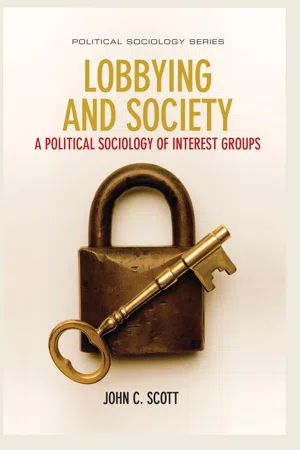
Lobbying and political interest groups occupy an ambivalent place in advanced democracies. Lobbying is viewed with suspicion, but is also a critical avenue for voices in policy debates.
This insightful book injects a new sociological understanding of politics and policy. Interest groups help set political agendas, provide support to policymakers, and mobilize resources around issues. They are also the means by which individuals and organizations achieve advantage over others in social and economic life. John C. Scott incorporates theory and research about interest groups into political sociology's approach to issues of power, inequality, and public policy. As he convincingly reveals, a sociological understanding of lobbying and interest groups illustrates the edges and boundaries of representative democracy itself.
Using case studies and data, and organized by topics such as influence, collective action, representation, and inequality, the book is a critical resource for students of policymaking and political sociology.
- English
- ePUB (mobile friendly)
- Available on iOS & Android
eBook - ePub
About this book
Information
1
Interests and Groups
Chapter aim: Where do interest groups come from? Why do they form? How are interests and influence connected? Collective action is an important concept in both political sociology and political science, and the goal of this chapter is to identify how interest groups fit within the standard mechanisms of collective action such as through the framing of issues and events. The chapter will cover major theories such as pluralism, elite theory, rational choice, and corporatism. Empirical examples of interest group behavior will provide the basis for critiques of political and sociological theories of collective action.
Case study: The interests of oil
The oil industry is one of the most active and aggressive political interest groups in the world, and its actions may shed some light on these challenges of identifying interests. Take a moment here to pause and answer these questions before reading further: What are the interests of the oil industry? What do you think they want from government, if anything? How many types of interest are possible?
For several decades, scientists have identified a gradual warming in the earth’s surface temperature, which is likely to have devastating effects on weather, the food supply, and communities. A critical cause of global warming is believed to be human activity in the form of burning fossil fuels – including oil and coal – for energy needs. To reduce or slow global warming, various policy proposals would reduce the use of fossil fuels by, for example, imposing stricter emission controls of oil- and coal-fired power plants, a tax on carbon emissions, or switching to renewable energy sources such as wind power or solar energy.
To combat these initiatives, the oil industry, and most prominently ExxonMobil, the world’s largest oil company, engaged in a campaign spanning many years to contest the science behind climate change. The effort sought to discredit both the science, which included funding studies that provided alternative theories or critiqued existing evidence, and the scientists who developed the evidence and implications of climate change. Recently revealed evidence shows that ExxonMobil executives were aware of the effects of climate change as early as 1977, well before they became known by a wider public, but nonetheless spent millions of dollars denying the issue and even generating misinformation.
Furthermore, experts agree that Exxon became a leader in campaigns of confusion. By 1989 the company had helped create the Global Climate Coalition (disbanded in 2002) to question the scientific basis for concern about climate change. It also helped to prevent the US from signing the international treaty on climate known as the Kyoto Protocol in 1998 to control greenhouse gases. Exxon’s tactic not only worked on the US but also stopped other countries, such as China and India, from signing the treaty. (Hall 2015)
But could government intervention be welcomed by the oil industry? Governments around the world subsidize oil and other fossil fuels, thereby encouraging their use. As reported by the Guardian, these subsidies can come in different forms, including not having to pay for the costs of pollution and global warming (Carrington 2015). But the report, based on a study by the International Monetary Fund, showed that oil companies received more than $300 billion in direct subsidies, which can come in the form of, for example, reduced prices for diesel fuel. In the US, oil companies also receive tax subsidies for producing oil, which largely come in the form of an ability to reduce taxes on corporate profits by the amount of expenses in the search for and pumping of oil. In the US government’s 2015 fiscal year, oil and gas exploration and production cost the Treasury nearly $5 billion in lost revenue (US Treasury 2015). The oil industry spent just over $130 million on lobbying in the US alone in one year, 2015.
What is the interest in interest groups?
How do interest groups form, or where do they come from? Why would one person or organization join an interest group or political coalition? Data tells us that interest groups and coalitions of groups are relatively stable, but groups take up considerable resources, which can consist of money, time, relationships, emotion, etc. As a result, some groups fail to take off and others fade away over time. We first assess traditional approaches to group collective action questions such as pluralism and elitism, each of which uses different assumptions about motivation and interaction.
A threshold issue in any theory of interest groups is identifying a person’s or a group’s interest. From one academic source, the term “interest” is not simply any value but rather “arises from the conjunction between some private value held by a political actor – public officials, or groups thereof as well as private sector operatives – and some authoritative action or proposed action by government” (Salisbury 1994: 12). When we think about political controversies, we usually look to see who or what is affected by the issue. Who wins? Who loses? From these sorts of questions, we usually say that people who share an interest, whether as the potential winners or the losers in an issue, will join together to work on it, whether by protesting or lobbying or mobilizing voters or some other activity.
For Karl Marx, shared interests could be found along class lines, with workers or the suppliers of labor on one side and the owners of capital or the means of production on the other side. This divide was clear and unchanging for Marx, and the inability of workers to find common cause was a result of the capitalist class using the tools of ideology or religion or the media to mislead the working class and create what he called a “false consciousness.”
As the political scientist Deborah Stone (2012) noted, the most problematic notion of interests suggests or assumes that people know what their interests are and already have set views of their interests before they try to influence the policymaking process. This fits with an economic view of life in which people know their tastes and preferences and pursue those interests in markets.
But Stone argues that political interests at the very least, but probably also even market interests, are not defined or predetermined but are malleable and variable. Because interests can be changed, political leaders try to influence interest formation by raising awareness around issues and framing outcomes in ways that appeal to individuals and groups. In a political context much more so than in a market context, group identities and memberships shape people’s interests – both how they perceive their values and needs and how policy affects their interests in concrete ways.
A person’s race, ethnicity, national origin, gender, or socioeconomic class can each have a significant effect on a person’s view of the world and their interests, and these characteristics are often more or less salient in particular contexts. To be a Muslim in the American South is a very different experience from being a Muslim in London or in Qatar. And, at the same time, people have a variety of identities and social groupings – e.g., a Latino wife who operates her own housecleaning business – but politics tends to elevate one identity over others. Tax legislation might be framed as highly beneficial to the small business owner, but an immigration enforcement order may cause her perception of ethnicity to dominate any other interest. For Stone, shared group identities can broadly shape interests of people, but it is the political process that defines the specific content of group interest.
A critical idea that flows from the prior statement is that politics makes it much easier to identify a shared problem than to find a common solution. As Stone notes, reformist groups have a much easier experience in diagnosing social ills of the present than in a vision of what the future should look like. A second critical idea is that we usually need someone to articulate the group interest; without that articulation, it is difficult to know what that group interest is. “No ‘general will’ of the community has ever manifested itself without a few leaders who claim to express it. Someone has to articulate the group interest and speak for the group” (Stone 2012: 230). But, because we belong to multiple and overlapping group identities, a common or shared interest can be undermined by competing interests.
Part of the problem in studying interest groups and lobbying is that an analyst may have difficulty in identifying the interests that the group is pursuing. Members of a group may have very different motivations for pursuing a common goal or may have similar yet different goals. This last point leads to the other important idea of this chapter: collective action. How do we convert shared interest into action that leads to political change? To explore that question, a case study that is mostly but not completely unrelated to interest groups is discussed.
Case study: A boycott in Montgomery
On December 1, 1955, Rosa Parks was arrested for not moving from her seat on a city bus in Montgomery, Alabama.1 Parks had sat in a largely vacant middle section of the bus when she got on, but as the bus continued through the city and more people boarded, her seat was needed for a white who had priority under city law. When she did not get up to go to the back of the bus, to the section reserved for African Americans, the bus driver ordered her to do so. When she still refused to move, he called for the police, who arrested Parks for violating a city ordinance that required blacks to sit in the rear of city buses.
As news of her arrest circulated, local civil rights activists began to spread the word of a one-day bus boycott for Monday, December 5; pastors advertised the boycott at black churches the day before. As a result, 40,000 people stayed off the buses on that Monday. More significantly, that day also saw the creation of the Montgomery Improvement Association (MIA) by African American local leaders in an effort to press the city for changes to its busing ordinances, and Martin Luther King, Jr., the relatively new 26-year-old pastor of Dexter Avenue Baptist Church, was chosen as its president.
Given the success of the one-day boycott and the fact that the bus system was heavily reliant on black ridership, the MIA lobbied Montgomery officials for modest yet seemingly feasible changes to bus policies, such as clarifying how buses could be filled by people of different races as well as more significant changes such as increased hiring of black drivers. But city officials rejected these proposals and negotiations resulted in stalemate. In response, MIA leaders decided to extend the boycott indefinitely.
The boycott proved extremely effective, with enough riders lost to the city transit system to cause financial losses to the company operating the buses. Instead of riding buses, boycotters organized a system of carpools, with car owners volunteering their vehicles or themselves driving people to various destinations. Some white housewives also drove their black domestic servants to work. Black taxi drivers charged 10 cents per ride, a fare equal to the cost to ride the bus, in support of the boycott. In addition to using private motor vehicles, some people used non-motorized means to get around, such as cycling, walking, or hitchhiking.
To ensure the boycott could be sustained, black leaders engaged in an intense series of logistical and emotionally supportive processes. Drivers for carpools had to be organized, gas for cars had to be procured, and the safety of walkers had to be ensured. Money had to be raised, and outreach and publicity had to be developed. Black leaders organized regular mass meetings at local churches to keep African American residents mobilized around the boycott. Outside Alabama, black churches raised money to support the boycott and provided other support to the boycotters.
In response, whites engaged in a variety of formal and informal efforts to suppress the boycott. Police routinely pulled over carpool drivers for trumped up traffic charges. When word of black taxi drivers charging reduced fares reached city officials, the order went out to fine any cab driver who charged a rider less than 45 cents. When the city pressured local insurance companies to stop insuring cars used in the carpools, the boycott leaders arranged policies at Lloyd’s of London. Membership of the White Citizens’ Council – a white supremacist group organized across the South and which carried out violent acts against African American activists – doubled during the course of the boycott, and local political leaders publicly voiced their support for the organization. Eventually, King’s house was firebombed, as were four black Baptist churches and the house of King’s close friend Ralph Abernathy. Boycotters were often physically attacked on the streets.
King and 89 other boycott leaders and carpool drivers were indicted for conspiring to interfere with a business under a 1921 ordinance. Rather than wait to be arrested, they boldly turned themselves in as an act of defiance. The indictment backfired, as boycotters were encouraged to continue their action, the protest sparked national attention.
In the midst of the boycott, the demands of the MIA shifted from modest changes to city ordinances to clarify seating to wholesale dismantling of segregation on city buses. Lawyers affiliated with the MIA filed suits in the federal court asking that laws requiring racial segregation on city buses be struck down. On June 5, 1956, a Montgomery federal court ruled that racially segregated seating on buses violated the 14th Amendment to the US Constitution. That amendment, adopted in 1868 following the American Civil War, guarantees all citizens, regardless of race, equal rights and equal protection under state and federal laws. The city appealed to the US Supreme Court, which upheld the lower court’s decision on December 20, 1956. Montgomery’s buses were integrated on December 21, 1956, and the boycott ended. It had lasted 381 days.
Against all odds and in the face of economic and violent intimidation, African Americans in the city of Montgomery, Alabama staged a year-long boycott in order to desegregate the city bus system. The boycotters were able to apply consistent economic, social, and political pressure on policymakers until the federal courts struck down segregation in public transportation. How was this sustained collective action possible in the face of strong resistance and violence? How did the boycott leaders discourage free-riding by boycott participants?
How do interest groups form? How does political activity get started? Groups form in a process that is alternatively referred to as “collective action” or “mobilization.” What is collective action, and why is it important? Stone (2012) says that mobilization or collective action is when people understand their problems as shared by others and the...
Table of contents
- Cover
- Copyright
- Acknowledgments
- Introduction: A Social Orientation to Interest Groups and Political Life
- 1. Interests and Groups
- 2. Power, Access, and Influence
- 3. Interest Groups as Intermediaries between Nation- States and Citizens
- 4. Inequality and Interest Groups
- 5. Interest Group Politics in a Global Context
- 6. New Directions in the Study of Lobbyists and Interest Groups
- References
- Index
- End User License Agreement
Trusted by 375,005 students
Access to over 1.5 million titles for a fair monthly price.
Study more efficiently using our study tools.
Frequently asked questions
Yes, you can cancel anytime from the Subscription tab in your account settings on the Perlego website. Your subscription will stay active until the end of your current billing period. Learn how to cancel your subscription
No, books cannot be downloaded as external files, such as PDFs, for use outside of Perlego. However, you can download books within the Perlego app for offline reading on mobile or tablet. Learn how to download books offline
Perlego offers two plans: Essential and Complete
- Essential is ideal for learners and professionals who enjoy exploring a wide range of subjects. Access the Essential Library with 800,000+ trusted titles and best-sellers across business, personal growth, and the humanities. Includes unlimited reading time and Standard Read Aloud voice.
- Complete: Perfect for advanced learners and researchers needing full, unrestricted access. Unlock 1.5M+ books across hundreds of subjects, including academic and specialized titles. The Complete Plan also includes advanced features like Premium Read Aloud and Research Assistant.
We are an online textbook subscription service, where you can get access to an entire online library for less than the price of a single book per month. With over 1.5 million books across 990+ topics, we’ve got you covered! Learn about our mission
Look out for the read-aloud symbol on your next book to see if you can listen to it. The read-aloud tool reads text aloud for you, highlighting the text as it is being read. You can pause it, speed it up and slow it down. Learn more about Read Aloud
Yes! You can use the Perlego app on both iOS and Android devices to read anytime, anywhere — even offline. Perfect for commutes or when you’re on the go.
Please note we cannot support devices running on iOS 13 and Android 7 or earlier. Learn more about using the app
Please note we cannot support devices running on iOS 13 and Android 7 or earlier. Learn more about using the app
Yes, you can access Lobbying and Society by John C. Scott in PDF and/or ePUB format, as well as other popular books in Social Sciences & Sociology. We have over 1.5 million books available in our catalogue for you to explore.