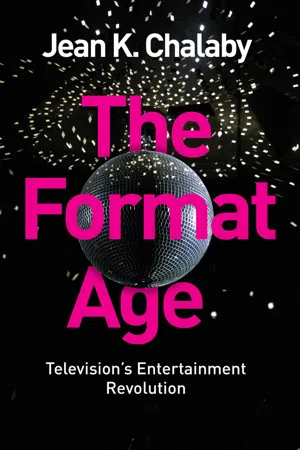
Few trends have had as much impact on television as formats have in recent years. Long confined to the fringes of the TV industry, they have risen to prominence since the late 1990s. Today, they are a global business with hundreds of programmes adapted across the world at any one time, from mundane game shows to blockbuster talent competitions, from factual entertainment to high-end drama. Based on exclusive industry access, this book provides an in-depth analysis of the complex world of the TV format from its origins to the present day.
Chalaby delivers a comprehensive account of the TV format trading system and conceptualizes the global value chain that underpins it, unpicking the corporate strategies and power relations within. Using interviews with format creators, he uncovers the secrets behind the world's most travelled formats, exploring their narrative structure and cultural meanings.
- English
- ePUB (mobile friendly)
- Available on iOS & Android
eBook - ePub
About this book
Information
Part I
Birth of a New Trade
1
TV Formats as an Anglo-American Invention
This chapter traces back to the origins of the TV format trade, uncovering those first deals and identifying the first formats to be aired across Europe. It shows how the key principles of the format industry were established by the early 1950s and contends that it is an Anglo-American invention, because the first format licences were adaptations of US shows acquired by British broadcasters. This chapter surveys the evolution of the trade up until the US game-show era, which started with the 1978 Goodson Worldwide Agreement.
The World’s First TV Format Agreements
Cross-border adaptations began in the sound broadcasting era and versions of US shows appeared on the BBC in the late 1920s. Adaptations also travelled to several Commonwealth countries, particularly Australia and Canada. Major Bowes’ Original Amateur Hour was an early favourite. A talent show that first aired in New York in 1934, it was adapted by the BBC in 1936 and four years later by a commercial station in Australia (Camporesi, 2000: 92, 119–20; Griffen-Foley, 2009: 212, 260). In March 1937, the BBC showed a version of an NBC contest called Spelling Bees and then, two years later, its first quiz show, Information, Please (also from NBC), which became The Brains Trust on the Corporation’s Home Service (Camporesi, 2000: 121–4). For the British broadcaster, the United States was a steady source of inspiration despite an overall ambivalent attitude towards American entertainment. The programmes selected by the BBC were popular, hence the rather acerbic comments published in Radio Pictorial in March 1938:
Why is it that the B.B.C. has been so slow to appreciate the appeal of this form of entertainment, and so loath to follow where America leads the way? The B.B.C. has its own representative in New York whose job is to pick up new ideas for transportation over here, and famous variety chiefs such as Eric Maschwitz have been in constant touch with the American studios. Yet the Spelling Bee was a radio feature for many years in the States before it was given its tardy radio debut in this island. It is the same story of the ‘Amateur Hour’ all over again. (cited in Camporesi, 2000: 122)
While it is unlikely that licences were acquired for these unscripted shows, scripts legally changed hands in the sound broadcasting era, and the Australian radio stations purchased scripts of the American dramas they were adapting in the 1930s (Griffen-Foley, 2009: 212–16). In the next two decades, when Havana was Latin America’s broadcasting hub, Cuban scripts for radionovelas travelled across the region. This trade was started by US advertising agencies, such as J. Walter Thompson and McCann-Erickson, interested in generating audiences in which to advertise the products of their clients (which included General Motors and Procter & Gamble) (Rivero, 2009). It was Richard Penn, an American radio specialist who worked on the marketing of Colgate-Palmolive, who brought the first Cuban script to Brazil. Em busca da felicidade [In Search of Happiness] aired in 1941 on Ràdio Nacional, establishing a model for future local adaptations in the region based on international formats (McCann, 2004: 217–18).
After the Second World War, the BBC returned to America for ideas, and the world’s first format to air on television (albeit only once) was a comedy panel radio show called It Pays to Be Ignorant, which premiered on WOR New York in June 1942 and made its US TV debut on CBS in June 1949 (Schwartz et al., 1999: 103–4). The show had come to the attention of Michael Standing, the BBC Light Programme’s head of variety, who insisted colleagues listen to a recording. They agreed that it was ‘hilariously funny’ and decided to purchase the UK rights from Maurice Winnick, a Manchester-born bandleader who represented in the UK the interests of some American radio and TV producers.1
The BBC retitled the show Ignorance Is Bliss and paid Sid Colin 40 guineas per episode to adapt the American scripts. It debuted on 22 July 1946 on the Light Programme and went on to be a notable success. Several series were recommissioned and the programme stayed on air until 1953.2 A one-off television broadcast took place on 24 April 1947 that came live from the Paris Cinema in central London.3 Before the performance went ahead, however, the BBC’s programme contracts director had to assuage the fears of panellists by promising them to ‘adhere to the undertaking that they will not be asked to take any notice of the television cameras or modify their normal performance in any way whatsoever.’4
This was followed by Twenty Questions: a quiz show based on the parlour game, it required a five-strong panel to guess the identity of an object in up to twenty questions. It premiered on the Mutual radio network in February 1946 and on American television (NBC) in November 1949 (Buxton and Owen, 1972: 314–15; Schwartz et al., 1999: 239). It crossed the Atlantic as a radio show airing on the BBC on 26 February 1947, with Winnick holding the UK rights again. The show proved very popular, attracting up to 9 million listeners, and was recommissioned for several series.5 In 1950 it was translated and broadcast on the Polish and Pakistani services. However, despite approaches from the BBC’s Television Service in 1951 and 1954, Twenty Questions never made it to the small screen because of a dispute with Winnick over rights (see next section).6
What’s My Line? was the first format to cross borders as a TV show. It began on 2 February 1950 on the CBS network and required four panellists to solve the problem of a guest’s occupation, with the guest’s replies to their questions limited to yes or no. What’s My Line?, created by Bob Bach and produced by Mark Goodson, became exceptionally popular and ran for no less than seventeen years in the USA (Schwartz et al., 1999: 246). The show reached the BBC via Maurice Winnick, and debuted there on 16 July 1951.7 What’s My Line? proved to be equally popular with a British audience and the BBC recommissioned on average two thirteen-episode series per year until 1963.8 It got another run on BBC Two between August 1973 and May 1974, and was revived by Thames Television for ITV between March 1984 and August 1990.9
The fourth American show adapted by the BBC was This Is Your Life, which launched on the NBC radio network in 1948. Two ingredients helped to make it a hit: the guest was kept in the dark until the actual show, and his or her former colleagues, close friends and relatives were invited along for the surprise (Buxton and Owen, 1972: 306–7). In 1955, within two months of the idea being floated by Ronald Waldman, a licence agreement was signed between the BBC and MCA, the rights holder. The show debuted in August, beginning a nine-year first run.10
Inventing Format Rights
The BBC archives reveal diverging views and some sharp exchanges between the Corporation’s executives, Maurice Winnick and the American rights holders. The sticking point was much less about fees than rights. For the BBC, the idea that something as intangible as the concept of a show could be copyrighted and thus legitimate a fee for duplication was hard to grasp at first.
The issue arose with Ignorance Is Bliss. The American original was heavily scripted and even though Sid Colin scantily referred to these scripts the BBC was comfortable with the idea of paying for them. H...
Table of contents
- Cover
- Title Page
- Copyright
- Dedication
- Acknowledgements
- Introduction
- Part I Birth of a New Trade
- Part II Production and Globalization
- Part III TV Formats: Structuring Narratives
- Conclusion: Trade, Culture and Television
- Personal Communications and Interviews by the Author
- References
- Index
- End User License Agreement
Trusted by 375,005 students
Access to over 1.5 million titles for a fair monthly price.
Study more efficiently using our study tools.
Frequently asked questions
Yes, you can cancel anytime from the Subscription tab in your account settings on the Perlego website. Your subscription will stay active until the end of your current billing period. Learn how to cancel your subscription
No, books cannot be downloaded as external files, such as PDFs, for use outside of Perlego. However, you can download books within the Perlego app for offline reading on mobile or tablet. Learn how to download books offline
Perlego offers two plans: Essential and Complete
- Essential is ideal for learners and professionals who enjoy exploring a wide range of subjects. Access the Essential Library with 800,000+ trusted titles and best-sellers across business, personal growth, and the humanities. Includes unlimited reading time and Standard Read Aloud voice.
- Complete: Perfect for advanced learners and researchers needing full, unrestricted access. Unlock 1.5M+ books across hundreds of subjects, including academic and specialized titles. The Complete Plan also includes advanced features like Premium Read Aloud and Research Assistant.
We are an online textbook subscription service, where you can get access to an entire online library for less than the price of a single book per month. With over 1.5 million books across 990+ topics, we’ve got you covered! Learn about our mission
Look out for the read-aloud symbol on your next book to see if you can listen to it. The read-aloud tool reads text aloud for you, highlighting the text as it is being read. You can pause it, speed it up and slow it down. Learn more about Read Aloud
Yes! You can use the Perlego app on both iOS and Android devices to read anytime, anywhere — even offline. Perfect for commutes or when you’re on the go.
Please note we cannot support devices running on iOS 13 and Android 7 or earlier. Learn more about using the app
Please note we cannot support devices running on iOS 13 and Android 7 or earlier. Learn more about using the app
Yes, you can access The Format Age by Jean K. Chalaby in PDF and/or ePUB format, as well as other popular books in Social Sciences & Media Studies. We have over 1.5 million books available in our catalogue for you to explore.