Georg Simmel, as well as being a major philosopher, is one of the founding figures of sociology whose work is comparable in importance to that of Marx, Weber, and Durkheim. His writings on money, metropolises, and modernity have inspired generations of thinkers for over a century.
In this book, leading expert Thomas Kemple clearly and accessibly introduces Simmel's sociological and philosophical work, ranging from his masterpiece The Philosophy of Money to his famous essays 'The Metropolis and Mental Life' and 'Fashion' and beyond. The author situates his writings within his social and intellectual circles and analyses them in light of current debates surrounding urban sociology and social networks, phenomenology and metaphysics, cultural criticism and the study of everyday life. He brings Simmel's most famous works into conversation with others that have received less attention, such as his writings on nature, art, religion, and sexuality.
Through diagrams, everyday examples, and expositions of the work of his predecessors and contemporaries, and successors, this highly readable book captures the innovative spirit of Simmel's unique method of thinking about cultural objects and his original style of writing about social life. Commemorating the 100th anniversary of Simmel's death, it will be the leading guide to Simmel's thought for generations of students and scholars.
1 Introduction: The Problem of Fitting in and Standing Out
In the summer of 1904 Georg Simmel took his young son Hans on a trip to the Swiss Alps, in the course of which the father told some of his signature stories. When they returned home Hans wrote out one of the more fanciful of these fairy tales, which Simmel himself later expanded on (Simmel 2009–10; GSG 20: 302–3, 547–9, 618–27; Hans Simmel 1958: 255). It recounts the life of little Grülp, a colour who cannot find his complement anywhere in the world, not even in the rainbow. A magician, an old owl named Colorum who could only see at night, is also unable to find a place for little Grülp, declaring him ‘the colour that doesn't exist’. Eventually little Grülp visits the Paris studio of the painter Clixorine, who is delighted to make use of him in his work. But when Clixorine can no longer sell his paintings he starves to death. In despair, little Grülp visits the Opal's house, where he finds a home among other colours that do not exist. But, at this point, our storyteller breaks off, unable to understand the name that little Grülp was given in his new family.
Besides offering an amusing glimpse into Simmel's own family life, this odd tale expresses some of Simmel's own ideas and can stand as a charming portrait of the man himself. In this regard, it bears some resemblance to Simmel's famous short piece on ‘The Stranger’, which many have argued is partly autobiographical. They note that Simmel himself is like the one who ‘comes today and stays tomorrow’, settling into various social and intellectual circles while remaining both an insider and an outsider in each of them (S: 601–5; ISF: 143–9, 296–330; Levine et al. 1976; Goodstein 2017: 296–330; Coser 1965: 29–42). Although I consider the theme of the stranger in later chapters, the tale of little Grülp's efforts to find his complement might serve just as well as a statement of Simmel's struggles to find a place in the university, if not also my own attempt here to fit him into the history of classic thinkers. Simmel's life and work are likewise mirrored in the attempts of the old owl Colorum to explain the unexplainable and to account for what does not seem to exist in reality. His frustrations with academic life are also reflected in the ambition of the obsessive painter Clixorine to produce some unknown masterpiece out of materials which have not yet been discovered, and even to represent the unrepresentable (Kemple 1995: 113–25). As a philosopher and sociologist, and as a theorist of art and life who was also a popular writer, Simmel often appears strange from the perspective of established academic disciplines or out of place with respect to recognizable literary genres. Like a colour we cannot name, or which at first might not even seem to exist, his work does not appear as a substantial contribution to any one field. His uniqueness and originality are thus a bit like little Grülp, who at first either stands out or seems invisible but may unexpectedly find a home somewhere.
In this introductory chapter I give an overview of Simmel's life and work by considering his career-long concern with combining sociological observation and philosophical speculation on modern experience. After reviewing some of his own personal struggles with fitting in and standing out in the academic world, I consider how many of his most interesting ideas are announced or anticipated in his early writings. These works from the 1890s include his first book, On Social Differentiation, his two-volume Introduction to Moral Science, and several shorter pieces that attempt to bridge philosophy and social science. Without abandoning his academic training in philosophy, Simmel developed his own approach to social life in the years when sociology was just beginning to establish its own journals, professional associations, and university departments. Later on, he expands on the relationship between ‘association and differentiation’ as his main problem (Hauptproblem) or basic question (Grundfrage), which the philosophers Immanuel Kant (1724–1804), Georg W. F. Hegel (1770–1831), and Friedrich Nietzsche (1844–1900), as well as the sociologist Herbert Spencer (1820–1903), first inspired him to formulate: ‘How is society possible?’ (S: 40–52; ISF: 6–22). Simmel's question concerns how people, events, and things stand out from one another as singular, unique, and purposeful, and also how they fit together as types, members, and parts of a whole. To situate his early work in the context of other major intellectual trends of the late nineteenth century, I include a short excursus on how Simmel's approach to ‘social evolution’ contrasts with that of other major thinkers of his day, namely Spencer and Sigmund Freud (1856–1939). The key themes that I highlight in my discussion of these early writings are anticipated in the chapters that follow on the complications of the money economy, the complexities of metropolitan society, and the unintended consequences of modern life.
Early Life and Work
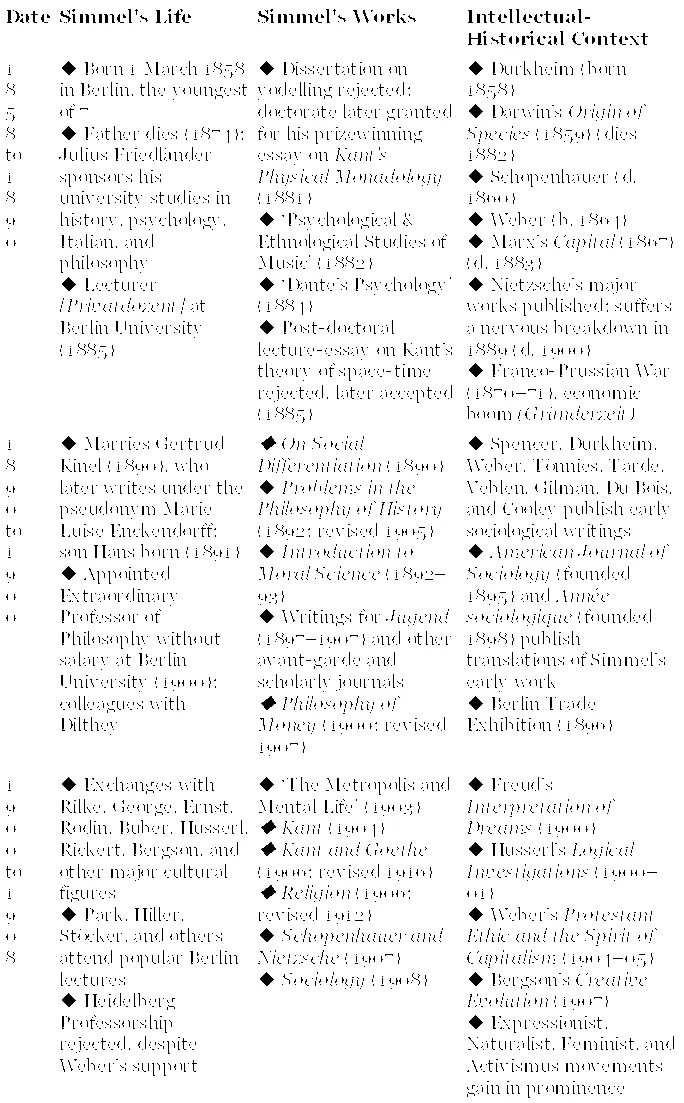
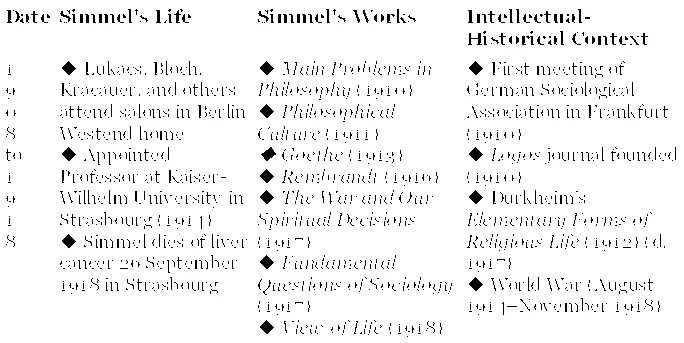
Although Simmel himself resisted writing out the details of his personal life, we can identify a number of significant events and turning points that illuminate the development of his ideas and the evolving shape of his work (see table 1). Since there is no complete biography of Simmel, these notes are based on letters, memoirs written by others, public documents, and other materials relating to his life (especially Helle 2013: 181–7; Köhnke 1996; Landmann 1958: 11–14; Pyyhtinen 2018: vii–x; and H. Simmel 1958). Thus we could at most call them ‘biographemes’ or mere fragments of a biography (Barthes 1989: 9). Simmel was born on 1 March 1858, the last of seven children, in a house that stood on the northwest corner of Friedrichstrasse and Leipzigerstrasse in central Berlin. As he grew up, the world around his childhood home changed rapidly in the wake of the Franco-Prussian War of 1871–2, which inaugurated a period of tremendous industrial and political development and led to the foundation of a unified German nation and the economic boom called the Gründerzeit. The opera, theatres, concert halls, museums, parliament, churches, markets, the castle, and the university, as well as countless restaurants, bars, and new venues of mass entertainment – all were within walking distance. As his good friend the poet, philosopher, and literary critic Margarete Susman (1872–1966) later reflected, ‘not just the time but also the place of his birth were decisive for his life and thought, a Berlin already on its way to becoming a lively and bustling metropolis’ (Susman 1992: 32).
Table 1 Simmel's life and work
Simmel's parents had migrated to Berlin from Breslau shortly after marrying, and both came from Jewish families that had converted to Christianity. Simmel was baptized a Protestant and regularly attended services until his final years, when he chose to pursue a more private and independent expression of his faith. His father, who co-founded a successful chocolate factory, died in 1874 when Simmel was just a teenager. A close family friend and wealthy sheet-music merchant, Julius Friedlander, was appointed his legal guardian and sponsored Simmel's studies in history, psychology, Italian, and philosophy at Berlin University. There he took classes with some of the most illustrious academics of the day, including the eminent historians Theodor Mommsen and Heinrich von Treitschke; the pioneers of social psychology (Völkerpsychologie) Moritz Lazarus and Heymann Steinthall; and the well-known economic historian Gustav Schmoller, who would publish some of Simmel's first works in his journal and book series. Simmel's difficulties in defending his doctoral and post-doctoral dissertations have become legendary, and they are often cited as early indications of his status as both an insider and an outsider to the academy. His doctoral thesis on the psychology and ethnology of music, which used an empirical case study of yodelling, was rejected by the examining committee as too stylistically sketchy and poorly proofread to be acceptable. Eventually his examiners agreed to accept his prize-winning essay on Immanuel Kant's physical monadology instead. A few years later, at his post-doctoral lecture on Kant's theory of space and time, Simmel ridiculed a senior faculty member's suggestion that the soul has a physical location in the brain (a belief also held by the seventeenth-century philosopher René Descartes). The examination was suspended and the candidate was asked to reflect on his breach of academic etiquette, although his work on Dante's psychology was later accepted in its place. Finally, in 1885 Simmel was appointed lecturer (Privatdozent) at the university that had grudgingly granted him his degrees, although his position was paid out of student fees rather than a fixed salary.
Although his career was only just beginning, Simmel's life and ideas began to take off after around 1890 (Köhnke 1996). Friedlander's death in 1889 left him with a considerable inheritance, although fluctuating returns on investments meant that his financial independence was never entirely secure. Nevertheless, he would continue to go his own way as a lecturer, thinker, and writer. In 1890 he married Gertrud Kinel (1864–1938), whom he had met through the artistic and literary circles with which he had become acquainted, and a year later their son Hans (1891–1943) was born. In addition to their shared cultural interests, the couple was an intellectual match, with Gertrud later writing her own philosophical books under the pseudonym Marie Luise Enckendorff (Leck 2000: 146–56). Simmel published a number of academic articles and journalistic pieces in these early years, as well as three major books i...
Table of contents
Cover
Table of Contents
Series page
Title page
Copyright page
Illustrations
Abbreviations
For Martha Garland
Open house in Berlin's Westend
Preface and Acknowledgements
1: Introduction: The Problem of Fitting in and Standing Out
Part I Philosophy of Money
Part II Sociology of Metropolises
Part III Cultures of Modernity
Suggestions for Further Reading
References
Index
End User License Agreement
Trusted by 375,005 students
Access to over 1.5 million titles for a fair monthly price.
Study more efficiently using our study tools.
Frequently asked questions
Yes, you can cancel anytime from the Subscription tab in your account settings on the Perlego website. Your subscription will stay active until the end of your current billing period. Learn how to cancel your subscription
No, books cannot be downloaded as external files, such as PDFs, for use outside of Perlego. However, you can download books within the Perlego app for offline reading on mobile or tablet. Learn how to download books offline
Perlego offers two plans: Essential and Complete
Essential is ideal for learners and professionals who enjoy exploring a wide range of subjects. Access the Essential Library with 800,000+ trusted titles and best-sellers across business, personal growth, and the humanities. Includes unlimited reading time and Standard Read Aloud voice.
Complete: Perfect for advanced learners and researchers needing full, unrestricted access. Unlock 1.5M+ books across hundreds of subjects, including academic and specialized titles. The Complete Plan also includes advanced features like Premium Read Aloud and Research Assistant.
Both plans are available with monthly, semester, or annual billing cycles.
We are an online textbook subscription service, where you can get access to an entire online library for less than the price of a single book per month. With over 1.5 million books across 990+ topics, we’ve got you covered! Learn about our mission
Look out for the read-aloud symbol on your next book to see if you can listen to it. The read-aloud tool reads text aloud for you, highlighting the text as it is being read. You can pause it, speed it up and slow it down. Learn more about Read Aloud
Yes! You can use the Perlego app on both iOS and Android devices to read anytime, anywhere — even offline. Perfect for commutes or when you’re on the go. Please note we cannot support devices running on iOS 13 and Android 7 or earlier. Learn more about using the app
Yes, you can access Simmel by Thomas Kemple in PDF and/or ePUB format, as well as other popular books in Social Sciences & Sociology. We have over 1.5 million books available in our catalogue for you to explore.