China's rapid rise as a regional and global power is one of the most important political developments of the twenty-first century. Yet the West still largely overlooks or oversimplifies the complex ideas and ideals that have shaped the country's national and international transformation from antiquity to the present day.
In this beautifully written introductory text, Youngmin Kim offers a uniquely incisive survey of the major themes in Chinese political thought from customary community to empire, exploring their theoretical importance and the different historical contexts in which they arose. Challenging traditional assumptions about Chinese nationalism and Marxist history, Kim shows that "China" does not have a fixed, single identity, but rather is a constantly moving target. His probing, interdisciplinary approach traces the long and nuanced history of Chinese thought as a true tradition anchored in certain key themes, many of which began in the early dynasties and still resonate in China today. Only by appreciating this rich history, he argues, can we begin to understand the intricacies and contradictions of contemporary Chinese politics, economy, and society.
- English
- ePUB (mobile friendly)
- Available on iOS & Android
eBook - ePub
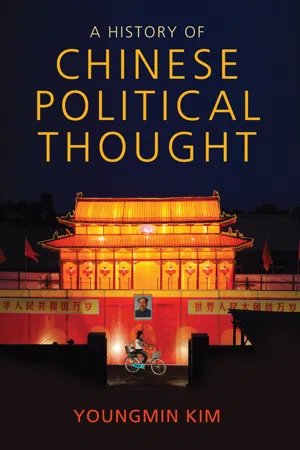
A History of Chinese Political Thought
About this book
Information
1
Introduction
As I try to offer a more fully historical narrative rather than the kind of synthetic history of Chinese political thought that has already been written, a review of the state of the art provides a useful point of departure. Although books and articles on Chinese political thought are voluminous, I here concern myself primarily with book-length studies whose title is “A History of Chinese Political Thought,” or something close to it.1
Hsiao Kung-chuan's A History of Chinese Political Thought (1979) is practically the only book-length study available in a Western language that introduces students to Chinese political thought from antiquity to modern times.2 In fact, Hsiao's work is part of the scholarly trend in the 1930s–40s that produced quite a few histories of Chinese political thought, including those of Lǚ Simian, Lǚ Zhenyu, Tao Xisheng, and Liang Qichao.3 Until the 1980s, very few scholarly efforts were made to write a chronological narrative of Chinese political thought in mainland China. Such a void in mainland Chinese scholarship was caused largely by political turmoil during that period (Zhu, 1988; Liu and Ge, 2001). Meanwhile, Taiwanese scholars, who were relatively free from political uncertainty (Ge, 2006, p. 296), produced a series of histories of Chinese political thought, including those of Xie Fuya, Sa Mengwu, Yang Youjiong, Ye Zuhao, and Zhang Jinjian, to name but a few.4 Over the last few decades, however, as the political landscape has changed, mainland Chinese scholars have increasingly produced histories of Chinese political thought.5 The growing number of volumes entitled “A History of Chinese Political Thought” indicates the fact that chronological and synthetic narrative is a popular genre in mainland Chinese scholarly writing, while there appears to be no corresponding tendency outside China. Synthetic surveys of Chinese political thought rarely have been attempted by Japanese scholars in the past half-century. Although the titles of a few books convey such an image, they are not intended as synthetic histories (see, e.g., Morimoto, 1967; Iwama, 1968).
To the extent that the present volume is written in English, it hopes to fill a major void after the publication of Hsiao's History. Hsiao's work is of course a classic one, and I cannot hope to emulate its impressive range. This book is much less ambitious, as I do not pretend to cover many significant political thinkers in Chinese history, let alone all of them, as Hsiao purportedly did. However, it is about forty years since the English version of Hsiao's book appeared, and a wealth of major advances in related subjects have been made since that time. For this reason alone, it seems worthwhile to try to furnish a more up-to-date synthetic account of Chinese political thought, taking account as far as possible of what I think are significant new perspectives and findings.
My decision to address anew Chinese political thought derives not only from my desire to incorporate newly produced scholarly achievements that have tremendously expanded our knowledge of Chinese intellectual tradition. This book is ambitious in the sense that it attempts to reconsider the assumptions that sustain existing synthetic narratives, including Hsiao's. One fruitful way of assessing the orientation of this volume is, then, to show how it departs from Hsiao's History. The following passage outlines the characteristic features of Hsiao's work.
China's history is a continuum extending through centuries from a remote past. … Political thought, too, saw a rapid and sudden development at this time, when Confucius assumed the role of teacher and established his teachings and the doctrines of the various other schools appeared in turn. … Meanwhile, we note in the imperial authoritarian forms of government only insignificant changes from the Qin and Han dynasties onward. … And had it not been for the continuous process of cultural and military invasion from the West via sea routes during the Ming and Qing dynasties, I fear that the Period of Continuation in political thought need not have ended with the Song and Yuan dynasties and that the subsequent Period of Change might not have come as it did in the Ming and Qing. The direct cause of the changes in China's political thought was the stimulus of outside forces. … The political thought of the authoritarian world had as its background the political institutions of the period from the Qin–Han dynasties to the Ming–Qing. … With all the schools of philosophy that had existed from pre-Qin times, it was their ability to adapt to the new historical environment [of the imperial age] that determined their prosperity or decline. The Confucians’ adaptability was greatest; hence the transmission of their teachings continued longest, and their real power and influence were strongest.
(Hsiao, 1979, pp. 3–4, 15–16, 20–1)
First, as exemplified by the sentence “China's history is a continuum extending through centuries from a remote past,” and other similar expressions throughout his book, Hsiao's work is driven by Chinese nationalism. Indeed, it views modern China as the inexorable culmination of earlier history. Second, in Hsiao's view, Chinese imperial history is characterized by authoritarian forms of government. Third, he regards Confucianism as a programmatic concept of Chinese political thought and Confucius as a “sudden” founder of it. Fourth, Chinese political thought represents an ideological justification of authoritarian forms of government. The success of Confucianism is explained in terms of its adaptability to Chinese despotism or autocracy. Fifth, there is no profound change in either Chinese imperial political arrangements or thought before Western learning impacted China.
Last but not least, Hsiao structures the chronological narrative of Chinese political thought according to putative stages of world-historical development, from the feudal world through the authoritarian empire to the modern nation-state. This stage of development roughly corresponds to European development from feudalism through absolute monarchy to the modern nation-state. Its primary flaw is teleology in that it takes the current outcome as determined and traces how past processes led up to it. As he believes in the dichotomous understanding of Western dynamism versus Chinese stagnation, Hsiao divides the history of Chinese political thought into three stages: the thought of the feudal world (including the Spring and Autumn and Warring States periods), the thought of the authoritarian empire (including the two thousand years from the Qin to the Qing), and the thought of the modern nation-state (from the late nineteenth century to the present day) (Hsiao, 1979, p. 19). Hsiao places most, if not all, Chinese political thinkers known at his time within this larger framework of Chinese history. The outcome is so mammoth that only half of this book has been translated into English.
I disagree with every point in the preceding citation, but it is still, I fear, a way of summing up a history of Chinese political thought to many people. Let us assess each of the points in turn.
What is China?
The first object of assessment is China itself, the core organizing concept of Hsiao's volume and other similar works. Most synthetic accounts of Chinese political thought seem to take “China” as ultimately a unitary unit, notwithstanding its internal multiplicity. Such a notion is not without merit in that it offers sustained signposts through which the narratives unfold. However, it leaves unexamined this long-cherished assumption.
A case in point is nationalist historiography, a dominant paradigm in mainland Chinese scholarship. Synthetic accounts in this mold are wedded to the nation as the subject of history, and take the current territorial and cultural boundaries of the Chinese nation-state for granted. One can find the theoretical blueprint of Chinese nationalism in Fei Xiaotong's The Unifying Structure of the Pluralist Chinese People (1999). The upshot is that, in principle, contemporary China is the inexorable culmination of earlier Chinese histories. Our everyday language and its categories also reflect nationalist historiography because many of us are still living in an apparent nation-state. They often lead us to suppose that we have long lived in a durable political unit which has had some allegedly pristine existence ever since antiquity.
However, critics have vigorously demonstrated that the notion of a historically unified nation-state of China is a myth. According to them, the nationalist image of China is much more a recent invention than a historical reality. While much debate still surrounds this politically charged issue, it is not the main concern of this book to settle the details of it. And yet it is evident that Chinese nationalism is both retrospective and teleological as a historiographical paradigm. It is retrospective in that the idea of China as a nation is projected back into pre-modern times, and it imputes significance to the past that it did not originally possess. It is also teleological in that it regards the current Chinese nation-state as the inevitable outcome of China's two-thousand-year-old imperial history.
History makes China more than China makes history. Instead of treating China as a monolith, therefore, this volume deals with it as a construction. Apart from the outcome of constant human effort to invent, reinvent, and reinforce Chinese identity through official rhetoric, historiography, and other means of ideological production, there is no absolute, eternal foundation that has sustained China. In a sense, what has been very much a reality is not China in itself but the quest for political identity under the rubric of China, which binds successive dynasties into an integrated whole. The quest has been reinterpreted, renegotiated, and readjusted in subsequent processes of fashioning Chinese identity. Rigid notions of Chinese identity have rarely survived for long periods of time, for they have been unable to cope with changing circumstances. Thus, this volume attempts to disentangle China from teleological historiography so as to appreciate Chinese political thought in its own historical contexts. Investigation of the relationship between the shifting ideas of China and the historical realities that produced them is interesting in its own right as a way to throw light on Chinese political thought. We want to know, among other things, how the Chinese constructed images of themselves as Chinese, why their self-identity took the precise forms it did, and in what way self-image conditioned political thought. In short, I would like to deal with the notion of China as a key contextual variable in narrating a long history of Chinese political thought.
Having said that, a few words about Chineseness seem in order.6 Chineseness here refers to a wide range of answers to the question, “What is China?” The answers, whatever they are, represent attempts to create a framework for imagining a trans-dynastic entity that can be applied across the entire span of what is called Chinese history. The trans-dynastic historical entity, however defined, is not the same as any particular spatio-cultural-political entity; it is a larger overall entity, within which each dynasty or state forges its identity. This type of fundamental question usually goes unasked, unless a new political entity emerges and attempts to relate itself to the historical succession of dynasties, thereby generating a larger sense of spatio-temporal continuity. Under normal circumstances, people tend to be more concerned about what China does rather than what China is. In recent decades, however, scholars have become increasingly concerned with the self-understanding of China, be it of state, national, ethnic, or cultural identity. It is a particularly daunting task to come to terms with the question of Chineseness, for China seems to be an enduring entity, but it is hardly a static one. Indeed, “China” continued to be invented and reinvented by various political actors, and thus constantly undergoes transformation that reflects changing historical conditions. These transformations stretch out over more than two thousand years. “China,” therefore, is not a fixed, single identity, but a constantly moving target.7 How, then, are we to capture the moving target and give ordered continuity to the otherwise messy historical material over the very long term?
Approaches to Chineseness
In English, we use the term “China” to refer to the polity of Zhongguo (“central state”) or Zhonghua (“central efflorescence”) in modern Chinese. The very term “China” was a variation of the word Qin (221–206 bc), the first unified imperial state in Chinese history and well known for its despotic power. In contrast, the term “central efflorescence” was obviously loaded with normative significance. That is, throughout Chinese history, Chinese rulers and intellectuals employed it to mean the universal vocation of “the center of civilization,” not referring to a modern type of nation-state. Imputing the contemporary sense of nationhood and statehood to Chinese history as a whole would be an anachronism. Most of the historical Chinas were certainly not yet the China w...
Table of contents
- Cover
- Table of Contents
- Dedication
- Title page
- Copyright page
- A Note on Conventions
- Dynasties and Periods
- Preface
- 1: Introduction
- 2: Enlightened Customary Community
- 3: Political Society
- 4: The State
- 5: Aristocratic Society
- 6: The Metaphysical Republic
- 7: The Greater Integrated World
- 8: Autocracy
- 9: Civil Society or Body Politic?
- 10: Empire
- Epilogue: China in Larger Contexts
- Glossary
- References
- Index
- End User License Agreement
Trusted by 375,005 students
Access to over 1.5 million titles for a fair monthly price.
Study more efficiently using our study tools.
Frequently asked questions
Yes, you can cancel anytime from the Subscription tab in your account settings on the Perlego website. Your subscription will stay active until the end of your current billing period. Learn how to cancel your subscription
No, books cannot be downloaded as external files, such as PDFs, for use outside of Perlego. However, you can download books within the Perlego app for offline reading on mobile or tablet. Learn how to download books offline
Perlego offers two plans: Essential and Complete
- Essential is ideal for learners and professionals who enjoy exploring a wide range of subjects. Access the Essential Library with 800,000+ trusted titles and best-sellers across business, personal growth, and the humanities. Includes unlimited reading time and Standard Read Aloud voice.
- Complete: Perfect for advanced learners and researchers needing full, unrestricted access. Unlock 1.5M+ books across hundreds of subjects, including academic and specialized titles. The Complete Plan also includes advanced features like Premium Read Aloud and Research Assistant.
We are an online textbook subscription service, where you can get access to an entire online library for less than the price of a single book per month. With over 1.5 million books across 990+ topics, we’ve got you covered! Learn about our mission
Look out for the read-aloud symbol on your next book to see if you can listen to it. The read-aloud tool reads text aloud for you, highlighting the text as it is being read. You can pause it, speed it up and slow it down. Learn more about Read Aloud
Yes! You can use the Perlego app on both iOS and Android devices to read anytime, anywhere — even offline. Perfect for commutes or when you’re on the go.
Please note we cannot support devices running on iOS 13 and Android 7 or earlier. Learn more about using the app
Please note we cannot support devices running on iOS 13 and Android 7 or earlier. Learn more about using the app
Yes, you can access A History of Chinese Political Thought by Youngmin Kim in PDF and/or ePUB format, as well as other popular books in Politics & International Relations & Social Policy. We have over 1.5 million books available in our catalogue for you to explore.