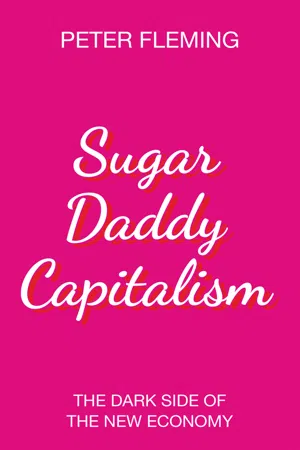
What is the connection between the sleaziness of Harvey Weinstein's 'business meetings' and the passionless doctrine of neoclassical economics? In this witty and incisive examination of the new economy, Peter Fleming argues that they are closer than you might think.
The quest to rid society of bureaucracy, shrink government and burn red tape has certainly made capitalism 'more human', but not in the family-friendly way envisaged by free-market gurus. Increasing informality has led to a capitalism fuelled by limitless exploitation and increasingly seedy methods of management, from semi-feudal workplace hazing rituals and predatory middle-managers with an axe to grind to arbitrary zero-hours contracts, Uber and, perhaps worst of all, the compulsory gym session with your boss.
Fleming dubs this 'Sugar Daddy Capitalism' after the controversial dating-app wealthy businessmen use to meet young girls, most of whom are struggling with university fees. What seems like a creepy outlier is actually a prescient metaphor for our whole economy: an anonymous and impersonal cash system that is also intent on getting under your skin, extra close and capable of ruining everything if you say ... 'no'.
- English
- ePUB (mobile friendly)
- Available on iOS & Android
eBook - ePub
Chapter One
Uberfamiliar
Over the last few years, a number of adverts on Craigslist and similar sites have illustrated the level of economic desperation people are facing in the long wake of the global financial crisis.1 These ‘rent-for-sex’ listings appear in the accommodation section of the website, typically in cities experiencing rising income inequality, a massive housing shortage and a euthanatized public sphere. Here are some examples:
$1 seeking young female roommate-free stay (Denver)I recently got out of a very long relationship. I want something very different. I’m looking for a young girl 18–20 who also wants something different. Maybe you are new here and need help. Or maybe you are getting out of a bad relationship and have nothing. Maybe no job or a shitty job you hate. Maybe you need place to stay, use of a car, new clothes, nice dinners, maybe travel (i love to go to Las Vegas for quick getways) etc.Contact me and i will let you know what i am looking for in return …£1 / 1br – Free single room in flat for Black Woman (London)This is my fantasy. Lovely room available for a broadminded black lady for 6 months only. A chance for you to save some money as you pay no rent. I’m normal easygoing guy in his 40s. My fantasy is that we live normally, giving you your own space & you let me lick your bumhole once a week. Serious replies with details of age, size & height with photos get first response.
Such rent-for-sex listings have proliferated and are a product of the times. In the dark neoliberal wasteland otherwise known as London, for example, the trend has become acute.2 Successive governments left the task of building new accommodation to the free market, which failed miserably to keep up with demand.3 Moreover, accommodation has suffered from an incredible speculation bubble, where faceless offshore firms (typically based in tax havens) see an easy investment opportunity, increasing rent for everyone else.4 For this reason, the so-called ‘shortage’ of housing can perversely coexist in communities with a large number of empty properties. Couple this with low wages and a personal debt crisis, and it’s no wonder some choose to sell their bodies in order to have somewhere to live.
The Age of Rent
Rent-for-sex is an extreme example of exploitation, of course. But it captures a broader mood among those struggling to live in a world that has been privatized to death. Here the market has been left to its own devices à la the prescriptions of neoclassical economics and the Chicago School. As a result, a predatory class of private rentiers have emerged. Because the options are so limited for people and they can easily find themselves homeless, tenants are frequently too afraid to complain about damp bedrooms or maltreatment from landlords.5 They are at the mercy of the property owner, a scenario we’d expect in some pre-industrial era, rather than 2018.6
A report pinpoints the issue succinctly, identifying characteristics that have increasingly reshaped other institutions too, including work, education and so forth: ‘it seems astonishing that the private rented sector … has no regulator, no ombudsman and no redress scheme … there are hundreds of thousands of landlords who have not had to pass a test of competence, demonstrate any knowledge of landlord or tenant law, or prove their honesty, financial probity … let alone have any experience of property management’.7
There’s always been an informal economy, of course. In poorer countries, global deregulation has seen this sphere grow dramatically, making up a good part of total economic output in some cases.8 And in rich developing countries, the informal employment sector – consisting of unregistered workers, the black and grey markets and sometimes even slavery – has been difficult for state officials to eradicate.9
But I’m interested in something slightly different – namely, understanding why unofficialdom has suddenly become so central to the way mainstream jobs and commerce are organized.
I see it as a by-product of the economic liberalization that’s inspired Western economic policy since the days of Thatcherism and Reaganomics up to the present. In a strange sort of way, the sex-for-rent scenario is a logical outcome of the free market doctrine so ardently embraced by Milton Friedman, Gary Becker and F. A. Hayek, although I’m guessing they wouldn’t want to admit it. For them, central planning by government distorts the equilibrium of supply and demand. The role of figuring out how work, goods and services are distributed should be left to millions of private individuals to grapple with alone. Enterprise and the price mechanism (a.k.a. cash) are far more efficient for allocating resources compared to distant and lethargic state bureaucrats. Moreover, anybody ought to be free to offer any service they like if there is a consumer willing to pay for it. Licences, registration and certification are barriers to open competition and entrepreneurship. If a service turns out bad, we don’t need a government shaking a stick. The customer will simply go elsewhere and the market will automatically correct itself.
In short, why do we need to waste taxpayers’ dollars on local housing authorities and government planning agencies when Craigslist can far more effectively distribute those plentiful spare bedrooms in London, Chicago or Glasgow? All at the touch of a button … and perhaps a little more besides, as the listings above indicate.
Land of Strangers?
This brand of unregulated, almost secretive, individualism is a key ideological driver behind the widespread Uberization of society we’ve witnessed over the last few years. This is where workers, for example, are deemed independent business owners, a logic that has also been embraced by the so-called ‘sharing economy’ and what some have dubbed ‘platform capitalism’.10 However, there’s a significant divergence between the academic models of free market capitalism (as envisaged by the neoclassical and mainstream economic tradition inaugurated by the Chicago School) and their messy, real-world implications. According to Hayek, for example, free market capitalism is great because it anonymizes and depersonalizes the actors involved.11 Complete strangers can come together and trade goods and services and then depart. There’s no complicated baggage or hang-ups involved. At the end of the day, business is business.
As we mentioned in the Introduction, Hayek considered this a good thing because money apparently blinds us to the particular ‘whom’ behind the transaction, solving a lot of problems in relation to favouritism and bias. Here, there are no personal whims or prejudice to contend with, which Hayek connected with government bureaucrats prone to cronyism and special interest groups (workers, the disabled and racial minorities are singled out, rather than corporatesponsored think tanks, of course). Due to the emphasis placed on cash anonymity, critics of neoliberal capitalism have lamented the veritable social desert that subsequently evolves, an unwelcoming ‘land of strangers’ that recognizes only the colour of your money and very little else.12
But, as the rent-for-sex example illustrates, this cold cash nexus might certainly be transactional and calculating, but it’s not anonymous. Sex (and god knows what else) is being exchanged, after all. While the ‘live-in bi plaything’ (to quote yet another Craigslist ad) appreciates it’s all just an economic arrangement, she must still engage with a massive amount of personal and arbitrary judgement. To a lesser extent, the same blend of cash objectivity and arbitrary discrimination is experienced in many facets of the economy. The agency worker in a bar, for example, feels the need to ingratiate herself with the boss in order to get another shift. The Uber driver seeks a high rating from a passenger. Or take the corporate employee who feels compelled to spend hours in the company gym listening to a sup...
Table of contents
- Cover
- Copyright
- Introduction The Economics of Sleaze
- 1 Uberfamiliar
- 2 Sugar Daddy Capitalism
- 3 Wiki-feudalism
- 4 The Human … All-Too-Human Workplace
- 5 No More Buddy Buddy
- Conclusion Less Human
- Index
- End User License Agreement
Trusted by 375,005 students
Access to over 1.5 million titles for a fair monthly price.
Study more efficiently using our study tools.
Frequently asked questions
Yes, you can cancel anytime from the Subscription tab in your account settings on the Perlego website. Your subscription will stay active until the end of your current billing period. Learn how to cancel your subscription
No, books cannot be downloaded as external files, such as PDFs, for use outside of Perlego. However, you can download books within the Perlego app for offline reading on mobile or tablet. Learn how to download books offline
Perlego offers two plans: Essential and Complete
- Essential is ideal for learners and professionals who enjoy exploring a wide range of subjects. Access the Essential Library with 800,000+ trusted titles and best-sellers across business, personal growth, and the humanities. Includes unlimited reading time and Standard Read Aloud voice.
- Complete: Perfect for advanced learners and researchers needing full, unrestricted access. Unlock 1.5M+ books across hundreds of subjects, including academic and specialized titles. The Complete Plan also includes advanced features like Premium Read Aloud and Research Assistant.
We are an online textbook subscription service, where you can get access to an entire online library for less than the price of a single book per month. With over 1.5 million books across 990+ topics, we’ve got you covered! Learn about our mission
Look out for the read-aloud symbol on your next book to see if you can listen to it. The read-aloud tool reads text aloud for you, highlighting the text as it is being read. You can pause it, speed it up and slow it down. Learn more about Read Aloud
Yes! You can use the Perlego app on both iOS and Android devices to read anytime, anywhere — even offline. Perfect for commutes or when you’re on the go.
Please note we cannot support devices running on iOS 13 and Android 7 or earlier. Learn more about using the app
Please note we cannot support devices running on iOS 13 and Android 7 or earlier. Learn more about using the app
Yes, you can access Sugar Daddy Capitalism by Peter Fleming in PDF and/or ePUB format, as well as other popular books in Economics & Economic Policy. We have over 1.5 million books available in our catalogue for you to explore.