In this short and provocative book, cultural studies scholar Angela McRobbie develops a much-needed feminist account of neoliberalism. Highlighting the ways in which popular culture and the media actively produce and sustain the cultural imaginary for social polarization, she shows how there is substantial pressure on women not just to be employed, but to prioritize working life. She fiercely challenges the media gatekeepers who shape contemporary womanhood by means of exposure and public shaming, and pays particular attention to the endemic nature of anti-welfarism as it is addressed to women, thereby reducing the scope for feminist solidarity.
In this theoretically rich and deep analysis of current cultural processes, McRobbie introduces a series of concepts including 'visual media governmentality' and the urging of women into work as 'contraceptive employment'. Foregrounding a triage of ideas as the 'perfect-imperfect-resilience' McRobbie conveys some of the key means by which consumer capitalism attempts to manage the threats posed by the new feminisms. She proposes that 'resilience' emerges as a compromise, as hard-edged neoliberalism proffers the option of a return to liberal feminism.
A lively and devastating critique, Feminism and the Politics of Resilience offers a much-needed wake-up call. It is essential reading for students and scholars of cultural studies, media, sociology, and women's and gender studies.
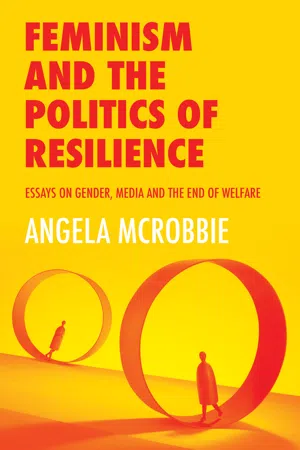
eBook - ePub
Feminism and the Politics of Resilience
Essays on Gender, Media and the End of Welfare
- English
- ePUB (mobile friendly)
- Available on iOS & Android
eBook - ePub
Feminism and the Politics of Resilience
Essays on Gender, Media and the End of Welfare
About this book
Information
1
Feminism, the Family and the New Multi-Mediated Maternalism
The Maternal–Feminine
In this first chapter1 I trace a line of development from liberal to neoliberal feminism, which is, I claim, being at least partly realized and embodied through the ubiquitous figure of the middle-class, professional wife and mother. Following on from a comment by Stuart Hall on the centrality of the ‘middle class’ to the neoliberal project, I overlay this with the additional categories of gender and maternity (Hall 2011). This emergent image of motherhood not only displaces, but also begins to dismantle, a longstanding political relationship, which in the UK has linked post-war social democracy with maternity, while simultaneously providing the political right with a new, more contemporary script that allows it to take the lead in the current debate on family life. The analysis I offer is restricted, more or less, to contemporary Britain, with several references to US popular culture and to US liberal feminism, for the reason that these have provided so much of a steer for the way in which the neoliberal agenda in the UK has addressed motherhood and domestic life. This agenda is quite different from the now out-of-date conservative mantra of ‘family values’. The right-wing newspaper the Daily Mail in its ‘Femail’ section has been particularly forceful in its championing of a style of affluent, feminine maternity. This idea of active (en route to the gym), sexually confident motherhood marks an extension of its pre-maternal equivalent, the ambitious and aspirational young working woman or ‘top girl’ (McRobbie 2008). It is also consistently pitched against an image of the abject, slovenly and benefits-dependent single mother, the UK equivalent of the US ‘welfare Mom’. (The political role of this imaginary of welfare maternity is explored in more detail in Chapters 3 and 4 of this volume.) Only in academic feminism do we find a more critical and empathetic response to the difficulties faced by out-of-work single mothers.2
While feminism has for many decades been a political formation with historic connection closer to the left than the right, this alignment is now undergoing change, with substantial gains for the right should it manage to develop further what is at the moment merely a kind of feminist flourish. Within and alongside the UK Coalition government we could see a fledgling feminist strand, led mostly by an urban, upper-middle-class stratum of women, including former Cabinet Minister Louise Mensch, Home Secretary Theresa May, Liberal Democrat MP Jo Swinson, as well as a number of influential young spokeswomen from right-wing think tanks such as Policy Reform. This tacit endorsement of feminism is informed by 1970s US liberal feminism, with an emphasis on equal rights, condemnation of domestic and sexual violence, and action against genital mutilation. It is drawn into the field of popular Tory neoliberal hegemony particularly through the idea of ‘welfare reform’, and in this realm it takes the form of an unapologetically middle-class white feminism, shorn of all obligations to less privileged women or to those who are not ‘strivers’ (a favoured term within welfare reform discourse).
In what is, I hope, a continuation of feminist discussions on the rise of neoliberalism led by Wendy Brown’s work on the demise of liberal democracy, and followed through by my own writing on young women as subjects of the meritocracy under New Labour, and by Nancy Fraser in her provocative argument that there has been ‘feminist complicity’, I aim to show how a new momentum for the political right is accomplished by means of a careful claiming of heterosexual maternal womanhood (Brown 2005; McRobbie 2008; Fraser 2009). What has emerged is a perhaps unexpected rehabilitation of feminism as a broad constellation of progressive socio-political interests converging around the category of woman that can be usefully deployed by those modernizing forces of the right, centre and also centre left, where previously such an association would have been shunned. The very words ‘conservative feminism’ are now commonplace, part of the everyday vocabulary of Louise Mensch in her newspaper articles, blogs and television appearances and a lively talking point across contemporary political culture in the UK. Feminism is no longer despised but is given new life through an articulation with a specific range of values pertaining to the project of contemporary neoliberalism. This connection is confirmed towards the end of the best-selling book Lean In: Women, Work and the Will to Lead by the Chief Operating Officer (COO) of Facebook, Sheryl Sandberg, where the author unashamedly declares herself a feminist (Sandberg 2012). I will return to Sandberg’s book and its significance in the final section of this chapter, but for the moment I want to highlight this take-up of feminism as an aspect of the ambitious reach of neoliberalism – a breadth of influence that means that its principles have become not just a new kind of common-sense, but also an active force-field of political values, at a time when the political left has been crushed or at least subdued.3 Others would remark that parties of both the left and (centre) left have in any case already conceded to the neoliberal agenda, such that there is not a great deal of difference in the UK between the modernizing agenda of Labour and the austerity-driven policies of the Coalition government. In each case there has been a commitment to privatization of the public sector, the denigration of welfare regimes as producing unaffordable dependencies, an emphasis on self-responsibility and entrepreneurialism, and constant advocacy of stable (if also now flexible and gay) forms of family life.
As a starting point, then, I would say that there is something of a feminist endorsement detectable in the political air. The animosity and repudiation, which were features of the Blair government and the popular culture and media of the time, have receded. Support for ‘hard-working families’, a phrase first coined by Gordon Brown during his time as Chancellor of the Exchequer, was retained by both leaders of the Tory Party and the Liberal Democrats, but this now incorporates a more engaged and sympathetic dialogue with mothers (stay-at-home and working), with some indication that this is a ‘feminist issue’ for today.4 This advocacy of women seems like more than just a pragmatic move to secure the female vote, and more than a knee-jerk response to the vocal presence of online campaigners and new female constituencies. Instead it is arguably part of a process of inventing a repertoire of woman-centred positions that will confirm and enhance the core values of the neoliberal project. A great deal of this ideological work takes place outside, but in close proximity to, the field of formal politics, in culture and in particular within the various forms of feminine mass media:5 including BBC Radio 4’s Woman’s Hour; the ‘Femail’ section of the Daily Mail mentioned above; the ‘women’s pages’ (or ‘lifestyle’ sections) of all the national quality daily newspapers such as the Guardian, the Independent, The Times and the Daily Telegraph; some key daytime television programmes such as Loose Women; and, of course, the range of women’s magazines from the fashion-oriented Grazia to Red and Elle and the traditional Woman’s Own. Where in the early 2000s an invitation to female empowerment seemed to require a ritualistic denunciation of feminism as old-fashioned and no longer needed (with the exception of the left-leaning Guardian newspaper and BBC Radio 4’s Woman’s Hour), the current media culture now feels able to make a claim, of sorts, to a feminism, of sorts.
The observations I offer in the pages that follow suggest the value of a feminism (with roots in the US liberal feminist tradition) for the neoliberal regime, offering a distinctively gendered dimension to the mantra of individualism, the market and competition as well as updating the now old-fashioned ‘family values’ vocabularies associated with social conservatism. These are old-fashioned for a number of reasons. For a start, female labour power is far too important to the post-industrial economy for anyone to be an advocate of long-term stay-at-home wives and mothers. Moreover, spurred on by the rise of feminism from the mid 1970s onwards, women expressed a strong desire to work. (LGBTQ and BAME women, along with their working-class white counterparts, have always been in paid labour.) The new conservative feminists see that with the high rate of divorce, having a career not only provides women with an income and independence, it also reduces the cost of welfare to government. It thus makes sense for government to champion women who will enter the labour market and stay in it. In this context the new ‘corporate’ feminism supports and extends the dominance of contemporary neoliberalism. If it runs into some difficulties when confronted, for example, by religious lobbies and individual politicians of both sexes opposed to abortion (or similar issues), these are surmountable obstacles. Choice, empowerment and a commitment to ‘planned parenthood’ are uppermost.
Imperative to this new neoliberal feminism is its stand and status with regard to its imagined other, the Muslim woman assumed to be oppressed and subjected to various forms of domination and control. Various feminist scholars writing in the context of the post 9/11 world have referred to this as the instrumentalization of feminism, and Jasbir Puar has reflected on the strategic value of homonationalism, and the instrumentalization of gay and lesbian rights, as a means by which Western governments, particularly in the US, can assert a kind of global progressive superiority (Puar 2012). What I am interested to chart here is the way in which, working through a number of powerful media channels, political parties and forces of the mainstream right – primarily, in my account, the British Conservatives, but also parties in Europe such as the German Christian Democrats – are able to revitalize and modernize the conservative agenda by adopting a weak version of feminism, which in turn permits a new kind of more attentive address to women.6
Revolutionary Road?
In what follows I first introduce the analysis of family values and neoliberal feminism by briefly considering the 2009 film Revolutionary Road (dir. Sam Mendes). I then look back at some strands of (second-wave) socialist–feminist writing on the family from the late 1970s. This is followed by a section on the Foucault tradition, especially the late 1970s biopolitics lectures and the concept of human capital. And then, as a tool for understanding the new address to mothers as active sexual subjects (expressed through body culture) as well as subjects who are proactive in the economic sense (in the workforce), I propose ‘visual media governmentality’ as a regulatory space for the formulation and working through of many of these ideas. It is here that the benchmarks and boundaries of female success are established, and it is here that new norms of failure symbolized in the abject body of the ‘single mother’ and in the bodies of her untidy children or ‘brood’ are to be found. In this visual field, vulnerability and dependency are graphically equated with personal carelessness, with being overweight and badly dressed, and these in turn become ‘performance indicators’ signalling inadequate life planning and what Wendy Brown calls ‘mismanaged lives’ (Brown 2005).
Why Revolutionary Road? This is a film positioned somewhere between the popular middlebrow, quasi-independent films associated with the Working Title productions of Richard Curtis, films often appealing primarily to women, and a more art-house genre. This generic slot promises a largely female, middle-class, possibly university-educated audience. Such are the complex economies of film production and distribution today that at the time of the cinematic release there are multiple strands of accompanying publicity and snippets of information widely disseminated across a range of media forms, with the result that films become remarkably open-ended cultural objects. Revolutionary Road reunited two of Hollywood’s most famous actors already known for their previous performance in Titanic, and in this sense the stars Kate Winslet and Leonardo DiCaprio bring to the film a whole set of both sexual and romantic expectations. The director Sam Mendes was at the time married to Kate Winslet and the film itself is about marital discord. Mendes is known for directing American Beauty, and he is regarded as someone with a liberal sensibility.
Both American Beauty and Revolutionary Road have small casts, like stage-plays, and they are prepared to tackle difficult emotional situations, underscored by a recognition of the place for, and impact of, sexual politics. If American Beauty told a story of post-feminist heterosexual family life, Revolutionary Road turns the director’s gaze back in time to pre-(liberal-)feminist USA. Based on a highly regarded novel published in 1962 by US writer Richard Yates, Revolutionary Road offers the opportunity to reflect on a move from the founding moments of white, middle-class US liberal feminism to its contemporary transformation into neoliberal feminism. It is a film that has as its subtext a range of feminist issues, serving as a reminder of the gains made in the moment coming directly after the period in which the film is set. It is not so much that it anticipates feminism as that it shows why, when it finally exploded, US liberal feminism took the shape that it did. It is therefore an immanent narrative fuelled by an unspeakable desire for something, which could only be a sexual politics to come. The timing of its production, the themes that the director does not quite bring to the surface, but leaves to the audience to infer, as well as a press comment by Kate Winslet that she read The Feminine Mystique in preparation for the role of April, all suggest that the producers of this multi-million-dollar film were persuaded that feminist questions could translate into box-office success.7 Set in the mid 1950s, the film, however, offers no evoking of nostalgia. Winslet’s wardrobe is carefully chosen both to constrain her within that pre-feminist moment of conservative femininity and also to suggest that s...
Table of contents
- Cover
- Contents
- Title page
- Copyright page
- Acknowledgements
- Introduction
- 1 Feminism, the Family and the New Multi-Mediated Maternalism
- 2 Feminism and the Politics of Resilience
- 3 Out of Welfare: Women and ‘Contraceptive Employment’
- 4 ‘Breaking the Spell of the Welfare State’: Gender, Media and Poverty-Shaming
- References
- Index
- End User License Agreement
Trusted by 375,005 students
Access to over 1.5 million titles for a fair monthly price.
Study more efficiently using our study tools.
Frequently asked questions
Yes, you can cancel anytime from the Subscription tab in your account settings on the Perlego website. Your subscription will stay active until the end of your current billing period. Learn how to cancel your subscription
No, books cannot be downloaded as external files, such as PDFs, for use outside of Perlego. However, you can download books within the Perlego app for offline reading on mobile or tablet. Learn how to download books offline
Perlego offers two plans: Essential and Complete
- Essential is ideal for learners and professionals who enjoy exploring a wide range of subjects. Access the Essential Library with 800,000+ trusted titles and best-sellers across business, personal growth, and the humanities. Includes unlimited reading time and Standard Read Aloud voice.
- Complete: Perfect for advanced learners and researchers needing full, unrestricted access. Unlock 1.5M+ books across hundreds of subjects, including academic and specialized titles. The Complete Plan also includes advanced features like Premium Read Aloud and Research Assistant.
We are an online textbook subscription service, where you can get access to an entire online library for less than the price of a single book per month. With over 1.5 million books across 990+ topics, we’ve got you covered! Learn about our mission
Look out for the read-aloud symbol on your next book to see if you can listen to it. The read-aloud tool reads text aloud for you, highlighting the text as it is being read. You can pause it, speed it up and slow it down. Learn more about Read Aloud
Yes! You can use the Perlego app on both iOS and Android devices to read anytime, anywhere — even offline. Perfect for commutes or when you’re on the go.
Please note we cannot support devices running on iOS 13 and Android 7 or earlier. Learn more about using the app
Please note we cannot support devices running on iOS 13 and Android 7 or earlier. Learn more about using the app
Yes, you can access Feminism and the Politics of Resilience by Angela McRobbie in PDF and/or ePUB format, as well as other popular books in Social Sciences & Media Studies. We have over 1.5 million books available in our catalogue for you to explore.