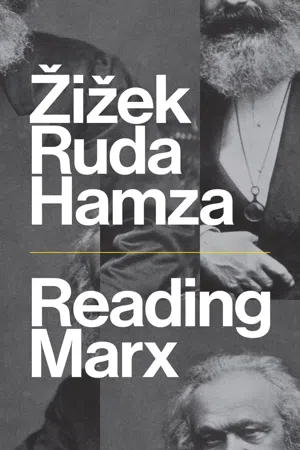
Marx's critique of political economy is vital for understanding the crisis of contemporary capitalism. Yet the nature of its relevance and some of its key tenets remain poorly understood. This bold intervention brings together the work of leading Marx scholars Slavoj Žižek, Frank Ruda and Agon Hamza, to offer a fresh, radical reinterpretation of Marxism that explains the failures of neoliberalism and lays the foundations for a new emancipatory politics.
Avoiding trite comparisons between Marx's worldview and our current political scene, the authors show that the current relevance and value of Marx's thought can better be explained by placing his key ideas in dialogue with those that have attempted to replace them. Reading Marx through Hegel and Lacan, particle physics, and modern political trends, the authors provide new ways to explain the crisis in contemporary capitalism and resist fundamentalism in all its forms. Reading Marx will find a wide audience amongst activists and scholars.
- English
- ePUB (mobile friendly)
- Available on iOS & Android
eBook - ePub
Reading Marx
About this book
Information
1
Marx Reads Object-Oriented Ontology
The reading of Marx we really need today is not so much a direct reading of his texts as an imagined reading: the anachronistic practice of imagining how Marx would have answered to new theories proposed to replace the supposedly outdated Marxism. The latest in this series is a complex field whose different versions go under the names of object-oriented ontology (OOO), assemblage theory, and new materialism (NM). Although its main target is transcendental humanism, what lurks in the background is clearly the specter of Marxism. In defending Marxism against this latest onslaught, we will proceed via an unexpected detour: our reading of OOO will privilege Graham Harman who, although he may appear to offer its most static and undialectical version, paradoxically brings out some features which enable us to establish a link with Marxist dialectics.1
Mechanism, organism, structure, totality, assemblage – one should negotiate a proper position between the two extremes: the assertion of just one category (say, assemblage or totality) as the only appropriate one, with the denunciation of others as false; the simple acceptance of each category as an appropriate description of a particular level of reality (mechanism for inanimate matter, organism for life, etc.). Especially interesting are cases of the dialectical intermingling of categories – for example, does Stephen Jay Gould’s thesis on exaptation not imply that organisms are structured like assemblages? Does Hegel’s deployment of the rise of Spirit out of Life not imply a “regression” to mechanism at the level of how signs function? (It is this “regression” to mechanism that sustains the passage from organic-expressive Whole characteristic of organisms to differential structure characteristic of symbolic networks.) The crucial point is, then, that the five notions – mechanism, organism, (differential) structure, totality, assemblage – are not at the same level. Totality is not the same as differential structure, but only in the sense that totality is differential structure thought to the end – that is, a differential structure that includes subjectivity and a constitutive antagonism. (Furthermore, mechanism of dead matter is not the same as the signifying mechanism.) Bearing all this in mind, we’ll focus on the opposition between assemblage and totality. Let us begin with the basic determinations of assemblage:
- Assemblages are relational: they are arrangements of different entities linked together to form a new whole. They consist of relations of exteriority, and this exteriority implies certain autonomy of the terms (people, objects, etc.) from the relations between them; the properties of the component parts also cannot explain the relations that constitute a whole.
- Assemblages are productive: they produce new territorial organizations, new behaviors, new expressions, new actors, and new realities.
- Assemblages are heterogeneous: there are no a priori limits as to what can be related – humans, animals, things, and ideas – nor is there a dominant entity in an assemblage. As such, assemblages are socio-material, i.e., they eschew the nature-culture divide.
- Assemblages imply a dynamic of deterritorialization and reterritorialization: they establish territories as they emerge and hold together but also constantly mutate, transform, and break up.
- Assemblages are desired: desire constantly couples continuous flows and partial objects that are by nature fragmentary and fragmented.
In this vision, the world is conceived as multiple and performative, that is, shaped through practices, as different from a single pre-existing reality. This is why, for Bruno Latour, politics should become material, a Dingpolitik revolving around things and issues of concern, rather than around values and beliefs. Stem cells, mobile phones, genetically modified organisms, pathogens, new infrastructure, and new reproductive technologies bring concerned publics into being that create diverse forms of knowledge about these matters and diverse forms of action – beyond institutions, political interests, or ideologies that delimit the traditional domain of politics. Whether it is called ontological politics, Dingpolitik, or cosmopolitics, this form of politics recognizes the vital role of nonhumans, in concrete situations, co-creating diverse forms of knowledge that need to be acknowledged and incorporated rather than silenced. Particular attention has gone to that most central organization of all for political geographers: the state. Instead of conceiving the state as a unified actor, it should be approached as an assemblage that makes heterogeneous points of order – geographic, ethnic, linguistic, moral, economic, technological particularities – resonate together. As such, the state is an effect rather than the origin of power, and one should focus on reconstructing the socio-material basis of its functioning. The concept of assemblage questions the naturalization of hegemonic assemblages and renders them open to political challenge by exposing their contingency. “By insisting that phenomena do not have to be a particular way just because they are a particular way, assemblage thinking and ANT [actor-network theory] open up avenues for alternative orderings and thus for political action.”2
The relative autonomy of the elements of an assemblage also enables the radical re-contextualization of a work of art; exemplary here, of course, is the case of Shakespeare’s plays, which can be transposed into a contemporary setting and given a different twist without losing their effectiveness. But let us take another more surprising example. Of the three post-WWII big versions of the movie Quo Vadis (1951, USA, Melvyn le Roy; 1985, TV miniseries, Italy, Franco Rossi; 2001, Poland, Jerzy Kawalerowicz), the first and the last are exemplary cases of “high quality” religious kitsch, while Rossi’s six-hour TV version with Klaus Maria Brandauer as Nero is much more unsettling in its dark mood. In this version, there is so much perverse darkness in the obscene power display of Nero and his court that the final redemption simply doesn’t work – the surviving Christians are just left to depart after their lives were effectively ruined and their innocent joy of life destroyed. Rossi demonstrates how a model cinema version should proceed: even the lowest form of Christian propaganda (Henryk Sienkiewicz’s unbearably pretentious novel, which got him the Nobel Prize) can be rendered in a way that counteracts its explicit message. Rossi does not introduce a foreign element into the novel – the narrative content is exactly the same; he merely takes the atmosphere of perverse tortures of the early Christians more seriously than the original novel did itself. So, to put it in the terms of ANT, Rossi’s version is contained in the novel’s diagram, as a virtual option. However, the conclusion that I draw from this example is not exactly the same as the one drawn by Harman. Rossi’s version is not contained in the novel In-itself; it was added to the novel’s diagram with the new trends in cinema. Furthermore, such a “change” is not the result of some mysterious In-itself of the novel that eludes its actual interactions; if we want to discern how such a different reading is rendered possible by the immanent structure of the novel, we should rather conceive the novel as in itself ontologically open, “unfinished,” inconsistent, traversed by antagonisms. I am basically making here the traditional Hegelian point: change doesn’t come just from outside. In order for a thing to (be able to) change, its identity already has to be “contradictory,” inconsistent, full of immanent tensions, and in this sense ontologically “open.” [In-itself? in-itself? in itself? Later on, the hyphenated version is always given with an initial capital letter: In-itself.]
In the domain of politics, it would be interesting to analyze the Trump movement as an assemblage – not as a consistent sui generis populist movement, but as a precarious assemblage of heterogeneous elements that enabled it to exert hegemony: populist anti-establishment protest rage, protection of the rich by lower taxes, fundamentalist Christian morality, racist patriotism, etc. These elements in no way belong together; they are heterogeneous and can as easily be combined into a totally different set (for example, anti-establishment protest rage was also exploited by Bernie Sanders; lower taxes for the rich are usually advocated on purely economic grounds by (economic) liberals who despise populism, etc.).
The logic of assemblage is also to be taken into account when we are dealing with big Leftist emancipatory slogans like “the struggle against Islamophobia and the struggle for women’s rights are one and the same struggle” – yes, as a goal, but in the mess of actual politics these are two separate struggles that not only run independently of each other but also work against each other: Muslim women’s struggle against their oppression; anticolonial struggle, which dismisses women’s rights as a Western plot to destroy traditional Muslim communal life, etc.
The concept of assemblage also opens up a path to the key question of the communist reorganization of society: how could one put together in a different way large-scale organizations that regulate water supply, health, security, etc.? We should raise here the question of how the notion of assemblage relates to Ernesto Laclau’s notion of the chain of equivalences, which also involves a combination of heterogeneous elements that can be combined with different others (for example, ecology can be anarchic, conservative, capitalist – believing that market regulations and taxations are the right measures – communist, state-interventionist …). What distinguishes Laclau’s “chain of equivalences” is that such a chain does not only assemble heterogeneous elements into an agency, it assembles them as part of the antagonistic struggle of Us against Them, and antagonism is something that traverses each of these elements from within. This is why we should not conceive assemblage as a combination of pre-given elements that strive toward some kind of unification: each element is already traversed by a universality which cuts into it as a universal antagonism/inconsistency, and it is this antagonism that pushes elements to unify, to form assemblages. The desire-for-assemblage is thus proof that a dimension of universality is already at work in all elements in the guise of negativity, of an obstacle that thwarts their self-identity. In other words, elements don’t strive for assemblage in order to become part of a larger Whole; they strive for assemblage in order to become themselves, to actualize their identity.
Dialectical Materialism is Immaterialism
Before we deal with this central topic of the relationship between assemblage and antagonism, we should clarify what Harman means by his anti-materialist stance (directed against other currents close to his) or, as he calls it, his “immaterialism.” In this short overview, I of course largely ignore the important differences between object-oriented ontology, actor-network theory, and new materialism (these differences are concisely deployed by Harman). The opposition of NM and Harman’s own immaterialism is the one between constant change of everything (flux) and intermittent change with stability as a norm – continuity of flow versus fixed identities and definite boundaries; everything is contingent versus not everything is contingent; actions/verbs versus substances/nouns; interactive practice versus autonomous essences; what a thing does versus what a thing is; multiple versus singular; immanence versus transcendence. And between ANT and OOO: the two share a basic ontology, but everything is an actor (ANT) versus action is not a universal property (OOO); reciprocity of action (ANT) versus non-reciprocity (OOO); and symmetry versus asymmetry of relations; etc. Basically, it is the Deleuzean concept of becoming versus a return to stable identities of being – a stance that is today more or less universally accepted. Who dares to deny that stable “essences” and clearly delimitated entities are just temporary “reifications” of some productive flux of becoming? The key difference between Harman’s theory and ANT is that, in ANT, assemblage’s unity is purely relational, irreducible to its component parts – and, paradoxically, I am here on Harman’s side, although, of course, with a twist. The first of Harman’s “Fifteen Provisional Rules of OOO Method” is: objects not actors – “things pre-exist their activity rather than being created by it.”3 His main argument for the stable “essential” identity of objects is paradoxically (the possibility of) change: if objects were totally externalized, actualized in their interactions with other objects, all their potentials would have been always already actualized and there would be no space for change.
There are many ways to discern materialism, the materialist position, today. One would be to insist on a minimal link of every universality to a particular species: a universality is never purely abstract, a neutral medium of its species; it always entertains a privileged link to one of its species – Hegel called this “concrete universality.” So where should we look for materialism today? Let us turn to quantum physics, the supreme battleline between materialism and idealism. In April 2017, a media report claimed that
Scientists have discovered a new mechanism in quantum mechanics that challenges existing knowledge about the point at which entangled light particles originate from.Quantum entanglement is the process where seemingly pairs or groups of counter-intuitiv...
Table of contents
- Cover
- Copyright
- Notes on the text
- Introduction
- 1 Marx Reads Object-Oriented Ontology
- 2 Marx in the Cave
- 3 Imprinting Negativity: Hegel Reads Marx
- To Resume (and not Conclude)
- Index
- End User License Agreement
Trusted by 375,005 students
Access to over 1.5 million titles for a fair monthly price.
Study more efficiently using our study tools.
Frequently asked questions
Yes, you can cancel anytime from the Subscription tab in your account settings on the Perlego website. Your subscription will stay active until the end of your current billing period. Learn how to cancel your subscription
No, books cannot be downloaded as external files, such as PDFs, for use outside of Perlego. However, you can download books within the Perlego app for offline reading on mobile or tablet. Learn how to download books offline
Perlego offers two plans: Essential and Complete
- Essential is ideal for learners and professionals who enjoy exploring a wide range of subjects. Access the Essential Library with 800,000+ trusted titles and best-sellers across business, personal growth, and the humanities. Includes unlimited reading time and Standard Read Aloud voice.
- Complete: Perfect for advanced learners and researchers needing full, unrestricted access. Unlock 1.5M+ books across hundreds of subjects, including academic and specialized titles. The Complete Plan also includes advanced features like Premium Read Aloud and Research Assistant.
We are an online textbook subscription service, where you can get access to an entire online library for less than the price of a single book per month. With over 1.5 million books across 990+ topics, we’ve got you covered! Learn about our mission
Look out for the read-aloud symbol on your next book to see if you can listen to it. The read-aloud tool reads text aloud for you, highlighting the text as it is being read. You can pause it, speed it up and slow it down. Learn more about Read Aloud
Yes! You can use the Perlego app on both iOS and Android devices to read anytime, anywhere — even offline. Perfect for commutes or when you’re on the go.
Please note we cannot support devices running on iOS 13 and Android 7 or earlier. Learn more about using the app
Please note we cannot support devices running on iOS 13 and Android 7 or earlier. Learn more about using the app
Yes, you can access Reading Marx by Slavoj Zizek,Frank Ruda,Agon Hamza in PDF and/or ePUB format, as well as other popular books in Philosophy & Philosophy History & Theory. We have over 1.5 million books available in our catalogue for you to explore.