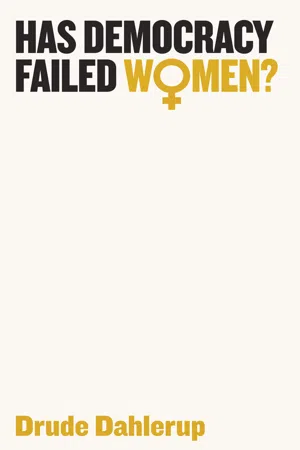
Why are women still under-represented in politics? Can we speak of democracy when women are not fully included in political decision-making? Some argue that we are on the right track to full gender equality in politics, while others talk about women hitting the glass ceiling or being included in institutions with shrinking power, not least as a result of neo-liberalism.
In this powerful essay, internationally renowned scholar of gender and politics Drude Dahlerup explains how democracy has failed women and what can be done to tackle it. Political institutions, including political parties, she argues, are the real gatekeepers to elected positions all over the world, but they need to be much more inclusive. By reforming these institutions and carefully implementing gender quotas we can move towards improved gender equality and greater democratization.
- English
- ePUB (mobile friendly)
- Available on iOS & Android
eBook - ePub
Has Democracy Failed Women?
About this book
Information
1
Exclusion Without Words
As the daughter of a feminist mother, I knew that my high-school teacher was wrong when, without any reservations, he taught us that the ancient city-state of Athens was the “cradle of democracy.” Can one really speak of democracy when a large portion of the population, perhaps even the majority, is excluded from political decision-making, as was the case in ancient Greece for women as well as for immigrants, slaves and workers? As a schoolgirl I protested in class, though to no avail.
The feminist critique of the celebration of the city-state of Athens as the cradle of democracy focuses on what we might call the “who” of democracy, that is, those who are included in, and those groups which are excluded from, political decision-making. This perspective challenges the traditional discourse, be it in political theory or in actual political life, which gives priority to the procedures – the “how” of democratic decision-making. Can one honestly speak of democracy if women and minorities are excluded, even if the procedures followed among the privileged men in the polity fulfill all the noble criteria of fair elections, deliberation and rotation of positions? In general, it is necessary to challenge the traditional definitions of democracy.
From a feminist perspective, the full and equal inclusion of women in politics is important as a right in itself because of the visible and highly symbolic value of political representation. Moreover, women’s movements have argued that the inclusion of women is necessary in order to change the political agenda and the political decisions. To those who say that the gender of politicians does not matter, feminists would respond: imagine a parliament or government with 80 percent women – would that not immediately cause a masculine uproar?
Two further dimensions of democracy are relevant here. The feminist critique also maintains that (although this is contested) there is a connection between those who participate in the decision-making and the policy result, that is, between women’s numerical representation and what we, thirdly, might call the “what” of democracy; in other words, which issues reach the political agenda and whose interests are being paid attention to? Some researchers talk further about the “where” of democracy as a fourth dimension.1 Democratic decision-making can be an ideal throughout society, from the kitchen table, the bedroom and the workplace, to education, sport and in civil society at large. Openness and inclusion in decision-making wherever it may take place are no doubt crucial for what happens within formal political institutions, and vice versa. The primary focus of this book is on the elected assemblies, the political parties, the governments and other key political institutions, including the pressure put on these institutions by national and transnational women’s movements and feminist scholarship.
Plan of the book
An ambiguous relationship exists between women and democracy. This relationship will be analyzed from a historical neo-institutionalist perspective, with its focus on the inertia, also called the “stickiness,” of institutions, many of which were formed before women had the right to participate. This approach implies a focus on formal as well as informal norms, including studies of the ways in which women’s under-representation is discussed (the discursive framework), and the constant pressure put on political parties and governments by women’s movements. This is all analyzed from a feminist scholarly perspective, stressing the unequal power relations between women and men.
Chapter 1 analyzes the early discussions about women’s right to vote before and just after the First World War. Key concepts to be used in this book are introduced, and references are made to contemporary discussions of women in political life. Chapter 2 looks at the gradual but still incomplete inclusion of women as political representatives into elected assemblies. Chapter 3 gives an overview based on new data on the unexpected global spread of gender quotas in politics in all types of political regimes. While Chapters 2 and 3 focus on the descriptive representation of women (the numbers), Chapter 4 discusses the substantive (the policy content) and symbolic representation of women, including the role of the few women in leadership positions. The fifth, and final, chapter takes us to the global arena, analyzing the presence – or lack of presence – of women and gender perspectives in global governance organizations, with examples from economic governance and from women in peace-building. This chapter also presents the final conclusions of the book.
Early exclusion
For a very long time, the exclusion of women was simply a non-issue. George H. Sabine, who wrote A History of Political Theory, the classic textbook read by so many generations of university students, including me, discusses the exclusion of workers, slaves and foreigners from political decision-making in the city-state of Athens and finds it explicable. Yet there is not a single word about the exclusion of women!
With the adoption of the first free constitutions of the eighteenth and nineteenth centuries, which included some limited voting rights for men, it usually went without saying that women were denied such rights. The dominant perception was that the exclusion of women, and of other groups such as servants or people receiving poverty relief, from the political arena was insignificant or simply “natural.” Women’s right to vote and to stand for election was unimaginable far into the nineteenth century, even for the majority of women. In the United Kingdom, it was not until the Reform Act of 1832 that voting rights became specified as a right for “male persons.”2
Consequently, it was extremely burdensome to challenge the exclusion of women, as illustrated in the story behind the following Danish suffragist poster from 1909 about national (“political”) female suffrage:
“There is NO UNIVERSAL suffrage . . . when women are deprived of POLITICAL SUFFRAGE.”
Today, this statement would seem self-evident, but this was not the case at the time. The old protocol tells that the Danish Women’s Society, the feminist organization behind the poster, was reluctant to publish it. They feared the text would seem inappropriate and lead to protests, especially as every child learned in school that “universal suffrage” had been introduced decades before with the adoption of limited male suffrage.3
One might ask whether exclusion from voting rights on account of sex, race or ethnicity was not quite different in nature from the restrictions on property, income, paying taxes, being a convict or a recipient of poverty relief, or, of course, age. The latter characteristics could, at least in principle, change during one’s lifetime, whereas exclusion on account of sex, race or ethnicity was for life.
The unhappy marriage between women and liberalism
Political theorist Carole Pateman has argued that the division between the public and the private spheres and the exclusion of women from the public sphere was no coincidence but rather a constitutive element when liberal democracies were first established in the nineteenth century. The public sphere was the realm of men, while the private sphere, which should be protected from intervention on the part of the government, was the proper place for women, although with the husband as the head of the household.4
However, the classic liberal (as well as the contemporary neo-liberal) quests for limits to the scope of government vis-à-vis the private sphere were never part of feminist ideology. Instead of liberal demands for the protection of the family from state intervention, feminists from all political camps have called on the state to recognize women’s rights, and to intervene for economic redistribution and for the protection of women against domestic violence and abuse, as summed up in the familiar slogan of the Women’s Liberation Movement in the 1970s: “The private is political!”
Is the public–private division still a barrier for women in politics, even if so much has changed for women in public life all over the world? The many incidents of sexual harassment against young women during the recent Arab Uprisings, as seen for instance in the demonstrations in Tahrir Square in Egypt, should be interpreted as attacks on women’s right to be in the public sphere. In the same way, the recent outbursts of sexist hate speech against female politicians on the Internet have made many women abstain from political involvement.
How could women be tacitly excluded from the right to vote in the eighteenth and nineteenth centuries when male suffrage was on the public agenda? Early liberal writer James Mill argued that a husband could represent the interests of his wife and the entire household, a view to which his son, John Stuart Mill, so eloquently objected in his seminal book The Subjection of Women (1869), which was immediately translated into many other languages. In 1866, J. S. Mill presented the first proposal on women’s suffrage to the British parliament. Mill’s vision was not equality of result, but what we may call “competitive equality,” that is, equality of opportunity. T...
Table of contents
- Cover
- Table of Contents
- Democratic Futures series
- Title page
- Copyright page
- Tables and figures
- Preface
- Acknowledgments
- 1: Exclusion Without Words
- 2: Breaking Male Dominance in Politics
- 3: The Impact of Gender Quotas
- 4: Gendering Public Policy
- 5: Women in Global Politics
- Further Reading and Resources
- End User License Agreement
Trusted by 375,005 students
Access to over 1.5 million titles for a fair monthly price.
Study more efficiently using our study tools.
Frequently asked questions
Yes, you can cancel anytime from the Subscription tab in your account settings on the Perlego website. Your subscription will stay active until the end of your current billing period. Learn how to cancel your subscription
No, books cannot be downloaded as external files, such as PDFs, for use outside of Perlego. However, you can download books within the Perlego app for offline reading on mobile or tablet. Learn how to download books offline
Perlego offers two plans: Essential and Complete
- Essential is ideal for learners and professionals who enjoy exploring a wide range of subjects. Access the Essential Library with 800,000+ trusted titles and best-sellers across business, personal growth, and the humanities. Includes unlimited reading time and Standard Read Aloud voice.
- Complete: Perfect for advanced learners and researchers needing full, unrestricted access. Unlock 1.5M+ books across hundreds of subjects, including academic and specialized titles. The Complete Plan also includes advanced features like Premium Read Aloud and Research Assistant.
We are an online textbook subscription service, where you can get access to an entire online library for less than the price of a single book per month. With over 1.5 million books across 990+ topics, we’ve got you covered! Learn about our mission
Look out for the read-aloud symbol on your next book to see if you can listen to it. The read-aloud tool reads text aloud for you, highlighting the text as it is being read. You can pause it, speed it up and slow it down. Learn more about Read Aloud
Yes! You can use the Perlego app on both iOS and Android devices to read anytime, anywhere — even offline. Perfect for commutes or when you’re on the go.
Please note we cannot support devices running on iOS 13 and Android 7 or earlier. Learn more about using the app
Please note we cannot support devices running on iOS 13 and Android 7 or earlier. Learn more about using the app
Yes, you can access Has Democracy Failed Women? by Drude Dahlerup in PDF and/or ePUB format, as well as other popular books in Social Sciences & Gender Studies. We have over 1.5 million books available in our catalogue for you to explore.