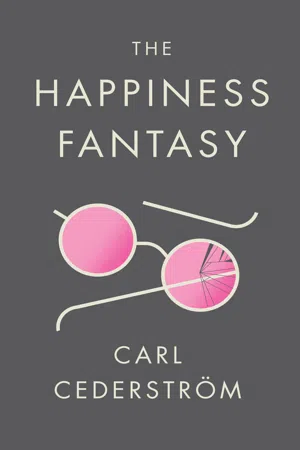
In this devastatingly witty new book, Carl Cederström traces our present-day conception of happiness from its roots in early-twentieth-century European psychiatry, to the Beat generation, to Ronald Reagan and Donald Trump. He argues that happiness is now defined by a desire to be "authentic", to experience physical pleasure, and to cultivate a quirky individuality. But over the last fifty years, these once-revolutionary ideas have been co-opted by corporations and advertisers, pushing us to live lives that are increasingly unfulfilling, insecure and narcissistic.
In an age of increasing austerity and social division, Cederström argues that a radical new dream of happiness is gathering pace. There is a vision of the good life which promotes deeper engagement with the world and our place within it, over the individualism and hedonism of previous generations. Guided by this more egalitarian worldview, we can reinvent ourselves and our societies.
- English
- ePUB (mobile friendly)
- Available on iOS & Android
eBook - ePub
The Happiness Fantasy
1
In Bed with Wilhelm Reich
I know how bitterly you resist your integrity, what mortal fear comes over you when called upon to follow your own, authentic nature. I want you to stop being subhuman and become ‘yourself.’ ‘Yourself,’ I say. Not the newspaper you read, not your vicious neighbor’s opinion, but ‘yourself.’Wilhelm Reich, Listen, Little Man!1
Encountering Reich
I first came across the ill-fated psychoanalyst Wilhelm Reich (1897–1957) in Adam Curtis’s documentary The Century of the Self. Or so I thought. I watched it a few years ago, watched it again, then started using clips from the film in my own teaching, to illustrate the dramatic change of American culture in the 1960s. It contains wonderfully evocative scenes of people screaming and shouting in dimly lit seminar rooms with soft mattresses. In these encounter sessions, participants were instructed to peel off the inauthentic layers of themselves. The belief was that, by acting out their true inner selves, they would become free. Even though Reich died in 1957, a few years before the human potential movement would take off, he played an important role in its making. He was an important precursor, a spiritual inspiration. Like these movements, Reich was more optimistic about humans’ inner potentials than he was about the organization of society, which, in his view, played an oppressive role, preventing individuals from becoming who they really were. Reich’s story, as it was told in the documentary, was brief but nonetheless riveting. From a hailed analyst in Vienna in the 1920s to a permanent outlaw, kicked out not just of the psychoanalytic establishment in the 1930s but also from several countries (mostly Scandinavian ones), and then, as an old and slightly mad man, imprisoned in the United States for promoting and selling his home-produced orgone accumulator, a life-sized wooden box with metal interior, designed to enhance a person’s orgastic abilities. The box was later parodied and immortalized as the Orgasmatron in Woody Allen’s Sleepers.
But it would turn out that it was not in Curtis’s documentary that I had first encountered Reich. I had known him rather intimately for more than a decade, through the music of Kate Bush, and her wonderful tune ‘Cloudbusting’, which appeared on her 1985 album Hounds of Love. When I recently watched the music video, I realized the song was all about Reich, chronicling his tragic fate. The video opens with two Sisyphus-like figures, played by Donald Sutherland (as Reich) and Kate Bush (as Reich’s son), pushing a huge covered object up a hill. Once they reach the top, exhausted and happy, they uncover a metal construction with wheels and handspikes, looking like a massive anti-aircraft gun. As Reich aims the gun at the sky, his son looks in awe at him. By the end of his life, Reich grew delusional, and believed his so-called ‘orgone gun’ was useful not just to alter the weather, and produce rain, but also to defend earth from an imminent threat from outer space. He died in prison at the age of sixty.
More than a madman, Reich came to have a profound influence on how we think of happiness today. I’m not suggesting that he discovered an entirely new notion of happiness, which then went on to become the dominant template for Western culture. He was, however, the first to bring authenticity and sexual pleasure into a coherent notion of happiness. As such, he played a crucial role in forming the kind of happiness fantasies that now, about a century later, have become neatly integrated into our culture.
What makes Reich interesting for the present analysis is not just his theories, as they were expressed in his writings, often with anger. I would agree with Philip Rieff when he says that reading Reich ‘is like going to a pacifist meeting: one is a little frightened to witness so much aggression displayed by men pleading an end to aggression’.2 Reich’s texts, especially the later ones, are hyperbolic and aggressive, as when he writes: ‘I want you to stop being subhuman and become “yourself”’,’ repeating, ‘“Yourself,” I say’ (see epigraph above). These texts are not, I must admit, particularly pleasant to read. Neither can I find any visible signs of genius, as so many others have claimed to have seen. But that does not make Reich any less interesting. What makes him fascinating is his unflinching ability to always be in the right place at the right time, and inscribe himself in critical historical moments. Or the wrong place at the wrong time, depending on one’s point of view. Because the fact remains that he was there, first in Vienna, when Freud and his colleagues lay the foundations for what would go on to become a massively influential view of the human psyche. He was working in one of the free clinics in Vienna when psychoanalysis was made available for the first time to common people. And Reich was there again, albeit as a shadow, when large parts of the American youth took to the streets (or fields) to rebel against the old bourgeois world of conformity, and set out what became known as the sexual revolution. The fact that Reich became conservative in his final years, and voted Republican, was just one among many other ironies, which seemed to be the defining feature of his life.
After his death, Reich came to embody a particular fantasy, a fantasy about happiness beyond repression. As the age of conformity came to an end in the early 1960s and the individual was no longer compelled to shoulder and act out predestined roles, Reich became the kind of cult figure that many searched for. His books were widely read among a new generation of young American bohemians from the 1940s onwards. He became a convenient symbol, hailed by countercultural figures such as William Burroughs, Fritz Perls, and Paul Goodman. In a time defined by social upheaval, political experimentation, and existential confusion, Reich became a potent symbol for hope and transformation.
Young women did not want to be like their mothers, whose image was tied to the well-ordered and infinitely sad housewife. And young men certainly didn’t want to follow in their father’s footsteps, taking up a mind-numbing job in a big corporation, coming home late in the evening to eat tasteless food in front of the television – and then keep on doing that, day in day out, until they would finally drop dead from a heart attack.
In Jack Kerouac’s 1958 semi-fictional novel The Dharma Bums, the character Japhy Rider (based on the poet Gary Snyder) envisions a revolution against this kind of monotonous life. In his revelation, he saw all forms of peculiar characters coming together, from rucksack wanderers and young Americans to Dharma Bums and Zen Lunatics. They all
refused to subscribe to the general demand that they consume production and therefore have to work for the privilege of consuming, all that crap they didn’t really want anyway such as refrigerators, TV sets, cars, at least new fancy cars, certain hair oils and deodorants and general junk you finally always see a week later in the garbage anyway, all of them imprisoned in a system of work, produce, consume, work, produce, consume.3
It was in this cultural climate that Reich’s ideas gained traction. He launched a theory of happiness which, in the decades following his death, would become neatly integrated into our culture. T...
Table of contents
- Cover
- Copyright
- Introduction
- 1 In Bed with Wilhelm Reich
- 2 Compulsory Narcissism
- 3 Happiness Inc.
- 4 Getting High on Happiness
- 5 Pleasuring Men
- Conclusion: Happiness After Trump
- Acknowledgements
- End User License Agreement
Trusted by 375,005 students
Access to over 1.5 million titles for a fair monthly price.
Study more efficiently using our study tools.
Frequently asked questions
Yes, you can cancel anytime from the Subscription tab in your account settings on the Perlego website. Your subscription will stay active until the end of your current billing period. Learn how to cancel your subscription
No, books cannot be downloaded as external files, such as PDFs, for use outside of Perlego. However, you can download books within the Perlego app for offline reading on mobile or tablet. Learn how to download books offline
Perlego offers two plans: Essential and Complete
- Essential is ideal for learners and professionals who enjoy exploring a wide range of subjects. Access the Essential Library with 800,000+ trusted titles and best-sellers across business, personal growth, and the humanities. Includes unlimited reading time and Standard Read Aloud voice.
- Complete: Perfect for advanced learners and researchers needing full, unrestricted access. Unlock 1.5M+ books across hundreds of subjects, including academic and specialized titles. The Complete Plan also includes advanced features like Premium Read Aloud and Research Assistant.
We are an online textbook subscription service, where you can get access to an entire online library for less than the price of a single book per month. With over 1.5 million books across 990+ topics, we’ve got you covered! Learn about our mission
Look out for the read-aloud symbol on your next book to see if you can listen to it. The read-aloud tool reads text aloud for you, highlighting the text as it is being read. You can pause it, speed it up and slow it down. Learn more about Read Aloud
Yes! You can use the Perlego app on both iOS and Android devices to read anytime, anywhere — even offline. Perfect for commutes or when you’re on the go.
Please note we cannot support devices running on iOS 13 and Android 7 or earlier. Learn more about using the app
Please note we cannot support devices running on iOS 13 and Android 7 or earlier. Learn more about using the app
Yes, you can access The Happiness Fantasy by Carl Cederström in PDF and/or ePUB format, as well as other popular books in History & World History. We have over 1.5 million books available in our catalogue for you to explore.