Millions passionately desire a viable alternative to austerity and neoliberalism, but they are sceptical of traditional leftist top-down state solutions.
In this urgent polemic, Hilary Wainwright argues that this requires a new politics for the left that comes from the bottom up, based on participatory democracy and the everyday knowledge and creativity of each individual. Political leadership should be about facilitation and partnership, not expert domination or paternalistic rule.
Wainwright uses lessons from recent movements and experiments to build a radical future vision that will be an inspiration for activists and radicals everywhere.
- English
- ePUB (mobile friendly)
- Available on iOS & Android
eBook - ePub
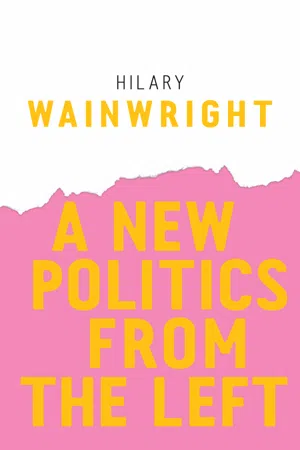
A New Politics from the Left
About this book
Information
1
A New Politics of Knowledge
The evident crisis of ruling political institutions across the world is also a crisis of how the ruling elites understand knowledge: whose and what kinds of knowledge they consider to be legitimate sources of expertise that matter for public policy. As with the widespread political crisis, this crisis of the politics of knowledge is a deep structural problem, not simply a character flaw of a particular elite.
These crises have historical roots. The events of 1968 and the immediate aftermath marked a turning point in the politics of knowledge: a leap in the desire for self-government. They signalled the breaking of the bond between knowledge and authority that underpinned the central post-war institutions: the paternalistic family and state, and the ‘scientific’ management that governed workplaces and the wider society. It was an understanding of knowledge that marginalized challenging insights and consequent debate arising from experience and practical expertise pointing beyond the dominant paradigm.1
Authority in all spheres of life and across the world was in question – and with it elite forms of knowledge. Rebel movements shared and developed their own kinds of knowledge, via practice and through debate and deliberations, and on to producing new ideas and the basis of new institutions. Authority, once it has been confidently questioned by those on whose obedience it depends, crumbles in ways that make it difficult to put together again.
In the UK, Margaret Thatcher used brutal methods to crush revolt – to starve striking miners and terrorize them into going back to work, and to axe local democracy in the towns and cities where the mining communities had allies. For several years, she was able to use the market and a foreign enemy (Argentina’s military dictatorship) to renew a traditional acquiescence to authority, rooted in imperial and wartime success. But, in the end, she was brought down by revolt, in the streets and in her own cabinet.
Tony Blair also tried to re-establish the authority of ruling institutions. He sought to make the knowledge of those in authority unchallengeable, technical and apolitical and above the hoi polloi – a sacred sphere of technocratic expertise available only to those trained to know and beyond challenge from those whose expertise was not deemed sufficiently technocratic or ‘professional’. While wooing ‘swing’ voters, he treated anyone connected to the public sector – or so-called ‘losers’ in the market casino – with contempt, as if their practical knowledge was irrelevant to the improvement of public services.
We have seen the elite contempt for the intelligence and know-how of Greek citizens in the recent behaviour of the European Union and its disregard for their democratic decisions. ‘Elections cannot interfere with economics’, declared German Finance Minister Wolfgang Schäuble when Greece’s Finance Minister, Yanis Varoufakis, openly presumed that his government’s mandate to reject the memorandum prescribed for the country by the Troika might have some influence on how the EU conducted its negotiations. This despite the fact that many Greek public servants were already willing to ‘whistle-blow’ in the public interest and share with the government their inside knowledge of the multiple sources of corruption.2 Many such ethically minded public servants – teachers and doctors, for instance – were already working voluntarily to improve public services, albeit without the funds to do so, while Greek farmers, workers and social entrepreneurs were initiating alternative forms of production on a modest scale, with support from the Syriza government.
In the UK, we have seen contempt for everyday knowledge over Brexit – on both sides. The leading faction for Brexit had no shame in telling lies, making commitments, and then disappearing when it came to implementing them, as if voters were stupid. These anti-EU campaigners had no hesitation in playing on the racist imperial legacy among the white working class, bolstering assumptions of (white) British superiority. The government Remain side, as led by the then Prime Minister David Cameron, patronized voters with a visionless, simplistic campaign and, following its defeat, attacked Brexit voters as ignorant and stupid. As has since been established, there were many different reasons for the swathe of working-class support for Brexit, particularly in England and Wales, amounting to a rebellion expressing a sense of dispossession and deep class resentment, arising from the destruction of people’s communities by successive governments – not stupidity at all.3
All these examples illustrate a politics of knowledge, because the questions that these and similar experiences raise about knowledge are entangled with the exercise of political power, especially at a time when official interpretations of politics are in question. Questions arose about whose knowledge – and whose future – matters in public policy, and what kinds of thoughts, ideas, beliefs, exchange of emotions and exercise of skills count as expertise and knowledge in public decision-making, and why. These are also questions about the basis on which our rulers rule: how they are accountable and how, when they behave in stupid, destructive or arrogant ways, they can be challenged.
Shock encounters with the free market in Central Europe
One particular experience shook me into taking the politics of knowledge seriously. The experience involved conversations with civic movement activists in Eastern Europe in 1990, following the fall of the Berlin Wall. It was the shock of witnessing the same young Czechs who had demonstrated in Wenceslas Square as part of the Velvet Revolution led by Václav Havel embracing Ronald Reagan and Margaret Thatcher as their heroes, and free-market theorist Friedrich von Hayek as their guru. As I wandered the streets of Prague, I was trying to puzzle out why impoverished students with no obvious vested interest in the free market would be so enamoured of its principles. How could those of us involved in social movements in the West sensitively challenge their illusion and convince them that socialism can be democratic?
First, it seemed to me, we had to understand the basis of their beliefs. So, after further discussions with Czech friends and an interview with Tomáš Ježek, Hayek’s Czech translator (and Minister for Privatization at the time), I came to some preliminary conclusions.
The young Central and East Europeans were reacting to years of unremitting repression, based on the official justification that the state knew best what was good for them and for society. The assumption behind this command economy was that economic and social knowledge, narrowly understood as ‘scientific’ laws based on statistical correlations, could be centralized through the state. In his famous attack on state planning (by social democratic parties in the West as well as by the Kremlin) in The Road to Serfdom (1944), and his essay ‘The Use of Knowledge in Society’, Hayek had challenged the very nature of knowledge that this presumed.4
Tacit knowledge as the justification of the free market
Hayek argued that there is a type of knowledge, crucial to the economy and society, that by its very nature cannot be centralized. This is practical knowledge, the ‘things we do but cannot tell’, in the words of Michael Polanyi, who first theorized the idea of tacit knowledge. It is in the practitioner’s head, but impossible to codify and thereby administer centrally.5
Hayek went further, arguing that such knowledge is necessarily individual. His exemplar was the intuitive knowledge of the individual entrepreneur. From here, it was a few short steps to justifying the price mechanism and the unregulated market as the only way that the individual practical, tacit knowledges of entrepreneurs and consumers could be co-ordinated.
Hayek celebrated as a mark of civilization what he called the ‘haphazard’ order that resulted from this unplanned, spontaneous co-ordination. Against the advocates of a planned economy, he insisted that those who planned, or who instructed the planners, could not possibly know the consequences of their plans and decisions, because of the individual, tacit character of this knowledge – limited, as he assumed it is, to particular times and circumstances. In effect, he argued that we are socially blindfolded: such is the nature of economic and social knowledge. He concluded that any attempt to act as if this is not the case is positively dangerous, preparing the way for authoritarian government.
Answering the free-market right through the practical, social knowledge of social movements
It was understanding the appeal of this justification of the free market to young East Europeans, and straining to think how to answer it, that led me to recognize the importance of something right under my nose: in the social movements – the women’s and radical shop stewards’ movements, for example – in which I was active. There, in the practice of these movements, in the sharing of the practical and tacit knowledge that is the lifeblood of their organizations, was a crucial but under-theorized innovation.
They illustrated, in the way they organized, how this tacit knowledge might be shared – mutually and horizontally – and hence enable its holders to have knowledge beyond their own personal times and circumstances. Indeed, in their practice, these movements demonstrated the social production of knowledge, through reflection on experiences, the use of inherited theory and the application of intuition and tacit skill. (In fact, one of the main points made by Michael Polanyi, the principal theorist of tacit knowledge, was to highlight its importance in scientific experiments, which are essentially collaborative, social processes.)
Through this social process, such activists lift the blindfold. They come to understand – more or less, and subject to constant improvement – the consequences of their action. They do so through constantly reflecting on the lessons of experience. Hence, they are capable of purposeful and planned action, through collaboration and without predictive certainty, constantly subject to further experiment and self-reflexivity – a process that could be compared with the unpredictable yet purposeful character of modern jazz with its combination of structure and improvisation.
Tools to challenge Cold War dichotomies: ‘the Berlin Wall did not fall on us’
This enables us, I concluded, to challenge the Cold War choice between the all-knowing state and the idea of the ‘free market’. By asserting the social and sharable nature of practical and tacit knowledge, we take off the blindfold and plan our actions. But we do so without certainty and not from some presumed ‘overview’ from on high, and always with an approximate understanding of the consequences, which we can strive to deepen.
The words of a leader of the Brazilian Worker...
Table of contents
- Cover
- Title Page
- Copyright
- Dedication
- Preface
- Acknowledgements
- 1 A New Politics of Knowledge
- 2 The New Politics in Practice
- 3 From Cells to Transitions
- 4 Conclusions: On Questions of Political Strategy and Organization
- Further Reading and Resources
- End User License Agreement
Trusted by 375,005 students
Access to over 1.5 million titles for a fair monthly price.
Study more efficiently using our study tools.
Frequently asked questions
Yes, you can cancel anytime from the Subscription tab in your account settings on the Perlego website. Your subscription will stay active until the end of your current billing period. Learn how to cancel your subscription
No, books cannot be downloaded as external files, such as PDFs, for use outside of Perlego. However, you can download books within the Perlego app for offline reading on mobile or tablet. Learn how to download books offline
Perlego offers two plans: Essential and Complete
- Essential is ideal for learners and professionals who enjoy exploring a wide range of subjects. Access the Essential Library with 800,000+ trusted titles and best-sellers across business, personal growth, and the humanities. Includes unlimited reading time and Standard Read Aloud voice.
- Complete: Perfect for advanced learners and researchers needing full, unrestricted access. Unlock 1.5M+ books across hundreds of subjects, including academic and specialized titles. The Complete Plan also includes advanced features like Premium Read Aloud and Research Assistant.
We are an online textbook subscription service, where you can get access to an entire online library for less than the price of a single book per month. With over 1.5 million books across 990+ topics, we’ve got you covered! Learn about our mission
Look out for the read-aloud symbol on your next book to see if you can listen to it. The read-aloud tool reads text aloud for you, highlighting the text as it is being read. You can pause it, speed it up and slow it down. Learn more about Read Aloud
Yes! You can use the Perlego app on both iOS and Android devices to read anytime, anywhere — even offline. Perfect for commutes or when you’re on the go.
Please note we cannot support devices running on iOS 13 and Android 7 or earlier. Learn more about using the app
Please note we cannot support devices running on iOS 13 and Android 7 or earlier. Learn more about using the app
Yes, you can access A New Politics from the Left by Hilary Wainwright in PDF and/or ePUB format, as well as other popular books in Social Sciences & Sociology. We have over 1.5 million books available in our catalogue for you to explore.