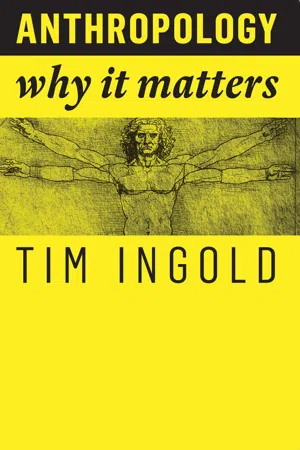
Humanity is at a crossroads. We face mounting inequality, escalating political violence, warring fundamentalisms and an environmental crisis of planetary proportions. How can we fashion a world that has room for everyone, for generations to come? What are the possibilities, in such a world, of collective human life? These are urgent questions, and no discipline is better placed to address them than anthropology. It does so by bringing to bear the wisdom and experience of people everywhere, whatever their backgrounds and walks of life.
In this passionately argued book, Tim Ingold relates how a field of study once committed to ideals of progress collapsed amidst the ruins of war and colonialism, only to be reborn as a discipline of hope, destined to take centre stage in debating the most pressing intellectual, ethical and political issues of our time. He shows why anthropology matters to us all.
Introducing Polity's Why It Matters series: In these short and lively books, world-leading thinkers make the case for the importance of their subjects and aim to inspire a new generation of students.
- English
- ePUB (mobile friendly)
- Available on iOS & Android
eBook - ePub
About this book
Information
1
On Taking Others Seriously
How should we live? No doubt human beings have always pondered this question. Perhaps it is the very pondering that makes us human. For other animals, it seems, the question scarcely arises. Each is more or less absorbed in its own way of doing things. But human ways of life – ways of doing and saying, thinking and knowing – are not handed down on a plate; they are not pre-ordained, nor are they ever finally settled. Living is a matter of deciding how to live, and harbours at every moment the potential to branch in different directions, no one of which is any more normal or natural than any other. As paths are made by walking, so we have continually to improvise ways of life as we go along, breaking trails even as we follow the footsteps of predecessors. We do so, however, not in isolation but in the company of others. Like the strands of a rope, lives intertwine and overlap. They go along together and mutually respond to one another in alternating cycles of tension and resolution. No strand carries on for ever; thus as some pass away, others join. That’s why human life is social: it is the never-ending and collective process of figuring out how to live. Every way of life, then, represents a communal experiment in living. It is no more a solution to the problem of life than is the path a solution to the problem of how to reach a destination as yet unknown. But it is an approach to the problem.
Let us summon up a field of study that would take upon itself to learn from as wide a range of approaches as it can; one that would seek to bring to bear, on this problem of how to live, the wisdom and experience of all the world’s inhabitants, whatever their backgrounds, livelihoods, circumstances and places of abode. This is the field I advocate in these pages. I shall call it anthropology. It may not be anthropology as you might have imagined it, or even as it is practised by many of those who profess to be anthropologists. Conceptions and misconceptions of the discipline abound, and it would be tedious to review them all. I make no apology for presenting a personal view, coloured by my own career as a student and teacher in the subject, perhaps less of what anthropology is than of what I think it should aspire to be. Others may differ, but that would be a sign of vitality, not of weakness. For whatever else it may be, anthropology will always be a discipline-in-the-making: it can be no more finished than the social life with which it is concerned. Thus the history of anthropology cannot be told as a story from beginning to end. Nor can we rest on our laurels, as if to suppose that after centuries of error, ignorance and prejudice we have finally emerged into the light. There is work to be done, and this book is as much about remaking anthropology for the future as it is about retelling its past.
Now you might think that the problem of how to live really belongs to philosophy, and you would not be wrong. It is a problem, after all, that touches on the very foundations of human existence in this world of ours. We call ourselves human beings, but what does it mean to be human? The name science has given us, as a species, is Homo sapiens, but in what does our alleged sapience, or wisdom, consist? How do we know, think, imagine, perceive, act, remember, learn, converse in language and live with others in such distinctive and yet various ways? By what means, and on what principles, do we organize ourselves into societies, build institutions, administer justice, exercise power, commit acts of violence, relate to the environment, worship the gods, care for the sick, confront mortality, and so forth? These questions are endless, and philosophers have addressed them at length. So too have anthropologists. But here’s the difference. Philosophers are reclusive souls, more inclined to turn inwards into a studious interrogation of the canonical texts of thinkers like themselves – mostly, though not exclusively, dead white men – than to engage directly with the messy realities of ordinary life. Anthropologists, to the contrary, do their philosophizing in the world. They study – above all through a deep involvement in observation, conversation and participatory practice – with the people among whom they choose to work. The choice depends on particularities of experience and interest, but in principle, they could be any people, anywhere. Anthropology, in my definition, is philosophy with the people in.
Never in human history has this kind of philosophy been more needed. Evidence that the world is at a tipping point is all around us, and overwhelming. With an estimated human population of 7.6 billion – set to rise to more than 11 billion by the end of the century – there are more of us than ever before, living on average for longer than ever before. More than half of the world’s population now resides in cities, most no longer drawing a livelihood directly from the land as their predecessors did. Supply chains for food and other produce criss-cross the globe. Forests are being laid waste, swathes of cultivable land have been turned over to soybean and palm-oil production, mining has gouged the earth. Human industry, above all the burning of fossil fuels on a massive scale, is affecting the world’s climate, increasing the probability of potentially catastrophic events, and in many regions shortages of water and other necessities of life have sparked genocidal conflicts. The world remains in the grip of a system of production, distribution and consumption that, while grotesquely enriching a few, has not only left countless millions of people surplus to requirements, condemned to chronic insecurity, poverty and disease, but also wreaked environmental destruction on an unprecedented scale, rendering many regions uninhabitable and clogging lands and oceans with indestructible and hazardous waste. These human impacts are irreversible and will likely outlast the tenure of our species on this planet. Not without reason have some declared the onset of a new era in the earth’s history: the Anthropocene.
This world-on-a-knife-edge is the only world we have. However much we might dream of life on other planets, there is none other to which we might escape. Nor is there any going back to the past, from which to try an alternative route to the present. We are where we are, and can only carry on from there. As Karl Marx observed long ago, human beings are the authors of their own history, but under conditions not of their own choosing.1 We cannot opt to be born into another time. Our present conditions were shaped by the actions of past generations that cannot be undone, just as our own actions, in turn, will irrevocably shape the conditions of the future. How, then, should we live now, such that there can be life for generations to come? What could make life sustainable, not for some to the exclusion of others, but for everyone? To address questions of this magnitude, we need all the help we can get. It is not as though the answers are lying around somewhere, needing only to be discovered. We will not find the secret in any doctrine or philosophy, in any branch of science or indigenous worldview. Nor can there be any final solution. History is full of monumental attempts to put an end to it, attempts that must necessarily fail if life is to continue. To find our way around the ruins is a task for all of us. That’s where anthropology comes in, and why – in our precarious world – it matters so much.
The problem is not that we are starved of information or knowledge. To the contrary, the world is awash with it, and with digital enhancement the wash has become a flood. According to a recent study, some 2.5 million scientific papers are published every year, and the number published since 1665 has passed the 50 million mark.2 Experts, armed with specialized data acquisition devices and sophisticated modelling techniques, are keen to offer their projections. We should listen to them, as we should listen to scholars steeped in disciplines of the arts and humanities whose reflections provide the contexts that better enable us to frame our current predicament. Yet all, scientists and humanists alike, have something in common, namely a sense that they can take the measure of the world from some place beyond it, up above or far ahead, whence they can look back and pronounce upon its workings with an authority denied to those whose business is more intimately tied to the mundane affairs of everyday life. From their vantage point, they profess to be able to explain what for the rest of us lies beyond comprehension. Physicists explicate the workings of the universe, biochemists the workings of life, neuroscientists the brain, psychologists the mind, political scientists the state, economists the market, sociologists society, and so on. Anthropology, too, for much of its disciplinary history, has claimed similarly exalted powers, namely to spell out the contexts, variously labelled ‘social’ or ‘cultural’, within which the works and lives of other people could be interpreted or even accounted for.
In what follows I shall have more to say about this claim. It is not, however, one to which I subscribe. The kind of anthropology I propound here has a different purpose. This is not to interpret or explain the ways of others; not to put them in their place or consign them to the ‘already understood’. It is rather to share in their presence, to learn from their experiments in living, and to bring this experience to bear on our own imaginings of what human life could be like, its future conditions and possibilities. Anthropology, for me, thrives on this engagement of imagination and experience. What it brings to the table is not a quantum of knowledge, to be added to the contributions of other disciplines, all bent on dredging the world for information to be turned into knowledge products. My kind of anthropology, indeed, is not in the business of ‘knowledge production’ at all. It aspires to an altogether different relation with the world. For anthropologists as for the people among whom they work, the world is not the object of study but its milieu. They are, from the start, immersed in its processes and relations. Critics may see this as a weakness, or a vulnerability. For them, it reveals a lack of objectivity. But for us, this is the very source from which anthropology takes its strength. For objective knowledge is not what we are after. What we seek, and hope to gain, is wisdom. These are by no means the same; they may even operate at cross-purposes.
Knowledge seeks to fix things within the concepts and categories of thought, to hold them to account, and to make them to some degree predictable. We often speak of arming ourselves with knowledge, or of using it to shore up our defences so that we can better cope with adversity. It gives us power, control, and immunity to attack. But the more we take refuge in the citadels of knowledge, the less attention we pay to what is going on around us. Why bother to attend, we say, when we already know? To be wise, to the contrary, is to venture out into the world and take the risk of exposure to what is going on there. It is to let others into our presence, to pay attention and to care. Knowledge fixes and puts our minds at rest; wisdom unfixes and unsettles. Knowledge arms and controls; wisdom disarms and surrenders. Knowledge has its challenges, wisdom has its ways, but where the challenges of knowledge close in on their solutions, the ways of wisdom open up to a process of life. Now I am not of course suggesting that we can do without knowledge. But we need wisdom as well. At the present juncture, the balance has tipped precipitously towards the former, and away from the latter. At no previous time in history, indeed, has so much knowledge been married to so little wisdom. It is the task of anthropology, I believe, to restore the balance, to temper the knowledge bequeathed by science with the wisdom of experience and imagination.
Among scholars of different stripes, anthropologists are distinguished by their readiness to learn from those who, in a world fixated on the advance of knowledge, might otherwise be dismissed as uneducated, illiterate or even ignorant. These are people whose voices, unused to dominant media of communication, would otherwise remain unheard. As anthropologists have demonstrated time and again, such people are wise beyond their allegedly more knowledgeable superiors. And with the world on a cusp, theirs is wisdom we can ill afford to ignore. We have much to learn, if only we allow ourselves to be educated by others with experience to share. Yet these others have been shunned by scholars who, for the most part, have been content to enlist them in their researches more as informants than as teachers, interrogated for what can be elicited from their minds rather than sought out for what they can show us of the world. Elaborate methods have been devised to keep them at arm’s length. Methods are the guarantors of objectivity, put in place to ensure that research results should not be contaminated by too close or affective an involvement of researchers with those they study. For anthropology, however, such involvement is of the essence. All study calls for observation, but in anthropology we observe not by objectifying others but by paying attention to them, watching what they do and listening to what they say. We study with people, rather than making studies of them. We call this way of working ‘participant observation’. It is a cornerstone of the discipline.
Participant observation takes time. It is not uncommon for anthropologists to spend many years in what they call the ‘field’. Initially set down in an unfamiliar place as a possibly uninvited guest, the fieldworker is largely beholden to his or her hosts. Anthropologists have written at length on the institution of the gift, and have shown how the principles of giving and receiving are at the core of everyday life. But these principles are equally fundamental to the practice of anthropological fieldwork. It is a practice founded on generosity, on receiving with good grace what is given rather than seeking to obtain, by deceit or subterfuge, what is not. This is what distinguishes the field from the laboratory. In the field you have to wait for things to happen, and accept what is offered when it is offered. That’s why fieldwork takes so long. The laboratory, by contrast, is a place artfully set up, equipped with an experimental apparatus by means of which things are either forced or t...
Table of contents
- Cover
- Title Page
- Copyright
- 1 On Taking Others Seriously
- 2 Similarity and Difference
- 3 A Discipline Divided
- 4 Rethinking the Social
- 5 Anthropology for the Future
- Further Reading
- Index
- End User License Agreement
Trusted by 375,005 students
Access to over 1.5 million titles for a fair monthly price.
Study more efficiently using our study tools.
Frequently asked questions
Yes, you can cancel anytime from the Subscription tab in your account settings on the Perlego website. Your subscription will stay active until the end of your current billing period. Learn how to cancel your subscription
No, books cannot be downloaded as external files, such as PDFs, for use outside of Perlego. However, you can download books within the Perlego app for offline reading on mobile or tablet. Learn how to download books offline
Perlego offers two plans: Essential and Complete
- Essential is ideal for learners and professionals who enjoy exploring a wide range of subjects. Access the Essential Library with 800,000+ trusted titles and best-sellers across business, personal growth, and the humanities. Includes unlimited reading time and Standard Read Aloud voice.
- Complete: Perfect for advanced learners and researchers needing full, unrestricted access. Unlock 1.5M+ books across hundreds of subjects, including academic and specialized titles. The Complete Plan also includes advanced features like Premium Read Aloud and Research Assistant.
We are an online textbook subscription service, where you can get access to an entire online library for less than the price of a single book per month. With over 1.5 million books across 990+ topics, we’ve got you covered! Learn about our mission
Look out for the read-aloud symbol on your next book to see if you can listen to it. The read-aloud tool reads text aloud for you, highlighting the text as it is being read. You can pause it, speed it up and slow it down. Learn more about Read Aloud
Yes! You can use the Perlego app on both iOS and Android devices to read anytime, anywhere — even offline. Perfect for commutes or when you’re on the go.
Please note we cannot support devices running on iOS 13 and Android 7 or earlier. Learn more about using the app
Please note we cannot support devices running on iOS 13 and Android 7 or earlier. Learn more about using the app
Yes, you can access Anthropology by Tim Ingold in PDF and/or ePUB format, as well as other popular books in Sozialwissenschaften & Kultur- & Sozialanthropologie. We have over 1.5 million books available in our catalogue for you to explore.