The pace of modern life is undoubtedly speeding up, yet this acceleration does not seem to have made us any more happy or content. If acceleration is the problem, then the solution, argues Hartmut Rosa in this major new work, lies in 'resonance'. The quality of a human life cannot be measured simply in terms of resources, options and moments of happiness: instead, we must consider our relationship to, or resonance with, the world.
Applying his theory of resonance to many domains of human activity, Rosa describes the full spectrum of ways in which we establish our relationship to the world, from the act of breathing to the adoption of culturally distinct worldviews. He then turns to the realms of concrete experience and action – family and politics, work and sports, religion and art – in which we as late-modern subjects seek out resonance. This task is proving ever more difficult as modernity's logic of escalation is both cause and consequence of a distorted relationship to the world, at individual and collective levels. As Rosa shows, all the great crises of modern society – the environmental crisis, the crisis of democracy, the psychological crisis – can also be understood and analyzed in terms of resonance and our broken relationship to the world around us.
Building on his now classic work on acceleration, Rosa's new book is a major new contribution to the theory of modernity, showing how our problematic relation to the world is at the crux of some of the most pressing issues we face today. This bold renewal of critical theory for our times will be of great interest to students and scholars across the social sciences and humanities.
Also available as an audiobook.
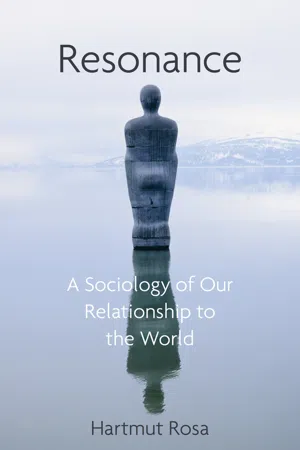
eBook - ePub
Resonance
A Sociology of Our Relationship to the World
- English
- ePUB (mobile friendly)
- Available on iOS & Android
eBook - ePub
Resonance
A Sociology of Our Relationship to the World
About this book
Information
PART ONE
The Basic Elements of Human Relationships to the World
II
Bodily Relationships to the World
1 Being Situated in the World
Any elementary analysis of the ways in which human beings come to relate to the world, experience and perceive it, act and orient themselves within it, cannot but begin with the body. The most basic and obvious answer to the question “How are we situated in the world?” is simply: on our feet. We stand upon the world. We feel it beneath us. It sustains our weight. The certainty that the ground we stand on will bear us up is among the most fundamental prerequisites of our ontological security. We must be able to depend on it, and we depend on it blindly in the normal course of everyday life. If the ground were to unexpectedly collapse, if the earth opened up beneath us, we would experience this as a shocking event, a traumatic loss of that very security. And it is certainly no coincidence that when we experience (cognitively, socially, and/or interactively) a loss of one of the quasi-ontological certainties of our relationship to the world – e.g. when we learn that we are terminally ill and have only a short time to live, that our child has been killed in an accident, that the woman we love now wants to live life as a man, that our house has burned down, or that we have lost our job – we feel that the rug has been pulled out from under us. Indeed, there is persuasive evidence that such experiences are capable of temporarily so unsettling our sense of equilibrium and orientation that we actually feel dizzy. Here we can already see that subjects always experience themselves as being situated in a world in which physical, social, emotional, and cognitive significances fundamentally overlap.
In analyzing the different ways in which human beings relate to the world, the relationship between foot and world seems to me to be not entirely insignificant (however negligible or even strange it may appear at first glance). Certainly, it makes a difference whether we stand in the world barefoot or shod. While the bare earth may confront our bare feet either as hard, brittle, and cold, even hostile, or as soft and moist, flexible and accommodating – in short, as either repulsive or responsive – all of these relationships are leveled out and held at a distance by sturdy footwear. The fundamentally modern “disengagement” between human beings and the world might stand on firmer ground here than other, worldview-oriented analyses may recognize. Shoes establish a highly effective “buffering” distance between body and world that allows us to move from a participative to an objectifying, reifying relationship to the world.1
Our feet are a privileged site of our relationship to the world simply by virtue of the fact that human beings are by nature always and everywhere subject to the effects of gravity. This endows us with an ineluctable sense of up and down, just as the arrangement of our sensory organs (eyes, nose, and mouth) and the design of our body as a whole (stomach and back, positioning of the feet, etc.) compel us to distinguish between front and back. As has been observed again and again in the phenomenological tradition, particularly since Merleau-Ponty,2 human beings’ basic orientation in the world is characterized by a universal sense of direction based on the distinction between up and down and front and back. The distinction between left and right, by contrast, appears to be secondary, derived from the bilateral symmetry of the body.
Before we develop this sense of direction, however, and long before we stand in the world on our own two feet, our skin, as the largest human organ, proves to be the critical “interface” in all of our bodily relationships to the world. We develop not only our sense of the world – as what resists us, as what we encounter out there – but also our sense of self, of what is peculiar to us, and of the boundary or distinction between the two through tactile experiences, i.e. by touching, grasping, and handling as well as by being handled, grasped, and touched. Phenomenologists from Husserl to Merleau-Ponty, Fuchs, Wiesing, and Waldenfels have repeatedly noted this, as well.3 Self and world encounter each other constantly and directly, if under constantly changing conditions, at and through the skin. Here we can understand the skin as a boundary and dividing line, a covering that separates inside from out and in a way protects the subject from the world. But it is also much more than that. The skin can better be understood as a semi-permeable membrane that brings subject and world into relation with each other, making them mutually receptive and pervious to each other.
Infant research has shown that for newborns, skin-to-skin contact (generally with their mother) is essential not – or not primarily – because it facilitates the differentiation and experience of an external world, but because it serves to establish (or re-establish) a primal responsive relationship. As Peter Sloterdijk has impressively demonstrated (unavoidable speculation notwithstanding), there are good reasons to suppose that an embryo and its mother together form a system of resonance. The womb provides an enveloping, sustaining, “securing” resonant space in which the embryo hears and feels its mother’s pulse, in which it is surrounded by her and perfused by her bloodstream, so that mother and child cannot but react and respond to each other physically, bodily. If Merleau-Ponty is correct that human existing begins with the perception (prior to any distinction between subject and object) that “there is something,”4 that something is present, then it also stands to reason that our ur-impression lies in this presence of warmth, flowing, and exchange. As Sloterdijk puts it, in his characteristically poetic/suggestive way:
In the beginning, […] humans are surrounded by something that can never appear as a thing. They are initially the invisibly augmented, the corresponding, the encompassed […]. My existence includes the presence of a pre-objective something floating around me; its purpose is to let me be and support me. Hence I am not, as current systemists and bio-ideologues claim I think, a living being in its environment; I am a floating being with whom geniuses forms spaces. “If anyone knew how marrowy I am at bottom.”5
What is peculiar about this fetal mode of being-in-the-world qua being-in-the-mother is that the resonant relationship here is not between a subject and an object (or between two subjects), but rather describes an initially inseparable, bipolar entity.6 Hence as Sloterdijk, drawing on the work of Thomas Macho, concludes, this first, constitutive resonant experience cannot be understood in terms of object relationships:7
First of all one must conceive of a phase of fetal cohabitation in which the incipient child experiences the sensory presence of liquids, soft bodies and cave boundaries: most importantly placental blood, then the amniotic fluid, the placenta, the umbilical cord, the amniotic sac and a vague prefiguring of the experience of spatial boundaries through the resistance of the abdominal wall and elastic walling-in. A foretaste of what will later be called reality presents itself in the form of an intermediate fluidal realm that lies embedded in a dark, spheric spatial factor softly cushioned within further boundaries. […] Objects that, like those we have named, are not objects because they have no subject-like counterpart, are referred to by Macho as “nobjects”: they are spherically surrounding mini-conditions envisaged by a non-facing self, namely the fetal pre-subject, in the mode of a non-confrontational presence as original creatures of closeness in the literal sense. […] Consequently one must assume, as the most original of the pre-oral regimes, a suspended stage whose essential content lies in the constant placenta-mediated exchange of blood between mother and child. […] In reality, the fetal modus vivendi can be described as a fluidal communion in the medium of blood: it is the first material between two individuals who will one day – when they become modern people – speak on the telephone. […] The second aspect of the pre-oral media field concerns the psychoacoustic initiation of the fetus into the uterine sound world. It is logical that acoustic events can only be given in the nobject mode – for sonorous presences have no tangible substrate that could be encountered in the attitude of standing opposite something. From the physiology of listening as a state of being set in sympathetic vibration, it is evident that acoustic experiences are media processes which cannot possibly be represented in languages of object relationships.8
Speculative as these reflections on the prenatal origins of human beings’ relationship to the world may be, they yet plausibly suggest that resonant experiences are not limited to already formed and developed subjects exploring their surroundings, but rather are constitutive of that which can later become a subject. At the same time, birth constitutes an initial radical break in the fundamental resonance that exists between mother and child. The “suspended state” comes to an abrupt end, as the newborn is directly subjected to the effects of gravity and the hard, often cold external surface...
Table of contents
- Cover
- Table of Contents
- Title Page
- Copyright
- Acknowledgments
- In Lieu of a Foreword: Sociology and the Story of Anna and Hannah
- I Introduction
- Part One: The Basic Elements of Human Relationships to the World
- Part Two: Spheres and Axes of Resonance
- Part Three: Fear of the Muting of the World: A Reconstruction of Modernity in Terms of Resonance Theory
- Part Four: A Critical Theory of Our Relationship to the World
- In Lieu of an Afterword: Defending Resonance Theory against Its Critics – and Optimism against Skeptics
- References
- Index
- End User License Agreement
Trusted by 375,005 students
Access to over 1.5 million titles for a fair monthly price.
Study more efficiently using our study tools.
Frequently asked questions
Yes, you can cancel anytime from the Subscription tab in your account settings on the Perlego website. Your subscription will stay active until the end of your current billing period. Learn how to cancel your subscription
No, books cannot be downloaded as external files, such as PDFs, for use outside of Perlego. However, you can download books within the Perlego app for offline reading on mobile or tablet. Learn how to download books offline
Perlego offers two plans: Essential and Complete
- Essential is ideal for learners and professionals who enjoy exploring a wide range of subjects. Access the Essential Library with 800,000+ trusted titles and best-sellers across business, personal growth, and the humanities. Includes unlimited reading time and Standard Read Aloud voice.
- Complete: Perfect for advanced learners and researchers needing full, unrestricted access. Unlock 1.5M+ books across hundreds of subjects, including academic and specialized titles. The Complete Plan also includes advanced features like Premium Read Aloud and Research Assistant.
We are an online textbook subscription service, where you can get access to an entire online library for less than the price of a single book per month. With over 1.5 million books across 990+ topics, we’ve got you covered! Learn about our mission
Look out for the read-aloud symbol on your next book to see if you can listen to it. The read-aloud tool reads text aloud for you, highlighting the text as it is being read. You can pause it, speed it up and slow it down. Learn more about Read Aloud
Yes! You can use the Perlego app on both iOS and Android devices to read anytime, anywhere — even offline. Perfect for commutes or when you’re on the go.
Please note we cannot support devices running on iOS 13 and Android 7 or earlier. Learn more about using the app
Please note we cannot support devices running on iOS 13 and Android 7 or earlier. Learn more about using the app
Yes, you can access Resonance by Hartmut Rosa, James C. Wagner, James Wagner,James C. Wagner in PDF and/or ePUB format, as well as other popular books in Social Sciences & Sociology. We have over 1.5 million books available in our catalogue for you to explore.