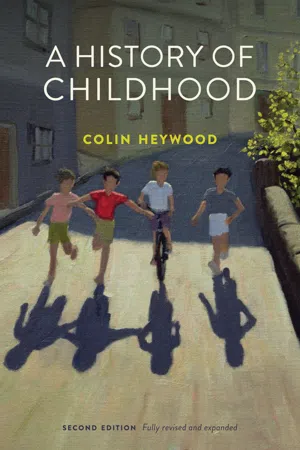
Colin Heywood's classic account of childhood from the early Middle Ages to the First World War combines a long-run historical perspective with a broad geographical spread.
This new, comprehensively updated edition incorporates the findings of the most recent research, and in particular revises and expands the sections on theoretical developments in the 'new social studies of childhood', on medieval conceptions of the child, on parenting and on children's literature. Rather than merely narrating their experiences from the perspectives of adults, Heywood incorporates children's testimonies, 'looking up' as well as 'down'. Paying careful attention to elements of continuity as well as change, he tells a story of astonishing material improvement for the lives of children in advanced societies, while showing how the business of preparing for adulthood became more and more complicated and fraught with emotional difficulties.
Rich with evocative details of everyday life, and providing the most concise and readable synthesis of the literature available, Heywood's book will be indispensable to all those interested in the study of childhood.
- English
- ePUB (mobile friendly)
- Available on iOS & Android
eBook - ePub
A History of Childhood
Part I
Changing Conceptions of Childhood
Childhood, according to the seventeenth-century French cleric Pierre de Bérulle, ‘is the most vile and abject state of human nature, after that of death’.1 It is tempting to agree – not least as an antidote to all the sentimental depictions of the supposedly pure and innocent child of the Victorian era. Such extremes serve to remind us that childhood is a social construct, which changes over time and, no less importantly, varies between social and ethnic groups within any society. As noted above, it is always tempting to think in terms of a ‘natural’ and ‘universal’ child, whose path to development is largely determined by its biological make-up. Biology does of course play a part in the psychological as well as the physical development of a child. Indeed, the psychologist Jerome Kagan, writing in 2004, noted that ‘Biology has returned to the study of children during the last two decades as a result of elegant discoveries in genetics, molecular biology, and neuroscience.’ These have revealed the existence of ‘biologically prepared competencies’ during the early years, such as improvements in memory and the emergence of language, which invariably appear as long as children are exposed to people and objects. At the same time, Kagan takes the now-familiar line that experience counts as well as biology.2 Any idea of a purely ‘natural’ child becomes difficult to sustain once it is realized that children readily adapt to their own particular environment, the product of assorted historical, geographical, economic and cultural forces. To the extent that human beings can construct their own nature, one might anticipate varying outcomes in what passes for childhood in different societies. Childhood is thus to a considerable degree a function of adult expectations.3
It follows that if historians wish to recreate the day-to-day experiences of children in the past (what might be called the social history of children), they must in the first instance understand how adults thought and felt about the young (the cultural history of childhood).4 Childhood is of course an abstraction, referring to a particular stage of life, as opposed to the group of persons implied by the word ‘children’. What we will be looking for in various societies is some understanding at a theoretical level of what it is to be a child, rather than mere descriptions of individual children. It may be useful at this point to follow philosophers in making the distinction between a concept and a conception. David Archard suggests that all societies at all times have had the concept of childhood, that is to say, the notion that children can be distinguished from adults in various ways. Where they differ is in their conceptions of childhood, which specify these ways of distinguishing the two. Thus they will have contrasting ideas on the key issues of how long childhood lasts, the qualities marking out adults from children, and the importance attached to their differences.5
Notes
1
Conceptions of Childhood in the Middle Ages
And in the beginning was Ariès. Centuries of Childhood, his wide-ranging and dramatic account of the ‘discovery’ of childhood, was a truly seminal work. Briefly stated, Ariès made the startling assertion that the medieval world was ignorant of childhood. What was missing was any sentiment de l’enfance,1 any ‘awareness of the particular nature of childhood, that particular nature which distinguishes the child from the adult, even the young adult’. The moment children could survive without the care and attention of their mothers or nannies, somewhere between the ages of five and seven, they were launched into the ‘great community of men’. They joined adults in their games and pastimes and, whether they were courtiers or workers, acquired a trade by throwing themselves into its daily routines, living and working with those who were already fully trained. According to Ariès, medieval civilization failed to perceive a transitionary period between infancy and adulthood. His starting point, then, was a society which perceived young people to be small-scale adults. There was no idea of education, medieval people having forgotten the paideia of classical civilization, and no sign of our contemporary obsessions with the physical, moral and sexual problems of childhood. The ‘discovery’ of childhood would have to await the fifteenth, sixteenth and seventeenth centuries. Only then would it be recognized that children needed special treatment, ‘a sort of quarantine’, before they could join the world of adults.2
Since the original French version of Centuries of Childhood first appeared in 1960, the vast body of research produced by historians has found little to support the work's main conclusions. It is now generally agreed that premodern societies in Europe were aware of the special nature of childhood, and that they did perceive a transitionary period of childhood and adolescence in the life cycle. Centuries may in the end have emerged as a series of working hypotheses, a ‘metanarrative’ combining original insights with sweeping generalizations barely supported by the evidence, but it has opened numerous channels for historians to explore. Patrick Hutton, author of a detailed study of the life and work of Ariès, is persuasive in arguing that even in the twenty-first century the book is worth reading ‘for the depths of his insight into the human predicament in his times’.3 Moreover, the notion that childhood is a modern invention and that children were perceived as miniature adults during the medieval period retains its grip on popular discourse in the press and elsewhere. All the same, the inclination of most historians is to acknowledge the massive contribution Ariès made in giving childhood a history, profit from his many insights into the past and move on.4 A more fruitful approach is to search for different conceptions of childhood in various periods and places, and to seek to explain them in the light of prevailing material and cultural conditions.
Entering and Leaving Childhood
According to Deborah Youngs, ‘age formed an essential part of a person's identity in late medieval Europe’.5 It has to be said that there was no official recording of births during this early period, suggesting that many children only had an approximate idea of their age.6 Early writers also veered between words that gave a fairly precise indication of age, such as ‘babe’ or ‘enfan laitier’ (defined by breastfeeding), and others that could cover a wide range, from infancy to young adulthood, such as Middle High German ‘kint’ or Middle English ‘youngling’. Early writers therefore appeared to play fast and loose with their language when referring to the young, even by our own not very consistent standards. Typically, the ninth-century monk Magister Hildem...
Table of contents
- Cover
- Table of Contents
- Title Page
- Copyright
- Acknowledgements
- Introduction
- Part I Changing Conceptions of Childhood
- Part II Growing up in the Family
- Part III Social Realism
- Conclusion
- Select Bibliography
- Index
- End User License Agreement
Trusted by 375,005 students
Access to over 1.5 million titles for a fair monthly price.
Study more efficiently using our study tools.
Frequently asked questions
Yes, you can cancel anytime from the Subscription tab in your account settings on the Perlego website. Your subscription will stay active until the end of your current billing period. Learn how to cancel your subscription
No, books cannot be downloaded as external files, such as PDFs, for use outside of Perlego. However, you can download books within the Perlego app for offline reading on mobile or tablet. Learn how to download books offline
Perlego offers two plans: Essential and Complete
- Essential is ideal for learners and professionals who enjoy exploring a wide range of subjects. Access the Essential Library with 800,000+ trusted titles and best-sellers across business, personal growth, and the humanities. Includes unlimited reading time and Standard Read Aloud voice.
- Complete: Perfect for advanced learners and researchers needing full, unrestricted access. Unlock 1.5M+ books across hundreds of subjects, including academic and specialized titles. The Complete Plan also includes advanced features like Premium Read Aloud and Research Assistant.
We are an online textbook subscription service, where you can get access to an entire online library for less than the price of a single book per month. With over 1.5 million books across 990+ topics, we’ve got you covered! Learn about our mission
Look out for the read-aloud symbol on your next book to see if you can listen to it. The read-aloud tool reads text aloud for you, highlighting the text as it is being read. You can pause it, speed it up and slow it down. Learn more about Read Aloud
Yes! You can use the Perlego app on both iOS and Android devices to read anytime, anywhere — even offline. Perfect for commutes or when you’re on the go.
Please note we cannot support devices running on iOS 13 and Android 7 or earlier. Learn more about using the app
Please note we cannot support devices running on iOS 13 and Android 7 or earlier. Learn more about using the app
Yes, you can access A History of Childhood by Colin Heywood in PDF and/or ePUB format, as well as other popular books in History & World History. We have over 1.5 million books available in our catalogue for you to explore.