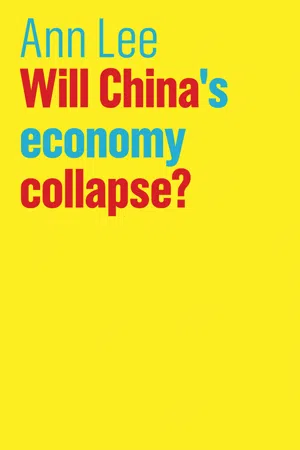
The recent downturn in the Chinese economy has become a focal point of global attention, with some analysts warning that China is edging dangerously close to economic meltdown. Is it possible that the second largest economy in the world could collapse and drag the rest of the world with it?
In this penetrating essay, Ann Lee explains both why China's economy will not sink us all and the policy options on which it is drawing on to mitigate against such a catastrophic scenario. Dissecting with realistic clarity the challenges facing the Chinese economy, she makes a compelling case for its continued robustness in multiple sectors in the years ahead.
- English
- ePUB (mobile friendly)
- Available on iOS & Android
eBook - ePub
Will China's Economy Collapse?
About this book
Information
1
The Modern Chinese Economy: The Good, the Bad, and the Ugly
China’s modern economy is an intricately complex web of state capitalism, laissez-faire capitalism, Keynesian economics, Austrian economics, Soviet-inspired planning, and good old-fashioned entrepreneurialism. Contradictions are a fact of life in the Chinese economy, and no simple definition or ideology can adequately describe everything that it encapsulates. One of the reasons for this complexity is that China is simply too large to manage uniformly. With 56 recognized ethnic groups practicing close to 300 living languages and spread over 3.7 million square miles among over 1.3 billion people, China gives rise to as many variations in economic activity as there are on the planet.
Despite such variability, China managed to modernize as one country with a speed that truly was unforeseen. For the past quarter-century, its miraculous growth has resulted in bringing the equivalent of the entire US population into the middle-income bracket. This remains the biggest economic news of our lifetime. China largely achieved this feat through a combination of exports and investments, which, as a percentage of gross domestic product (GDP), remain among the highest in the world. While other nations such as South Korea and Japan have also grown rapidly in past decades to achieve developed country status, the scale and duration of growth that China has achieved remain unparalleled. Some of the factors that distinguish China from other countries were the subject of my prior book, What the US Can Learn from China.1 As noted there, China’s leaders adopted a number of approaches that minimized problems and enhanced the probability of better outcomes for the nation as a whole.
However, there have been some developments in China that many find concerning. From strong capital outflows to volatile stock markets, a rising chorus of pundits such as David Shambaugh predict an economic crisis for the country. When China began developing, it was a small trading state and thus had tremendous room for growth by taking market share at the expense of other countries. Initially, it followed the same growth model adopted decades earlier by the four Asian Tigers of South Korea, Hong Kong, Taiwan, and Singapore. As they demonstrated, economic growth is primarily determined by (1) domestic economic competition, (2) infant industry protection, (3) state control of financial resources and international capital flows, (4) incentives that promote industrial production and exports, and (5) labor movement from rural to urban settings coupled with productivity increases. The principles driving growth haven’t changed. Today, as the largest trading nation in the world, China is nonetheless constrained by the size of the world economy. It can no longer grow faster than the world economy through trade alone.
The problem of overcapacity emerged more severely in China since the world was unable to absorb its exports, resulting in a slowing of its export engine. This overcapacity led to even more severe price cuts and eventually massive layoffs of workers, who, during the 2008 financial crisis, were no longer needed in factories for everything from textiles to steel. For instance, China has the capacity to export two-thirds of the world’s steel, but the world only needs half of China’s steel production. Thus, in an attempt to forestall worker unrest, Chinese policymakers created a second engine of growth by inducing heavy investment domestically in the years immediately following the financial crisis of 2008 in order to rehire the unemployed workforce. China’s second growth engine was characterized by infrastructure investments of all types, from sophisticated water treatment systems to rampant real estate investments that created entirely new cities out of the blue. Yet, even domestic infrastructure investments that were needed to offset the drop in exports have hit their limit for China. High-speed trains have now been constructed all over the country, and real estate expansion among third-tier cities lacks the residents and commercial activity to sustain it. A third engine of growth is now needed to keep China growing in order to lift the rest of its population out of poverty.
Developing a third engine of growth while the two former engines are slowing dramatically is challenging in itself, but the difficulty is compounded in China by its ballooning debt.
The problem with China’s credit growth is that the country had already accumulated vast amounts of both public and private debt in order to fund its second leg of growth following the 2008 financial crisis. China’s debt increase since 2009 has been faster than the debt buildup that occurred in the United States before the global financial crisis. Since China’s GDP did not grow commensurately, its debt-to-GDP ratio has also shot up. The continued growth of its credit while its GDP growth continues its downward trajectory has caused many people to predict that the country is headed for an inevitable debt crisis that will bring about the collapse of its economy.
A Closer Look at China’s Debt Situation
Throughout the modern world, the phenomenon of financial crisis usually results from a prolonged cyclical credit surge that leads to widespread and sustained deterioration in various financial and economic indicators. Hyman Minsky, an economist who observed these cycles, documented this pattern of financial fragility. The question is whether China’s set of circumstances will follow this template.
While it is undeniable that there are signs that China’s economy does not seem as robust as in years past, its broad economic health actually appears rather stable. Yes, its debt is sharply higher, but that alone cannot trigger a crisis. When one examines its other economic indicators, one sees a different story which doesn’t fit the stereotypical picture of the prelude to an economic crisis. For one, China’s GDP growth has continued to be among the highest in the world for over two decades while its inflation and unemployment levels remain consistently low. China also has largely maintained a current account surplus even at its more advanced stage. This surplus has shrunk considerably in recent years, but it still contributes to the country’s enormous foreign exchange reserves. Despite sharp drops in 2015 and 2016, these reserves continue to be the highest in the world and can be used as an effective buffer against financial contagion. China also has modest fiscal deficits that give its government additional financial leeway for future action. The country’s high savings rates at roughly 50% could also potentially drive growth. Most importantly, China has very low external debt, which is no more than 10% of its GDP.2 By way of contrast, Japan’s foreign debt is 60% of its GDP. With such low external debt, China would not be under threat from a foreign entity for repaying its debt under less than ideal conditions and thus avoid “the sudden stop” to its economy that other nations with high external debt have suffered.
China’s banks are also financially healthy. They have a very low number of non-performing loans in their portfolios (around 2%),3 are more transparent than the large US banks such as JP Morgan, and, despite the removal of the 75% cap on loan-to-deposit ratios, generally rely less on interbank lending to service their daily liquidity needs than do Western banks. Finally, unlike large US banks that count on large institutional clients with leveraged assets, Chinese banks rely mostly on the savings of the large population of households for their funding and thus are not likely to experience a crisis stemming from a single client, as was the case with the US banks during the Long-Term Capital crisis.
Bear in mind that historically most financial crises have stemmed from fiscal irresponsibility, financial exuberance, or some mixture of the two. China’s debt problem, by contrast, originated when its government acted responsibly by creating an emergency stimulus package to neutralize the negative fallout from the global financial crisis in 2008, a move which explains why the country’s debt level is an outlier among otherwise strong economic indicators. The stimulus package came via the state-owned banks, which were forced to lend because the government felt this was a more efficient way of increasing the money supply into the economy than through its fiscal budget. Most of the lending went to other state-owned enterprises (SOEs) and to local governments, since these entities had the capacity to employ large numbers of workers who had been laid off during the global financial crisis.
Although the government reduced bank lending by almost half when the crisis abated a year later, informal non-bank lending provided the fuel to keep the economic engine chugging. The bank stimulus and informal credit channels jointly created a surge of debt in China that had reached 250% of GDP,4 an increase of over 60% over the next five-year period.5 This figure, though higher than that in most developing countries, remains low compared to advanced economies. Japan’s central government debt alone, for instance, is around 230% of GDP, according to the CIA Factbook, and its total debt has topped 600%.6 The question of collapse is driven not so much by the quantity of debt outstanding as by its quality and relation to the economy, which could create potential vulnerabilities for a financial crisis.
Corporate Debt
The vast majority of China’s debt increase came from corporate debt. As mentioned earlier, the bank lending from the stimulus package went largely to other SOEs. As it turned out, most of these SOEs were in the industrial manufacturing and mining sectors, which helped build the infrastructure throughout China during this period. Unfortunately, once China’s massive infrastructure building had reached its limit, these SOEs were no longer productive. With these SOEs experiencing falling revenues and profits, these debts, which are still accumulating, could eventually reach crisis proportions if they are unable to be serviced.
While high corporate leverage is a worry, however, they are far from crisis levels and may never get there. Business Insider reported in October 2016 that China’s non-financial corporate debt reached 169% of equity. By comparison, median debt-to-equity ratios of other East Asian countries before the Asian financial crisis were much higher. South Korea’s ratio was 350% and Thailand’s was 240% leading up the crisis.7 More importantly, the trend of debt growth has been down. By August 2016, short-, medium-, and long-term corporate loans in China had all been contracting.8 Finally, Chinese policymakers have been announcing measures to limit leverage like forbidding corporates to borrow if their debt load reaches 80% of its capital structure and introducing programs like debt-to-equity swaps, to reduce the likelihood that this issue will ever spiral out of control.
One approach that some people have suggested for dealing with China’s corporate debt is to privatize the SOEs. The argument is that they have no incentives to scale back their operations to a profitable level if they know that they will be bailed out by the government. The belief is that privatizing the SOEs would reduce corporate debt and improve productivity and profitability. True, a change in ownership would probably manage to squeeze a few percentage points of cost savings in the short term. However, the downside to such an approach is structural unemployment, since many of these entities are located in parts of China where there is no other work available. The government could face a worse problem of worker unrest since the safety net of social security is not yet accessible to every Chinese citizen. Moreover, private Chinese firms are not necessarily better at managing assets. A number have run into trouble in recent years, such as the many companies involved in the solar panel manufacturing sector, because private Chinese entrepreneurs have had a tendency to hastily invest in similar manufacturing fields. They often compete with each other in a cut-throat way in a phenomenon referred to as “swarming.” Rapid phases of expansion in certain manufacturing sectors were often followed by industrial overcapacity, which led to painful sectoral shakeouts involving mergers, bankruptcies, and restructurings. Finally, cost cut- ting can only go so far. The bigger issue is finding revenue growth. With the global economy growing more slowly than China’s, it is unlikely that private ownersh...
Table of contents
- Cover
- Title Page
- Copyright
- Acknowledgments
- Preface
- 1 The Modern Chinese Economy: The Good, the Bad, and the Ugly
- 2 Preparing for a Soft Landing
- 3 Even Black Swans Won’t Kill
- 4 Can China’s Economy Lift Us All?
- Epilogue
- End User License Agreement
Trusted by 375,005 students
Access to over 1.5 million titles for a fair monthly price.
Study more efficiently using our study tools.
Frequently asked questions
Yes, you can cancel anytime from the Subscription tab in your account settings on the Perlego website. Your subscription will stay active until the end of your current billing period. Learn how to cancel your subscription
No, books cannot be downloaded as external files, such as PDFs, for use outside of Perlego. However, you can download books within the Perlego app for offline reading on mobile or tablet. Learn how to download books offline
Perlego offers two plans: Essential and Complete
- Essential is ideal for learners and professionals who enjoy exploring a wide range of subjects. Access the Essential Library with 800,000+ trusted titles and best-sellers across business, personal growth, and the humanities. Includes unlimited reading time and Standard Read Aloud voice.
- Complete: Perfect for advanced learners and researchers needing full, unrestricted access. Unlock 1.5M+ books across hundreds of subjects, including academic and specialized titles. The Complete Plan also includes advanced features like Premium Read Aloud and Research Assistant.
We are an online textbook subscription service, where you can get access to an entire online library for less than the price of a single book per month. With over 1.5 million books across 990+ topics, we’ve got you covered! Learn about our mission
Look out for the read-aloud symbol on your next book to see if you can listen to it. The read-aloud tool reads text aloud for you, highlighting the text as it is being read. You can pause it, speed it up and slow it down. Learn more about Read Aloud
Yes! You can use the Perlego app on both iOS and Android devices to read anytime, anywhere — even offline. Perfect for commutes or when you’re on the go.
Please note we cannot support devices running on iOS 13 and Android 7 or earlier. Learn more about using the app
Please note we cannot support devices running on iOS 13 and Android 7 or earlier. Learn more about using the app
Yes, you can access Will China's Economy Collapse? by Ann Lee in PDF and/or ePUB format, as well as other popular books in Politics & International Relations & Globalisation. We have over 1.5 million books available in our catalogue for you to explore.