When we look back from the vantage point of the 21st century and ask ourselves what the previous century was all about, what do we see? Our first inclination is to focus on historical events: the 20th century was the age of two devastating world wars, of totalitarian regimes and terrible atrocities like the Holocaust – "the age of extremes," to use Hobsbawm's famous phrase. But in this new book, the philosopher Peter Sloterdijk argues that we will never understand the 20th century if we focus on events and ideologies. Rather, in his view, the predominant motif of the 20th century is what Badiou called a passion for the real, which manifests itself as the will to actualize the truth directly in the here and now.
Drawing on his Spheres trilogy, Sloterdijk interprets the actualization of the real in the 20th century as a passion for economic and technological "antigravitation". The rise of consumerism and the easing of the burdens of human life by the constant deployment of new technologies have killed off the kind of radicalism that was rooted in the belief that power would rise from a material base of production. If the 20th century can still inspire us today, it is because the fundamental shift that it brought about opened the way for a critique of extremist reason, a post-Marxist theory of enrichment and a general economy of energy resources based on excess and dissipation.
While developing his highly original interpretation of the 20th century, Sloterdijk also addresses a series of related topics including the meaning of the Anthropocene, the domestication of humans and the significance of the sea. The volume also includes major new pieces on Derrida and on Heidegger's politics. This work, by one of the most original thinkers today will appeal to students and scholars across the humanities and social sciences, as well as anyone interested in philosophy and critical theory.
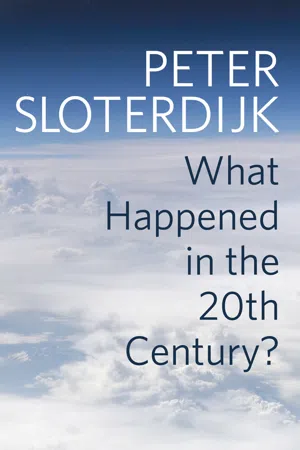
eBook - ePub
What Happened in the Twentieth Century?
Towards a Critique of Extremist Reason
- English
- ePUB (mobile friendly)
- Available on iOS & Android
eBook - ePub
What Happened in the Twentieth Century?
Towards a Critique of Extremist Reason
About this book
Information
1
THE ANTHROPOCENE – A STAGE IN THE PROCESS ON THE MARGINS OF THE EARTH’S HISTORY?
1.1 Weightless Humanity
In the year 2000, when the Dutch atmospheric chemist Paul J. Crutzen suggested that we use the term “Anthropocene” – drawing on an analogous concept of the Italian geologist Stoppani (1824–91) from 1873 – to designate the present age from the perspective of natural history, it was assumed that this term would remain part of a hermetic discourse that is spoken behind the closed doors of institutes for gas analysis or geophysics.
Yet, through a strange series of accidents, the synthetic semantic virus must have succeeded in getting past the quite secure laboratory doors and spreading to the lifeworld in general. We thus get the impression that it easily reproduces itself in the context of the sophisticated feuilleton, the museum, macrosociology, new religious movements, and literature warning of ecological collapse.
The proliferation of this concept can mainly be traced back to the fact that, under the guise of scientific neutrality, it conveys a message of almost unparalleled moral-political urgency, a message that can be explicitly formulated as follows: human beings have become responsible for the habitation and management of the Earth as a whole, since their presence upon it is no longer more or less seamlessly integrated with it.
The concept “Anthropocene,” ostensibly a geological term, implies a gesture that in a juridical context would be characterized as the designation of a responsible agency. With the attribution of responsibility, an address is provided to which possible accusations can be sent. This is precisely what we have to do today when we attribute the capacity for geo-historical offenses to “the human being” – without further specification.
When we speak of an “Anthropocene,” we only seem to be sitting in a geoscientific seminar. In reality, we are taking part in a court case – in a preliminary hearing before the main trial, to be more precise – in which, as a first step, the accused’s culpability is supposed to be settled.
This preliminary hearing is concerned with the question of whether it makes any sense at all to try the offender in question, given that the latter is not of age. This hearing would include the author Stanislaw Lem, among others, who seems to exonerate “the human being” by awarding him,1 in a tellurian context, the status of a quantité négligeable, or as Lem himself puts it:
… were all humanity taken and crowded together in one place, it would occupy three hundred billion liters, or a little less than a third of a cubic kilometer. It sounds like a lot. Yet the world’s oceans hold 1,285 million cubic kilometers of water, so if all humanity – those five billion bodies – were cast into the ocean, the water level would rise less than a hundredth of a millimeter. A single splash, and Earth would be forever unpopulated.2
In the case of quantitative relations such as these, it does not matter if we introduce present-day humanity, numbering seven billion, into the picture instead of a humanity totaling five billion (as assumed by Lem) or the eight or nine billion that will be reached after the year 2050. In terms of biomass, a randomly and rapidly ever-increasing humanity would remain infinitesimally small, if we could sink humanity toto genere into the ocean. But then, what is the point of putting on trial a species that pales in comparison to the material dimensions of the Gaia-system, the hydrosphere? Lem’s position, incidentally, is very close to certain classic disparagements of the human being – such as Schopenhauer’s contemptuous remark that the human race is like an ephemeral mold on the surface of the planet Earth.3
The prosecution will reply to these objections that the whole of humanity at its current stage of evolution simply cannot be defined merely in terms of biomass. If humanity is supposed to be put on trial, this is mainly because it epitomizes a meta-biological agency that is able to exert quite a bit more influence on the environment, by virtue of its capacity for action, than we would assume on the basis of its relative physical weightlessness.
Obviously, in this context, we immediately think of the technological revolutions of the modern age and their side effects, which not without reason are chalked up to collective humanity. In truth, “collective humanity” initially means European civilization and its technocratic elite. It was the latter that introduced a new agency into the game of global powers from the seventeenth and eighteenth centuries onward with the use of coal, and later petroleum, in machines. In addition, the discovery and demonstration of the nature of electricity shortly before the year 1800, and the technical mastery of it in the nineteenth century, gave rise to a new universal in the discourse on energy. Without this new universal, the metabolic interaction of human beings with nature – to recall the Marxist definition of labor – would be inconceivable. The collective that is characterized these days by expressions such as “humanity” mainly consists of agents who within less than a century have acquired technologies developed in Europe. When Crutzen speaks of an “Anthropocene,” this is a gesture of Dutch courtesy – or avoidance of conflict. In fact, talk of a “Eurocene” or a technocene initiated by Europeans would be more fitting.
That human actors have an impact on nature in their turn is not really a new observation. Already in antiquity, deforestations were noted in Greece and Italy that were ascribed to the demand for timber in the shipbuilding industry. The emergence of cultivated landscapes, too, is inconceivable without taking the influence of agriculture, viticulture, and animal husbandry into consideration. The latter, in particular, continues to be an unsettling item on the bill that the ecosystem “Earth” will present to human beings. Only in more recent times has the connection between human pastoral power and political expansionism been emphasized.4 In macrohistorical terms, there is quite clearly a relatively recent (that is, spanning about 3,000 years) causal nexus between raising cattle and imperial politics: not a few historical empires – such as those of the Romans, the British, the Habsburgs, and the Americans – were ultimately based on the cultivation of herds of livestock that provided their herdsmen with a significant surplus of labor power, mobility, protein, and leather, not to mention the link between being assured of a certain caloric intake on a daily basis and political expansionism. In more recent times, we have also become aware that herds of cattle have a considerable impact on the environment, because of their metabolic functions.
At present, there are supposedly about 1.5 billion cattle on Earth – if we were to dump them all in the ocean the latter would rise about five times as much as it would if humanity itself were dumped there: even so, we would still be dealing with tenths of a millimeter and yet would have never left the realm of quasi-weightlessness.
Indirect anthropogenic environmental impact due to animal husbandry is nevertheless striking: every cow maintained by a human being produces a quantity of greenhouse gases in its thirty-year lifespan, owing to digestive flatulence, that would correspond to a trip of 90,000 kilometers with a mid-range engine.
In referring to how widespread the current exercise of human pastoral power has become, we leave the realm of negligible dimensions behind. As the producer of enormous indirect emissions, humanity in the industrial age might actually take on a geologically relevant role, despite its weightlessness, in terms of biomass. This would result in particular from its operation of enormous fleets of automobiles, airplanes, and ships that run on combustion engines, but it would have just as much to do with the heat balance in regions of the world where a pronounced winter gives rise to compensatory pyrotechnic and architectonic attempts at restoring balance. With these preliminary remarks out of the way, the case against the “Anthropocene” can be allowed to proceed to a full hearing.
1.2 Doctrines of Ages of the World
With the concept of the “Anthropocene,” contemporary geology once again adopts the nineteenth-century epistemological habit of historicizing anything and everything, and of organizing all historical fields into eons, ages, or epochs. The triumph of historicism is primarily fueled by the idea of evolution, which is taken to refer to all areas of reality, from minerals up to the large composite bodies that are known as human “societies.”
Marx and Engels, in harmony with the spirit of their age, could thus claim: “We know only one science, the science of history.”5 In their eyes, human history represented a special case of natural history, insofar as the human being per se is the “animal” that has to secure its own existence through production. Consequently, the history of the “relations of production” would be nothing more than the continuation of natural history in another register. Human metanaturalism would merely be natural history that was technologically alienated. What we call the human being’s inner “nature” would be what Spinoza called the impulse (conatus) to self-preservation at any price, which marks all life with the form of forward flight.
For a time, the Marxist image of the world popularized the saga of the “relations of production” – along with their great stages of the hunter-and-gatherer era through to slave-holding societies, feudalism, capitalism, and all the way to “communism.” This myth had the great merit of replacing ancient doctrines of the ages of the world or eons (which descend from the golden to the iron age), as well as the doctrine of world empire found in the Book of Daniel in the Bible, with a pragmatic theory of epochs. According to this theory, the ages of the world are distinguished from each other by the manner in which human beings organized their “metabolism with nature.”
The concept of the “Anthropocene” logically belongs to the group of pragmatic theories of the ages of the world. It posits a state of telluric metabolism in which the emissions caused by human beings have begun to influence the course of the Earth’s history. The concept of “emission” helps us to recognize that the kind of influence we are concerned with here has until now taken place in the mode of a “side effect” – otherwise, we would be talking about a “mission” or a “project.” The “e” in “emission” reveals the involuntary character of the anthropogenic impact on the exo-human dimension. Thus the concept of the “Anthropocene” includes nothing less than the task of testing out whether the agency of “humanity” is capable of transforming something ejected into a project, or of transforming an emission into a mission.
Anyone who speaks of an “Anthropocene” thus appeals to a still scarcely existent “critique of narrative reason.” Since effective histories can only be organized from their end points backwards, the anthropocenic standpoint amounts to a narrative with a stark moral choice. In the narrative culture of the West, this position was formerly reserved exclusively for apocalyptic literature. Apocalypticism is the attempt to evaluate the world from its end – it implies a cosmicmoral procedure of sorting, in which good is separated from evil. To separate good from evil simply means to extract what is worthy of survival from what is not worthy of survival: what one calls eternal life is an intensified metaphysical term for being allowed to carry on, whereas eternal damnation signifies that a specific modus vivendi has no future and is to be removed from the series of forms of existence worthy of being passed down.
Everything thus suggests conceiving of the “Anthropocene” as a term that is only meaningful within the fram...
Table of contents
- Cover
- Copyright
- 1 The Anthropocene – A Stage in the Process on the Margins of the Earth’s History?
- 2 From the Domestication of the Human Being to the Civilizing of Cultures: Answering the Question of Whether Humanity is Capable of Taming Itself
- 3 The Ocean Experiment: From Nautical Globalization to a General Ecology
- 4 The Synchronized World: Philosophical Aspects of Globalization
- 5 What Happened in the 20th Century?: Toward a Critique of Extremist Reason
- 6 The Thinker in the Haunted Castle: On Derrida’s Interpretation of Dreams
- 7 Deep Observation: Toward a Philosophy of the Space Station
- 8 The Persistent Renaissance: The Italian Novella and News of Modernity
- 9 Heidegger’s Politics: Postponing the End of History
- 10 Odysseus the Sophist: On the Birth of Philosophy from the Spirit of Travel Stress
- 11 Almost Sacred Text: Essay on the Constitution
- 12 The Other Logos, or the Reason of Cunning: On the Intellectual History of the Indirect
- Editorial Note
- End User License Agreement
Trusted by 375,005 students
Access to over 1.5 million titles for a fair monthly price.
Study more efficiently using our study tools.
Frequently asked questions
Yes, you can cancel anytime from the Subscription tab in your account settings on the Perlego website. Your subscription will stay active until the end of your current billing period. Learn how to cancel your subscription
No, books cannot be downloaded as external files, such as PDFs, for use outside of Perlego. However, you can download books within the Perlego app for offline reading on mobile or tablet. Learn how to download books offline
Perlego offers two plans: Essential and Complete
- Essential is ideal for learners and professionals who enjoy exploring a wide range of subjects. Access the Essential Library with 800,000+ trusted titles and best-sellers across business, personal growth, and the humanities. Includes unlimited reading time and Standard Read Aloud voice.
- Complete: Perfect for advanced learners and researchers needing full, unrestricted access. Unlock 1.5M+ books across hundreds of subjects, including academic and specialized titles. The Complete Plan also includes advanced features like Premium Read Aloud and Research Assistant.
We are an online textbook subscription service, where you can get access to an entire online library for less than the price of a single book per month. With over 1.5 million books across 990+ topics, we’ve got you covered! Learn about our mission
Look out for the read-aloud symbol on your next book to see if you can listen to it. The read-aloud tool reads text aloud for you, highlighting the text as it is being read. You can pause it, speed it up and slow it down. Learn more about Read Aloud
Yes! You can use the Perlego app on both iOS and Android devices to read anytime, anywhere — even offline. Perfect for commutes or when you’re on the go.
Please note we cannot support devices running on iOS 13 and Android 7 or earlier. Learn more about using the app
Please note we cannot support devices running on iOS 13 and Android 7 or earlier. Learn more about using the app
Yes, you can access What Happened in the Twentieth Century? by Peter Sloterdijk, Christopher Turner in PDF and/or ePUB format, as well as other popular books in Philosophy & Philosophy History & Theory. We have over 1.5 million books available in our catalogue for you to explore.