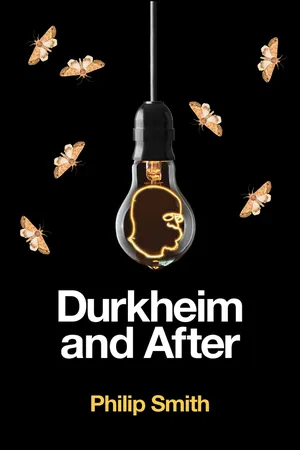
Émile Durkheim's major works are among the founding texts of the discipline of sociology, but his importance lies also in his immense legacy and subsequent influence upon others.
In this book, Philip Smith examines not only Durkheim's original ideas, but also reveals how he inspired more than a century of theoretical innovations, identifying the key paths, bridges, and dead ends – as well as the tensions and resolutions – in what has been a remarkably complex intellectual history. Beginning with an overview of the key elements of Durkheim's mature masterpieces, Smith also examines his lesser known essays, commentaries and lectures. He goes on to analyse his immediate influence on the Année Sociologique group, before tracing the international impact of Durkheim upon modern anthropology, sociology, and social and cultural theory. Smith shows that many leading social thinkers, from Marcel Mauss to Mary Douglas and Randall Collins, have been carriers for the multiple pathways mapped out in Durkheim's original thought.
This book will be essential reading for any student or scholar seeking to understand this fundamental impact on areas ranging from social theory and anthropology to religious studies and beyond.
- English
- ePUB (mobile friendly)
- Available on iOS & Android
eBook - ePub
About this book
Information
Chapter 1
Durkheim’s Life and the Four Major Books
Situating Durkheim – early life and training – The Division of Labor – The Rules of Sociological Method – Suicide – the middle career phase – L’Année sociologique – The Elementary Forms of Religious Life – death
Almost every biographer or intellectual historian runs up against the same frustration. The goal of their labors becomes more elusive and complex the further they travel. Even if we look away from the psyche of Émile Durkheim, for which there is not so much information, to focus on the written work, for which we have plenty to go on, we still find this pattern of regress repeated. The more we read, the more we study, the more the hope that we will come to any final understanding and arrive at our destination evaporates. We seem to be pumping a handcar down railroad lines that converge at infinity.
Look at the ink on the page. Without trying particularly hard or even knowing much about him we can see that Durkheim is associated with many styles of social thought, with multiple vocabularies and authorial postures. These have contributed to debate, to a proliferation of interpretations (Jones 1999; Lukes 1973), and they have been considered by scholars at some times as complementary and at others as contradictory. For example, Durkheim was an advocate of the social fact, positivism, social statistics, and the possibility of a rigorous and objective study of society. But he also spoke about intangibles such as normative integration, morality, and anomie, and suggested that society cohered due to a collective conscience – each of these being somewhat ineffable. A less pretentious word would be “fuzzy.” So was he a scientist or a humanist? Later in his career Durkheim brought in elements of a new vocabulary that further complicate the picture. He insisted on ritual, on classification, and on notions of the sacred and profane as the keys to understanding social process. This move brings in a further topic for debate as well as a third set of tools. Some say Durkheim had an epistemological break and that as his career progressed he became a radically different “cultural” theorist. Others insist that there are just shifts in emphasis and point out that the same concepts, problems, and vocabularies can be found – more or less – throughout his work. What is clear is that he remained committed to empirical inquiry. Sociology needed to observe regularities and patterns in the world rather than being a merely theoretical discipline. Yet by the same token Durkheim hated empiricism. The sociologist had to go beyond just describing things. We need to dig beneath the surface to uncover hidden laws, to theorize connections and discover general principles of social organization.
Durkheim can, of course, be positioned as heir to more specific intellectual legacies as well as in terms of axiomatic generalities. While all commentators admit there are multiple influences, many cannot resist boiling these down to just one or two that are, in their reading, truly essential. Candidates include earlier scholars like Comte, Saint-Simon, Rousseau, Kant, Renouvier; or historically embedded intellectual traditions such as French reactionary Catholicism and German Romanticism. The ancestor or lineage that is picked very much depends on whether Durkheim is read as a positivist, an idealist, a critical realist, or a realist, as religious or secular, as a moralist or as a scientist. It also varies according to which book is taken to capture his essence.
We can also attempt to define Durkheim in ways less closely related to the world of pure ideas and the ivory tower sociological enterprise. Here too there are multiple positions to be taken. Consider the case of his politics. For many critical theorists Durkheim is a conservative whose work failed to come to terms with power and injustice. As we will see, this is a complaint that has continued to dog his tradition to this day. However, Durkheim can also be identified as a person who wrote on socialism, who objected to the social impacts of inherited wealth, who saw that contracts could be unfair when there were inequalities between the participants, and who argued that state power needed to be subordinated to the social will. He advocated roles for occupational groups and centralized bargaining in an effort to head off the worst excesses of capitalism. His was a vision of something rather like the Swedish system that was taken as a model of best practice by many critical sociologists with a normative commitment to social democracy.
It is equally significant that Durkheim came out in public support of Alfred Dreyfus (1859–1935), a military officer from a Jewish background who was unfairly convicted of treason in 1895 and condemned to life imprisonment. The Dreyfus Affair split France and was a crucial litmus test of social attitudes at the time. Progressives and liberals pressed vigorously for a pardon and exoneration. On the other side there was a concerted establishment effort to keep Dreyfus in jail, to save face and to cover up of the identity of the real perpetrator. A wider debate attached to the Dreyfus specifics. This concerned the extent to which France was an essentially Catholic nation or one founded upon ideas regarding equal citizenship and human rights. At some risk to his career Durkheim stood up for justice and universalism.
In thinking about Durkheim’s multiplicity and complexity we might also refer to a variability of intellectual style, a dimension that has autonomy from the content of the ideas themselves. He can be seen as a deep thinker with a great propensity for abstraction and a consequent extended deployment of image and metaphor. For example, at times he writes somewhat metaphysically and inspira-tionally, and in a mode not unlike that of his rival the philosopher Henri Bergson, when he speaks of solidarity or the role of currents in the collective conscience. Yet there is also a scholar who can move pedantically and at a painfully slow speed, a kind of high-powered, brute-force chess automaton who tries to arrive at a precise definition or to refute opponents step by step. Another iteration of his authorial persona was that of a punchy, no-nonsense intellectual. For example, there is a Durkheim who thought statistics could resolve things or cut through the chatter: we should follow the trail of social facts. Then there is the polemicist who stands up for sociology against psychology, and the anxious neat-freak social engineer who wants to order and organize society before it is too late. As we will see, the “real Durkheim” is in a sense all of these. It depends a little on where you look and quite a bit upon which interpretative lens you reach for.
About this Chapter, About this Book
Where to start? This chapter is about the big highlights. Here is a slightly facetious analogy. When people go on safari they like to see the “big five” – elephant, buffalo, rhino, lion, and leopard, or some such combination of charismatic megafauna. The search for these is a priority that structures a wider experience in which the tourist might encounter other animals – warthogs, antelope, anteaters, and the like. If they chance upon these it is a bonus, but it is the “big five” that gets them onto that long-haul flight. In this book we follow a similar logic and put first things first. At the end of the day Durkheim is best known to most people as the author of four monographs that changed the path of social science. The full titles for each are The Division of Labor in Society, The Rules of Sociological Method, Suicide: A Study in Sociology, and The Elementary Forms of Religious Life. However these books are so well known they are almost universally referred to in scholarship by abbreviated titles as follows: Division of Labor, Rules, Suicide, and Elementary Forms.
And so our very long initial chapter starts with these, but with a substantial cautionary note. As we will see later in detail, Durkheim wrote a number of lesser but still highly significant and somewhat lengthy works. Even if his “big four” had never been written, these mid-size contributions and extended essays would have made Durkheim at the very least a significant, highly creative mid-weight player in the history of social theory. This often forgotten output covers a bewildering variety of topics: education, professions, and punishment, to name but three. The plurality does not stop with these books and assembled lectures. He wrote a large number of reviews and introductions in his team’s journal, the Année sociologique, as well as letters and reports. Intellectual significance does not always covary with length. Sometimes a very short item will provide a major clue to his creative thinking on a big topic – be it totemism or socialism or individualism, or some other “ism,” or for that matter “ology.”
Because this scattered output is so interesting, dense, and creative, it needs to be understood, also. Shortcuts are risky. It can be more than a little frustrating to try to become a Durkheim scholar because there are just so many such references that need to be read – and our lives being the way they are, these can easily become so many things we should have read but never found time for. It is especially perilous to see the long tail as insignificant for the main game, as it contains fresh ideas and intellectual moves that cast Durkheim’s “big four” in a new light. For example, his writings on property have been generally neglected but, when examined, are a way to connect The Division of Labor to The Elementary Forms. Thankfully a minor industry of expert Durkheim scholarship has existed for quite a while, engaged in just such a task of information retrieval and intellectual reconstruction that pays attention to small details in quiet corners. It has helped generate not only a fuller picture of the man and thinker, but also a sense of dynamic activity and prodigious intellectual engagement.
Durkheim died in 1917. This may seem a long time ago. But think of it this way. The year of his death is only twenty-eight years before the first use of the atomic bomb and less than fifty years before The Beatles were at their zenith. We are now more than 50 years from Sgt. Pepper and moving away fast, but many people still feel the album belongs in our epoch, not in some distant age. This kind of timeline reminds us that Durkheim can be thought of as “recent.” In this regard he has had the luck to have two excellent biographers in Steven Lukes (1973) and Marcel Fournier (2013). They have fixed much of the phenomenological experience of immediacy and proximity. Their books combined give us around 1,500 pages of vivid information. Recent decades have also seen the emergence of a cluster of Durkheim scholars, many of them publishing detailed essays in the journal they founded in the 1990s: Durkheimian Studies/Études Durkheimiennes. Figures such as W. S. F. Pickering, William Watts Miller, Robert Alun Jones, Philippe Besnard, Massimo Borlandi, Mike Gane, Kenneth Thompson, Alexander Gofman, and Alexander Riley, among many others, have made it their task to engage in detailed reconstruction of Durkheim’s thinking, the recovery of lost or forgotten letters and archives, the editing and translation of nearly forgotten texts, the retranslation of well-known ones, and the elaboration of detailed chronologies (see chapter 5 for information on this group). The result of this activity has been a far more comprehensive and three-dimensional account than we had in the initial decades after Durkheim’s death. It has put in the foreground several insights that should be remembered in this chapter and the next. Collectively they temper the impression we can easily form of an isolated genius working by candlelight, cut off from the world and obsessed with his four major books to the point where they define who he was. This kind of recent scholarship has demonstrated the following:
- Durkheim was at the center of a team. He taught, encouraged, commissioned, edited, and organized at the expense of his own personal research time. Team members mostly underperformed after his death and without his leadership. However, the group helped him develop his thinking, especially on religion, and the research network or paradigm was for a while an effective way to leverage his influence.
- It is now clearer than ever that Durkheim’s work amounted to much more than just four major monographs. We alluded to this above. Specialist Durkheim scholars have pointed to his lectures as major accomplishments, to his multiple book reviews as a substantial intellectual achievement, and to the breadth and diversity of his scholarship (for example, his thoughts on pragmatism, socialism, or education). Much of this is not readily apparent to an undergraduate on a survey course or to a fast, strategic reader.
- Durkheim’s major book projects had long gestation periods. We can trace the evolution of his ideas for each of these with a detailed intra-corpus reading. Work on what would become the Division of Labor (published 1893) started in 1884; Suicide (1897) in a course taught in 1889–90; the Elementary Forms (1912) in a course from 1894–5, another from 1900–1, yet another in 1906–7, and in various essays in the Année sociologique. This commitment to long-term labor militates against the vision of Durkheim as an opportunist publishing willy-nilly in a quest for visibility and prestige, or as a person struck by inspiration and hence jumping into new topics by whim.
- Many of Durkheim’s ideas evolved via real or virtual engagement with other thinkers of his time on the major contemporar...
Table of contents
- Cover
- Front Matter
- Preface and Acknowledgments
- 1 Durkheim’s Life and the Four Major Books
- 2 Durkheim’s Other Works and the Contributions of His Students
- 3 Durkheimian Thought, 1917–1950
- 4 Through the Cultural Turn, 1950–1985
- 5 Into the Twenty-First Century: Durkheim Revived, 1985–2020
- References
- Index
- End User License Agreement
Trusted by 375,005 students
Access to over 1.5 million titles for a fair monthly price.
Study more efficiently using our study tools.
Frequently asked questions
Yes, you can cancel anytime from the Subscription tab in your account settings on the Perlego website. Your subscription will stay active until the end of your current billing period. Learn how to cancel your subscription
No, books cannot be downloaded as external files, such as PDFs, for use outside of Perlego. However, you can download books within the Perlego app for offline reading on mobile or tablet. Learn how to download books offline
Perlego offers two plans: Essential and Complete
- Essential is ideal for learners and professionals who enjoy exploring a wide range of subjects. Access the Essential Library with 800,000+ trusted titles and best-sellers across business, personal growth, and the humanities. Includes unlimited reading time and Standard Read Aloud voice.
- Complete: Perfect for advanced learners and researchers needing full, unrestricted access. Unlock 1.5M+ books across hundreds of subjects, including academic and specialized titles. The Complete Plan also includes advanced features like Premium Read Aloud and Research Assistant.
We are an online textbook subscription service, where you can get access to an entire online library for less than the price of a single book per month. With over 1.5 million books across 990+ topics, we’ve got you covered! Learn about our mission
Look out for the read-aloud symbol on your next book to see if you can listen to it. The read-aloud tool reads text aloud for you, highlighting the text as it is being read. You can pause it, speed it up and slow it down. Learn more about Read Aloud
Yes! You can use the Perlego app on both iOS and Android devices to read anytime, anywhere — even offline. Perfect for commutes or when you’re on the go.
Please note we cannot support devices running on iOS 13 and Android 7 or earlier. Learn more about using the app
Please note we cannot support devices running on iOS 13 and Android 7 or earlier. Learn more about using the app
Yes, you can access Durkheim and After by Philip Smith in PDF and/or ePUB format, as well as other popular books in Social Sciences & Sociology. We have over 1.5 million books available in our catalogue for you to explore.