At the end of life, our comfort lies mainly in relationships.
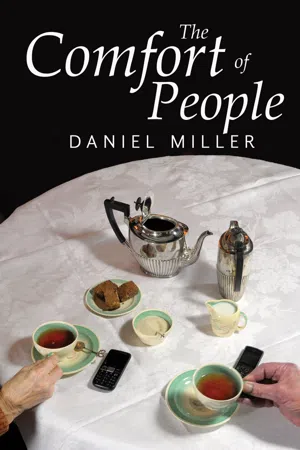
In this book, Daniel Miller, one of the world's leading anthropologists, examines the social worlds of people suffering from terminal or long-term illness. Threading together a series of personal stories, based on interviews conducted with patients of an English hospice, Miller draws out the implications of these narratives for our understanding of community, friendship, and kinship, but also loneliness and isolation.
This is a book about people's lives, not their deaths: about the hospice patients rather than the hospice. It focuses on the comfort given by friends, carers and relatives through both face-to-face relations and, increasingly, online communication. Miller asks whether the loneliness and isolation he uncovers is the result of a decline of English patterns of socialising, or their continuation.
This moving and deeply humane book combines warmth and sharp observation with anthropological insight and practical suggestions for the use of media by the hospice. It will be of interest not only to students and scholars of anthropology, sociology, social policy and media and cultural studies, but also to healthcare professionals and, indeed, to anyone who would like to know more about the role of relationships in the final stage of our lives.
- English
- ePUB (mobile friendly)
- Available on iOS & Android
eBook - ePub
The Comfort of People
About this book
Information
Story 1
Sarah
It was six days before her death. We didn’t know it would only be six days, but we knew that Sarah would not grace us with her presence for much longer. And yet the temptation is to describe the occasion as rather lovely and certainly fun. She had offered us each a glass of Prosecco, and had a small one herself, perfect for a pleasant ambience, sitting in the back garden of her village home on a warm summer’s day. But the real setting was this combination of Irish openness in speaking about death and an English love of black humour. She is talking about what will happen to her corpse: ‘No reason why you can’t put me in the dining room. I’ll be very quiet. I’ll be good…. He’s going to put me in a pair of pink silk pyjamas. I have never worn a pair of pink silk pyjamas in my entire life. Not too worried what shade it is.’ She tells of a recent expedition to the pub, where the family all went by car, leaving ‘one skinny terminal’ to jog her way up the hill. Listening now to those two hours of recorded conversation, the dominant sound is of constant banter and laughter, Sarah reporting the look on the face of that girl at the funeral parlour when she realized that the funeral Sarah was organizing was for herself. Black humour gets us through life − and death.
Still, as with all humour, the timing has to be right, and the place. One of the leitmotifs of this conversation is Sarah getting things wrong. As she remarks, it is partly because when you are terminally ill for such a long time, you tend to live within a bubble of people who are always appraised of this situation. So you may forget that others are ill prepared. One place where she got it wrong was the pub. Someone asked her how she was. The trouble came when she actually bothered to answer in some detail. One of the women there started to shake and tell her to ‘stop it, stop it’, that she ‘can’t take this’, that ‘it’s too close to what happened to her mother’. Everyone was in tears. Clearly, there are limits and rules to pub banter; flirting and football are fine, but apparently not death, not even as jokes.
Sometimes it’s the other way around. People expect to visit you in a hospital; it seems the right time to do this, without invading the privacy of the home. We know the drill, even if we forget that these days flowers are no longer allowed, which is really annoying. But the hospice is different. Terminal care is almost entirely in one’s own home; people tend to come to the hospice only for brief periods to control pain, or regain some energy or take up various kinds of outpatient and activity sessions, such as counselling. So, unless this is literally the deathbed scene, it is actually a time when you probably don’t want to see anyone at all. But when Sarah last went in, she had nine visitors on the first day. Fortunately, after that her ever-loving and highly sensitive husband put a stop to it. She had made a rather crucial mistake. She had posted on Facebook that she was going into the hospice so everyone immediately knew and this had caused the crush.
In every other respect, Facebook was a gift, a gift to Sarah and from Sarah, but then giving is what Sarah is all about. She was diagnosed with cancer ten months previously, and this was confirmed as terminal four months before we met. It’s clear in retrospect that much of her time has been spent trying to think of ways that this terminal prognosis could be turned into something of value to others. But she would never in a million years have predicted that the means to achieve this would be Facebook. In fact, up to that moment she had never been on Facebook. It was the perspicacity of her son who had set up a Facebook account on the day of her diagnosis. Quite quickly, she sensed how this new relationship with people outside could transform her relationship to what was happening to her inside. Facebook would be her extended voice teaching the world about something that they needed to hear and were reluctant to confront, which was the experience of cancer and dying. Sarah was as aware as anyone about the need for this, having spent more than thirty years as a nurse and having witnessed the ignorance, misconceptions and denials. So Facebook would give her a final purpose, a means to turn all this negativity into something positive.
Despite their protestations to the contrary, it often tends to be older women who take as ducks to Facebook’s water. This is social media, and in most families it’s the women who do the business when it comes to keeping the conversations going, the business of simply being social. It’s one of the comments the family often made about Sarah, well before Facebook. She was the glue, the chain, the one who kept the extended and extensive family linked, beyond the weddings and the wakes. She knew what had happened to whom and she told the others; not gossip, just the kind of sharing that makes family something more present and real. When trouble had come to one part of the family, she had been the person who had helped those children get through their parent’s divorce. So a new technology that could bring with it a network of people and enable them to feel closer just fell straight into her lap. Her son knew that the best gift was to help her with the technology in setting up this new Facebook account, while her daughter is the one who helps her use it to maintain the social connections over the long term.
The story is there, scrolling through her Facebook account. It starts with a gradual build-up of people, though there were newcomers joining right up to her death. Lots of positive messages respond to the postings about her scans and chemotherapy:
‘Sarah, what a joy to see your beautiful smile. All the Ryans on this side of the pond are holding every positive thought for you and sending them with wings of love.’‘Sarah, you are a healer and have been there for many people, including me! Your strength is admired and your spirit is strong … It is time for the universe to deliver some good karma for you.’
There was plenty of hope in that initial period. On the one hand, Facebook became an effective way to keep people appraised without having to tell them individually. Being a nurse, Sarah had no qualms about including the details.
Good news is ‘no cancer spread’, just isolated to the lower half of my stomach. The chemotherapy should help to reduce the thickness of my stomach lining and prevent further tumour cells or spread. They will check my response to treatment with a CT scan following 4 cycles of chemo and blood tests through monitoring tumour markers … I have completed the first of the three chemos via a drip over 15 mins, then the second over 2 hours, all seemed to be going well, then I experienced broncho spasm (couldn’t breathe or swallow). TERRIFYING. The nurses and doctors responded quickly with oxygen, injections of hydrocortizone and Piriton, also warm blankets.
But this is constantly interlaced with humour: ‘Tried on wigs at Selfridges post scan today, I looked a right Herbert − think I’ll go bald in next three weeks with as much dignity as I can muster; depends on the shape of my head.’ Sarah was as good as her word; she went for the bald look. It wasn’t that this appealed to her in any way, she just felt wigs were still worse.
As requested, others respond with their jokes:
Knock, knockWho’s there?EileenEileen who?Eileen on the bar while you buy the drinks
The close relationship with her husband and children is touching. Sometimes it isn’t even clear if it is Sarah or her husband who is posting the news. They clearly share everything, including the Facebook account and password. You can also feel how all members of this group, through their responses, are doing all they can, just willing their words to turn things around for Sarah. There is so much wanting to do something, to say something. ‘You are the most inspiring person I have met ever in my life. Now is the time, Sarah, for everyone to bounce back to you every ounce of love and healing right your way!!! So brace yourself girl, I am sending it to you by special courier; her name is faith. xxxx’
But, while the words help, they cannot heal, and the news gets worse until:
I have been discharged by the surgeons and referred to the oncologists for palliative chemo, but have already decided to refuse. I want to claim my body back now and go with it. Sorry since the 9th Jan, my surgery, if I have acted out, but I am still in shock and hugely upset with the inoperable result. It’s a shock. If you were in my boots, how would you feel? Anyhow looking for a hotspot in Europe to go and relax and enjoy what’s left. xxx
Even with this, one of the worst communications anyone could receive, there is always the sense that the pill must be sugared with humour in order to be swallowed. ‘Had holy communion but unfortunately my mobile phone went off with some rock song.’ ‘Thanks, Jean, for the laughter this morning; you can be absolutely hilarious and such great fun. Better medicine than any hospital has ever given me. Keep it up, I need it.’
Against her doctor’s advice, she and her husband settle for a last Mediterranean holiday, and a mass of photos are posted of them by the pool and clearly enjoying the break. This itself was something of a final triumph since, days before she went, her doctors had been insisting that all food and drink would from now on only be ingested through a tube and she had insisted on taking the tube out. But it was also a triumph with respect to Facebook as it was only thanks to this holiday that she had finally been able to participate in ‘normal’ Facebook, posting those very ordinary shots of cocktails and swimsuits that everyone else gets to post. Just for a couple of weeks, her Facebook looks like Facebook is supposed to look. But then there is the inevitable return. We had not expected to see ourselves incorporated into the very stuff that we were studying, even prior to our first meeting. Clearly, Sarah had carefully read our introductory materials.
Meeting with the research team today. I have already been advised that it can be exhausting, or may be emotional answering questions, and I can pull out at any time if it gets too much. Me thinketh they have no idea what they are letting themselves in for. I am not the one that will be emotionally drained or exhausted, so bring it on.
What you experience on Facebook is her honesty about the steps and stages that have to be accepted, dragging you to a place you haven’t the slightest desire to reach but which keeps getting closer. A time comes when drinking a glass of champagne makes her vomit, at which point she posts that dying really is a ‘pain in the arse’. Of course, it gets still worse:
I am feeling quite ill and weak now, not myself, quite emotional. The drug they have me on is like speed, so can really affect your emotions and make you feel very tired. Last night I was quite symptomatic with sickness, reflux and diarrhoea, so I am not on form. I would like to send my husband, children and grandchildren a big hug to let them know how much they mean to me. xxxxx
The appeal of Facebook lies in her insistence that dying is something to be open about. Having previously worked in the health service, she has the experience and feels it has given her strength. For her, the crucial point is that most people don’t have to confront these things and, without comparative experience, they are even more scared and anxious. She is sure there is a benefit to sharing her death and also her acceptance. She tells us how important this is with respect to her own family’s response. ‘I don’t care if I am incontinent, or burping or letting out nasty noises; it’s part of death. I have looked after people to the very end and given them the best death that they can possibly have and all I am asking for is a good death, a sweet ending, where my family aren’t going to suffer too much.’ She feels there is an additional suffering that comes from denial and avoidance and is lessened by acknowledgement and presence. Facebook gives her that presence, makes her gradual demise visible and so also meaningful.
The hospice becomes increasingly important. Earlier on she had noted, ‘A big day yesterday; met with the hospice team re my future care and management. They already understand that I want to live my life fully and will only call them when I need them. Hopefully that is a long way off yet.’ When that time comes she posts: ‘Good news. I am getting oral fluid down and hope to go home tomorrow, God willing. Mind you, have met some lovely fellow patients and nurses, had a right laugh.’
What a beautiful sunny day. I’ve stopped taking some of the medication (steroids) that has been causing me mood disturbances, tearfulness and fatigue; also stopping the antibiotic because it is making me sick. These things may alleviate some symptoms but they create more havoc with others. It’s about knowing your body and its likes and dislikes. There is no use prolonging your life if it deteriorates the quality of it. Enjoy the sunshine today, it’s a new day.
Finally, you know it is her husband who is posting: ‘I’m hugely saddened in having to let everybody know that Sarah passed away at approximately 4.20 a.m. today. The family would like to thank everybody for the messages of support, thoughts & prayers that have given us so much strength. It has really meant so much to us all, but especially Sarah.’
The next few days sees a flood of posts. Even the most sceptical can see the potential of Facebook as a site where people who live too far away, or who cannot come to the funeral for other reasons, can at least express something of what they feel. ‘Sorry I wasn’t able to make it along yesterday to pay my respects personally but Sarah was in my thoughts and prayers throughout the day. God speed her wherever she heads next.’ Many images of candles follow, but also glasses of champagne. Later on, there is fundraising for the hospice, and acknowledgement of the birthday that Sarah didn’t live to see, ‘Thinking of you, Auntie Sarah. Sending love and positive thoughts out into the universe in honour of your birthday and burning a flame in honour of you tonight.’ Then more memories, more acknowledgements and, in the end, just the desire to retain something of the good that was Sarah.
Reading her posts and the responses, it becomes clear why for Sarah Facebook was nothing trivial, but as with t...
Table of contents
- Cover
- Title Page
- Copyright
- Acknowledgements
- Foreword
- Introduction
- Story 1 Sarah
- Story 2 Champneys for the Terminal
- Story 3 The Curse of Confidentiality
- Story 4 Parkinson’s
- Story 5 Four Friends
- Story 6 Betty and Gloria
- Story 7 Tom, Dick and Robin Rigby
- Story 8 My Fair Lady
- Story 9 Maypole
- Story 10 Control Centre
- Story 11 Our Forum
- Story 12 Depression
- Story 13 Community
- Story 14 Bluebells
- Story 15 The Intimacy of Strangers
- Story 16 The Silent Community
- Story 17 In This Room
- Story 18 Matt
- Conclusions
- Recommendations for Hospice Use of New Media
- References
- End User License Agreement
Trusted by 375,005 students
Access to over 1.5 million titles for a fair monthly price.
Study more efficiently using our study tools.
Frequently asked questions
Yes, you can cancel anytime from the Subscription tab in your account settings on the Perlego website. Your subscription will stay active until the end of your current billing period. Learn how to cancel your subscription
No, books cannot be downloaded as external files, such as PDFs, for use outside of Perlego. However, you can download books within the Perlego app for offline reading on mobile or tablet. Learn how to download books offline
We are an online textbook subscription service, where you can get access to an entire online library for less than the price of a single book per month. With over 1.5 million books across 990+ topics, we’ve got you covered! Learn about our mission
Look out for the read-aloud symbol on your next book to see if you can listen to it. The read-aloud tool reads text aloud for you, highlighting the text as it is being read. You can pause it, speed it up and slow it down. Learn more about Read Aloud
Yes! You can use the Perlego app on both iOS and Android devices to read anytime, anywhere — even offline. Perfect for commutes or when you’re on the go.
Please note we cannot support devices running on iOS 13 and Android 7 or earlier. Learn more about using the app
Please note we cannot support devices running on iOS 13 and Android 7 or earlier. Learn more about using the app
Yes, you can access The Comfort of People by Daniel Miller,Daniel Miller in PDF and/or ePUB format, as well as other popular books in Social Sciences & Cultural & Social Anthropology. We have over 1.5 million books available in our catalogue for you to explore.