In 1816, the climate went berserk. The winter brought extreme cold, and torrential rains unleashed massive flooding in Asia. Western Europe and North America experienced a 'year without a summer', while failed harvests in 1817 led to the 'year of famine'. At the time, nobody knew that all these disturbances were the result of a single event: the eruption of Mount Tambora in what is now Indonesia – the greatest volcanic eruption in recorded history.
In this book, leading climate historian Wolfgang Behringer provides the first globally comprehensive account of a climate catastrophe that would cast the world into political and social crises for years to come. Concentrating on the period between 1815 and 1820, Behringer shows how this natural occurrence led to worldwide unrest. Analysing events as diverse as the persecution of Jews in Germany, the Peterloo Massacre in the United Kingdom, witch hunts in South Africa and anti-colonial uprisings in Asia, Behringer demonstrates that no region on earth was untouched by the effects of the eruption. Drawing parallels with our world today, Tambora and its aftermath become a case study for how societies and individuals respond to climate change, what risks emerge and how they might be overcome.
This comprehensive account of the impact of one of the greatest environmental disasters in human history will be of interest to a wide readership and to anyone seeking to understand better how we might mitigate the effects of climate change.
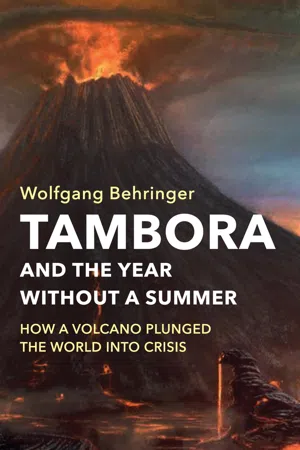
eBook - ePub
Tambora and the Year without a Summer
How a Volcano Plunged the World into Crisis
- English
- ePUB (mobile friendly)
- Available on iOS & Android
eBook - ePub
About this book
1
INTRODUCTION: THE TAMBORA CRISIS
Would anyone be interested in reading a book about a volcanic eruption? In the case of Tambora, there is good reason to believe they would. This book is less about geology than about the societal reactions to an event that affected the climate worldwide – the largest volcanic eruption in human history. The explosions of April 1815 were so powerful that they could be heard thousands of kilometres away. The lava and pyroclastic flow devastated the immediate surroundings, and cyclones, tsunamis, ash fall and acid rain the adjacent region. The explosion cloud reached a height of 45 km. Large parts of Asia suffered for months under a ‘dry fog’ that obscured the sun. Upper winds distributed the gas and suspended particles around the world. The aerosols reduced solar radiation and led to a global cooling. The winter of 1815/16 was one of the coldest of the millennium. Glaciers expanded. Torrential rains caused flooding in China and India. In Europe and North America, 1816 became the ‘year without a summer’.1 In many parts of the world, 1817 became the ‘year of famine’.2
The years that followed were devoted to coping with the results of the crisis. Epidemics paralysed entire regions; mass migration shifted social problems to other corners of the globe; and mass demonstrations, uprisings and suicide attacks generated a pre-revolutionary mood. The eruption of Tambora served as a great experiment in fields where we normally cannot conduct experiments: the economy, culture and politics. The question is, how do different countries, legal systems and religions respond to a sudden worsening of living conditions imposed by external forces? To changes in nature, failed harvests, inflation, famine, epidemics and social unrest? As the Indian historian Dipesh Chakrabarty has noted, climatic events are uniquely suited to being viewed from a global perspective.3
Throughout the world, the volcanic eruption forced the affected societies to confront a current problem using their own specific mechanisms for coping with an unexpected change in the climate that – whether through cold, drought or constant rain – challenged their usual means of supplying the population with basic necessities. Nearly all societies in the world had to demonstrate virtually simultaneously how capable they were of managing such a subsistence crisis, which almost always coincided with a spiritual crisis. Some of them seemed to do so effortlessly.4 The Tambora Crisis caused others to slide into a protracted decline.5 The sudden and simultaneous appearance of acute problems worldwide has the character of an experiment whose design we cannot determine, but can reconstruct. From the distance of two centuries, this allows us to analyse the vulnerability and resilience of the societies of the time when faced with sudden climatic turmoil.6
That is the topic of the present volume, which is interested not in the volcanic eruption as such, but in its cultural consequences as well as the capacities of societies at the time to respond to sudden climate change. The time period of this study is 1815 to 1820, dates that are familiar from political history as well. In 1815, participants in the Congress of Vienna resolved to reorganise the world, and in 1820, the Final Act of the Viennese Ministerial Conference integrated the intervening experiences of crisis into a set of regulations. The future US Secretary of State Henry Kissinger (b. 1923) wrote his doctoral thesis about this period, in which an excess of wars and crises led, through diplomatic negotiations, to a political order that assured peace and stability for a generation.7 The European post-war politician Robert Marjolin (1911–1986) also wrote a study of this period, one devoted specifically to the unrest and revolts unleashed by famine in France.8 The struggle for political stability took place in domestic politics as well, without some knowledge of which one cannot truly understand the foreign policy of the time. The domestic policy of these years was coloured by the climate crisis.
The period from 1815 to 1820 will be treated here as a coherent period of crisis – I call it the Tambora Crisis, to define it by its triggering factor. When the literature refers repeatedly to a crisis in the wake of the ‘European wars’,9 it reveals more than the authors’ refusal to meet the challenge of a worldwide crisis that was precisely not rooted in the political or military processes so familiar to them. It is almost touching to watch the same historian trying over and over again to attribute the same crisis to a different cause in every European country.10 After all, this crisis had no logical cause. The volcanic eruption could just as easily have occurred a few years earlier or later, and it could happen again today or tomorrow. It was an event ‘external’ to human society. This presents historians and sociologists with a methodological problem. The universal ‘rule of sociological method’ that it is ‘in the nature of society itself that we must seek the explanation of social life’11 does not apply here. Emile Durkheim’s ‘social facts’ are abrogated when the conditions are set not by Napoleon or the bourgeoisie but by a volcano.
From the standpoint of global history, it is easy to see that the traditional explanations do not work everywhere anyway. Why should there be famines in China and South Africa or a cholera outbreak in India because Napoleon lost a war, the British Army demobilised its troops or more machines were used in European industry? Even in Europe, one would be hard-pressed to find documents showing that anyone connected the constant rain, floods and failed harvests or the unrest that followed with the wars and their end, or with nascent industrialisation. Historians who nonetheless make this claim have used the simple facts of chronology to draw a causal connection, along the lines of the post hoc fallacy, which psychologists call a logical fallacy.12
The dimensions of the Tambora Crisis were so extraordinary because its roots lay in nature, in processes of geology, atmospheric physics and meteorology. These forces of nature respect no borders. Their effects are not merely global, but also on a very particular scale. Without knowing anything about Tambora, contemporaries recognised the unusual character of this crisis by comparing it to earlier ones. According to the Swiss professor of theology and writer on poor relief Peter Scheitlin (1779–1848), ‘In 1760 people in the country earned handsomely and all foodstuffs were extremely cheap – in 1771 they earned handsomely and all foodstuffs were very dear – in 1817 they earned nearly nothing but the inflation was terrible – in 1819 they earned nearly nothing but everything was very cheap. What a strange diversity! What an interesting distribution of all the possible cases in a period of 50–60 years, that is wit...
Table of contents
- Cover
- 1 Introduction: The Tambora Crisis
- 2 The Year of the Explosion: 1815
- 3 The Year without a Summer: 1816
- 4 The Year of Famine: 1817
- 5 The Turbulent Years that Followed: 1818–1820
- 6 The Long-Range Effects of the Tambora Crisis
- 7 Epilogue: From Meaningless to Meaningful Crisis
- Abbreviations
- Select Bibliography
- Picture Credits
- Index
- End User License Agreement
Trusted by 375,005 students
Access to over 1.5 million titles for a fair monthly price.
Study more efficiently using our study tools.
Frequently asked questions
Yes, you can cancel anytime from the Subscription tab in your account settings on the Perlego website. Your subscription will stay active until the end of your current billing period. Learn how to cancel your subscription
No, books cannot be downloaded as external files, such as PDFs, for use outside of Perlego. However, you can download books within the Perlego app for offline reading on mobile or tablet. Learn how to download books offline
Perlego offers two plans: Essential and Complete
- Essential is ideal for learners and professionals who enjoy exploring a wide range of subjects. Access the Essential Library with 800,000+ trusted titles and best-sellers across business, personal growth, and the humanities. Includes unlimited reading time and Standard Read Aloud voice.
- Complete: Perfect for advanced learners and researchers needing full, unrestricted access. Unlock 1.5M+ books across hundreds of subjects, including academic and specialized titles. The Complete Plan also includes advanced features like Premium Read Aloud and Research Assistant.
We are an online textbook subscription service, where you can get access to an entire online library for less than the price of a single book per month. With over 1.5 million books across 990+ topics, we’ve got you covered! Learn about our mission
Look out for the read-aloud symbol on your next book to see if you can listen to it. The read-aloud tool reads text aloud for you, highlighting the text as it is being read. You can pause it, speed it up and slow it down. Learn more about Read Aloud
Yes! You can use the Perlego app on both iOS and Android devices to read anytime, anywhere — even offline. Perfect for commutes or when you’re on the go.
Please note we cannot support devices running on iOS 13 and Android 7 or earlier. Learn more about using the app
Please note we cannot support devices running on iOS 13 and Android 7 or earlier. Learn more about using the app
Yes, you can access Tambora and the Year without a Summer by Wolfgang Behringer in PDF and/or ePUB format, as well as other popular books in History & World History. We have over 1.5 million books available in our catalogue for you to explore.