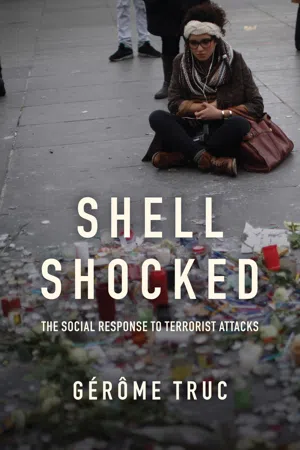
What is it that leaves us shell shocked in the face of the massacres carried out in New York on 9/11 or in Paris on 13 November 2015? How are we to explain the intensity of the reaction to the attacks on Charlie Hebdo? Answering these questions involves trying to understand what a society goes through when it is subjected to the ordeal of terrorist attacks. And it impels us to try to explain why millions of people feel so concerned and shaken by them, even when they do not have a direct connection with any of the victims.
In Shell Shocked, sociologist Gérôme Truc sheds new light on these events, returning to the ways in which ordinary individuals lived through and responded to the attacks of 9/11, of 11 March 2004 in Madrid and 7 July 2005 in London. Analysing political language and media images, demonstrations of solidarity and minutes of silence, as well as the tens of thousands of messages addressed to the victims, his investigation brings about the complexity of our feelings about the Islamists' attacks. It also uncovers the sources of the solidarity that, in our individualistic societies, ultimately finds expression in the first person singular rather than the first person plural: 'I am Charlie', 'I am Paris.'
This timely and path-breaking book will appeal to students and scholars in sociology and politics and to anyone interested in understanding the impact of terrorism in contemporary societies.
- English
- ePUB (mobile friendly)
- Available on iOS & Android
eBook - ePub
About this book
Trusted by 375,005 students
Access to over 1.5 million titles for a fair monthly price.
Study more efficiently using our study tools.
Information
Part I
What is happening to us
We do not know what is happening to us, but this is precisely what is happening to us: the fact that we do not know what is happening to us.
José Ortega y Gasset
1
Under attack
There's been a massacre at the Charlie Hebdo offices. They say a dozen people have been killed … The circumstances are still vague. Nobody has any further details. You turn on the radio, the television; you look for news online. You ask the people around you, and phone round for information. Your day has been interrupted; you've already realized that things aren't going to follow their usual course today. This is the main characteristic of a terrorist attack: it ‘brutally disrupts our tacit expectation that our environment will provide stability and continuity’.1 Suddenly, without warning, violence, death and destruction break into the peaceful course of our lives, and radically undermine the ‘routine grounds’2 of our activities.
This phenomenon has probably never been as brutally clear as on 11 September 2001, since the terrorist attacks carried out on that day represented ‘a radical transformation of the ordinary forms of terrorism’:3 rightly or wrongly, these attacks seemed to come from nowhere – there had been no warning signs, and they did not fall within the context of any familiar historical struggle. This was not true of the periodical Charlie Hebdo, which had been the focus of threats after it published caricatures of Muhammed. Likewise, the Spanish initially thought that the train bombings on 11 March 2004 were yet another ETA attack. And even before the 7 July 2005 attack in London, the British had had time to take on board the idea that, sooner or later, they would be targeted by Islamists. So it is impossible to understand the reactions produced by these attacks in Europe – the reason why, for example, the Charlie Hebdo shootings were seen as a ‘French 9/11’ – without having first taken the trouble to examine how the attacks on 11 September had been experienced on either side of the Atlantic. We need to focus on what was involved in this initial attack if we are to understand every new Islamist assault that occurs in a Western country.
9/11 live: Accident, terrorist attack, or act of war?
Even if some terrorist attacks come as less of a surprise than others, every attack, at the time it is carried out, creates a new and uncertain situation that needs to be defined. What is happening? What do I now need to expect? What should be done? Answering these questions requires what the American sociologist Erving Goffman calls a ‘framework’,4 i.e. ‘a cognitive and practical structure for organizing social experience, enabling us to understand what is happening to us and to take part in it’.5 A framework is not just an interpretation, a representation or an after-the-event narrativization of what has happened. It becomes apparent in the very course of ongoing events, by way of describable activities – the framing operations – that help us to explain the events, specify which people are concerned by them, and decide on the best way to react to them. As one case of uncertainty as to the framework of a particular situation, Erving Goffman takes the example of the blackout that, on 30 November 1965, plunged the north-eastern United States into darkness: ‘With the lights failing all over New York, the individual does not know whether there has been a technical failure, an enemy attack, or sabotage.’6 It was exactly this same uncertainty that marked the first hours of 11 September 2001. When, a few seconds after 8.46 a.m., New Yorkers suddenly heard the noise of a loud explosion coming from the south of Manhattan,7 and turned to look at the towers of the World Trade Center, they realized that the north tower was on fire. But the vast majority of them did not at that time know what had led to the blaze.
11 September 2001, 8.46 a.m.: The need to define a situation
The event instantly reached American newsrooms, which thereupon kept their cameras permanently trained on Manhattan. CNN was the first national channel to interrupt its programme, a few seconds before 8.50 a.m., to broadcast a static shot showing a thick cloud of smoke rising from the upper floors of the north tower of the World Trade Center into the clear blue sky of that Tuesday morning.8 Superimposed on the image were the words ‘World Trade Center Disaster’. At this stage, CNN journalists had no reliable information at their disposal. They spoke of ‘something devastating’ and mentioned the possibility of a plane crashing into the tower only as a hypothesis, stemming from ‘unconfirmed reports’.
At the same time, CNN reporters were roaming the streets of Manhattan looking for eyewitnesses. The first hours of live media coverage of 9/11, on both television and radio, in the United States as in the rest of the world, would give a great deal of space to these eyewitness accounts gathered in the streets.9 But these were partial and often contradictory: some people swore that the tower had imploded from within and confirmed that they had heard reports of a bomb, while others stated that they had seen a plane flying in over Manhattan at a very low altitude just before the explosion in the tower. But at that time, nobody had access to any image that would enable this to be confirmed with certainty.10 So there was a plethora of hypotheses as to what kind of plane had been involved: a small tourist plane such as a Cesna, or an airliner, maybe a Boeing? In the former case, it might be an accident, but in the latter, it might have been a hijacked plane. Furthermore, the weather conditions, which on that morning were perfect, did not make an accidental crash seem likely.
Suddenly, at 9.03 a.m., just as one witness was on air stating that he had seen a big plane embedding itself in the north tower of the World Trade Center, a plane in flight surreptitiously appeared on the image for a fraction of a second, then vanished. The picture was interrupted for a moment, then the screen showed a ball of fire. The static shot broadcast by CNN did not distinguish between the Twin Towers, and so it was some time before the journalists gathered what had just happened: initially, they thought there had been a second explosion in the same tower. Then, when they realized that it was in fact the south tower that was now on fire, they again mentioned the possibility of a plane crash, but only as a hypothesis that needed to be verified. The framework of the developing situation was still very ill-defined.
However, this framework would become clear over the next half hour, as experts (especially those from air security and the FBI) were contacted by journalists, and press releases were issued by Associated Press and Reuters. The hypothesis of a hijacked plane gained ground, while an accident started to seem increasingly unlikely. Journalists were now talking in terms of a probable ‘terrorist act’. At 9.29 a.m., President Bush, speaking from Emma Booker Elementary School in Sarasota, Florida, where he was visiting, made a brief statement in which he spoke of a ‘national tragedy’ and an ‘apparent terrorist attack on our country’. Barely eight minutes later, at 9.37 a.m., journalists reported a new explosion, this time at the Pentagon, Washington. Less than one hour after the first plane had crashed, there was no further room for doubt: these were not accidents, and the United States was the target for several coordinated attacks.
The event now became international in its scope. In Europe, it was the mi...
Table of contents
- Cover
- Table of Contents
- Dedication
- Title page
- Copyright page
- Preface to the English edition
- Acknowledgements
- Introduction: Terrorist attacks as a test
- Part I: What is happening to us
- Part II: What touches us
- Conclusion: ‘There's something of Charlie in all of us’
- Afterword to the English edition
- Selective bibliography
- Index
- End User License Agreement
Frequently asked questions
Yes, you can cancel anytime from the Subscription tab in your account settings on the Perlego website. Your subscription will stay active until the end of your current billing period. Learn how to cancel your subscription
No, books cannot be downloaded as external files, such as PDFs, for use outside of Perlego. However, you can download books within the Perlego app for offline reading on mobile or tablet. Learn how to download books offline
Perlego offers two plans: Essential and Complete
- Essential is ideal for learners and professionals who enjoy exploring a wide range of subjects. Access the Essential Library with 800,000+ trusted titles and best-sellers across business, personal growth, and the humanities. Includes unlimited reading time and Standard Read Aloud voice.
- Complete: Perfect for advanced learners and researchers needing full, unrestricted access. Unlock 1.5M+ books across hundreds of subjects, including academic and specialized titles. The Complete Plan also includes advanced features like Premium Read Aloud and Research Assistant.
We are an online textbook subscription service, where you can get access to an entire online library for less than the price of a single book per month. With over 1.5 million books across 990+ topics, we’ve got you covered! Learn about our mission
Look out for the read-aloud symbol on your next book to see if you can listen to it. The read-aloud tool reads text aloud for you, highlighting the text as it is being read. You can pause it, speed it up and slow it down. Learn more about Read Aloud
Yes! You can use the Perlego app on both iOS and Android devices to read anytime, anywhere — even offline. Perfect for commutes or when you’re on the go.
Please note we cannot support devices running on iOS 13 and Android 7 or earlier. Learn more about using the app
Please note we cannot support devices running on iOS 13 and Android 7 or earlier. Learn more about using the app
Yes, you can access Shell Shocked by Gérôme Truc, Andrew Brown in PDF and/or ePUB format, as well as other popular books in Social Sciences & Sociology. We have over 1.5 million books available in our catalogue for you to explore.