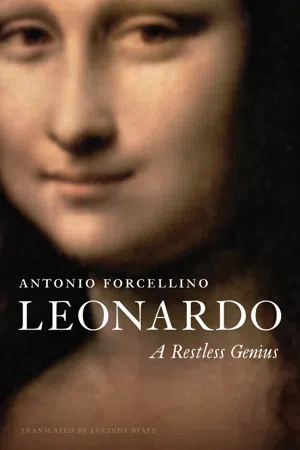
A visionary scientist, a supreme painter, a man of eccentricity and ambition: Leonardo da Vinci had many lives. Born from a fleeting affair between a country girl and a young notary, Leonardo was never legitimized by his father and received no formal education. While this freedom from the routine of rigid and codified learning may have served to stimulate his natural creativity, it also caused many years of suffering and an insatiable need to prove his own worth. It was a striving for glory and an obsessive thirst for knowledge that prompted Leonardo to seek the protection and favour of the most powerful figures of his day, from Lorenzo de' Medici to Ludovico Sforza, from the French governors of Milan to the pope in Rome, where he could vie for renown with Michelangelo and Raphael.
In this revelatory account, Antonio Forcellino draws on his expertise – both as historian and as restorer of some of the world's greatest works of art – to give us a more detailed view of Leonardo than ever before. Through careful analyses of his paintings and compositional technique, down to the very materials used, Forcellino offers fresh insights into Leonardo's artistic and intellectual development. He spans the great breadth of Leonardo's genius, discussing his contributions to mechanics, optics, anatomy, geology and metallurgy, as well as providing acute psychological observations about the political dynamics and social contexts in which Leonardo worked.
Forcellino sheds new light on a life all too often overshadowed and obscured by myth, providing us with a fresh perspective on the personality and motivations of one of the greatest geniuses of Western culture.
- English
- ePUB (mobile friendly)
- Available on iOS & Android
eBook - ePub
About this book
Information
PART I
ILLEGITIMATE SON
1
THE SUMMER CHILD
On 15 April 1452, in the tiny hamlet of Vinci, not far from Florence, the peasant farmers were enjoying the scents of plum and apple blossom carried by the early evening breeze. In one of the roughly built stone and brick houses, a young country girl named Caterina was about to give birth to a boy who would be christened Leonardo.
By ten o’clock in the evening (‘three hours of the night’, as was said at the time), when her labour was over and the child was well, the midwives presented him to his grandfather, Antonio di Ser Piero da Vinci, an 80-year-old notary who was not wealthy but was nonetheless affluent enough to be the most notable citizen in the village. Antonio was the descendant of a family of notaries who had enjoyed prominence since at least 1333. He and his relatives owned a respectable house in the centre of Vinci, with an adjoining vegetable garden and a farm with some ten stadi of land nearby. From his tax returns [denunzie catastali] it appears that he also owned other, smaller farms that produced wheat, oil and wine. His total wealth, 1,400 gold florins, was deposited with the Monte Commune of Florence and yielded enough interest for a decent lifestyle. Antonio was happy with his new grandson. At his age he did not have many years for seeing his descendants, and he hastened to record the event in his family memoirs.
15 April 1452. My grandson was born, son of Ser Piero, my son, on 15 April, a Saturday, at 3 hours of the night. He was given the name Lionardo. The priest Piero di Bartolomeo da Vinci baptized him in the presence of Papino di Nanni Bantti, Meo di Tonino, Piero di Malvolto, Nanni di Venzo, Arigho di Giovanni Todescho, monna Lisa di Domenico di Brettone, monna Antonia di Giuliano, monna Niccholosa del Barna, mona Maria, daughter of Nanni di Venzo, monna Pippa (di Nannj of Venzo) of Previcone.1
However joyful the event and however welcome the birth of a baby boy, matters had not gone exactly as he had hoped: the child was not the son of the right woman and would remain ‘illegitimate’, a descendant who could not aspire to have full rights to the family inheritance, whether material or ideal. The previous summer his eldest son Piero, who was then a little over 20, had started his career as a notary in Florence, where he lived in a rented house. He had then come to spend the summer months at home in Vinci, and during those lazy hot days he had met and seduced a young peasant girl, Caterina, whose only defect, apart from being poor, was that she was exceedingly beautiful.
Piero had taken advantage of her without any qualms: she was, after all, a peasant and he was due to marry a Florentine woman of suitable social standing, Albiera di Giovanni Amadori. The sole justification for the passing affair was the couple’s youthful exuberance and the beauty of those summer evenings in the cypress-scented countryside. Moreover, the seduction of a poor girl by a well-to-do young man was such a frequent occurrence in the countryside around Florence that it hardly deserved a mention. Indeed Ser Piero had married Albiera that same year.
For her part, Caterina received perhaps, in compensation, a small dowry from the old notary and was married to a local man about whom we know very little, but whose name did not bode well for a comfortable future. The man was called Acchattabriga [‘Troublemonger’] and was the son of Piero della Vaccha – names that indicate humble origins and tricky temperaments. After her marriage, Caterina walked away from the da Vinci family and, judging by the silence of the sources, also from young Leonardo’s life. However, not straight away: as was customary, she breastfed her baby son, whether in her home or in the da Vinci household, for at least a year or two – just enough time for her to grow to love her son and then to suffer when he was taken away, because after that first stage the boy was completely entrusted to his father’s family.
Leonardo was cared for by old Antonio, his 59-year-old wife Lucia, and his second son Francesco, who was just 17. Another daughter, Violante, had already left home to marry a certain Antonio from Pistoia. As an illegitimate son, the boy did not receive a normal education, which in a Florentine bourgeois family involved learning, from the age of seven, Italian grammar, basic mathematical skills, and above all Latin, which was essential for an administrative career and for access to classical books and manuscripts (all of these were still in Latin at that time). However, this lack of formal education, which undoubtedly affected Leonardo later in life, was a source of happiness in his early childhood, since he was freed from the burden of strict learning as laid down by the rules of scholastic institutions. The boy’s rather eccentric upbringing at the hands of his grandparents and young uncle stimulated unusual avenues for his creativity and helped him to develop a lifelong curiosity for the natural world.
Leonardo spent his childhood in that house deep in the countryside, living with his aged grandparents and young uncle Francesco, who was uninterested in work of any sort, as Antonio noted in a later tax return: ‘he lives in the country and does nothing’. Francesco’s lazy lifestyle was a stroke of luck for the child, who benefited from much of his uncle’s extensive free time because life in the tiny hamlet of Vinci did not offer many other distractions and also because, as the notary’s son, Francesco was not expected to work on the land, like others of his age.
We know from later documents that Francesco was the only relative to have loved Leonardo (apart from his grandparents), so much so that he was even willing to challenge the strict laws governing inheritance for the sake of his nephew. It was probably he who taught Leonardo to read and write, indeed the latter’s handwriting retained the typical notarial script of fifteenth-century civil servants, whereas school pupils at the time were already taught to write with the rounded hand whose flowery style epitomized the enthusiasm for humanist studies that had become so fashionable in mid-fifteenth-century Tuscany. School pupils were taught this well-formed handwriting with the same rigour as they were trained in the rhetorical art of grammatical compositions – another trait that Leonardo’s prose would never acquire, despite the artist’s later efforts to fill the lacunae in his self-taught education. Leonardo’s writing, learned at home in an isolated village, far from any school, lacked discipline. Moreover, although quite capable of writing with his right hand, the boy preferred to use his left and to write from right to left, something that only the Jews did at that time. If he had attended any ordinary school, this habit would have been punished and corrected, but as an illegitimate son he did not have to live up to any intellectual expectations and no one wasted time correcting him: writing was a game for him and his grandparents did not think that he would use it much in life.
As time passed the boy’s upbringing became increasingly unusual and unorthodox. Occupied by his new marriage and by his career as a notary, Leonardo’s young father had little time to spare. Moreover, the mere presence of the boy was a constant reminder of a painful problem that Ser Piero now faced: the lack of children. Albiera could not conceive and Leonardo’s presence was an unspoken denunciation of her sterility. The years passed and Albiera and Ser Piero would have no legitimate heirs until Albiera’s death in 1465, after 13 years of what cannot have been a happy marriage. In Florence as in the rest of Italy during the fifteenth century, marriage was above all a financial transaction that served to consolidate social alliances and to ensure the continuity of private wealth and family honour. A childless marriage was a useless marriage and the fault always lay with the woman, who was held to be responsible for the couple’s sterility. However distant and confined to the small village of Vinci, the boy, who was growing up to be strong and handsome, was a source of sadness for Albiera and of embarrassment for Ser Piero: family reunions could not have been easy, either for the couple or for Leonardo. For the same reasons, the fact that the grandparents knew that another heir would not arrive soon increased their love for Leonardo, who grew up in their sometimes overly affectionate care.
The conditions in which the child was raised were very unusual. On the one hand, the absence of other children in the grandparents’ household meant that he was alone much of the time; on the other, this was not helped by the gulf between him and other boys in the village, which was due to the fact that the da Vinci family had to defend its standing in the rural community and certainly could not send this young grandson to work in the fields, like all the other boys of his age. Even if illegitimate, Leonardo was the son and grandson of respected notaries and, as such, stood apart from other village boys. A life of ease, freedom and solitude, albeit not lacking in basic education, was an ideal medium in which he could nurture a growing sense of curiosity in the surrounding world. But, on the other hand, what was certainly a painful relationship with his father and stepmother served as an equally necessary condition for the child’s creative introspection to develop, shielded as it was in the arms of his grandparents, who undoubtedly loved him even if they failed to discipline him.
Vinci was a world suspended between domesticated and wild nature. The village lay on the edge of the wooded ravines of the foothills to the Tuscan Apennines, where farmed countryside gave way to large areas of wilderness. Olive groves, vineyards and fields of wheat occupied part of the hillsides between the crags, while the soft outlines of the woods were broken by rows of cypresses. The rest of the surrounding countryside was full of narrow gorges excavated by streams as they flowed downhill to join the Arno, the majestic river whose sediments had moulded the valley over thousands of years and presented the boy with landscapes of extraordinary beauty. Fascinated by the wilderness, Leonardo started to explore it during his solitary childhood. Later, in early adolescence and during the heady phase of puberty, he undertook these explorations of the world around him with growing enthusiasm, and his observations became more systematic.
There was something else that the strange family could offer almost in spite of itself, something that would mark the rest of the boy’s life: this was paper, a material that was not lacking in a notary’s household. Large quantities of paper were purchased by the da Vinci family, as is borne out by a credit note dated 1451 and signed by grandfather Antonio, which mentions, among other debts, the 12 lire that Piero owed the cartolaio Giovanni Parigi.2 That paper, so precious to the notarial profession, must have been invaluable for the boy’s solitary games and adventures. Paper was not readily available, especially not to poor children, but Leonardo must have had access to considerable amounts, if only in the form of waste paper and cut-offs.
By a lucky coincidence, the best circumstances conspired to develop the boy’s genius: freedom, solitude and scraps of paper, the material on which he could give tangible expression to his thoughts and with which, early in childhood, he established a relationship that would remain unchanged for the rest of his life. Paper would become the principal medium through which he communicated with the rest of the world. Leonardo entrusted every observation, every memory to paper: whether in note form or as a sketch, his mind would project onto paper as if that were his alter ego, an extension of his self, a fetish that he could not be free of and with which he would be burdened to the end, passing from scraps to sheets of drawing paper and then to notebooks, and finally to the voluminous codices. His relationship with paper certainly stems from his unusual childhood in Vinci and paper was the best gift the family could have given him, much better than the social legitimacy his father would always deny to him.
Paper and ink became the boy’s playthings and companions, and then a precocious marker of his talent as he gradually began to reproduce on paper the shapes of what he observed during his long, lazy days. The story told by Vasari about the dying Leonardo contains a kernel of truth that counterbalances and confirms the insight offered by his grandfather’s accounts.
Nevertheless, in spite of the fact that he worked at so many different things, he never gave up drawing and working in relief, pursuits which appealed to him more than any others. When Ser Piero saw this and considered the level of his son’s genius, he one day took some of his drawings and brought them to Andrea del Verrocchio, who was a very good friend of his, and urgently begged him to say whether Leonardo would profit from studying drawing. Andrea was amazed when he saw Leonardo’s extraordinary beginnings, and he urged Ser Piero to make Leonardo study this subject; and so Piero arranged for Leonardo to go to Andrea’s workshop, something that Leonardo did very willingly.3
In this passage Vasari cleverly transforms the moment when Piero makes a derogatory choice for his illegitimate son: the choice of a ‘mechanical’ career of painter instead of a ‘liberal’ career of notary, which would have been open to Leonardo if he had been legitimate. Leonardo’s experience offers a parallel to that of Michelangelo, who was also born into a very affluent family, but in his case the family had fallen on such hard times that they could not afford a liberal career for their son. ...
Table of contents
- Cover
- Title Page
- Copyright
- Prologue
- Part I Illegitimate Son
- Part II In Milan
- Part III Back to Florence
- Part IV In Exile
- Plate Credits
- Index
- End User License Agreement
Trusted by 375,005 students
Access to over 1.5 million titles for a fair monthly price.
Study more efficiently using our study tools.
Frequently asked questions
Yes, you can cancel anytime from the Subscription tab in your account settings on the Perlego website. Your subscription will stay active until the end of your current billing period. Learn how to cancel your subscription
No, books cannot be downloaded as external files, such as PDFs, for use outside of Perlego. However, you can download books within the Perlego app for offline reading on mobile or tablet. Learn how to download books offline
Perlego offers two plans: Essential and Complete
- Essential is ideal for learners and professionals who enjoy exploring a wide range of subjects. Access the Essential Library with 800,000+ trusted titles and best-sellers across business, personal growth, and the humanities. Includes unlimited reading time and Standard Read Aloud voice.
- Complete: Perfect for advanced learners and researchers needing full, unrestricted access. Unlock 1.5M+ books across hundreds of subjects, including academic and specialized titles. The Complete Plan also includes advanced features like Premium Read Aloud and Research Assistant.
We are an online textbook subscription service, where you can get access to an entire online library for less than the price of a single book per month. With over 1.5 million books across 990+ topics, we’ve got you covered! Learn about our mission
Look out for the read-aloud symbol on your next book to see if you can listen to it. The read-aloud tool reads text aloud for you, highlighting the text as it is being read. You can pause it, speed it up and slow it down. Learn more about Read Aloud
Yes! You can use the Perlego app on both iOS and Android devices to read anytime, anywhere — even offline. Perfect for commutes or when you’re on the go.
Please note we cannot support devices running on iOS 13 and Android 7 or earlier. Learn more about using the app
Please note we cannot support devices running on iOS 13 and Android 7 or earlier. Learn more about using the app
Yes, you can access Leonardo by Antonio Forcellino, Lucinda Byatt in PDF and/or ePUB format, as well as other popular books in Art & History of Art. We have over 1.5 million books available in our catalogue for you to explore.