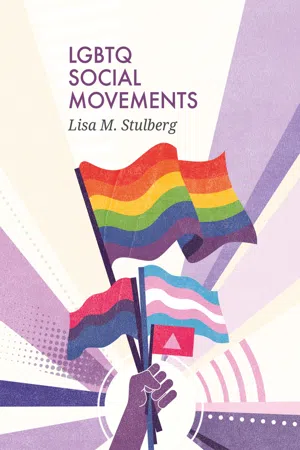
In recent years, there has been substantial progress on lesbian, gay, bisexual, transgender, and queer (LGBTQ) civil rights in the United States. We are now, though, in a time of incredible political uncertainty for queer people. LGBTQ Social Movements provides an accessible introduction to mainstream LGBTQ movements in the US, illustrating the many forms that LGBTQ activism has taken since the mid-twentieth century.
Covering a range of topics, including the Stonewall uprising and gay liberation, AIDS politics, queer activism, marriage equality fights, youth action, and bisexual and transgender justice, Lisa M. Stulberg explores how marginalized people and communities have used a wide range of political and cultural tools to demand and create change. The five key themes that guide the book are assimilationism and liberationism as complex strategies for equality, the limits and possibilities of legal change, the role of art and popular culture in social change, the interconnectedness of social movements, and the role of privilege in movement organizing.
This book is an important tool for understanding current LGBTQ politics and will be essential reading for students and scholars of sexuality, LGBTQ studies, and social movements, as well as anyone new to thinking about these issues.
- English
- ePUB (mobile friendly)
- Available on iOS & Android
eBook - ePub
LGBTQ Social Movements
About this book
Information
1
Introduction
“I was going to die, if not sooner then later, whether or not I had ever spoken myself. My silences had not protected me. Your silence will not protect you.” I have carried these words with me since the moment I read them in college. They belong to Audre Lorde, an incredible African American lesbian activist and writer, and she wrote them after she had been diagnosed with cancer, when she was facing her own mortality. She continued:
We can learn to work and speak when we are afraid in the same way we have learned to work and speak when we are tired. For we have been socialized to respect fear more than our own needs for language and definition, and while we wait in silence for that final luxury of fearlessness, the weight of that silence will choke us … [I]t is not difference which immobilizes us, but silence. And there are so many silences to be broken. (1984, pp. 41, 44)
I read this on the last day of my undergraduate social movements class each spring. Silence is debilitating. Silence is dangerous. “And there are so many silences to be broken.” This is the same sentiment that moved AIDS activists in the 1980s. They proclaimed that “Silence = Death,” and they mobilized around being as loud as possible for their cause and their survival.
This is a book about people who have broken past their silences. The book is meant for students and others who are new to lesbian, gay, bisexual, transgender, and queer (LGBTQ) social movement history and politics. I have taught an American social movements class to undergraduates at New York University a number of times since the early 2000s. I have found that students had learned almost nothing about LGBTQ history and activism in high school or in their other college courses and that they are eager for and incredibly receptive to this material. They have a strong and quite visceral reaction to the history and present-day injustices faced by LGBTQ Americans and the ways in which they and their allies have fought back. In the few years in which these young students have been politically conscious or active, they have experienced the national debate on same-sex marriage, and they want to grasp why marriage is such a hot-button issue. They have watched as states have debated so-called “bathrooms bills,” and they want to know why providing equal access to transgender people is so controversial. They debate LGBTQ politics with their families, and they are excited to use their new knowledge at the holiday dinner table. They are LGBTQ themselves or have queer friends and family members and want to understand their rights and the challenges they face and are likely to face as they plan to enter the workforce or start families. They want to mobilize for LGBTQ justice, and they want to learn from previous generations of activists.
I attempt to tell a story of more than 70 years in a short, accessible way, and that has felt nearly impossible. LGBTQ social movements in the United States, like any other movement, contain so many different approaches to social change within them and are characterized by both diversity and inevitable internal conflict (Ghaziani, 2008). I cannot possibly do justice to this varied, complicated, and dynamic set of movements and movement actors in a short, introductory book. But the story I tell here is one about the mainstream LGBTQ movements since World War II in the US.1 I have chosen to include here those events, organizations, and people that help raise key themes that I believe are central to understanding the politics of gender and sexuality of the past few generations.
This book is a starting point for those who want to know just a little bit, so they can contextualize the current politics of gender and sexuality in the US, or who want to know much more but need a foundation and a set of resources to explore further. I hope this is a good first stop. I hope this book will prompt you to learn more, to flip through the bibliography to find those resources that resonate with you, and to pay attention to the current politics of LGBTQ social change (maybe having picked up here a bit more knowledge to guide your understanding). Pairing this book with a look at the primary historical and political documents of these movements (some of which are cited here) is another wonderful way to further explore the themes and events that are introduced here.
This is a story about marginalized people and communities using a wide range of political and cultural tools at their disposal to make demands on the state – their government – to fight for full citizenship and to realize their full humanity in a country that often thinks of them as less than fully human, less than fully deserving of basic rights and freedoms. The unifying idea of this book is that LGBTQ social movements, like most others by oppressed peoples in the US, have always been about marginalized groups’ relationships to their country and its institutions. They interact with history in dynamic, complex ways on multiple fronts. Ultimately, they raise central questions about the mechanisms of change and the limits and possibilities of democracy.
We see this in a few key ideas that I highlight in my discussion in these chapters: in the way that marginalized communities and their activists work to either assimilate into existing cultures and institutions or lose faith in these cultures and institutions and remove themselves from them, building alternatives instead; the way they view the law as both a vehicle for and a constraint on social change; and the way they use many tools at their disposal to not just change law but to change hearts and minds. The themes that structure this book’s discussion of LGBTQ social movements in the US are: (1) assimilationism and liberationism as complex sets of strategies for equality and social justice; (2) the limits and possibilities of law and policy; (3) the role of art and popular culture in social change; (4) the interconnectedness of social movements; and (5) the role of privilege in movement organizing.
In LGBTQ movements, participants and analysts have often understood the ways in which activists orient themselves toward the state to be either assimilationist or liberationist. Sociologist Steven Seidman argues of this distinction: “At the heart of this political division are contrasting images of America” and its potential (2002, p. 183). The distinction is both strategic and philosophical. As political scientist Craig A. Rimmerman writes, liberationists embrace “more radical cultural change, change that is transformational in nature and often arises outside the formal structures of the U.S. political system.” On the other hand, “[t]he assimilationist approach typically embraces a rights-based perspective, works within the broader framework of pluralist democracy … and fights for a seat at the table” and tends to be more gradualist and “patient with creeping toward long-term movement goals” (2008, pp. 5, 133). Writer Michael Bronski adds, on the cultural politics of assimilation versus liberation: “The assimilationist position is predicated on a deeply held belief in the worth of such basic social structures as traditional sexual morality, monogamous marriage, accepted gender roles, and the nuclear family” (1998, p. 3), and this has characterized the mainstream movement since its inception after World War II (Rimmerman, 2002).
LGBTQ people and activists have had the same debates and tensions as other marginalized Americans about whether it is best to assimilate to mainstream norms and institutions or whether these American institutions are fundamentally broken and in need of rejection in favor of community-controlled alternatives. These movements have also, since the beginning of social action, targeted the law for change, used the law to advance civil equality, and, conversely, recognized the limits of the law in changing culture and everyday private behavior. Social movements are not and have never been just about mass, collective action. Art, media, culture, and popular culture have always been sites and vehicles for social change, for bringing in new voices, for resistance and community-building, and for telling stories that can build sympathy and empathy. So, too, we will see, social movements develop in relationship to each other, whether that is building on movements with the same general political orientation from the Left or responding to movements that are directly opposed from the Right. Finally, people who come together in communities and social movements may share something of their biographies and experiences, but they also differ in important ways, by race, gender, gender identity, class, sexual orientation, religion, ability or immigration status. These differences matter a lot in the way that movements are shaped. The way that I tell this story of diversity and difference here is to focus on privilege and the role it has played in LGBTQ movements over time.
It was only in the second half of the nineteenth century that homosexuality began to be named and mobilized around as an identity; the mid-twentieth before gender identity would become politicized.2 In the US, gay and lesbian people began to develop their own cultures and communities in the early part of the twentieth century. But it was not until World War II, when both gay and lesbian visibility and repression rose significantly, that the seeds of the modern movements were sown in the US and around the world. The first lesbian and gay political organizations in the US were founded in the 1950s, as small, mostly secretive groups known as the homophile movement. Through the 1960s, when gay men and lesbians now had other contemporaneous examples of social movements from which to draw inspiration and practical lessons, they began to organize for change. The Stonewall rebellion, when New York City bar-goers and their supporters fought back against the kind of police repression that had become routine for them, changed the future of LGBTQ politics.
After Stonewall, the gay liberation movement blossomed and produced more than a thousand organizations dedicated to a wide range of lesbian, gay, bisexual, and transgender efforts for social change. The liberation movement, at the height of the radical late 1960s and early 1970s, shifted within a couple of years into a kind of gay pride and gay rights movement – a gay identity movement (Armstrong, 2002) – that has continued to this day. When AIDS blindsided the community with such force in the early 1980s, AIDS activism became another – separate but related – part of the broader sexual identity movement. Out of AIDS activism, too, came a challenge from the Left to broaden the movement, making space for bisexual and transgender activists to both join the pan-identity movement and to continue to articulate their own interests and politics. Since then, over the past few decades, we have seen efforts for social change on scores of different fronts: from explicitly political fights to change civil rights laws, to efforts to change school culture and sports culture, to media campaigns to increase visibility, to the renewal of longstanding fights to recognize and fully honor intersectional identities.
One of the primary arguments of this book is that movements for social change take many forms. When you think about social movements, you might envision large groups of people holding hands in solidarity or marching in a mass with signs and bullhorns: those iconic images on posters, stamps, and in the pages of history texts. Or, you might recall a sketch from a children’s picture book or grainy documentary of a small, brave group of people – maybe even one person at first – sitting, standing, fighting back, riding a bus or not riding a bus in a public act of defiance. These are collective, public actions for change. This kind of activism often focuses on the state, on changing laws and policy. But, these are just some of the kinds of activism that are part of LGBTQ – and many other – movements.
From the social movement literature that specifically takes up LGBTQ organizing,3 I draw specifically on that which understands the cultural to be an important part of the political.4 Some of this kind of activism focuses on the state – on making demands on the government for social welfare or for civil rights protections.5 Other forms of LGBTQ activism that are central to my discussion are not primarily state-centered and may be, instead, about raising visibility, building alternative communities and identities, and changing hearts and minds both for and beyond the purpose of changing laws. Some may be a combination of both – using cultural and symbolic tactics for the purposes of effecting law and policy change.
Sociologist Joshua Gamson, for instance, identifies an “orientation towards identity and expression” in the direct action AIDS activism of the late 1980s, which, while “cultural” and “theatrical” in nature – as we will see in chapter 3 – was nevertheless aimed at changing science, industry, and public policy (1989, p. 355). Sociologist Verta Taylor and colleagues write of the 2004 mass wedding protest in San Francisco – featured in chapter 4 – that those who participated in this kind of cultural protest, a wedding that had the mayor’s blessing but was not certified by the state, was a form of laying claim to a state-given civil right (marriage) and had the effect of spurring its participants into “more traditional forms of political action” (2009, p. 886). They argue that “social movements often adapt, create, and use culture – ritual, music, street theatre, art, the Internet, and practices of everyday life...
Table of contents
- Cover
- Title Page
- Copyright
- Acknowledgments
- 1 Introduction
- 2 Before and After Stonewall
- 3 Activism in the Early Days of AIDS
- 4 Marriage Politics
- 5 LGBTQ Youth and Social Change
- 6 The “B” and the “T”
- 7 Conclusion
- References
- Index
- End User License Agreement
Trusted by 375,005 students
Access to over 1.5 million titles for a fair monthly price.
Study more efficiently using our study tools.
Frequently asked questions
Yes, you can cancel anytime from the Subscription tab in your account settings on the Perlego website. Your subscription will stay active until the end of your current billing period. Learn how to cancel your subscription
No, books cannot be downloaded as external files, such as PDFs, for use outside of Perlego. However, you can download books within the Perlego app for offline reading on mobile or tablet. Learn how to download books offline
Perlego offers two plans: Essential and Complete
- Essential is ideal for learners and professionals who enjoy exploring a wide range of subjects. Access the Essential Library with 800,000+ trusted titles and best-sellers across business, personal growth, and the humanities. Includes unlimited reading time and Standard Read Aloud voice.
- Complete: Perfect for advanced learners and researchers needing full, unrestricted access. Unlock 1.5M+ books across hundreds of subjects, including academic and specialized titles. The Complete Plan also includes advanced features like Premium Read Aloud and Research Assistant.
We are an online textbook subscription service, where you can get access to an entire online library for less than the price of a single book per month. With over 1.5 million books across 990+ topics, we’ve got you covered! Learn about our mission
Look out for the read-aloud symbol on your next book to see if you can listen to it. The read-aloud tool reads text aloud for you, highlighting the text as it is being read. You can pause it, speed it up and slow it down. Learn more about Read Aloud
Yes! You can use the Perlego app on both iOS and Android devices to read anytime, anywhere — even offline. Perfect for commutes or when you’re on the go.
Please note we cannot support devices running on iOS 13 and Android 7 or earlier. Learn more about using the app
Please note we cannot support devices running on iOS 13 and Android 7 or earlier. Learn more about using the app
Yes, you can access LGBTQ Social Movements by Lisa M. Stulberg in PDF and/or ePUB format, as well as other popular books in Social Sciences & Sociology. We have over 1.5 million books available in our catalogue for you to explore.