Why has the chicken become the meat par excellence, the most plentifully eaten and popular animal protein in the world, consumed from Beijing to Barcelona? As renowned historian Paul Josephson shows, the story of the chicken's rise involves a whole host of factors; from art, to nineteenth-century migration patterns to cold-war geopolitics. And whereas sheep needed too much space, or the cow was difficult to transport, these compact, lightweight birds produced relatively little waste, were easy to transport and could happily peck away in any urban back garden.
Josephson tells this story from all sides: the transformation of the chicken from backyard scratcher to hyper-efficient industrial meat-product has been achieved due to the skill of entrepreneurs who first recognized the possibilities of chicken meat and the gene scientists who bred the plumpest and most fertile birds. But it has also been forced through by ruthless capitalists and lobbyists for "big farmer", at the expense of animal welfare and the environment. With no sign of our lust for chicken abating, we're now reaching a crisis point: billions of birds are slaughtered every year, after having lived lives that are nasty, brutish and short. The waste from these victims is polluting rivers and poisoning animals. We're now plunging "egg-first" into environmental disaster.
Alongside this story Josephson tells another, of an animal with endearing characteristics who, arguably, can lay claim to being man's best friend long before the dog reared its snout or the cat came in from the cold. Lionized in medieval romances and modern cartoons, the chicken's relationship to humanity runs deep; by treating these animals as mere food products, we become less than human.
A Jewish woman had two chickens. One got sick, so the woman made chicken soup out of the other one to help the sick one get well.
– Henny Youngman
Chickens have millennia-long proximity to humans. Chickens, like dogs and cats, have lived with us in our houses, huts and barns, outside in the yards, and nearby in the fields. They become friends and playthings, not only meat- and egg-providers. They have been the focus of music and poetry, the objects of art and sculpture, and the center of attention of clubs, all of which are discussed in this chapter. Chickens, as well, reflected norms and expectations of race and gender in the way they were raised and who raised them. People keep chickens until they become too old or lose their egg-producing capabilities, or until the moment they have decided that it is time to eat them. Often, they grow fond of their animals. My Maine “down east” cousins raised a pig, whom they named “Pig,” they told me, to lessen the sadness of parting with her at full growth for her to become sausage, pork chops and so on; they stopped raising pigs.
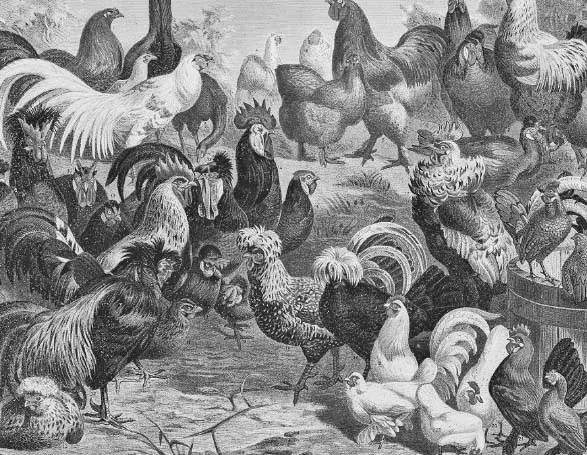
2This nineteenth-century chicken poultry stock illustration indicates the diversity and beauty of various birds.
The world’s inhabitants produce the prevailing share of today’s meat animals in industrial settings, and in so doing deny them individuality in behavior, and even, at times, any sense that they are animals. People have no intention to stop raising them. Factory farms remove them from the consumer’s awareness by rearing them in boxes, sheds or corrals, big and small, before hurrying them to conveyor-belt abattoirs. We can see the change in slaughtering practices on canvas. Bernando Strozzi’s The Cook (1625) features several fowl in the cook’s hands, hanging upside down by their legs, lying on a nearby table, ready to be plucked, eviscerated and baked. In Pehr Hilleström’s En Qvinna slagtar höns (A Woman Slaughtering Hens), a woman, with help, is holding a chicken between her legs as she cuts its neck; several others, already dead, lie at her feet (c.1775).
Since domesticated, millennia ago, chickens have been cherished, celebrated and collected for their familiarity and even commonness, their suggestion of fertility, and their beautiful feathers and carriage by wealthy folk, including Queen Victoria; used in cockfights by wealthy and non-wealthy people alike; and often met their end in religious sacrifices at the godly hands of Jews, Christians and Muslims. Marc Chagall’s The Cock (1928) reveals the love between the animal and a harlequin riding her, while Pablo Picasso’s Rooster (1938) looks like an American weather vane. Painted Ukrainian Easter eggs communicate traditional meanings and sacral ones, including fertility; my favorite painted Easter eggs are from the Zaporozh’e region. Similarly, musicians and composers have engaged chickens. Rock musician Alice Cooper once received a live chicken on stage from his audience and threw it back to the crowd, where, apparently, it fared badly. Sergei Prokofiev briefly owned a small electric incubator that gave him pleasure when the chickens were hatched, but their overwhelming sickliness led him to give the incubator away. The magical glowing firebird of Russian folklore and of Sergei Stravinsky’s Firebird ballet is, however, not a chicken.
I have found no references to chickens in Shakespeare, although it is worth remembering that “’tis an ill cook that cannot lick his own fingers.”1 Elsewhere in the medieval European world, chickens were the source of metaphors and sayings, although not entirely in keeping with their bright, curious and seemingly optimistic outlook. The expression, “A bad chicken was brooding,” was noted in fifteenth-century Flanders when the guilds of Ypres were in open revolt to regain the privileges lost to the ruling patrician class.2 In the Canterbury Tales, Geoffrey Chaucer used food as staples of everyday life and the eating habits of various characters to convey their attitudes, values, level of wealth, and the variety and abundance of food in the fourteenth century. In several poems, animals play a significant role, but in only one, as far as I can tell, does a chicken or rooster provide us with a lesson. In the “Nun’s Priest’s Tale,” the rooster, Chanticleer, manages to escape the jaws of a fox after first recklessly allowing himself to be caught by crowing proudly with his eyes closed.3 So don’t be reckless, watch out for foxes, and stay out of factory farms.
The chicken has long been holiday meat at the dinner table. According to the chef-authors of one cookbook:
Without chicken, humankind would never have become the species it now is: the top of the food chain. And vice versa. Alongside humankind, chicken has spread all over the world and its diversity has increased enormously. For thousands of years, the range of human cultures has not only found its counterpart in the biology of the chicken, but certainly also in the nutritional importance of our most important ‘companion animal.’4
US President Herbert Hoover – famously and mistakenly – forecast a time of prosperity in the US during the 1928 presidential campaign, in a Republican Party campaign brochure that claimed that, if he won, then there would be “a chicken for every pot and a car in every garage.” He did win, but the stock market crash of 1929 “plunged the country into the Great Depression and people eventually lost confidence in Hoover,”5 and showed Republican claims of unregulated capitalism as the savior of the common citizen to be an empty pot. It would be another two generations before Americans were consuming as much chicken as Hoover anticipated. Republicans in the US Congress in the twenty-first century have spent significant energy trying to cut school lunch programs in America to ensure that no one gets chicken.
Chickens serve more than literary, cultural and religious purposes. For centuries, people have collected chickens for display because of their beautiful feathers, crowns and bodies. They have raised them as pets. They have used the roosters for cockfights, equipping the hapless birds with spurs to ensure bloodletting and death. The latter has a 6,000-year history. In his The Commendation of Cockes, and Cock-fighting; Wherein is shewed, that Cocke-fighting was before the coming of Christ (1607), George Wilson tried to justify the practice by showing its ancient roots. He wrote, of Henry VIII:
He did take such pleasure and wonderful delight in the cocks of the game that he caused a most sumptuous and stately cock pit to be erected in Westminster, wherein His Majesty might disport himself with cock fighting among his most noble and loving subjects who in like manner did affect that pastime so well, and conceived so good an opinion of it . . . that they caused cock-pits to be made in many cities, boroughs and towns throughout the whole realm.6
Cockpits spread in the seventeenth century among such self-proclaimed civilized people as the Brits who decried the savages they had conquered in their empire, yet who provided calendars of forthcoming bloodlettings, and who organized free-for-alls among several prize birds.
If cockfights have been outlawed in most places of the world, they still continue, and they draw blood-hungry crowds and gamblers to see one cock’s spurs dice another cock’s neck. In India, they were transformed from a pastime of elites into that of the common folk after British colonization and the adoption of more “gentlemanly” pastimes such as cricket and tennis.7 Anthropologist Clifford Geertz encountered cockfights, which were generally illegal in Indonesia, when he was doing his doctoral research. He claimed, based on interviews with local people and observations of the cockfights and the men running them and betting on the fights, that the cock indeed, in Balinese as in English, has the double-entendre meaning of a prideful, powerful man, and the penis, a phallic symbol, and also that the rituals of the betting and fights reflect important social relationships of kin and village governance. Cockfighting was, in fact, not only a traditional practice but a religious ritual. The spilling of blood on the ground warded off the evil spirits. Yes, some cockfighting occurs as a business for entertainment. But its traditional nature has encouraged local police often to look the other way.8
In the US, the state of Louisiana outlawed the vile practice only in 2007. In 2000, the then Senate majority leader, Trent Lott (R–Mississippi), a notorious segregationist and a fan of bloodletting, blocked a federal law that would have ended cockfighting in Oklahoma, Louisiana and New Mexico – perhaps because he had no moral qualms about allowing violence toward other creatures.9 This book asks, implicitly, whether the slaughter of chickens in CAFOs is not as immoral and unwelcome as cockfighting. Surely, the unwillingness to regulate CAFOs more carefully, from animal rights, public health and environmental points of view, reflects a kind of thinking that birds have fewer or no rights compared to the consumer. Also, likely the greater reluctance to regulate CAFOs (compared to cockfighting) reflects the greater economic power of those who profit from them.
Chickens also mean a lot in other kinds of sport. Russian and American officials are having a cockfight over American exports to Russian markets, while Russian officialdom had no love for chickens inside World Cup soccer stadiums during the 2018 championship. Authorities in Kaliningrad, Russia, forbade fans from bringing live chickens to matches. Some football fans dye chickens in the national colors as a good-luck symbol, including those from Nigeria, who played Croatia in Kaliningrad. The regional culture and tourism minister, Andrei Yermak, said that “fans from Nigeria asked whether they could bring a chicken to the stadium. It’s their symbol and people support the team with them at all the games. [But] We told them they cannot bring a live chicken at all.” Yermak advised Nigerian fans to call a hotline to learn “where to buy a chicken. We’re prepared to satisfy...
Table of contents
Cover
Front Matter
Introduction: Egg First
1 Chicken Culture
2 Ecology and Industry
3 Chicken as Machine
4 Shit and Feathers
5 Pecking and Protest
6 Drumsticks
Epilogue: Broiler Chernobyl
Index
End User License Agreement
Trusted by 375,005 students
Access to over 1.5 million titles for a fair monthly price.
Study more efficiently using our study tools.
Frequently asked questions
Yes, you can cancel anytime from the Subscription tab in your account settings on the Perlego website. Your subscription will stay active until the end of your current billing period. Learn how to cancel your subscription
No, books cannot be downloaded as external files, such as PDFs, for use outside of Perlego. However, you can download books within the Perlego app for offline reading on mobile or tablet. Learn how to download books offline
Perlego offers two plans: Essential and Complete
Essential is ideal for learners and professionals who enjoy exploring a wide range of subjects. Access the Essential Library with 800,000+ trusted titles and best-sellers across business, personal growth, and the humanities. Includes unlimited reading time and Standard Read Aloud voice.
Complete: Perfect for advanced learners and researchers needing full, unrestricted access. Unlock 1.5M+ books across hundreds of subjects, including academic and specialized titles. The Complete Plan also includes advanced features like Premium Read Aloud and Research Assistant.
Both plans are available with monthly, semester, or annual billing cycles.
We are an online textbook subscription service, where you can get access to an entire online library for less than the price of a single book per month. With over 1.5 million books across 990+ topics, we’ve got you covered! Learn about our mission
Look out for the read-aloud symbol on your next book to see if you can listen to it. The read-aloud tool reads text aloud for you, highlighting the text as it is being read. You can pause it, speed it up and slow it down. Learn more about Read Aloud
Yes! You can use the Perlego app on both iOS and Android devices to read anytime, anywhere — even offline. Perfect for commutes or when you’re on the go. Please note we cannot support devices running on iOS 13 and Android 7 or earlier. Learn more about using the app
Yes, you can access Chicken by Paul R. Josephson in PDF and/or ePUB format, as well as other popular books in History & Science History. We have over 1.5 million books available in our catalogue for you to explore.