Neo-Confucianism is a philosophically sophisticated tradition weaving classical Confucianism together with themes from Buddhism and Daoism. It began in China around the eleventh century CE, played a leading role in East Asian cultures over the last millennium, and has had a profound influence on modern Chinese society.
Based on the latest scholarship but presented in accessible language, Neo-Confucianism: A Philosophical Introduction is organized around themes that are central in Neo-Confucian philosophy, including the structure of the cosmos, human nature, ways of knowing, personal cultivation, and approaches to governance. The authors thus accomplish two things at once: they present the Neo-Confucians in their own, distinctive terms; and they enable contemporary readers to grasp what is at stake in the great Neo-Confucian debates.
This novel structure gives both students and scholars in philosophy, religion, history, and cultural studies a new window into one of the world's most important philosophical traditions.
- English
- ePUB (mobile friendly)
- Available on iOS & Android
eBook - ePub
About this book
Information
1
Introduction
This is a book for anyone who would like an introduction to Neo-Confucian philosophy. Most of our readers will have little or no background in Neo-Confucianism or in the last millennium of Chinese history; many will also be unfamiliar with the sources from which Neo-Confucianism emerged, such as classical-era Confucianism, Chinese Buddhism, and the great social transformation of China around the year 1000 ce. Do not worry. This Introduction is designed to help all readers get oriented, and the eight topical chapters that follow assume only that you have a basic familiarity with this Introduction. In writing the book as we have, we have of course made a series of decisions about its scope and approach, and the purpose of section 1 of the Introduction is to explain our thinking. The three key terms in our book's title help to organize what we discuss. In section 2, we turn to the background needed to make sense of the rest of the book.
1 This book
“Neo-Confucianism”
“Neo-Confucianism” is not a translation of any word that the individuals we are calling Neo-Confucians ever used to refer to themselves. We use “Neo-Confucianism” to capture the broad renaissance of Confucian thinking that emerges in the Song dynasty (960–1279) and which becomes central to Chinese and much of East Asian culture over the following eight centuries. The central reason for eschewing a native term to label this phenomenon is that no single Chinese term corresponds to the whole sweep of intellectual activity that we discuss in this book. Admittedly, we will have to be careful that the vagueness of “Neo-Confucianism” does not lead us into historical inaccuracies or the sense that all “Neo-Confucians” agreed with one another.1 In a work such as this, which spans multiple centuries and dynasties, it remains the case that native terms are inadequate to call attention to all the continuities and also the differences that we believe are important.
Within Neo-Confucianism, we also recognize a narrower, though still quite diverse, category that we call “Daoxue” – a native term that can be translated as “Learning of the Way.” This term emerges early in the Song to refer to an emphasis on the moral Way instead of on literary attainments and soon becomes a label used by the brothers Cheng Hao and Cheng Yi and the many subsequent philosophers who saw themselves as developing the Cheng brothers' ideas.2 The scope of the movement and of the label narrows in the thirteenth and later centuries, though, such that many Ming dynasty thinkers who share a great deal with earlier Daoxue come to reject the label.3 In this book, we use “Daoxue” in essentially the way that twelfth-century Chinese used it, except that we extend their inclusive sense of Daoxue ideas forward into later centuries, instead of restricting it to a narrow kind of orthodoxy centered on the teachings of Zhu Xi, as happened historically.4 We are therefore comfortable referring to many Ming dynasty Confucians as Daoxue thinkers who themselves would have rejected such a label. Importantly, though, throughout our era there are individuals who count as Neo-Confucians but not as adherents of Daoxue. These critics of Daoxue orientations – people like Su Shi, Wang Tingxiang, and Dai Zhen – form important parts of Neo-Confucian discourse.
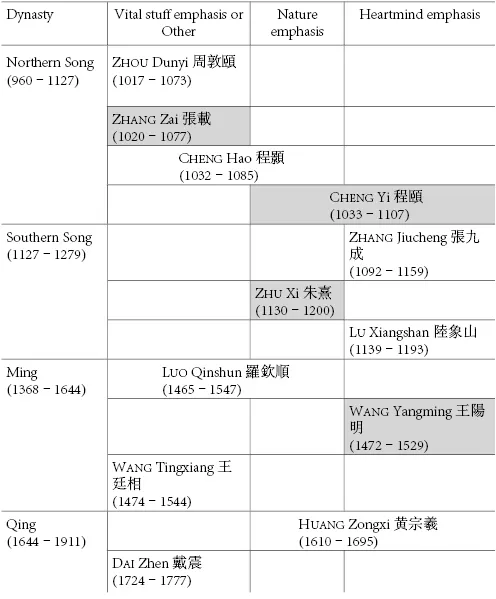
As we will emphasize throughout the book, Daoxue thinkers often disagreed with one another. We find the ways in which these differences have been marked in the past, such as different scholarly genealogies, regional identities, and ideas of “orthodoxy,” to be of limited use for our purposes. This is important data for intellectual historians, and can often help us understand particular texts or statements, but is less central to the idea-driven approach that we take here.5 Most scholarship on Neo-Confucianism from the twentieth century to the present divides what we call Daoxue up into two “schools,” generally referred to as Cheng–Zhu Pattern learning (lixue) and Lu–Wang heartmind learning (xinxue).6 Each school is named after the two figures putatively at its core – Cheng Yi and Zhu Xi, and Lu Xiangshan and Wang Yangming, respectively – and are sometimes also distinguished as “rationalism” and “idealism.” For three reasons, we find the division of Daoxue into these two schools to be problematic. First, it does not correspond with historical reality. Certainly, there is truth to an explicitly recognized “Cheng–Zhu” configuration, but there was no corresponding Lu–Wang grouping, so seeing Neo-Confucianism as structured by two competing schools is misleading.7 Second, dichotomizing Daoxue into two schools both overemphasizes the differences among many ideas and thinkers, and it leaves no place for thinkers clearly within the Cheng–Zhu lineage who demonstrate key philosophical emphases that supposedly are the purview of “Lu–Wang.” We will see that there are a range of issues that crosscut the supposed Cheng–Zhu/Lu–Wang divide. Third, the association of the two schools with “rationalism” and “idealism” is greatly misleading, no matter how those terms are understood. So we will avoid this talk of “schools.” Still, we do acknowledge that there is some truth lying behind such locutions, and we think that readers find it helpful to have rough categories into which they can place Neo-Confucian thinkers. Therefore, we talk about three general areas of emphasis within Daoxue: vital stuff, nature, and heartmind. This is graphically expressed in Table 1.1 (and in the fuller version of the same table included as appendix 2 at the back of the book). These central categories (vital stuff, nature, and heartmind) are introduced in the first three topical chapters. All these thinkers are discussed at some length in the book (and still more will receive brief mention), with the four individuals marked by shaded boxes featuring most prominently.
Table 1.1 Prominent Neo-Confucians
To sum up, our book is concerned with Neo-Confucianism in quite a broad sense, ranging from the eleventh through the eighteenth centuries. Our main attention is directed at developments in China but, since Neo-Confucian thinking extended to the rest of East Asia, we will sometimes be able to point out philosophically significant innovations outside China.
“Philosophical”
The second key term in the book's title is “philosophical.” As was the case with “Neo-Confucianism,” neither “philosophy” nor its translation into Chinese (zhexue 哲學) was used by the thinkers whom we study here. A term corresponding to the English word “philosophy,” like those for “religion,” “politics,” and many others, did not exist in Chinese prior to the nineteenth century.8 And it was only in the early twentieth century that Chinese and foreign scholars began explicitly to refer to “Chinese philosophy” (zhongguo zhexue).9 These facts have allowed for much debate, both within China and without, over whether it is in fact appropriate to analyze China's traditions of learning as philosophy. Many pioneering scholars of “Chinese philosophy,” especially in China, took their major categories of analysis from existing approaches to western philosophy and sought ways to fit Chinese traditions into these frameworks. This meant identifying Chinese thinkers as “rationalists” or “empiricists,” “materialists” or “idealists,” or as advocates of “heteronomy” or “autonomy.” Such work is often based on meticulous readings of the texts and can be helpful if used carefully, and we ourselves sometimes find it convenient to use terms like “metaphysics” or “epistemology” in loose senses, but we are sympathetic with the many critics who argue that whenever one tries to fit Chinese traditions into pre-existing categories, there is a danger of misunderstanding the source material.10 At the same time, we resist the extreme conclusion of some of these critics, which is to reject the idea that traditional Chinese scholars can be thought of as engaged in philosophy. So long as “philosophy” is understood in an appropriately broad sense, we believe that it is obvious that Neo-Confucians (and Chinese thinkers of other eras) were engaged in philosophy, and that it is fruitful to view them this way.
Philosophy is systematic reflection on our existence, seeking to answer questions like “What is our place in the cosmos?” or “How should we best live our lives?” For many philosophers – very much including the Greeks who stood at the beginnings of western philosophy – the asking and answering of such questions was part of a philosophical way of life: that is, philosophy is not confined to abstract, intellectual pursuits but is implemented in one's daily life.11 We think that even cursory examination of the Neo-Confucian thinkers we cover in this book makes it clear that they were centrally committed to philosophy in precisely this sense. They discoursed about issu...
Table of contents
- Cover
- Table of Contents
- Dedication
- Title page
- Copyright page
- Preface
- 1: Introduction
- 2: Pattern and Vital Stuff
- 3: Nature
- 4: Heartmind
- 5: Emotions
- 6: Knowing
- 7: Self-Cultivation
- 8: Virtues
- 9: Governance and Institutions
- 10: The Enduring Significance of Neo-Confucianism
- Appendix 1: Teaching Neo-Confucianism Topically
- Appendix 2: Table of Neo-Confucians (by Date and Philosophical Emphasis)
- Appendix 3: Abbreviations of Primary Sources
- Bibliography
- Index
- End User License Agreement
Trusted by 375,005 students
Access to over 1.5 million titles for a fair monthly price.
Study more efficiently using our study tools.
Frequently asked questions
Yes, you can cancel anytime from the Subscription tab in your account settings on the Perlego website. Your subscription will stay active until the end of your current billing period. Learn how to cancel your subscription
No, books cannot be downloaded as external files, such as PDFs, for use outside of Perlego. However, you can download books within the Perlego app for offline reading on mobile or tablet. Learn how to download books offline
Perlego offers two plans: Essential and Complete
- Essential is ideal for learners and professionals who enjoy exploring a wide range of subjects. Access the Essential Library with 800,000+ trusted titles and best-sellers across business, personal growth, and the humanities. Includes unlimited reading time and Standard Read Aloud voice.
- Complete: Perfect for advanced learners and researchers needing full, unrestricted access. Unlock 1.5M+ books across hundreds of subjects, including academic and specialized titles. The Complete Plan also includes advanced features like Premium Read Aloud and Research Assistant.
We are an online textbook subscription service, where you can get access to an entire online library for less than the price of a single book per month. With over 1.5 million books across 990+ topics, we’ve got you covered! Learn about our mission
Look out for the read-aloud symbol on your next book to see if you can listen to it. The read-aloud tool reads text aloud for you, highlighting the text as it is being read. You can pause it, speed it up and slow it down. Learn more about Read Aloud
Yes! You can use the Perlego app on both iOS and Android devices to read anytime, anywhere — even offline. Perfect for commutes or when you’re on the go.
Please note we cannot support devices running on iOS 13 and Android 7 or earlier. Learn more about using the app
Please note we cannot support devices running on iOS 13 and Android 7 or earlier. Learn more about using the app
Yes, you can access Neo-Confucianism by Stephen C. Angle,Justin Tiwald in PDF and/or ePUB format, as well as other popular books in Philosophy & Eastern Philosophy. We have over 1.5 million books available in our catalogue for you to explore.