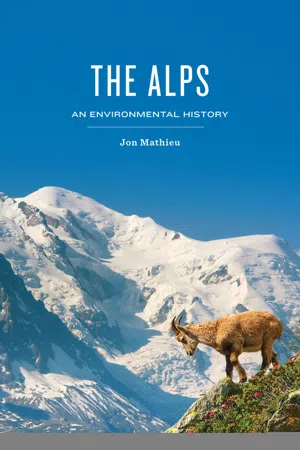
Stretching 1,200 kilometres across six countries, the colossal mountains of the Alps dominate Europe, geographically and historically. Enlightenment thinkers felt the sublime and magisterial peaks were the very embodiment of nature, Romantic poets looked to them for divine inspiration, and Victorian explorers tested their ingenuity and courage against them. Located at the crossroads between powerful states, the Alps have played a crucial role in the formation of European history, a place of intense cultural fusion as well as fierce conflict between warring nations. A diverse range of flora and fauna have made themselves at home in this harsh environment, which today welcomes over 100 million tourists a year.
Leading Alpine scholar Jon Mathieu tells the story of the people who have lived in and been inspired by these mountains and valleys, from the ancient peasants of the Neolithic to the cyclists of the Tour de France. Far from being a remote and backward corner of Europe, the Alps are shown by Mathieu to have been a crucible of new ideas and technologies at the heart of the European story.
The Alps are the highest mountains in central Europe, as Johann Heinrich Zedler wrote in 1732 in his encyclopaedia: ‘They are a wall built by nature, so to speak, which separates Italy from France and Germany. They extend very far, from the Ligurian Sea to Nice, Provence, Dauphine, Savoy, the Valais lands, Switzerland, Grisons, Tyrol, Trent, Brixen, Salzburg, Carinthia, Carniola, a part of Milan and the Venetian territories; indeed they seem to stretch even into Serbia.’ As early as the fourteenth century, Italian humanists saw the Alps in a similar way – namely, as a barrier or wall which protected Italy from the north. Later, Martin Luther observed in his writings that the mountain wall separated Germany from Italy. This separating function of the European Alps remained an important idea until the Enlightenment. Two centuries after Zedler, it was also emphasized by Denis Diderot in the Encyclopédie.1
Then, in the nineteenth and above all the twentieth centuries, academics and politicians began increasingly to emphasize the role of the Alps as a space of transit. Now the mountains were described as ‘bridges of culture between the Mediterranean and northern Europe’, and the wall and border functions were qualified. ‘It is not the least paradox of the Alps’, so went a study of transport history, ‘that this colossal chain of mountains never posed an insurmountable barrier, but rather a link between east and west, south and north, a contact zone, a nodal point for economies, ideas and conventions’.2 The background to this new perspective was above all the penetration of the mountain range by modern means of transport and the enormous increase in transit traffic compared to the early modern period. Infrastructural development simultaneously promoted Alpine tourism. The Alps thereby acquired an additional role as The Playground of Europe, as Leslie Stephen expressed it in a now famous Alpine work of 1871.3
With the regionalism of the second half of the twentieth century, a further viewpoint eventually emerged: the Alps as a living space for the local population. Thus, the participants in an international congress on the ‘Zukunft der Alpen’ [Future of the Alps] in 1974 stated that the Alps must be described as a ‘European inheritance’ and a ‘natural, historical, cultural and social unity of vital importance’. The great currents of civilization had been separated, reshaped and connected by them. ‘But in spite of the sometimes difficult relationships and connections between peoples and political systems, an independent Alpine culture developed, and although the Alps have never known political unity, the way of life and activities of their populations demonstrate a striking similarity of character.’4
In whatever way this culture and way of life was actually formed (and we shall return repeatedly to this question), it is clear that for a long time the Alps have had a considerable population. If we take the area of the Alpine Convention as a basis, there must have been around 3.1 million people in 1500, growing to 5.8 million in 1800; in 2000 there were already 13.7 million people.5 Admittedly, the numbers are heavily dependent on the exact delimitation used, and here there are and have been very different takes. Like many naturally defined areas, the Alps cannot be clearly demarcated. The most arbitrary aspect is the demarcation of the lower mountain ranges of the Apennines in Italy and the so-called Dinaric Alps in the Balkans, which had already been remarked upon by Zedler in his reference to Serbia. That the definition also depends on particular interests is shown in the drafting of the international Alpine Convention of 1991, in which a binding territory was agreed. At that time, Bavaria decided to expand its Convention area to the vicinity of Munich, thereby increasing the Bavarian Alps threefold in comparison with earlier classifications. In other countries, on the other hand, some regions were particularly conservative and wanted to avoid integration. This created a politically constituted Alpine region of 191,000 square kilometres in total.
Geographically, this space differs from its surrounding areas in its relief and its altitude. According to chroniclers of mountaineering, there are some 1,350 summits in the Alps. Large parts of the Alpine area lie more than 2,000 metres above sea level, and its highest peak, Mont Blanc, reaches a good 4,800 metres. But the area is also traversed by many low-, and some very low-, lying valleys. Around a third of traditional settlements lie below 500 metres, and only 2 per cent are situated above 1,500 metres.6 It has often been emphasized that at the higher altitudes there are large stretches of ‘unproductive land’. However, no one knows exactly how large or unproductive they are. The differences in the area statistics point to the fact that the precise extent of unproductive land also depends on the measures of value used by the various national administrations. In general, ‘nature’ and ‘culture’ are relational, time-bound concepts. From the outside, the Alps seem more like a natural space, and from within more like a cultural and living space.
1.2 Flight and Tunnelling
Today, the fragmented and inaccessible Alps can be observed from the comfort of an aeroplane. Nothing seems easier than to fly over these 3,000- and 4,000-metre-high mountains. But, in the history of flight, the mountain range initially posed a challenge. This was vividly displayed by the first transalpine balloon flight in 1898 and the first plane flight over the main Alpine ridge in 1910.
The idea of a transalpine balloon flight came from the Zurich geology professor and Alpine expert Albert Heim, who wanted one day to see his research subject from above. It was carried out with the help of Flight Captain Eduard Spelterini. In the second half of the nineteenth century, professional balloon flight had established itself in Europe. Spelterini had obtained his aeronautical licence in Paris in 1877 and had since taken paying passengers on his flights. He later made a name for himself as a pioneer of aerial photographs, which he presented in numerous lectures in the form of coloured slides (see figure 1). A mountain crossing by balloon was for a long time held to be impossible, as there was no means of controlling for fall wind. After detailed aeronautical study, however, Spelterini believed that he could solve the problem with a very high flight of over 5,000 or 6,000 metres. The plan was carried out with the help of numerous scientists and donors. Before a large crowd, the balloon took off on its Alpine flight from the Valais on 3 October 1898. The flight lasted more than five hours and was pulled northwards by the wind currents over the mountains and into France.7
Figure 1Aerial photograph of the Matterhorn by Eduard Spelterini, 1910
The Valais was also the setting of the first Alpine crossing by aeroplane, which, however, was unsuccessful and ended with a crash. The tragic hero was Jorge Chávez, the son of a rich Peruvian who had settled in France. Chávez attended a flight school near Paris and completed his first flight in February 1910. In the following months, he participated in flight competitions across the whole of Europe, repeatedly breaking the existing record for altitude. He then decided to take part in the ‘Gran Premio della Traversata delle Alpi’ [Grand Prize for the Crossing of the Alps], put on by a committee in Milan. For a flight from the Valais southwards over the main Alpine ridge to Italy, the organizers would pay out a prize of no less than 100,000 lira. On the appointed day, however, three of the five registered pilots had withdrawn without even testing their machines, and a fourth pilot had been unable to reach the necessary flying height of over 2,000 metres in his bi-plane. That left Chávez, who took off on 23 September 1910, to the animated appreciation of the public, spiralled upwards, flew over the Simplon Pass in the Zwischbergen Valley and unfortunately crashed at Domodossola. The death of the young pilot excited much attention: the international airport of Lima in Peru bears his name to this day.8
The resistance of the mountains and the endeavours to conquer them are also clearly evident in the history of tunnel construction. In Europe, mining for metal extraction soared from the late Middle Ages. In the Alps there were numerous mines, and the mining technique of tunnel excavation made considerable progress. So, it is understandable that the age of tunnel building began in the fifteenth and sixteenth centuries. For the facilitation of the salt trade between the two sides of the Western Alps, the Marquis of Saluzzo had a summit tunnel of some 75 metres in length excavated in the region of Monte Viso in around 1480. The tunnel was built just tall enough to be traversed by a pack animal and a stooping man, and its time-saving advantages were obviously not insignificant. The facilitation of transalpine commerce was also served by a tunnel created in the second half of the sixteenth century from the Loibl Pass in the Karavanks to the southern border of Carinthia. It was a 150-metre-long passage directly under the ridge. The tunnel was later abandoned because of the imminent threat of collapse and replaced by a ground cutting.9
In the seventeenth and ei...
Table of contents
Cover
Front Matter
Preface
Writing a History of the Alps
Personal Note and Acknowledgements
Timeline
1. The Alps in European History
2. Modern Scholars on the Alps
3. In the Beginning was Hannibal
4. Coping with Life – High and Low
5. Paths to the Nation State
6. Religious Culture, Early Science
7. The Perception of the Alps
8. Which Modernity?
9. Europeanization and Environmentalism
10. Conclusion
Bibliography
Image Credits
Index
End User License Agreement
Trusted by 375,005 students
Access to over 1.5 million titles for a fair monthly price.
Study more efficiently using our study tools.
Frequently asked questions
Yes, you can cancel anytime from the Subscription tab in your account settings on the Perlego website. Your subscription will stay active until the end of your current billing period. Learn how to cancel your subscription
No, books cannot be downloaded as external files, such as PDFs, for use outside of Perlego. However, you can download books within the Perlego app for offline reading on mobile or tablet. Learn how to download books offline
We are an online textbook subscription service, where you can get access to an entire online library for less than the price of a single book per month. With over 1.5 million books across 990+ topics, we’ve got you covered! Learn about our mission
Look out for the read-aloud symbol on your next book to see if you can listen to it. The read-aloud tool reads text aloud for you, highlighting the text as it is being read. You can pause it, speed it up and slow it down. Learn more about Read Aloud
Yes! You can use the Perlego app on both iOS and Android devices to read anytime, anywhere — even offline. Perfect for commutes or when you’re on the go. Please note we cannot support devices running on iOS 13 and Android 7 or earlier. Learn more about using the app
Yes, you can access The Alps by Jon Mathieu, Rose Hadshar in PDF and/or ePUB format, as well as other popular books in History & World History. We have over 1.5 million books available in our catalogue for you to explore.