Allegations of Russian conspiracies meddling in the affairs of Western countries have been a persistent feature of Western politics since the Cold War – allegations of Russian interference in the US presidential election are only the most recent in a long series of conspiracy allegations that mark the history of the twentieth century. But Russian politics is rife with conspiracies about the West too. Everything bad that happens in Russia is traced back by some to an anti-Russian plot that is hatched in the West. Even the collapse of the Soviet Union – this crucial turning point in world politics that left the USA as the only remaining superpower – was, according to some Russian conspiracy theorists, planned and executed by Russia's enemies in the West.
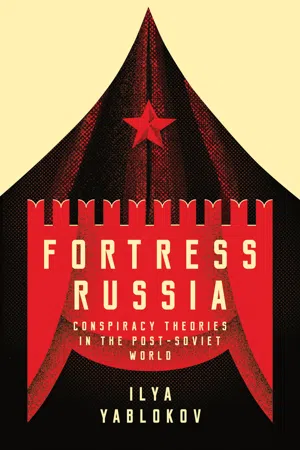
This book is the first-ever study of Russian conspiracy theories in the post-Soviet period. It examines why these conspiracy theories have emerged and gained currency in Russia and what role intellectuals have played in this process. The book shows how, in the new millennium, the image of the 'dangerous, conspiring West' provides national unity and has helped legitimize Russia's rapid turn to authoritarianism under Vladimir Putin.
- English
- ePUB (mobile friendly)
- Available on iOS & Android
eBook - ePub
About this book
Information
1
Building ‘Fortress Russia’
The Imperial Period
Conspiracy theories have a long history in Russia. According to Andrei Zorin (2001), the concept of conspiracy originated in European intellectual thought and arrived in Russia in the eighteenth century. Zorin analysed a poem by a court poet, Vasilii Petrov, that described an alliance of European countries against Russia, which they perceived to be a growing power with global ambitions. Petrov saw the intrigues of European monarchs against Russia as a malevolent plan to destroy the country’s greatness. Although this cannot be called a genuine conspiracy theory since it lacks the crucial elements, it points to the origins of the phenomenon and the social level at which these concepts initially emerged. As with Western European countries, ideas about conspiracy in Russia initially emanated from intellectual and political elites who were well educated and who suffered the most from changes in the social and political environment (von Bieberstein, 2008).
Fears about masonic plots – one of the most popular and enduring of conspiracy theories, which first emerged in the mid eighteenth century – were also promulgated, for the most part, by people in the upper echelons of Russian society. As Smith (1999) demonstrates, suspicion of Freemasonry in Russia was based on rumours that its members had close ties to the devil, were atheists and indulged in sexual rituals. In this respect, Russia was no different to Europe. These fears about the Masonry appeared simultaneously in other European countries, with Freemasons accused, for example, of triggering the French revolution. A similar fear in Russia that Freemasons were plotting revolution led the Russian state to clamp down on them at the end of the eighteenth century, closing Freemason societies across the country and imprisoning the leader, Nikolai Novikov. All the same, fear of what was thought to be the omnipotent Masonry continued throughout the nineteenth and twentieth centuries as an important element in anti-Western conspiracy theories (Nilus, [1903] 2012; Platonov, 1996).
The anti-Western stance did not undergo any significant development until the mid nineteenth century. Even the famous debates between Slavophiles and the Westernizers, which began in the late eighteenth century, was less harsh at the beginning of the nineteenth century than it was at the end. Vera Tolz points out that the first round of debates between Westernizers and Slavophiles ‘reflected the divide between cosmopolitans of the Enlightenment and (proto) nationalists’ (2001, p. 65). In the late eighteenth and early nineteenth centuries the rapid development of the nation had not yet begun; this would not happen until the second half of the nineteenth century. Accordingly, a search for the dangerous ‘Other’, which would help to design the country’s identity and clarify who was ‘Us’ and ‘Them’, was at a premature stage.
The watershed in the rapid development of conspiracy theories in Russia was the Crimean War (1853–6), which was triggered by the desire of Russia’s rulers to gain control over the territories of the Ottoman Empire. The alliance of European governments supporting the Ottoman Empire was devastating for Russia, and resulted in her losing territory, influence in Europe, and the right to keep a fleet on the Black Sea. Many conservative thinkers in Russia had imagined her advancing into the Middle East and the Balkans as part of a messianic mission; these illusions of grandeur were now shattered (Duncan, 2005).
A new generation of Slavophiles emerged in the wake of the Crimean disaster, with more radical views about the West. Russia’s humiliation in the Crimean War was not the only factor in the spread of anti-Western sentiment and conspiracy fears. The Slavophiles enjoyed the support of conservative groups in governing circles, especially during the reign of Aleksandr III, who promoted a counter-liberal agenda. Many elements of anti-Western conspiracy theories appeared in Russia at this time.
The proliferation of conspiracy fears in the Russian Empire in the late nineteenth century was the result of several factors. Aleksandr II introduced a series of reforms which liberalized Russia and set it on the path of rapid industrialization and modernization. The mass migration of people from villages to cities changed the social structure of Russian society, and helped spread rumours and fears (Fuller, 2006; Kolonitskii, 2010). In addition, Russians became better educated as a result of Aleksandr’s educational reforms, and this was instrumental in helping to produce and disseminate conspiratorial ideas. As Hofstadter explains, conspiracy theorists aimed to present their ideas in an academic style, and this required a basic education and the ability to formulate ideas. Ironically, conspiracy theories became a mechanism by which conservative intellectual elites understood the liberal changes that were taking place in Russian society. Aleksandr’s reforms, which allowed more freedom for both liberal and conservative groups, were perceived by the conservatives as a Western plan to corrupt and destroy Russia.
Among the first groups of intellectuals which openly endorsed conspiratorial notions to interpret domestic and foreign policies were the conservatives, that were called ‘okhraniteli’ (defenders). Their clear anti-Western views were characteristic of conspiracy theories in late Imperial Russia. The idea that Russia had a special path (teoriia osobogo puti), an historic mission to save the world, rested on an idealized vision of the country as a repository of morality and of Christian Orthodoxy (Poe, 2000). The writer Dostoevsky became a driving force in disseminating the idea of Russia’s global mission, both in the nineteenth century and for later generations of Russian conservatives. The Diary of a Writer became a manifesto for Russian conservatism, outlining the main tenets of Russia’s ‘special mission’ (Dostoevsky, 1995). The dichotomy between the corrupt Catholic Church of the West and the pure and faithful Orthodox Church of the East framed the conflict between Russia and the West. The revolutionaries who emerged in post-Crimean Russia were in Dostoevsky’s view, connected to Catholicism and hence a weapon being used by the West to destroy Russia from within.
The perceived need to extricate Russia from heretical Western influence was also an important issue for late Slavophiles. Aleksei Khomiakov, one of the early Slavophiles, had put forward the idea that Russia had become a virtual colony of the West because of Peter the Great’s reforms. To shape a new national identity, Russians needed to rid themselves of Western influence and promote a spiritual rebirth (Khomiakov, 1982). Danilevskii, a prominent thinker of the late nineteenth century, went so far as to advocate the radical separation of Russia from Europe, insisting that Russia was an autonomous cultural-historical entity which must evolve independently from Europe (Danilevskii, 2013). Danilevskii’s ideas have been widely adopted in the writings of post-Soviet conspiracy theorists and, as we will see, have often been used to explain supposed Western hatred towards Russia.
Nationalist movements reached their apotheosis in the period of Aleksandr II’s reforms. Following the Polish uprising of 1863 and the rise of Ukrainian nationalists (Miller, 2012b), the term ‘national’ began to appear more frequently in the conservative press. The Poles and the Jews, who inhabited the Western territories of the Russian empire, were often depicted as Russia’s main enemies. The Poles were considered particularly dangerous not only due to their religion but also because they had a strong and active nationalist movement which was thought to threaten the integrity of the Empire. The image of the conspiratorial Catholic Polish priest was central to these fears. The Imperial government was also suspicious about local anti-Russian Catholic activists who were thought to receive instructions from their foreign superiors on how to resist and overthrow the Tsar (Dolbilov, 2010).
Mikhail Katkov, a prominent writer and publisher in nineteenth-century Russia, was an iconic conservative conspiracy theorist of the late nineteenth century who focused on the supposed Western plot. He linked the threat to Russia by Polish revolutionaries directly to Western anti-Russian plotters. In his view, every Russian patriot had a duty to be loyal to the state in the same way that a soldier was loyal to his commander. A ‘genuine Russian’ had to be an Orthodox Christian, a committed monarchist and a loyal subject. If not, he would be considered an enemy of the nation (Katkov, 1863). Just as post-Soviet Russian conspiracy theorists claim that the opposition movement gets funding from the West, Katkov accused the Poles of funding bloodshed and revolution with money from abroad (Katkov, 1881). As is typical of conspiracy theorists, Katkov divided Russia into two groups, the national and anti-national. The nationalists rejected reforms which they considered to threaten Russia’s very existence; they thought they were aimed at changing Russia’s territorial integrity, and that this could only benefit Russia’s enemies (Katkov, 1880). They believed that anti-Russian plotters in the West manipulated revolutionaries into threatening and destabilizing the Russian monarchy; they also tried to destroy Russia’s reputation in the European press and wrote cynical lies portraying the country as backward (Katkov, 1865).
Katkov became the key intellectual in the promotion of the counter-reforms which began during the reign of Aleksandr III; his radical conservative views bolstered repressive legislation in schools, universities and the press (Riabov, 2010). The counter-revolutionary measures introduced by the government and the rise of radical Russian nationalism led to anti-Semitic conspiracy theories which became central to the conspiratorial discourse up to the October 1917 revolution and since then have been an important element in the conspiratorial discourse of Russia’s far right movements (Shnirel’man, 2002; Rossman, 2002; Shnirel’man, 2012).
Savelii Dudakov (1993) undertook a detailed study of the anti-Jewish conspiratorial attitudes in Russian nineteenth-century fiction which provided the impetus for the dissemination of one of the most persistent anti-Jewish conspiratorial texts of all times, The Protocols of the Elders of Zion. This fabricated pamphlet was used as evidence of a global ‘Jewish-Masonic conspiracy’ to achieve world domination. Its impact on Russian society was enormous. Its origins are still not fully understood. It is likely that it stemmed from long-standing anti-Jewish sentiment, which increased considerably in the late nineteenth century. As Michael Hagemeister (2008) demonstrates, anti-Semitic conspiracy theories existed in Russia long before the Protocols appeared; they were just another iteration of the conspiracy myth.
Jacob Brafman’s The Book of the Kahal could be considered a conceptual precursor of the Protocols. The Kahal was a traditional form of social organization of Eastern European Jews. The Russian authorities, together with enlightened and secularized Jews, attempted to dismantle the Kahal to assimilate Jews, who had hitherto lived in the pale of settlement, into mainstream Russian society. The state plan to take the Jews out of the Kahal was not well designed and was inconsistently applied, often leaving the newly assimilated Jews with, at best, very limited rights (Lowe, 1993). However, Brafman’s interpretation of the persistence of the Kahal was influential. The author presented the Kahal as a ‘state within the state’ – a typical anti-Semitic image – which supposedly had tremendous power over its members, as well as tentacles which reached beyond its borders into the Russian Empire as a whole (Brafman, 2005). This portrayal of the Jewish organization added to concern on the part of Russian intellectuals from both sides of the political spectrum about the reforms in Russia. As Israel Bartal (2005) noted, the Jews were the ‘convenient Other’ for the left, who saw them as landowners and exploiters of peasants; while for the right they were subversive agents of Western modernization and hence represented mortal danger to the Russian nation.
The spread of popular political movements and the growth of the far-right movement in the run up to the 1905 revolution turned anti-Jewish conspiracy theories into a powerful instrument for popular mobilization (Laquer, 1993). The ‘Black Hundreds’, a conglomerate of far right political movements in late Imperial Russia, were in the vanguard of the Russian conspiracy culture. They embraced anti-Semitic conspiracy theories, especially the Protocols, which won them substantial support. The anti-Jewish pogroms of the late nineteenth and early twentieth centuries, which were organized by the ‘Black Hundreds’, demonstrate the potentially destructive nature of conspiratorial ideas (Klier, 2014).
The rapidly changing socio-economic environment following Aleksandr II’s reforms left many people vulnerable to the changing environment of everyday life, and this explains, to a certain extent, the wide acceptance of these ideas. There was a developing nationalist mood in Russia before and during the First World War, and this was used by the authorities to foster short-term social cohesion in support of the regime (Schimmelpenninck Van Der Oye, 2001; Lohr, 2003). As was usually the case, this mobilization was achieved by creating an image of a dangerous, conspiring ‘Other’, in the form of other nationalities. This alienated many ethnic groups, which in turn led to concern on the part of the authorities about potential treason.
Fears about rebellion within the Russian Empire demonstrate the pervasiveness of conspiracy theories among different social and political groups by the end of the Imperial period. Fuller (2006) argues that the pattern of conspiracy thinking, together with other social and political developments, prepared the intellectual platform for the February and October revolutions of 1917, and played a crucial role in undermining the position of the ruling elites. Fear of treason and conspiracy became accepted features of the interpretation of the political situation in late Imperial Russia, and contributed to the development of a conspiracy culture in the Soviet period.
The Soviet Period
While the political and intellectual elites of Imperial Russia occasionally utilized ideas of conspiracy to secure their positions, and justify the suspension of liberal reforms, in the Soviet period these ideas found a new purpose. The politics of large-scale social and economic modernization led to the instrumental deployment of conspiracy discourse in Soviet propaganda. The ‘enemy of the people’ (vrag naroda) is a particularly clear example of the Bolsheviks’ binary view of the world (Bonnell, 1999), as is the discursive division of the world into the socialist and capitalist blocs. The search for internal and external enemies became a paradigm of Bolshevik rule after the 1917 revolution. The Bolshevik state had to protect itself from plots by capitalists and members of the ancien régime. The Emergency Committee (the notorious Cheka) and the Red Army fought against counter-revolutionaries who, in cahoots with their Western allies, had supposedly started the Civil War to reinstate the capitalist exploiters (Mints, 1979). This understanding of the Soviet Union as a besieged nation became a norm in Soviet life, especially in the 1930s when the active search for public enemies and ‘wreckers’ began. During the Great Terror, as Sheila Fitzpatrick (2000) has demonstrated, the pursuit of conspiracies affected millions of citizens in all walks of life. To the authorities’ suspicious eye, friends and colleagues who created informal networks to help each other survive the hard times of post-revolutionary Russia looked like groups of plotters and spies.
The incredible number of deaths in the first post-revolutionary decades, as well as the devastated state of the economy, put additional burdens both on the party apparatus, and on ordinary people. The latter had to work in extreme conditions and under enormous pressure because of the state’s single-minded focus on the country’s economic development. The growth of Nazism and the threat of foreign invasion by the capitalist states ...
Table of contents
- Cover
- Copyright
- Acknowledgements
- Introduction
- 1 Building ‘Fortress Russia’
- 2 The Spectres of Conspiracy Mythmaking
- 3 In Search of the ‘Agents of Perestroika’
- 4 Sovereign Democracy and its Enemies
- 5 Battling against ‘Foreign Agents’
- 6 Shadows of the Revolution
- 7 The War has Begun
- Conclusion
- References
- Index
- End User License Agreement
Trusted by 375,005 students
Access to over 1.5 million titles for a fair monthly price.
Study more efficiently using our study tools.
Frequently asked questions
Yes, you can cancel anytime from the Subscription tab in your account settings on the Perlego website. Your subscription will stay active until the end of your current billing period. Learn how to cancel your subscription
No, books cannot be downloaded as external files, such as PDFs, for use outside of Perlego. However, you can download books within the Perlego app for offline reading on mobile or tablet. Learn how to download books offline
Perlego offers two plans: Essential and Complete
- Essential is ideal for learners and professionals who enjoy exploring a wide range of subjects. Access the Essential Library with 800,000+ trusted titles and best-sellers across business, personal growth, and the humanities. Includes unlimited reading time and Standard Read Aloud voice.
- Complete: Perfect for advanced learners and researchers needing full, unrestricted access. Unlock 1.5M+ books across hundreds of subjects, including academic and specialized titles. The Complete Plan also includes advanced features like Premium Read Aloud and Research Assistant.
We are an online textbook subscription service, where you can get access to an entire online library for less than the price of a single book per month. With over 1.5 million books across 990+ topics, we’ve got you covered! Learn about our mission
Look out for the read-aloud symbol on your next book to see if you can listen to it. The read-aloud tool reads text aloud for you, highlighting the text as it is being read. You can pause it, speed it up and slow it down. Learn more about Read Aloud
Yes! You can use the Perlego app on both iOS and Android devices to read anytime, anywhere — even offline. Perfect for commutes or when you’re on the go.
Please note we cannot support devices running on iOS 13 and Android 7 or earlier. Learn more about using the app
Please note we cannot support devices running on iOS 13 and Android 7 or earlier. Learn more about using the app
Yes, you can access Fortress Russia by Ilya Yablokov in PDF and/or ePUB format, as well as other popular books in Social Sciences & Sociology. We have over 1.5 million books available in our catalogue for you to explore.