Can we talk about the news media without proclaiming journalism either our savior or the source of all evil? It is not easy to do so, but it gets easier if we put the problems and prospects of journalism in historical and comparative perspective, view them with a sociological knowledge of how newsmaking operates, and see them in a political context that examines how political institutions shape news as well as how news shapes political attitudes and institutions.
Adopting this approach, Michael Schudson examines news and news institutions in relation to democratic theory and practice, in relation to the economic crisis that affects so many news organizations today and in relation to recent discussions of "fake news." In contrast to those who suggest that journalism has had its day, Schudson argues that journalism has become more important than ever for liberal democracies as the keystone institution in a web of accountability for a governmental system that invites public attention, public monitoring and public participation. For the public to be swayed from positions people have already staked out, and for government officials to respond to charges that they have behaved corruptly or unconstitutionally or simply rashly and unwisely, the source of information has to come from organizations that hold themselves to the highest standards of verification, fact-checking, and independent and original research, and that is exactly what professional journalism aspires to do.
This timely and important defense of journalism will be of great value to anyone concerned about the future of news and of democracy.
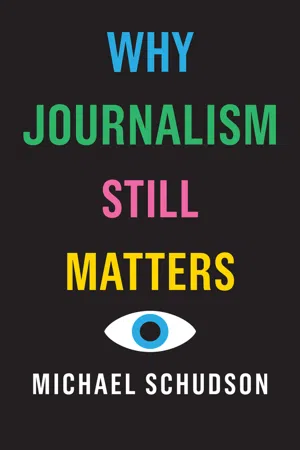
- English
- ePUB (mobile friendly)
- Available on iOS & Android
eBook - ePub
Why Journalism Still Matters
About this book
Trusted by 375,005 students
Access to over 1.5 million titles for a fair monthly price.
Study more efficiently using our study tools.
Information
Part I
Where Journalism Came From
1
14 or 15 Generations: News as a Cultural Form and Journalism as a Historical Formation
This chapter was originally a presentation at an annual meeting of the Association for Education in Journalism and Mass Communication, and was later published in American Journalism in 2013.
A perennial issue for historians is to determine for the topic at hand the relative importance of change and continuity and where on the calendar to locate turning points or times of transition.
Different thinkers take different positions on these matters, but professional historians typically are more interested to focus on and seek to explain change than continuity.
In contrast, Bill Kovach and Tom Rosenstiel, distinguished journalists, eloquent interpreters of American journalism, and leaders in their profession, emphasize continuity in the history of American journalism. They stake this claim in their influential book The Elements of Journalism. They begin by associating themselves with media scholar Jim Carey's view that, as they paraphrase it, holds that “in the end journalism simply means carrying on and amplifying the conversation of people themselves.”1 There is an abiding and somehow comforting element of truth in this. But Kovach and Rosenstiel then add that this definition has “held so consistent through history, and proven so deeply ingrained in the thinking of those who produce news through the ages, that it is in little doubt.”2 In fact, they continue, “the basic standards of newsworthiness have varied very little throughout history.”
That is the assertion I dispute here. They go on to approvingly quote journalist and journalism scholar Mitchell Stephens's generalization:
The basic topics with which … news accounts have been concerned, and the basic standards by which they evaluate newsworthiness, seem to have varied very little. Humans have exchanged a similar mix of news with a consistency throughout history and cultures that makes interest in this news seem inevitable, if not innate.3
If this is right, there is nothing new under the sun – nothing, at any rate, of much import, nothing that touches on journalism's fundamentals.
But it isn't right. If you look back at the Pennsylvania Gazette published by Benjamin Franklin in the 1700s, you see that, like the very few other papers of the day, it printed largely foreign news (more than 90 percent according to the most thorough study we have, with only 6 percent concerning Philadelphia and Pennsylvania).4 There was scarcely anything in Franklin's pages reflective of the local conversation. In France, newspapers that circulated in the countryside focused on “national or universal themes over local, specific ones.” Local papers that focused on local news became common only from the 1870s.5 In India, local news became a staple of newspapers only since the early 1970s. Before then, as one well-informed observer has put it, Indians had “not yet come to look upon the press as something of intimate relation to themselves.”6 This is perhaps an unusual case, since the Indian press was not even written in any of the languages most Indians spoke – hard to carry on the conversation of the people themselves if you don't speak the language! But, in many countries, newspapers and even broadcasting did not in the beginning aspire to, let alone practice, a journalism that took the tastes and interests of the people themselves into consideration.
Consider whether it is “consistent throughout history,” as Kovach and Rosenstiel say, or “throughout history and cultures,” as Stephens puts it, that journalists report on the so-called private lives of public figures. A presidential candidate's extramarital affair in 1940 would have been of great interest to many people, I suspect, but it was not news as far as journalists were concerned. Reporters knew very well that Republican candidate Wendell Willkie was having an affair with the New York Herald Tribune's book review editor Irita van Doren.7 None of them wrote about it. But Gary Hart's affair was big news when he sought the Democratic nomination for president in 1988. What explains this change?
This is the sort of thing historians are typically interested in – “change over time.” A Universal and Eternal Constant is necessarily silent about change. Why, then, are Kovach and Rosenstiel so interested in reaching for the timeless and the universal in journalism? They go pretty far in this direction, positing that “people crave news out of basic instinct, what we call the Awareness Instinct.” People need to know the unknown and they use news for practical purposes. News responds to the human need to be aware of one's environment. People “need to know what is going on over the next hill, to be aware of events beyond their direct experience. Knowledge of the unknown gives them security; it allows them to plan and negotiate their lives. Exchanging this information becomes the basis for creating community, making human connections.”8
They have something here. After all, it does feel like there's something relatively timeless and relatively universal at least in the gossipy side of news. If journalism were true to the interests of the public, and not busy repressing information for the sake of some precepts about the dignity of our political life, Wendell Willkie's adultery would have been widely discussed in the press, just as Gary Hart's was half a century later. Perhaps this is what Kovach and Rosenstiel have in mind. But if that's the case, it is all the more interesting and worthy of remark – and research – that other forces overcame gut-level instinct for generations of journalists. Why should that have been so? Why should newspapers seeking profits have adopted norms of reporting that flew in the face of attracting readers and serving the Awareness Instinct? To give Kovach and Rosenstiel the benefit of the doubt, can we say that there are some constants about journalism somewhere? That journalism – at least if given free rein (which, of course, it never is) – would invariably provide a lot of the same stuff that seems to always and everywhere draw popular attention? Stuff about assault and murder, sex and romance, conflict and competition, mystery and wonder, birth and death, health and illness, babies left on doorsteps – and perhaps any juicy bits about kings, queens, presidents, and prime ministers? Would these stories – were a perfect journalistic world to be unrestrained by politics, culture, intellectual pretension, professional pride, party loyalty, and religious preoccupation – flow unceasingly throughout journalism history?
Maybe. Maybe not. Maybe the reality is even less flattering to the human species. Consider the observation of the anthropologist Claude Lévi-Strauss on the origins of writing. The one thing that has invariably accompanied the emergence of writing, he says, is:
the exploitation … of mankind. This exploitation made it possible to assemble workpeople by the thousand and set them tasks that taxed them to the limits of their strength … the primary function of writing, as a means to communication, is to facilitate the enslavement of other human beings. The use of writing for disinterested ends, and with a view to satisfactions of the mind in the fields either of science or the arts, is a secondary result of its invention – and may even be no more than a way of reinforcing, justifying, or dissimulating its primary function.9
But Lévi-Strauss's claim to a universal and timeless truth about writing is as unsatisfying as Kovach and Rosenstiel's that journalism expresses and responds to an Awareness Instinct. In both cases, the authors stand at a huge distance from what they are trying to fathom. The relative changelessness they see in media history takes a perspective that seems fit for...
Table of contents
- Cover
- Table of Contents
- Title page
- Copyright page
- Personal Acknowledgments
- Acknowledgments
- Introduction
- Part I Where Journalism Came From
- Part II Going Deeper into Contemporary Journalism
- Part III Short Takes on Journalism and Democracy
- Part IV Afterword
- End User License Agreement
Frequently asked questions
Yes, you can cancel anytime from the Subscription tab in your account settings on the Perlego website. Your subscription will stay active until the end of your current billing period. Learn how to cancel your subscription
No, books cannot be downloaded as external files, such as PDFs, for use outside of Perlego. However, you can download books within the Perlego app for offline reading on mobile or tablet. Learn how to download books offline
Perlego offers two plans: Essential and Complete
- Essential is ideal for learners and professionals who enjoy exploring a wide range of subjects. Access the Essential Library with 800,000+ trusted titles and best-sellers across business, personal growth, and the humanities. Includes unlimited reading time and Standard Read Aloud voice.
- Complete: Perfect for advanced learners and researchers needing full, unrestricted access. Unlock 1.5M+ books across hundreds of subjects, including academic and specialized titles. The Complete Plan also includes advanced features like Premium Read Aloud and Research Assistant.
We are an online textbook subscription service, where you can get access to an entire online library for less than the price of a single book per month. With over 1.5 million books across 990+ topics, we’ve got you covered! Learn about our mission
Look out for the read-aloud symbol on your next book to see if you can listen to it. The read-aloud tool reads text aloud for you, highlighting the text as it is being read. You can pause it, speed it up and slow it down. Learn more about Read Aloud
Yes! You can use the Perlego app on both iOS and Android devices to read anytime, anywhere — even offline. Perfect for commutes or when you’re on the go.
Please note we cannot support devices running on iOS 13 and Android 7 or earlier. Learn more about using the app
Please note we cannot support devices running on iOS 13 and Android 7 or earlier. Learn more about using the app
Yes, you can access Why Journalism Still Matters by Michael Schudson in PDF and/or ePUB format, as well as other popular books in Languages & Linguistics & Journalism. We have over 1.5 million books available in our catalogue for you to explore.