What distinguishes fiction from ordinary experience is not a lack of reality but a surfeit of rationality – this was the thesis of Aristotle's Poetics. The rationality of fiction is that appearances are inverted. Fiction overturns the ordinary course of events that occur one after the other, aiming to show how the unexpected arises, happiness transforms into unhappiness and ignorance into knowledge.
In the modern age, argues Rancière, this fictional rationality was developed in new ways. The social sciences extended the model of causal linkage to all spheres of human action, seeking to show us how causes produce their effects by inverting appearances and expectations. Literature took the opposite path. Instead of democratizing fictional rationality to include all human activity in the world of rational knowledge, it destroyed its principles by abolishing the limits that circumscribed a reality peculiar to fiction. It aligned itself with the rhythms of everyday life and plumbed the power of the "random moment" into which an entire life is condensed.
In the avowed fictions of literature as well as in the unavowed fictions of politics, social science or journalism, the central question is the same: how to construct the perceptible forms of a shared world. From Stendhal to João Guimarães Rosa and from Marx to Sebald, via Balzac, Poe, Maupassant, Proust, Rilke, Conrad, Auerbach, Faulkner and some others, this book explores these constructions and sheds new light on the constitutive movement of modern fiction, the movement that shifted its centre of gravity from its traditional core toward those edges in which fiction gets confronted with its possible revocation.
- English
- ePUB (mobile friendly)
- Available on iOS & Android
eBook - ePub
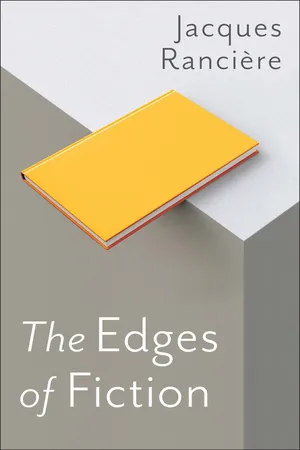
The Edges of Fiction
About this book
Information
Index
- active and passive men 130–1
- Agee, James 104, 137–8
- analytic faculty 73–6, 77, 79
- anti-Romantic programme 41
- appearances/expectations, inversion of see peripeteia
- aristocratic world of feelings and actions 6, 14, 18
- Aristotle 2, 34
- Poetics 1, 129, 149
- Politics 149
- art 5
- astrology 121
- Auerbach, Erich 6, 115, 128–9, 131, 133, 150
- Mimesis 7, 126
- Bachelard, Gaston 3
- Ballanche, Pierre-Simon 149
- Balzac, Honoré de 6, 20, 24, 47, 79
- At the Sign of the Cat and Racket 25, 79
- Beatrix 79
- The Collection of Antiquities 21–2
- A Daughter of Eve 23
- Lost Illusions 6, 127
- Louis Lambert 76–7
- The Muse of the Department 20
- Old Man Goriot 128, 131
- ‘The Purse’ 26–7
- A Second Home 22–3
- Ursule Mirouet 20–1, 76–7
- The Wild Ass’s Skin 27
- Baudelaire, Charles 48, 78
- Benjamin, Walter 107, 136, 151
- Bergen-Belsen 108–9, 111
- Berlin 110
- Bioy Casares, Adolfo 80
- Morel’s Invention 70
- bon mot 30
- Borges, Jorge Luis 70, 80
- Braudel, Fernand 3
- Browne, Thomas 106, 120
- capacity to invent 165–6
- capitalism
- commodity exchange 53–6, 58–9, 67
- experimentation on workers’ bodies 60–5
- genesis of capital 68–9
- primitive accumulation 63–4, 68
- subjugation of nature 120
- see also commodities
- cartography of time 121
- Casement, Roger 113
- causal chains 1–3, 11, 30, 72, 74–5, 79, 84–5, 87, 105, 115, 127–9, 131, 143
- inversion of see peripeteia
- causal rationality 3, 10, 73, 79, 130
- Chandler, Raymond 87
- chara...
Table of contents
- Cover
- Contents
- Title page
- Copyright page
- Acknowledgements
- Introduction
- Doors and Windows
- The Threshold of Science
- The Shores of the Real
- The Edge of the Nothing and the All
- Index
- End User License Agreement
Trusted by 375,005 students
Access to over 1.5 million titles for a fair monthly price.
Study more efficiently using our study tools.
Frequently asked questions
Yes, you can cancel anytime from the Subscription tab in your account settings on the Perlego website. Your subscription will stay active until the end of your current billing period. Learn how to cancel your subscription
No, books cannot be downloaded as external files, such as PDFs, for use outside of Perlego. However, you can download books within the Perlego app for offline reading on mobile or tablet. Learn how to download books offline
Perlego offers two plans: Essential and Complete
- Essential is ideal for learners and professionals who enjoy exploring a wide range of subjects. Access the Essential Library with 800,000+ trusted titles and best-sellers across business, personal growth, and the humanities. Includes unlimited reading time and Standard Read Aloud voice.
- Complete: Perfect for advanced learners and researchers needing full, unrestricted access. Unlock 1.5M+ books across hundreds of subjects, including academic and specialized titles. The Complete Plan also includes advanced features like Premium Read Aloud and Research Assistant.
We are an online textbook subscription service, where you can get access to an entire online library for less than the price of a single book per month. With over 1.5 million books across 990+ topics, we’ve got you covered! Learn about our mission
Look out for the read-aloud symbol on your next book to see if you can listen to it. The read-aloud tool reads text aloud for you, highlighting the text as it is being read. You can pause it, speed it up and slow it down. Learn more about Read Aloud
Yes! You can use the Perlego app on both iOS and Android devices to read anytime, anywhere — even offline. Perfect for commutes or when you’re on the go.
Please note we cannot support devices running on iOS 13 and Android 7 or earlier. Learn more about using the app
Please note we cannot support devices running on iOS 13 and Android 7 or earlier. Learn more about using the app
Yes, you can access The Edges of Fiction by Jacques Rancière, Steve Corcoran in PDF and/or ePUB format, as well as other popular books in Littérature & Théorie de la critique littéraire. We have over 1.5 million books available in our catalogue for you to explore.