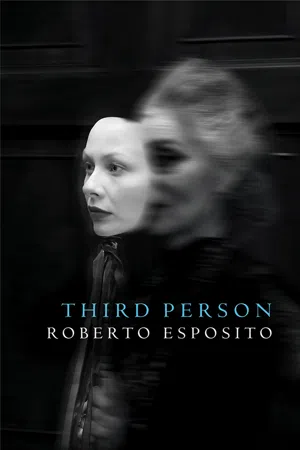
The radical and alarming thesis put forward in this book is that the notion of person is unable to bridge this gap because it is precisely what creates this breach. Its primary effect is to create a separation in both the human race and the individual between a rational, voluntary part endowed with particular value and another, purely biological part that is thrust by the first into the inferior dimension of the animal or the thing. In opposition to the performative power of the person, whose dual origins can be traced back to ancient Rome and Christianity, Esposito pursues his strikingly original and innovative philosophical inquiry by inviting reflection on the category of the impersonal: the third person, in removing itself from the exclusionary mechanism of the person, points toward the orginary unity of the living being.
- English
- ePUB (mobile friendly)
- Available on iOS & Android
eBook - ePub
The Third Person
About this book
All discourses aimed at asserting the value of human life as such—whether philosophical, ethical, or political—assume the notion of personhood as their indispensable point of departure. This is all the more true today. In bioethics, for example, Catholic and secular thinkers may disagree on what constitutes a person and its genesis, but they certainly agree on its decisive importance: human life is considered to be untouchable only when based on personhood. In the legal sphere as well the enjoyment of subjective rights continues to be increasingly linked to the qualification of personhood, which appears to be the only one capable of bridging the gap between human being and citizen, right and life, and soul and body opened up at the very origins of Western civilization.
Information
1
The Double Life The Machine of the Human Sciences
1
In the early 1800s, the concept of person – understood as a rational subject capable of self-determination in relationship with other individuals endowed with the same characteristics – was rocked by a crisis originating outside of political theory, in the field of biology. As often happens in times of paradigm shift, the impact that was crucial in creating the effects of change came from outside the discipline. Our modern political categories, for that matter, now in dispute, came into being marked by contamination with secularized theological concepts. There is a difference, however: what entered into the legal–political vocabulary then was a transcendental element; now we are talking about a material, or a substance, like life, which is immanent. What is even more symptomatic of the dialectic that occurs between the various sciences of man is that this concept of life, destined to profoundly change the political lexicon, itself had political connotations. From its earliest formulations, the notion of life investigated by the new biological knowledge was specifically defined by its absolute conflict with death. The best way to grasp the extraordinary novelty of Xavier Bichat’s work – and the reason why it met with such popularity in the first half of the nineteenth century, even by comparison to the vitalist view it is usually associated with – is by focusing on the threatening presence of death that looms over life from both inside and outside it. The classic vitalists, like Bordeu or Barthez, limited themselves to removing the living organism from the general laws of physics, and by doing so they ended up depriving it of a normative principle capable of unifying its variety of expressions within a scientifically described framework. Bichat, on the other hand, identified the specific status of the living body precisely in its active opposition to the pressure of death. When he writes, in the famous opening words of his Recherches, that “life is the totality of those functions which resist death,”1 we are meant to take this statement in the sense of a conflict without truce. In the body, life and death confront each other as opposing powers whose tendency is to outdo each other in a zero-sum game in which the advancement of one means the retreat, or breakdown, of the other: “The measure of life then, in general, is the difference which exists between the effort of external powers, and of internal resistance. The excess of the former announces its weakness; the predominance of the latter is an indication of its strength.”2
It would be difficult to find traces of a more intensely political lexicon in biological knowledge than the one adopted by Bichat at the dawn of modern physiology. As Georges Canguilhem points out, its metaphors are based on the art of war:3 action–reaction, attack–defense, and power–resistance are among the most commonly used words in a story whose topic is the survival or the extermination of bios. A definition of life can seemingly be conceived only within a semantic orbit marked by the necessity for deadly conflict: to the death and with death. The first part of the book, dedicated to a general definition of life, only takes on meaning and consistency in association with the second, which is devoted to a detailed phenomenology of the various types of death. The fact that Bichet (who died at the age of 31) during his short life opened up and examined thousands of corpses of people who had come to a violent death – people who, for the most part, were guillotined during the Terror – has a deeper significance, perhaps, than that of a mere biographical curiosity. “What is observation worth if we are ignorant of the seat of disease [mal]? Open a few bodies, this obscurity will soon disappear, which observation alone would never have been able to have dissipated.”4 More than a clinical suggestion, this famous proposition from the Anatomie générale sounds like a grand curtain sweeping the scene open onto the constitutive interweaving between death and knowledge of life. To arrive at the deepest truth about a body, medical science is forced to insinuate itself into the same cut that etched death into the body, and then redouble it. As Michel Foucault expressed it, only the clear light of death can illuminate, like a lightning flash, the dark night of life, revealing the logical and epistemological predominance of death over life.5 This predominance is exercised primarily from the outside, by the environmental forces that squeeze life into a circle it cannot break and whose fatal power it can only resist as long as its own energy remains. But then, at the same time, death also exercises its ascendancy from inside the body, where its possibility, indeed its necessity, takes seat from the moment of birth, like a tumor that grows progressively and inexorably. Rather than a clean cut that chops off the head in a single sweep, death appears as a dull murmur accompanying and silently gnawing at every moment of life, distributing itself into many little deaths, which only at a certain point join together to form one lethal event.
Into this framework of partial deaths, local entropies and continuous, unbridled mortality is also introduced the phenomenon of apparent death: a posthumous survival in which death seems to hang back and retreat before the unexpected return of life. What is its basis? What other truth does this enigmatic and disturbing phenomenon give voice to? Bichat’s answer, in many ways decisive, is that this duplication of death points to a duplication of life itself. Apparent death – death that is not absolute and in which an interval occurs between its first appearance on the scene and its final victory – is the reversed expression of the preliminary gap between life’s two modes of being. Or rather, between the two lives that make up all life: organic life, to which Bichat ascribes the vegetative functions (digestion, respiration, circulation of the blood) and animal life, which governs the motor, sensory, and intellectual activities involving relations with the outside. While organic life is closed and inward-looking, animal life is in contact with the environment, changing it and being changed by it. While no principle of symmetry is to be found in organic life – there is one heart, one stomach, one liver – animal life is organized in a symmetrical and binary fashion, as is clear from the correspondence of the eyes, ears, and arms. But the aspect that appears to capture Bichat’s attention even more, just as we saw in the relationship of death to life, is the functional and quantitative prevalence of organic life over animal life. First, in the sense that organic life continues even during sleep, while animal life is instead interrupted, resuming only when the organism wakes up again. But also, and even more, in the sense that there is organic life before birth, when the fetus experiences only a nutritive life, and at the end, with the advent of death, when organic life continues for some time after animal life has ended, as can be seen from the growth of nails and hair even after the ‘first’ death. A double death, in short, is matched by a double life, which has unequal importance not only because it is geared for different purposes, but also because it has a different intensity.6
Without stopping to look in greater detail at the clinical consequences of this difference – one that is crucial in deciding, for example, on the possibility of transplanting organs that are still alive after brain death – what really matters for our inquiry is the transversal consequence it leads to in other discourses, especially in the lexicon of political philosophy. This explains why this difference is constantly picked up by writers and texts not directly concerned with physiological research but, precisely for this reason, expressive of the significance that the life sciences have in shaping philosophy and politics. The question that gets entangled here first and foremost is the relationship between the nature of the living subject and the form of political action. This is where the disruptive effects of Bichat’s model are discharged: at this point of tangency where the categories intersect. While, as we know, the unquestioned assumption of modern political philosophy is that of subjects endowed with a rational will who, by collective choice, establish a certain political order, the physiological principle of a ‘double life,’ naturally in a form external to the intentions of its author, creates a significant shift in perspective. If we take the position of Hobbes as a reference point, the criterion of the founding break between the natural state and the political state is called into question, as is the logical path that leads to the covenant, and thus to the establishment of order. Not only because life can never break its biological link with nature, but because life itself is ‘decided’ [‘decisa’], or cut off7 from a distinction prior to any other decision and destined to weigh heavily on it. If the passions, for example – which Hobbes had placed at the origin of the civil choice – derive from organic life and not from animal life, as Bichat clearly claims, no acts based on them can any longer be attributed to rational motivations. Not only that, but, strictly speaking, a political subject does not even exist as a source of voluntary action, because the will, although linked to animal life, is deeply innervated in a bodily system that is sustained and to a large extent governed by its vegetative part. This alone – far beyond the intentions of Bichat, as we said earlier – opens up an avenue, by itself disruptive to modern conceptual language, which leads toward a radical desubjectivization of human praxis. What begins to break down, or at least become unrecognizable in its canonical formulation, is the very idea of the person, understood as a site of legal and political imputation. With its classic prerogatives already under attack from the overwhelming pressure of death, the person now appears further decentralized by being split into two overlapping – or underlapping – zones that preclude any unified image for it. Divided into a ‘life inside’ and a ‘life outside,’ into a vegetal life and an animal life, the person is traversed by a power that is foreign to it, which shapes its instincts, emotions, and desires into a form that can no longer be ascribed to a single element. It is as if a non-human – something different from and earlier than animal nature itself – had taken up residence in the human being; or as if it had always been there, with dissolutive effects on the personal modality of this being. From this moment on, the role of politics – now inevitably biopolitics – will no longer be to define the relationship between human beings as much as to identify the precise point at which the frontier is located between what is human and what, inside the human itself, is other than human.
2
The deconstruction of the subject that Bichat carried out in the world of biology had a profound effect on philosophy, most notably on the work of Schopenhauer. True, other thinkers starting with Hegel had explicitly referred to the author of the Recherches. But, for them, Bichat remained an external relation. For Schopenhauer, the relation became so entirely intrinsic that it took the form of an out-and-out identification with “this distinguished man who was snatched from the world at so early an age,” the author of “one of the most profoundly conceived works in the whole of French literature.”8 The opposition between organic life and animal life, which Schopenhauer ascribes to his own opposition between will and intellect, lies at the heart of this identification. If Bichat seems to ascribe the will to animal life, this must not be misinterpreted, says Schopenhauer, cautioning the reader against an insufficiently radical reading of the Recherches. What Bichat is speaking about, he explains, is conscious free choice: deliberation and estimation of the motives, whose product appears as an act of will; not true desire, which is blind and opaque and exclusively ascribable to organic life. Once this switch in terminology is made clear, Schopenhauer is convinced that their work corresponds perfectly: “His reflections and mine mutually support each other, since his are the physiological commentary on mine, and mine the philosophical commentary on his; and we shall best be understood by being read side by side.”9 There are essentially two topical loci in this full-blown convergence, and they are interconnected within a single discursive frame. First, the passions are part of the vegetative life, the same one that the sphere of the will belongs to. Second, as a consequence, the moral character is immutable: since it is rooted in the organic layer of the living being, it cannot be altered by education or by the external environment. The conclusion that Schopenhauer draws from this is a forceful rejection of the Cartesian thesis – relaunched not long before, first by Franz Joseph Gall and later by Jean-Marie Pierre Flourens – according to which acts of will are equivalent to thoughts. The unity of life – in full harmony with the perspective opened up by Bichat – is no longer broken down by the old dualism between body and soul, but by the biological difference between an organic type of “life within” and a relational “life outside.”
It would be hard to imagine a more violent blow to the consciousness-based tradition of modern t...
Table of contents
- Cover
- Table of Contents
- Title
- Copyright
- Introduction
- 1 The Double Life The Machine of the Human Sciences
- 2 Person, Human, Thing
- 3 Third Person
- Notes
- Index
- End User License Agreement
Trusted by 375,005 students
Access to over 1.5 million titles for a fair monthly price.
Study more efficiently using our study tools.
Frequently asked questions
Yes, you can cancel anytime from the Subscription tab in your account settings on the Perlego website. Your subscription will stay active until the end of your current billing period. Learn how to cancel your subscription
No, books cannot be downloaded as external files, such as PDFs, for use outside of Perlego. However, you can download books within the Perlego app for offline reading on mobile or tablet. Learn how to download books offline
Perlego offers two plans: Essential and Complete
- Essential is ideal for learners and professionals who enjoy exploring a wide range of subjects. Access the Essential Library with 800,000+ trusted titles and best-sellers across business, personal growth, and the humanities. Includes unlimited reading time and Standard Read Aloud voice.
- Complete: Perfect for advanced learners and researchers needing full, unrestricted access. Unlock 1.5M+ books across hundreds of subjects, including academic and specialized titles. The Complete Plan also includes advanced features like Premium Read Aloud and Research Assistant.
We are an online textbook subscription service, where you can get access to an entire online library for less than the price of a single book per month. With over 1.5 million books across 990+ topics, we’ve got you covered! Learn about our mission
Look out for the read-aloud symbol on your next book to see if you can listen to it. The read-aloud tool reads text aloud for you, highlighting the text as it is being read. You can pause it, speed it up and slow it down. Learn more about Read Aloud
Yes! You can use the Perlego app on both iOS and Android devices to read anytime, anywhere — even offline. Perfect for commutes or when you’re on the go.
Please note we cannot support devices running on iOS 13 and Android 7 or earlier. Learn more about using the app
Please note we cannot support devices running on iOS 13 and Android 7 or earlier. Learn more about using the app
Yes, you can access The Third Person by Roberto Esposito in PDF and/or ePUB format, as well as other popular books in Philosophy & Philosophy History & Theory. We have over 1.5 million books available in our catalogue for you to explore.