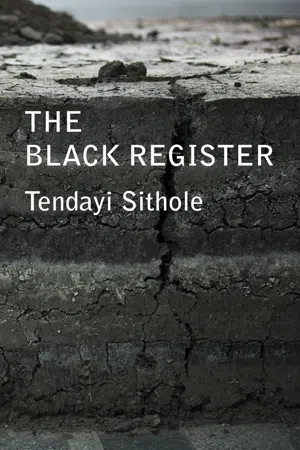
How can thinkers grapple with the question of the human when they have been dehumanized? How can black thinkers confront and make sense of a world structured by antiblackness, a world that militates against the very existence of blacks?
These are the questions that guide Tendayi Sithole's brilliant analyses of the work of Sylvia Wynter, Aimé Césaire, Steve Biko, Assata Shakur, George Jackson, Mabogo P. More, and a critique of Giorgio Agamben. Through his careful interrogation of their writings Sithole shows how the black register represents a uniquely critical perspective from which to confront worlds that are systematically structured to dehumanize. The black register is the ways of thinking, knowing and doing that emerge from existential struggles against antiblackness and that dwell in the lived experience of being black in an antiblack world. The black register is the force of critique that comes from thinkers who are dehumanized, and who in turn question, define, and analyze the reality that they are in, in order to reframe it and unmask the forces that inform subjection.
This book redefines the arc of critical black thought over the last seventy-five years and it will be an indispensable text for anyone concerned with the deep and enduring ways in which race structures our world and our thought.
- English
- ePUB (mobile friendly)
- Available on iOS & Android
eBook - ePub
The Black Register
About this book
Information
1
Sylvia Wynter: Contra Imperial Man
The modern colonial world cannot be divorced from the processes that brought the human into being. This also includes the reversal of such processes through the logic of dehumanization. The manner in which humanity assumes its place in the modern colonial world signifies the excess of difference and this is not natural or a given phenomenon by the creation of the human and the non-human. To account for the human or to install such an ontological category in the modern colonial world is to encounter that which is not human. This creation comes out of the fabrication of being that the human is itself, for-itself, and in-itself. For it is the logic that sees the human as a given and not linked to the processes of social formation. Indeed, this has instilled the fallacy that the individual is prior to sociality and the human is a transcendental subject who can also be said to be separate from the embodiment of being and its relationality to the world. This is the subject positionality of the Imperial Man – the figure of the human who is both last and foremost human against all others who are different and who are solely non-human.
The modern colonial world produces the human through difference precisely because its logic of racism is the one that dehumanizes what it differentiates. It is the infrastructure of racism that enforces the classification, demarcation, location, hierarchization, and zoning of the human. This, of course, is done in the pure logic of difference. To facilitate dehumanization and give it some moral relief, justification of difference is nothing but the mask of dehumanization itself. In the greater scheme of things, Sylvia Wynter is the important figure to engage the human question in the manner in which the making of the modern colonial world is revealed and such a world unfolds in its mutations while affirming its position in maintaining the ontological distinction of superiority and inferiority. Wynter confronts the modern colonial world by unmasking its legitimation of ontological distinction and showing its installation of Man – the figure of the human who is human against the rest of those different from it and the ways in which the figure of Man is that of Imperial Man. Just because there is a different ontological standing that claims superiority, Wynter assumes the solidity of her marginalized, violated, exploited, alienated, and dehumanized blackness as a site of subjectivity. The signature of being in the ontologico-existential struggle – Wynter’s “yours in struggle” – is to show her contra positionality to the Imperial Man and the supposition that her political commitment is that of continuity and not temporality.
Wynter’s work is not only a declaration of intent; it is a call for the unmaking of the colonial world. As such, it is the work of the political and its subjectivity that is informed by confrontation of dehumanization and a move to the creation of the human. There is, so to say, no human in the modern colonial world, but the Imperial Man with his phallic power and those whom he dehumanizes. For Wynter, the epistemic shift of studying the human condition from the existential point of damnation and being in contradiction with the Imperial Man is to assume a clear stance of the rebel. Not only does she differ for the sake of differing, she also demystifies that superiority of the Imperial Man. This is fundamental, since the figure of the human is not that which is created by the Imperial Man, but the human – After Man – the creation of the human in the world comes into being through ontologico-existential struggle. What does it mean to then think the human differently from the dehumanized position and to be contrary to the Imperial Man? This does not pertain only to thinking the human differently, but to be in confrontation and not in the terms that the hegemonic Imperial Man dictates in his epistemic strictures. What Wynter’s meditations keep on harking back to is the figure of the human contra Imperial Man which leads to the unmaking of the modern colonial world.
The Imperial Man
The Imperial Man is an individual, the subject of self-definition and self-justification. He does not claim or emphasize this standpoint because he is the embodiment of the world. If everything in human history is to be narrated, it should be done through the triumph and pageantry of the Imperial Man. Weheliye (2008, 323) also adds that the Imperial Man is the one “who could define himself as the universal human.” This is the imposition of the disembodied embodiment, the very configuration of blackness as that which is defiled, making it nothing that exists. In this case, human history is thus mono-narrative and overly totalizing as it cannot be something outside the Imperial Man. Wynter (1995) highlights the historical event of 1492, which marks the conquest of the Americas as the kick-starting of the Imperial Man’s overrepresentation in the making of the modern colonial world and the continuity of its aftermath. Wynter has been at the receiving end of events resulting from 1492, as the other in the colonial-centric historico-existential experience. It is this era that attests to the logic of voyages of discovery having led to the inauguration of the unmaking of the world. It is in this configuration that the modern colonial world is in favor of the Imperial Man, which in turn is the very opposite when it comes to those who are located at the existential abyss.
In point of fact, the racialized, colonized, criminalized, exploited, subjected, and more acutely, blackened subject, is the sole creation of the Imperial Man. This then allows such a subject to be the target of and vulnerable to dispossession, oppression, and dehumanization. This subject is, in the eyes of the Imperial Man, the negative of the human. Wynter, by standing in opposition to the Imperial Man, clearly shows how standing on the side of liberatory politics that are destined to bring about the end of the Imperial Man is an indomitable task that requires politics of commitment. This form of politics is met with fierce resistance by virtue of its contradictory positionality against the Imperial Man. Wynter destabilizes the foundations of the modern colonial world and pathos and logos which privilege the Imperial Man. Maldonado-Torres (2007, 190) writes: “Instability is often met with force of edicts, rules, regressive propositions, reforms, imprisonment, or even bullets.” Wynter assumes the positionality of being near to death, for she is the blackened subject who stands contra Imperial Man.
The contra positionality – the politics of liberatory oppositionality and affirmation so to say – articulates the pain and agony of being black, even while that pain is denied. It is to act against the very co-optation and to refuse to be consumed by the Imperial Man. To be consumed is to be rendered complicit and to have nothing to do with liberatory politics. Wynter stands in the contra positionality which Maldonado-Torres refers to as the “grammar of dissent.” This grammar does not bow to the subjection of the Imperial Man in his structures of modernity and its attended eclipse of political imagination. What informs Wynter’s instability is not chaos for its own sake, but rather the terrain of the practice of liberatory politics of the very form of the livelihood of the blackened subject.
The subject formation of the Imperial Man is the self as complete. It is the self as a conqueror which, as Maldonado-Torres (2007, 245) notes, provides “a solid foundation of the self.” The expansionist logic is what informs the Imperial Man; the beginning of history and its aftermath are those of the Imperial Man. Nothing has been there before the Imperial Man, and if there are lands that happened to be expropriated, they are regarded as empty lands without people; not only that there were no people – there have never been any people before and even after the conquest. More crudely, their ontological superfluity and invisibility mean that everything begins and ends with the Imperial Man. The Imperial Man, as Ferreira da Silva (2015, 91) amplifies, “rules as the transcendental-empirical king.” To be such is to be an oversized figure which is ontologically created by projects that reify dehumanization since the operating logic is to exercise lordship as a form of dehumanization.
This then leaves the way for the Imperial Man to question the humanity of the colonized where the Imperial Man claims superiority while inferiorizing others. The ego-politics of the Imperial Man inaugurates, as Wynter (1989, 640) argues, “the Self of Man and its instituted mode of subjectivity/subject, conceptualized as a selected being and purely natural organism.” The Imperial Man is not defined, he defines himself and he has the absolute right to define others to the point of defiling them. The Imperial Man’s power of definition also determines who lives and who dies. The life of the black is wholly dependent on the will of the Imperial Man.
This man, who depends as everyone else does on the social world for his being, sees himself as independent of it precisely because he expects it as conditioned by him and for him … His model becomes, in a word, himself, which issues the realm of a contradictory solipsism – the self as world by virtue of a denial of others without whom the self could not have been posited in the first place. It is this inhabitation that constitutes an obstacle to the emergence of the human.
(Gordon 2006, 248 [emphasis original])
The Imperial Man is against sociality, and even the holistic constitution of humanity. For the Imperial Man, there are no humans outside himself. That is why fixity of difference is the key ontological marker. It is important to consider difference in terms of those who are here and those who are out there. To be here means to be in the realm of life and to be out there is to be in the shadow of death. It is to be violated in such an extreme form that to be out there is to be a non-entity. The Imperial Man does not see the conciliation of the here and out there since difference is vital. As such, to maintain ontological purity, which is merely a narcissistic attachment, is to claim that those who are out there will contaminate the ontological purity of those who are here. That is why, as Gordon notes, the imposition of the genuine world poses a threat to the Imperial Man. This imposition is necessary to end those who are here and those who are out there.
To affirm his existence, the Imperial Man imposes himself as God over those he seeks to dominate or already dominates. The role of claiming to be God comes through the excess of self-definition. The Imperial Man knows very well that he is not God, but he makes an institutionalized, naturalized, and normalized subjection – the demand to want to be regarded as superior by those whom he oppresses. If the Imperial Man claims to be God, tacitly or not, the logic of difference will be reinforced to see Man qua Man as one ontological dimension and the Imperial Man commanding lordship over the rest of organisms and species. Indeed, the projection of God by the Imperial Man is simply a distortion of himself.
The one under the sight and control of Imperial Man is forced to live in conditions where her and his worth augments in direct relation to her and his self-evisceration, that is, to the devaluation of her or his own body, identity, and culture. Since Imperial Man structurally and semiotically functions as God, the holy call to imitate God becomes an explicit act of violation.
(Maldonado-Torres 2008, 114)
The Imperial Man, as Wynters insists, is not God, let alone his representative. It is in Wynter’s work that the challenging of the orthodox occurs in how the politics of representation are used and always skewed in favor of the Imperial Man. In the same way, to say the least, this orthodoxy is “a theocentric view of the relation between God and man” (Wynter 1991, 255 [emphasis original]). It is this view which is embedded in hierarchization and also the claim of having proximity to God, if not being God. Indeed, the justification of the Imperial Man of being closer to God or being God is the fact that the Imperial Man justifies his existence as unquestionable. In simple terms, the Imperial Man is closer to God or is God himself by virtue of being the Imperial Man – the being above all beings – reason, standards, and morality being some of the currencies that border on the omnipotence. This then leaves the infrastructure of violence to be the figure of the arbitrary; the Imperial Man has unlimited excess of lordship over those whom he marks as inferior, if not non-human. It is Cartesian logic to be a transcendental subject while those who are inferiorized and dehumanized cannot be transcendental, let alone subjects of the human. It is only the Imperial Man who is the human, and who assumes the ontological category of Man as Wynter shows. The ontological cancellation of those the Imperial Man inferiorizes and dehumanizes is nothing but the eschatological escalation (in fallacious terms, of course) to create its other. The Imperial Man produces certain forms of humanity which are hierarchized into superiority and inferiority. These form the existential composition of the world – the modern colonial world – where in the logic of difference the Imperial Man determines the fate of humanity as being superior or inferior. The condemnation of other humans to inferiority means that they have no existence and it cannot be justified. Therefore, their existence, being insistently a hellish one, inaugurates subjection as the exercise form of human relations.
It is, from Wynter’s standpoint, that the Imperial Man is confronted directly and his claims to invention being nothing that make him come closer to creation. To claim what rightfully belongs to God to himself, the Imperial Man creates the impression of being the master of the world and all the species and things on earth should be subjected to his lordship. Placing the Imperial Man in a different positionality allows for Wynter’s contradiction. This means that there is no pre-existing or given – that is, it is there by virtue of being there as if there are no existential formations. This claim is falsified by Wynter, who shows that the Imperial Man is the product of invention and this is tidily closed to forms of existence that take prevalence in the modern colonial world. The production of the racist infrastructure which condemns those who are racialized is systematic, systemic, and continuous subjection. Wynter’s opposition rests on black subjectivity which is informed by the clear task of unmasking the deceit of the Imperial Man. To think from Wynter’s standpoint is to be in direct oppositio...
Table of contents
- Cover
- Contents
- Series title
- Title page
- Copyright page
- Dedication
- Acknowledgments
- Foreword by Fred Moten
- Introduction: The Black Register
- 1. Sylvia Wynter: Contra Imperial Man
- 2. Aimé Césaire and the Scandal of the Human
- 3. Steve Biko as the Figure of the Outlawed
- 4. The Prison Slave Narrative: Assata Shakur and George Jackson’s Captive Flesh
- 5. For Mabogo P. More: A Meditation
- 6. Marikana: The Conceptual Anxiety of Bare Life
- Conclusion: On the Reconfiguration of the Subject
- References
- Index
- End User License Agreement
Trusted by 375,005 students
Access to over 1.5 million titles for a fair monthly price.
Study more efficiently using our study tools.
Frequently asked questions
Yes, you can cancel anytime from the Subscription tab in your account settings on the Perlego website. Your subscription will stay active until the end of your current billing period. Learn how to cancel your subscription
No, books cannot be downloaded as external files, such as PDFs, for use outside of Perlego. However, you can download books within the Perlego app for offline reading on mobile or tablet. Learn how to download books offline
Perlego offers two plans: Essential and Complete
- Essential is ideal for learners and professionals who enjoy exploring a wide range of subjects. Access the Essential Library with 800,000+ trusted titles and best-sellers across business, personal growth, and the humanities. Includes unlimited reading time and Standard Read Aloud voice.
- Complete: Perfect for advanced learners and researchers needing full, unrestricted access. Unlock 1.5M+ books across hundreds of subjects, including academic and specialized titles. The Complete Plan also includes advanced features like Premium Read Aloud and Research Assistant.
We are an online textbook subscription service, where you can get access to an entire online library for less than the price of a single book per month. With over 1.5 million books across 990+ topics, we’ve got you covered! Learn about our mission
Look out for the read-aloud symbol on your next book to see if you can listen to it. The read-aloud tool reads text aloud for you, highlighting the text as it is being read. You can pause it, speed it up and slow it down. Learn more about Read Aloud
Yes! You can use the Perlego app on both iOS and Android devices to read anytime, anywhere — even offline. Perfect for commutes or when you’re on the go.
Please note we cannot support devices running on iOS 13 and Android 7 or earlier. Learn more about using the app
Please note we cannot support devices running on iOS 13 and Android 7 or earlier. Learn more about using the app
Yes, you can access The Black Register by Tendayi Sithole in PDF and/or ePUB format, as well as other popular books in Literature & Literary Criticism Theory. We have over 1.5 million books available in our catalogue for you to explore.