The triumph of technological rationality and of the sciences as a whole has by no means provided answers to humanity's great questions. Instead, it has raised new and old questions and problems. To orient ourselves in the twenty-first century, we must take a new look at the central categories of philosophy that, often unbeknownst to us, continue to shape our everyday thinking.
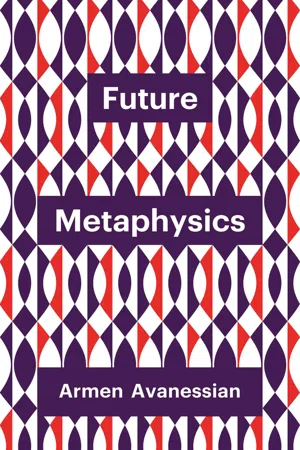
Future Metaphysics is an attempt at restating the importance of the great metaphysical categories for the present: how our contemporary predicament forces us both to reclaim them and to give them a radically new twist. Armen Avanessian re-examines and displaces categories like substance and accident, form and matter, life and death, giving them an unexpected twist. What if the idea of accident, for instance, had to take into account the many new kinds of glitches, crashes and crises – from finance to ecology, from technological catastrophes to social collapses – that permeate our culture and make everyday news? Can we keep on using this concept as it was traditionally meant to be used when risk and chance have become part of the very substance of our world, so rendering the distinction between substance and accident meaningless? The other concepts and distinctions require a similar interrogation, giving birth to a new metaphysical landscape, where the most urgent realities of the twenty-first century impinge on the most fundamental categories of thought.
- English
- ePUB (mobile friendly)
- Available on iOS & Android
eBook - ePub
Future Metaphysics
About this book
Information
Introduction: Metaphysics
Origin of man now proved. – Metaphysics must flourish. –He who understands baboon would do more towards metaphysics than Locke.Charles Darwin
BAD TIMES, BUT GOOD TIMES FOR METAPHYSICS – Our society is suffering at every level from overwhelming challenges and crises of meaning that we have forgotten to conceive as metaphysical. The leaps in technology or advances in physics and other natural sciences that once sallied forth to alleviate or even liberate us entirely from our earthly problems are not necessarily of any further help to us. To the contrary, we are increasingly confronted by collateral damage from modernity’s technological revolutions (climate change, for example) that threatens the life forms of our planet – humanity included – and thus more than ever raises questions which cannot be approached empirically.
Even where the triumphs of modern science have indisputably led to improvements in the quality of life and longer lives overall, ever increasing life expectancies and the transhumanist fantasy of unending life give rise to new metaphysical questions on a par with those concerning the possible disappearance of our species. To put it dramatically, whether eternal life is imminent or the human race as a whole is at risk of going extinct in what has pointedly been dubbed the “Anthropocene” age – a world dominated by transhuman “Homo” sapiens and a world without humans both confront us to an unprecedented degree with metaphysical problems.
RETIRING THE ANIMAL LABORANS – Human beings are natural-born philosophers. To be human, Martin Heidegger once wrote to his mistress Elisabeth Blochmann, is to philosophize, and the philosophical tradition is filled with definitions of man as an animal metaphysicum and animal rationale. This metaphysical and rational animal is also a working animal, an animal laborans. And indeed, philosophers, no less than sociologists and economists (revolutionary as well as bourgeois), have traditionally agreed that man may be defined through his labor as Homo faber.
With the establishment of modern capitalism beginning in the sixteenth century, and industrialization in the eighteenth century, the lives of most working- and middle-class people (at first primarily men) came to be defined, and their conceptions of themselves shaped, by their occupation and employment. Today, however, the notion that an occupation lends human life internal stability (Helmut Schelsky) is at best only partly true. It is rather much more a major source of bourgeois insecurity, not least because the boundaries between work and non-work have become fluid. According to the sociologist and renowned expert on risk Ulrich Beck, the system of standardized full employment – familiar only since the latter half of the twentieth century, and often assumed to be the normal condition of liberal capitalist societies – “is beginning to soften and fray at the margins into flexibilizations of its three supporting pillars: labor law, work site, and working hours.”1 The animal laborans is thus becoming problematic in an entirely new way, regardless of whether we are talking about physical or intellectual labor (if such a distinction – itself metaphysical – were still at all appropriate).
ON HEAVEN AND EARTH – Disparaging or pitying remarks about philosophers being out of touch with the world are as old as philosophy itself, dating back at least to the sixth century BCE, when a Thracian maiden famously mocked Thales of Miletus for falling into a well while gazing up at the sky. A well-worn prejudice has it that metaphysics stands in direct contradiction to reality, making it a hopelessly obsolete or old-fashioned way of thinking. Metaphysical thought’s dubious reputation can also be seen in the negative connotations that the word “speculation” has taken on over time. Particularly since the advent of modernity two centuries ago, it has often been employed as a purely pejorative term: “mere speculation” in the sense of baseless ratiocination untethered from reality.
Books on the history of modern philosophy report a turn away from naive belief in philosophy’s ability to come to grips with matters directly and toward an epistemology that precedes all established knowledge. Philosophy’s metaphysical or speculative energies have never truly abated, however, not least because metaphysical questions always have historical connotations and thus continually reemerge as we grapple with currently prevailing sciences and technologies. Perhaps philosophy’s speculative energies always experience an upsurge anytime there is a technological revolution. The first Ionian and Greek cosmologies and natural philosophies elaborated by Anaximenes, Anaximander, and Thales would then also be responses to the acquisition of writing, the settling down of Homo sapiens, and the accompanying transition to agriculture.
Thales, for example, according to a less widely circulated anecdote, is supposed to have come into his wealth as a direct result of his knowledge of astronomy, which allowed him to predict the yield of olive harvests. The rise of modern philosophy likewise cannot be separated from the invention of the printing press, nor the emergence of new speculative approaches today, from the need to respond to digitalization, which – as is becoming ever clearer, although it only began a few decades ago – is radically transforming our society.
MANDATORY MEMBERSHIP IN A CLUB NO ONE WANTS TO BELONG TO – If we look at the modern history of metaphysics, particularly that of the last few centuries, we notice a tendency among philosophers to toil away at what they believe to be unresolved metaphysical questions in the work of their predecessors. The “crusher of everything” Immanuel Kant did this with the skeptic David Hume; the pessimist Arthur Schopenhauer with Kant; the self-proclaimed “transvaluer of all values” Friedrich Nietzsche with Schopenhauer; Martin Heidegger with Nietzsche’s frantic efforts to turn the history of metaphysics upside down by taking recourse back to pre-Socratic philosophies; Jacques Derrida with Heidegger, with the insight that metaphysics ultimately cannot be overcome …
At the same time, of course, we can also observe historical shifts that shed light on the changes in meaning of what various epochs have understood as metaphysics. In the early modern period, with the renaissance of philosophy in the sixteenth century, we see increasingly sharp critiques from humanists such as Rabelais, Montaigne, and Erasmus against university philosophers, whom they considered to be irrelevant and out of touch with or even hostile to life (since which time words like “academic,” “scholastic,” and “metaphysics” have often had a negative ring to them).
In parallel with this, the orientation of those philosophers who dedicated themselves to metaphysics also changed in terms of content. Indeed, the rationalists of the seventeenth and eighteenth centuries (e.g. Descartes, Spinoza, and Leibniz) covered a far greater range of topics than did, say, the theologians of the Middle Ages. Metaphysicians now occupied themselves not only with eternal being, the highest substance, or God, but also with a host of related questions: man’s relation to God, the essence of the mortal or immortal soul, the connection between body and mind, the problem of the possibility or impossibility of free will in sensual beings, etc. Put bluntly, all those questions that could not easily be assigned to another philosophical discipline such as logic, epistemology, or ethics were henceforth deemed to be metaphysical. It is no coincidence that this same period gave birth to “ontology,” that discipline which deals with questions of being, existence, or substance, what for centuries prior had been considered the true object of metaphysics.
WHAT WE TALK ABOUT WHEN WE’RE NOT SURE WHAT WE’RE TALKING ABOUT – The self-critical reorientation and reinvention of metaphysics in modernity also correlates with an essential change – in the full meaning of that word – in what metaphysics previously had dealt with, namely, an immutable, everlasting, substantial, divine essence or the true being or nature of all that which exists. As physics and other increasingly “empirical” and natural sciences dedicated themselves to this nature, submitting physis to their categorizing grip, the branch of philosophical thought called meta-physics naturally had to reorient itself. Owing to its high degree of abstraction, not even the rationalistic realignment of philosophy ushered in by Descartes was immune to renewed criticism by empiricist thinkers such as Hobbes, Hume, and Berkeley. These critiques were joined in the eighteenth century by skeptical positions that posited the impossibility of metaphysics or even went so far as to deny that it had any right or reason to exist. Its questions were somewhere between unanswerable (according to milder skeptics) and meaningless (according to more radical critics); in any case, there was no point in getting oneself mixed up in metaphysical adventures or the adventure of metaphysics.
A fundamental difficulty in defining metaphysics certainly lies in the fact that there is no prevailing consensus as to its object. Does it even have an object, in the way that biology explores life or economics the field of the economy? Aristotle’s definition of the object of metaphysics as the highest of all things had long-lasting repercussions (extending well beyond medieval philosophy). Unlike other philosophical disciplines, such as ethics or logic, he asserted, metaphysics was concerned with the divine, the prime mover (itself unmoved), or, in less theological terms, with (immutable) being as such, the substance underlying everything, or with purely logical principles such as the law of identity (A=A).
If conversely, however, as Alexander Gottlieb Baumgarten postulated in the mid eighteenth century, metaphysica est scientia prima cognitionis humanae principia continens: i.e. if metaphysics is that science which contains the first principles of human knowledge, then does it still have a timeless object at all, beyond things that can be known? Or does it now only occupy itself narcissistically with human knowledge itself? Like Buster Keaton at the end of Samuel Beckett’s Film, finally free of all pursuers and ou...
Table of contents
- Cover
- Front Matter
- Introduction: Metaphysics
- Changing Times
- Speculation
- Index
- End User License Agreement
Trusted by 375,005 students
Access to over 1.5 million titles for a fair monthly price.
Study more efficiently using our study tools.
Frequently asked questions
Yes, you can cancel anytime from the Subscription tab in your account settings on the Perlego website. Your subscription will stay active until the end of your current billing period. Learn how to cancel your subscription
No, books cannot be downloaded as external files, such as PDFs, for use outside of Perlego. However, you can download books within the Perlego app for offline reading on mobile or tablet. Learn how to download books offline
Perlego offers two plans: Essential and Complete
- Essential is ideal for learners and professionals who enjoy exploring a wide range of subjects. Access the Essential Library with 800,000+ trusted titles and best-sellers across business, personal growth, and the humanities. Includes unlimited reading time and Standard Read Aloud voice.
- Complete: Perfect for advanced learners and researchers needing full, unrestricted access. Unlock 1.5M+ books across hundreds of subjects, including academic and specialized titles. The Complete Plan also includes advanced features like Premium Read Aloud and Research Assistant.
We are an online textbook subscription service, where you can get access to an entire online library for less than the price of a single book per month. With over 1.5 million books across 990+ topics, we’ve got you covered! Learn about our mission
Look out for the read-aloud symbol on your next book to see if you can listen to it. The read-aloud tool reads text aloud for you, highlighting the text as it is being read. You can pause it, speed it up and slow it down. Learn more about Read Aloud
Yes! You can use the Perlego app on both iOS and Android devices to read anytime, anywhere — even offline. Perfect for commutes or when you’re on the go.
Please note we cannot support devices running on iOS 13 and Android 7 or earlier. Learn more about using the app
Please note we cannot support devices running on iOS 13 and Android 7 or earlier. Learn more about using the app
Yes, you can access Future Metaphysics by Armen Avanessian, James C. Wagner,James Wagner in PDF and/or ePUB format, as well as other popular books in Philosophy & Philosophical Metaphysics. We have over 1.5 million books available in our catalogue for you to explore.