With a foreword by Lee Child.
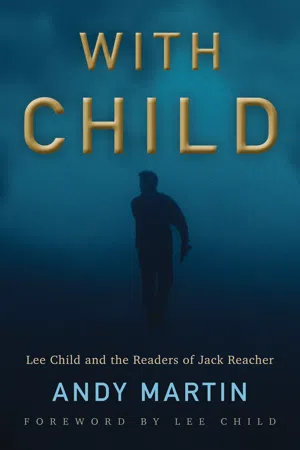
Andy Martin spent a year in the company of Lee Child, creator of tough-guy hero Jack Reacher. With Child is the diary of their adventures, tracking the publication and reception of Make Me, the writing of Night School at an apartment in Manhattan, the filming of Never Go Back in New Orleans, all the agony and ecstasy of the creative process and the sheer hard work of selling a bestseller. They go on the road together, from TV studios to bookstores, from Harvard to Stockholm, amid literary conferences and gunshows, rivalries and reviews ranging from adulatory to murderous. We meet fellow writers like Stephen King and David Lagercrantz and Karin Slaughter, and dissect the latest novel from Jonathan Franzen.
But Martin also reaches out to Child's legion of readers in America and around the world. He tracks down a woman in Texas whose name appears in the home invasion scene in Make Me; he goes up a mountain in Montana in search of the only reader who thinks Reacher is a "lightweight"; and he talks to obsessive fans from Europe to South Africa who find salvation or consolation in the colossal form of Jack Reacher.
This compelling account of life on the road with Lee Child demonstrates that readers are just as important as writers in the making of modern fiction.
- English
- ePUB (mobile friendly)
- Available on iOS & Android
eBook - ePub
About this book
Information
FALL
1
THE GORGEOUS FEELING
It begins (whatever it is). Or it should do. 1 September 2015. New York. Twenty-one years to the day since he went out to buy the paper and the pencil he would use to write Killing Floor, his first Jack Reacher novel. Twenty novels later, it is time to begin the twenty-first, the successor to Make Me. 1 September: a date he cannot miss. Kick-off. Ignition. Genesis.
It is a ritual with him: a superstition, a good luck charm. So long as he starts a new book on the first day of September he knows that, infallibly and inevitably, he will complete it, some time around April, May at the outside, in the following year. It was a completely reliable system, like a chronometer, keeping the ship steady and heading in the right general direction rather than falling off the edge of the world. All he had to do was sit down at his desk in his office in his eleventh-floor apartment on Central Park West and switch on his computer and type. Pausing only to light another cigarette. ‘It’s not rocket science,’ he would say. ‘It’s not curing cancer.’ Writer’s block was pure myth. He had nothing in his head, almost nothing, but something would come to him. It always did.
So long as he got going on 1 September. It was in the diary. What could go wrong?
Of course he had to have his traditional summer break, recharge the old batteries, hang with the family. He had spent a couple of weeks on a ship cruising around Norway; he loved all those fjords, and the bright sun at sea-level and then the snowcapped mountains right above. Crisp and clean. Cut off, remote from the world, no wi-fi. He was off the grid again, on the loose, roaming free, almost like Reacher. (Albeit with more stylish kit – and Reacher on a ship …? One way or another he’d probably have to sink it, after locking antlers with the captain, in reality a drug smuggler or people trafficker, and the second-in-command, and the third … .)
As he looked up into those mountains – not so high after all, eminently climbable – and visualized himself up there, looking back at the ship a couple of thousand feet below, and peering out over the abyss, he couldn’t help but recall the idea, which a friend had put to him in the Union Square Café, one year before, and that had fallen on fertile ground and grown and blossomed into Make Me, that when the time came for oblivion, all you had to do was climb up a mountain (did he say in Austria, specifically? or Switzerland? surely Norway would do – a couple of thousand feet would still kill you, it didn’t have to be the north face of the Eiger) and fling yourself off, sailing down down into the void. A seductive idea, but he’d never given his friend’s specific plan much credence.
All that climbing, the pure air, the ruggedly beautiful landscape below: you’d want to live! You’d never finish yourself off that way, unless you just accidentally fell off, exhausted by all the unaccustomed exercise. But the principle was sound enough: to choose one’s own fate. With complete clarity of mind. And he knew the perfect little veterinary store down Mexico way with a more than adequate supply of horse tranquillizer, when the time was right. Pity about catalytic converters. Back in the day all you needed was a car exhaust and a hosepipe and it was off to dreamland. He loved the whiff of benzene.
But that time was not yet. There was at least one more novel to write. It said so in his three-book contract and he didn’t want to let anyone down. Anyway, he could feel one coming on, even though he had no clear idea, no plot, and no title. That was the way he liked it. Inspiration would come, at the right time, in the right place. He didn’t want to have to think about it too hard, in advance. Far better to relax and forget about it and let it happen. Just cruise … on the cruise. He barely left his deckchair (got more reading done that way). An occasional lap of the deck – enough exercise and fresh air! Feet up again.
Back to Winston Churchill. The Grand Alliance, volume III of his history of the Second World War. The Brits declared war on Japan faster than the Americans. Churchill only had to go through the cabinet; Roosevelt had to check it was OK with Congress. The British Prime Minister sent his letter to the Japanese ambassador, declaring war, the day after Pearl Harbor. Signed off with,
I have the honour to be, with high consideration,Sir,Your obedient servant,Winston S. Churchill
‘Some people did not like this ceremonial style,’ he added in the history. ‘But after all when you have to kill a man it costs nothing to be polite.’ Reacher had a line just like that in A Wanted Man (Reacher 17). You don’t have to be rude. Just do it. After you, No, after you, and then … pow! The courteous killer. The executioner’s etiquette. A gorilla with manners. He liked that, jotted the Churchill down on a scrap of paper and tucked it in his wallet. You never know when these things might come in handy. 90% of writing was reading anyway.
His muse had never been known to let him down before. She wouldn’t this time either – always providing, of course, that he had it all lined up, everything in place, for 1 September. He had the flight booked for Monday morning, 31 August. From London. Not too early. But back to New York just a few hours later. Jet lag minimal. Down to it by the crack of noon the next day (coffee on, Camels out).
Got to London City Airport in plenty of time. So convenient. A brief pause at Shannon, on the west coast of Ireland, to refuel. Settled himself comfortably into his business-class seat, stretched out his long legs. (First-class? No thanks; they never left you alone for five minutes, ‘Another glass of champagne, sir?’ It was too much.) Felt sublimely, blissfully, confident. He’d had enough vacation, enough fjords, it was time to get down to business again. Reacher-time. And talking of time (he pulled out his phone and checked, he didn’t have quite the same chronological omniscience as Reacher), wasn’t this plane kind of late to take off?
2
THE DEARTH OF THE AUTHOR
I was barely on to my second cup of coffee that morning when I picked up the Leemail. By his standards it was almost long-winded.
Urgent – forget tomorrow – plane broke down, stuck in Ireland for the night. Don’t know when I’ll get home. Which explains how it comes about that I am in New York, on 1 September, writing about Lee Child’s newly published Make Me in the absence of Child himself. The author is not dead, he is only delayed, somewhere in Ireland. But he is AWOL. He has stood up the muse. Risky.
He should have known he was leaving it too late – the day before. Pure hubris and thoroughly deserving of a comeuppance. I had a kind of smug told-you-so feeling. Verging on Schadenfreude. I whipped off the following reply:
Looks like I’m going to have to start without you. Maybe you should try writing in the airport lounge? I knew he hated writing in airport lounges. He had to be back in his cool, comfortable office space on the Upper West Side, or nothing. No loud rock music (unlike Stephen King, for one). No perching on stools in cafés. He needed that silver metal desk, the size of a steam engine or the wing of a Spitfire. The 27-inch monitor. The reference books and the bestseller listings on the wall. And – above all – the cigarettes. Maybe if you could smoke in airport lounges and Starbucks it would be a different story.
I wasn’t too worried about him, to be honest. He would probably get over the bad start. Then again, maybe all his worst fears would come true and he would completely mess up the next book. Maybe it would never happen.
But it wasn’t my concern. I had to prioritize. And my priority was the fate of Make Me.
I had watched over the slow, sometimes gruelling genesis and evolution of a book. I had borne witness, almost like a midwife, to its birth. In fact I was more involved than a midwife – I had been there, at the primal scene, overseeing the inception, the embryonic struggle for life, division and multiplication, the gradual formation of a text. And now it was out there, in the world, on its own, and somebody had to keep an eye on it. I had gone from midwi...
Table of contents
- Cover
- Front Matter
- Foreword
- Before: ‘A Lot of Writers are Like That, They Start with Dialogue’
- Fall
- Winter
- Spring
- After: In Case you Wanted to know What Happened to that Romance with Chang
- Acknowledgements
- End User License Agreement
Trusted by 375,005 students
Access to over 1.5 million titles for a fair monthly price.
Study more efficiently using our study tools.
Frequently asked questions
Yes, you can cancel anytime from the Subscription tab in your account settings on the Perlego website. Your subscription will stay active until the end of your current billing period. Learn how to cancel your subscription
No, books cannot be downloaded as external files, such as PDFs, for use outside of Perlego. However, you can download books within the Perlego app for offline reading on mobile or tablet. Learn how to download books offline
Perlego offers two plans: Essential and Complete
- Essential is ideal for learners and professionals who enjoy exploring a wide range of subjects. Access the Essential Library with 800,000+ trusted titles and best-sellers across business, personal growth, and the humanities. Includes unlimited reading time and Standard Read Aloud voice.
- Complete: Perfect for advanced learners and researchers needing full, unrestricted access. Unlock 1.5M+ books across hundreds of subjects, including academic and specialized titles. The Complete Plan also includes advanced features like Premium Read Aloud and Research Assistant.
We are an online textbook subscription service, where you can get access to an entire online library for less than the price of a single book per month. With over 1.5 million books across 990+ topics, we’ve got you covered! Learn about our mission
Look out for the read-aloud symbol on your next book to see if you can listen to it. The read-aloud tool reads text aloud for you, highlighting the text as it is being read. You can pause it, speed it up and slow it down. Learn more about Read Aloud
Yes! You can use the Perlego app on both iOS and Android devices to read anytime, anywhere — even offline. Perfect for commutes or when you’re on the go.
Please note we cannot support devices running on iOS 13 and Android 7 or earlier. Learn more about using the app
Please note we cannot support devices running on iOS 13 and Android 7 or earlier. Learn more about using the app
Yes, you can access With Child by Andy Martin in PDF and/or ePUB format, as well as other popular books in Social Sciences & Media Studies. We have over 1.5 million books available in our catalogue for you to explore.