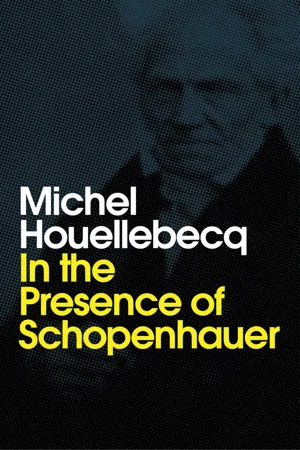
The work of Michel Houellebecq – one of the most widely read and controversial novelists of our time – is marked by the thought of Schopenhauer. When Houellebecq came across a copy of Schopenhauer's Aphorisms in a library in his mid-twenties, he was bowled over by it and he hunted down a copy of his major philosophical work, The World as Will and Representation. Houellebecq found in Schopenhauer – the radical pessimist, the chronicler of human suffering, the lonely misanthrope – a powerful conception of the human condition and of the future that awaits us, and when Houellebecq's first writings appeared in the early 1990s, the influence of Schopenhauer was everywhere apparent.
But it was only much later, in 2005, that Houellebecq began to translate and write a commentary on Schopenhauer's work. He thought of turning it into a book but soon abandoned the idea and the text remained unpublished until 2017. Now available in English for the first time, In the Presence of Schopenhauer is the story of a remarkable encounter between a novelist and a philosopher and a testimony to the deep and enduring impact of Schopenhauer's philosophy on one of France's greatest living writers.
- English
- ePUB (mobile friendly)
- Available on iOS & Android
eBook - ePub
In the Presence of Schopenhauer
About this book
Information
Chapter 1
The world is my representation
The world is my representation. This proposition is a truth for every living and thinking being, though only man can bring it to the state of abstract and reflective knowledge. When he really does so, one can say that the philosophical spirit has been born in him. He is then absolutely sure that he is acquainted with neither a sun nor an earth, but only with an eye that sees a sun, a hand which touches an earth.1
Schopenhauer was especially famous for his powerful depiction of the tragedy of the will, which has unfortunately had the effect of making him seem closer to the category of the novelists, or even worse that of the psychologists, and further removed from the ‘true philosophers’. And yet there is in his work something that we won’t find in Thomas Mann, let alone Freud: a complete philosophical system which aspires to answer all the questions (metaphysical, aesthetic, ethical) that have been asked by philosophy ever since its origins.
‘The world is my representation’: as the first sentence of a book, it’s difficult to find anything franker or more honest. Schopenhauer uses this first proposition as a springboard for the philosophical spirit: as we can see, for him philosophy does not arise from death. Later, he will agree that awareness of our death is a powerful spur to the search for truth, or at least to the publication of works claiming that such is their aim (indeed, this awareness is a spur to pretty much every activity); but the main origin of all philosophy is the awareness of a gap, of an uncertainty about our knowledge of the world. Schopenhauer’s philosophy is first and foremost a commentary on the conditions of knowledge – an epistemology.
Our own body is already an object, and, from this point of view, a representation. It is indeed only an object among objects, subject to the laws that apply to objects; but it is an immediate object. Like every object of intuition, it is subject to the formal conditions of all knowledge, namely time and space, from which multiplicity proceeds.2
There is something comforting about envisioning our own body as an immediate object; and something disturbing about considering multiplicity, an inexhaustible source of misfortune in practice, as a consequence of the formal conditions of knowledge – especially when we know (and it will be the merit of the twentieth century to have established this) that these conditions are not as binding as Kant supposed.
On the contrary, gravity, although it knows no exception, must be classified as knowledge a posteriori, contrary to the opinion of Kant who, in his Metaphysical Foundations of Natural Science, considers it as knowable a priori.3
Today we are familiar with massless particles on which gravity does not act; we are familiar with non-Euclidean geometries, etc. In short, we have succeeded, at the cost of some effort, in going beyond the a priori conditions of knowledge according to Kant – those conditions which, in the latter’s view, ruled out any metaphysics. Conditions do exist, defined by our brain; but they are also variable. Thus metaphysics has become, in a way, doubly impossible.
The way children (and the congenitally blind, once they have been operated on) learn to see; the way we see a single object in spite of the double sensation received by our eyes; the double vision and the double touching caused when our sensory organs have been displaced from their usual position; the perception of objects as upright while their image in the eye is upside down; the purely internal function which leads to the creation of a sense of colour via the separation of polarized lights (an activity of the eye); and finally the stereoscope – all these facts are solid and irrefutable arguments which establish that intuition is not merely sensory, but on the contrary intellectual, that is to say, it consists in knowing the cause from the effect by means of the understanding, and thus presupposes causality, from which all intuition, and therefore all experience, derives its primary and sole possibility. Causality cannot, therefore, be drawn from experience, as Hume’s scepticism, which is here refuted, would have it.4
Somewhere in the world, an observer has the impression that a needle is moving on the dial of his measuring instrument; he deduces from this that the needle has moved on the dial of his measuring instrument; if in doubt, he consults another observer, who confirms the observation. Any modelling of the world starts out from these elements of immediate causality, and must, at journey’s end, finish with them. On this level, Schopenhauer’s argument hasn’t changed: the notion of observation contains in itself not only time and space (a needle moves), but also, as is essential to go beyond internal sensation, the idea of causality (I have the impression that a needle moves, therefore a needle moves).
On the one hand realist dogmatism, which considers the representation as an effect of the object, seeks to separate the representation from the object, whereas they actually form a unity, and to create a being quite distinct from the representation, an object in itself, independent of the subject – something quite inconceivable, for every object presupposes the subject, and thus remains only a representation. Against this, scepticism, starting out from the same erroneous premises, argues that in the representation we have only the effect and not the cause, and so we can know only the action of objects as distinct from their being, an action which may have almost no resemblance to those objects. For scepticism, it would indeed be wrong in general to accept this, since on the one hand causality is deduced from experience, and on the other hand the reality of experience must rest on causality.
We must correct these two theories, firstly by pointing out that the representation and the object are one and the same thing; and secondly that the being of the objects of intuition simply is their action: this is what constitutes their actual reality, and to seek the presence of the object apart from the representation of a subject, the being of things apart from their action, is a foolish and contradictory enterprise; for the knowledge of an object’s mode of action exhausts the idea of this object as object, that is, as representation, since this knowledge leaves nothing else in it to know. In this sense, the world of intuition in time and space, which reveals itself to us in the limpid form of causality, is perfectly real, and perfectly in accordance with the way in which it gives itself, fully and without reserve: as a representation, linked to the law of causality. This is its empirical reality. On the other hand, causality exists only in the understanding and for the understanding, so that the real world, that is, the active world, is always conditioned by the understanding, and without it would be nothing. Not only for this reason, but also because no object can without contradiction be conceived apart from the subject, we must refuse to allow the dogmatics, who define the reality of the external world by its independence from the subject, to entertain the very possibility of any such reality. The world of objects as a whole is and remains a representation, and therefore remains eternally and forever conditioned by the subject; that is to say, it has a transcendental ideality.5
In his Tractatus, Wittgenstein in his first period would say the same thing: ‘The world is what happens.’6 At this stage of his work (he was not yet thirty), Schopenhauer, who after all had already written two works (On the Fourfold Root of the Principle of Sufficient Reason, and ‘On Vision and Colours’), had reached a perfectly lucid position: he had assimilated Kant’s critical philosophy, of which he gives a clearer and more precise account, and the first pages of the World as Will and Representation are simply a – particularly lucid – synthesis of these early works.
Wittgenstein soberly concludes his treatise with the proposition: ‘On what I cannot speak about, I am obliged to keep silent’.7 Schopenhauer, on the contrary, at this point embarks on the second stage of his career, in which he will earn undying glory; he is going to speak about what we cannot speak about: he is going to speak about love, death, pity, tragedy and pain, and attempt to extend the spoken word to the world of singing. Boldly, and still without parallel among philosophers, he will enter the field of novelists, musicians and sculptors (who will reward him with their lasting recognition, and will always be comforted to have at their side such a seren...
Table of contents
- Cover
- Contents
- Title page
- Copyright page
- Preface by Agathe Novak-Lechevalier
- Leave childhood behind, my friend, and wake up!
- Chapter 1: The world is my representation
- Chapter 2: Look at things attentively
- Chapter 3: In this way the will to live objectifies itself
- Chapter 4: The theatre of the world
- Chapter 5: The conduct of life: what we are
- Chapter 6: The conduct of life: what we have
- End User License Agreement
Trusted by 375,005 students
Access to over 1.5 million titles for a fair monthly price.
Study more efficiently using our study tools.
Frequently asked questions
Yes, you can cancel anytime from the Subscription tab in your account settings on the Perlego website. Your subscription will stay active until the end of your current billing period. Learn how to cancel your subscription
No, books cannot be downloaded as external files, such as PDFs, for use outside of Perlego. However, you can download books within the Perlego app for offline reading on mobile or tablet. Learn how to download books offline
Perlego offers two plans: Essential and Complete
- Essential is ideal for learners and professionals who enjoy exploring a wide range of subjects. Access the Essential Library with 800,000+ trusted titles and best-sellers across business, personal growth, and the humanities. Includes unlimited reading time and Standard Read Aloud voice.
- Complete: Perfect for advanced learners and researchers needing full, unrestricted access. Unlock 1.5M+ books across hundreds of subjects, including academic and specialized titles. The Complete Plan also includes advanced features like Premium Read Aloud and Research Assistant.
We are an online textbook subscription service, where you can get access to an entire online library for less than the price of a single book per month. With over 1.5 million books across 990+ topics, we’ve got you covered! Learn about our mission
Look out for the read-aloud symbol on your next book to see if you can listen to it. The read-aloud tool reads text aloud for you, highlighting the text as it is being read. You can pause it, speed it up and slow it down. Learn more about Read Aloud
Yes! You can use the Perlego app on both iOS and Android devices to read anytime, anywhere — even offline. Perfect for commutes or when you’re on the go.
Please note we cannot support devices running on iOS 13 and Android 7 or earlier. Learn more about using the app
Please note we cannot support devices running on iOS 13 and Android 7 or earlier. Learn more about using the app
Yes, you can access In the Presence of Schopenhauer by Michel Houellebecq, Andrew Brown in PDF and/or ePUB format, as well as other popular books in Literature & Literary Criticism. We have over 1.5 million books available in our catalogue for you to explore.