The idea that the people have a right to shape political decisions through democratic means is widely accepted. The same cannot be said of the decisions that impact on our everyday economic life in the workplace and beyond.
Andrew Cumbers shows why this is wrong, and why, in the context of the rising tide of populism and the perceived crisis of liberal democracy, economic democracy's time has come. Four decades of market deregulation, financialisation, economic crisis and austerity has meant a loss of economic control and security for the majority of the world's population. The solution must involve allowing people to 'take back control' of their economic lives. Cumbers goes beyond older traditions of economic democracy to develop an ambitious new framework that includes a traditional concern with workplace rights and collective bargaining, but shifts the focus to include consideration of individual economic rights and processes of public engagement and deliberation beyond the workplace.
This topical and original book will be essential reading for anyone interested in radical solutions for our economic and political crises.
- English
- ePUB (mobile friendly)
- Available on iOS & Android
eBook - ePub
The Case for Economic Democracy
1
A Brief History of Economic Democracy as Industrial Democracy
Introduction
It is important to remember that demands for more democratic economies and egalitarian societies always involve struggles from below against dominant elites. Even the more enlightened elite projects, such as liberal Keynesianism, are, from a democratic point of view, incomplete and, from the point of view of economic democracy, unsatisfactory solutions aimed at preserving elite power and control over ‘the masses’ rather than transforming the economy in a more democratic and egalitarian fashion.1 Marx and Engels’ basic dictum is that: ‘the whole history of mankind … has been a history of class struggles, contests between exploiting and exploited, ruling and oppressed classes’ (Marx and Engels 1848: 8). Those at the sharp end of oppression and exploitation by the ruling class must always struggle and organize collectively to secure basic economic and social rights that improve their conditions of existence.
The history of capitalism is replete with such struggles. Even prior to the industrial revolution, movements such as the Diggers during the English Civil War argued for a radical redistribution of wealth and ownership in opposition to elite attempts to appropriate land. Struggles for economic democracy up until the 1970s tended to be of two kinds: movements to assert rights to common or cooperative ownership; and attempts by workers, usually collectively through trade unions, to regain more autonomy or self-government of their own labour against management encroachment.2
In this chapter I briefly review these past struggles for social justice from the perspective of economic democracy.3 While recognizing the importance of their achievements, my argument is that they were restricted and partial forms of economic democracy. The emergence in the post-1945 period of a strong labour movement across many economies in the Global North made huge advances in reducing inequalities and developing modern welfare states. It also achieved greater rights and participation in the workplace, though still short of the forms of economic democracy advocated here. But it centred around an exclusionary, predominantly white, male form of trade unionism with its roots in the (predominantly industrial) workplace at the expense of other groups, especially women, migrants, ethnic minorities and domestic labour. By the 1970s, many of the gains made by labour and the working class were under attack, and subsequent advances made by neoliberals were in part enabled by the lack of a commitment to a more deep-seated economic democracy both within the workplace and in the wider economy.
Struggles for economic democracy in the nineteenth century
Struggles for economic democracy in the nineteenth century were framed against the backdrop of industrialization and urbanization, beginning in Europe before spreading outwards to the rest of the world. These represented attempts by workers and communities to exert local collective agency to improve what were often appalling material conditions of poverty and exploitation. But they also articulated more radical visions for new forms of society, challenging the rapacious and destructive forms of capitalism then emerging. Of the two traditions of economic democracy that emerged, one sought to create cooperative forms of ownership within the developing factory system, espousing alternative values around mutualism and solidarity; and the second, rooted in growing trade union action and strength, sought to challenge and even overthrow the capitalist control of the economy itself. While they often operated together through the same actors and places, they could also be antagonistic to one other, particularly evident in ‘successful’ revolutionary states such as the Soviet Union and China, where state ownership ‘on behalf of the workers’ ended up brutally extinguishing older forms of mutualism.
Cooperativism originated in the textile districts of northern England and central Scotland in the early 1800s, associated with emblematic figures such as Robert Owen and the Rochdale Pioneers, but also had roots in France where a separate tradition of skilled workers’ cooperatives emerged (Zamagni and Zamagni 2011). Elsewhere, cooperative banks and credit unions developed in Germany and northern Italy, with cooperative movements also becoming established in North America by the early 1900s. The central economic concern for cooperatives was to develop autonomous organizations to meet basic collective needs, independent of dominant local employers, notably in the provision of cheap food but over time expanding to include housing, finance and even medical care. Politically, cooperatives aimed at producing more harmonious reciprocal societies of mutual care in opposition to the individualistic and exploitative nature of capitalism.
Mass industrial trade unionism, supplanting a craft-based and conservative labour aristocracy (Hobsbawm 1964), grew in strength as a collective democratic challenge to privately owned capitalism from the 1870s onwards, once again emerging in the UK but quickly spreading across Western Europe and North America. With the growth of large-scale factory organization and massive concentrated workforces in heavy engineering, coal and steel, shipbuilding and armaments, linked to a creeping militarism and imperialism, collective action around workplace-based trade unionism became the critical sphere for social and political mobilization. While the cooperative movement persisted and remained strong, particularly in rural areas, it became subsumed as a focus for social and economic reform by a workplace-based urban class politics.4
In the context of my argument here, both of these traditions were primarily ‘collectivist’ projects for social justice, focused on improving the conditions of communities and workers at the sharp end of an unregulated capitalized society. To varying degrees, they also represented movements for economic democracy in challenging capitalist control both in the workplace and wider economy. But, as collectivist projects, they neglected individual rights and their underpinning values of liberty and freedom were downplayed as elements of the broader struggle. The third enlightenment aspiration for equality, but conceived of largely in class or collective terms, became dominant.
The growth of a social democratic labour politics in the twentieth century
The continued growth of an industrial proletariat, mass trade unions and the successful growth of Labour and Social Democratic parties in the first decades of the twentieth century created further momentum around this second form of collectivism. The increased agglomeration of industry in key urban centres, with new consumer industries (notably automobiles) creating further massive concentrations of workers alongside the older industrial sectors, made it easy to organize collective action against a common enemy to improve wages and conditions. As capitalist organizations grew, merged and developed into more centralized national corporate oligopolies, trade unions themselves developed national and regional centres for co-ordinating workplace-based struggles and campaigns.
Growing trade union strength, mass disruption to industry and even the overthrow of capitalism itself, with revolutions in Russia and the threat of them elsewhere, particularly in Germany and Italy, were all factors that encouraged many business elites to side with Fascism against democracy in the 1920s and 1930s. This, together with the effects of the Great Depression, left capitalism in disrepute at the end of the Second World War and working-class organizations newly empowered. Outside the Communist Bloc, historic class compromises between workers, unions and employers were struck that redistributed income between rich and poor through progressive taxation policies (see figure 1), provided employees with enhanced rights at work and increased social welfare provision alongside a Keynesian influenced commitment to full employment policies.
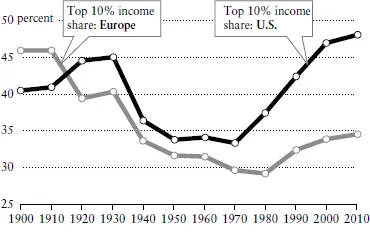
Figure 1. Income Inequality in Europe and the United States, 1900–2010: Share of Top Income Decile in Total Pre-Tax Income
Source: Piketty and Saez (2014: 838).
These represented considerable and historically unprecedented gains for organized labour and the working class as a whole. Not only did working and living conditions improve dramatically but trade unions became recognized in many countries by governments as legitimate social actors. There were two developments in particular that symbolized the changes to capitalist political economy in the post-1945 era: widespread nationalization programmes that transferred whole sectors of the economy into public ownership; and the introduction of co-determination principles in many European countries that gave workers and trade unions unprecedented rights over how their labour was managed and organized.
Outside the Communist Bloc, where entire economies were taken over by the state, though far removed from any semblance of economic democracy, nationalization programmes were also enacted throughout the capitalist world, in countries as diverse as Argentina, France, India, South Korea and the UK. In the UK, nationalization was brandished as a ‘socialization’ policy of the new Labour Government in 1945, delivering on the Party’s promise to deliver ‘common ownership of the means of production’. While it did transfer two million workers into public ownership, helped improve pay and working conditions and provide cheaper and universal services for working-class groups – significant achievements in themselves – it did little to deliver worker empowerment or participation in economic decision making. State enterprises continued to be run by a managerial class – many from the private companies of the previous era – in a top-down fashion with little decision-making power for workers.5
Trade union organizations were certainly strengthened and collective bargaining increased across the broader economy, but trade union leadership and the Labour Party hierarchy set their face against giving workers or citizens any real voice in the new public enterprises, let alone the kinds of decentralized, grassroots industrial democracy advocated by those such as G.D.H. Cole (1920). In a telling aside, the future Labour leader Hugh Gaitskell wrote scathingly in 1949 to the minister responsible for nationalization, Herbert Morrison: ‘to the effect that TU representatives should be placed on the Boards with the right of members to recall such TU representatives as and when considered necessary is a more extreme example of syndicalist tendencies than anything yet put forward’ (Saville 1993: 59). Where trade unionists were appointed to boards, they tended to be right-wing establishment figures such as Sir Joseph Hallsworth (NCB) and Lord ...
Table of contents
- Cover
- Front Matter
- Introduction
- 1 A Brief History of Economic Democracy as Industrial Democracy
- 2 The Three Pillars of Economic Democracy
- 3 Putting Economic Democracy into Practice
- Conclusion
- References
- End User License Agreement
Trusted by 375,005 students
Access to over 1.5 million titles for a fair monthly price.
Study more efficiently using our study tools.
Frequently asked questions
Yes, you can cancel anytime from the Subscription tab in your account settings on the Perlego website. Your subscription will stay active until the end of your current billing period. Learn how to cancel your subscription
No, books cannot be downloaded as external files, such as PDFs, for use outside of Perlego. However, you can download books within the Perlego app for offline reading on mobile or tablet. Learn how to download books offline
Perlego offers two plans: Essential and Complete
- Essential is ideal for learners and professionals who enjoy exploring a wide range of subjects. Access the Essential Library with 800,000+ trusted titles and best-sellers across business, personal growth, and the humanities. Includes unlimited reading time and Standard Read Aloud voice.
- Complete: Perfect for advanced learners and researchers needing full, unrestricted access. Unlock 1.5M+ books across hundreds of subjects, including academic and specialized titles. The Complete Plan also includes advanced features like Premium Read Aloud and Research Assistant.
We are an online textbook subscription service, where you can get access to an entire online library for less than the price of a single book per month. With over 1.5 million books across 990+ topics, we’ve got you covered! Learn about our mission
Look out for the read-aloud symbol on your next book to see if you can listen to it. The read-aloud tool reads text aloud for you, highlighting the text as it is being read. You can pause it, speed it up and slow it down. Learn more about Read Aloud
Yes! You can use the Perlego app on both iOS and Android devices to read anytime, anywhere — even offline. Perfect for commutes or when you’re on the go.
Please note we cannot support devices running on iOS 13 and Android 7 or earlier. Learn more about using the app
Please note we cannot support devices running on iOS 13 and Android 7 or earlier. Learn more about using the app
Yes, you can access The Case for Economic Democracy by Andrew Cumbers in PDF and/or ePUB format, as well as other popular books in Economics & Economic Policy. We have over 1.5 million books available in our catalogue for you to explore.